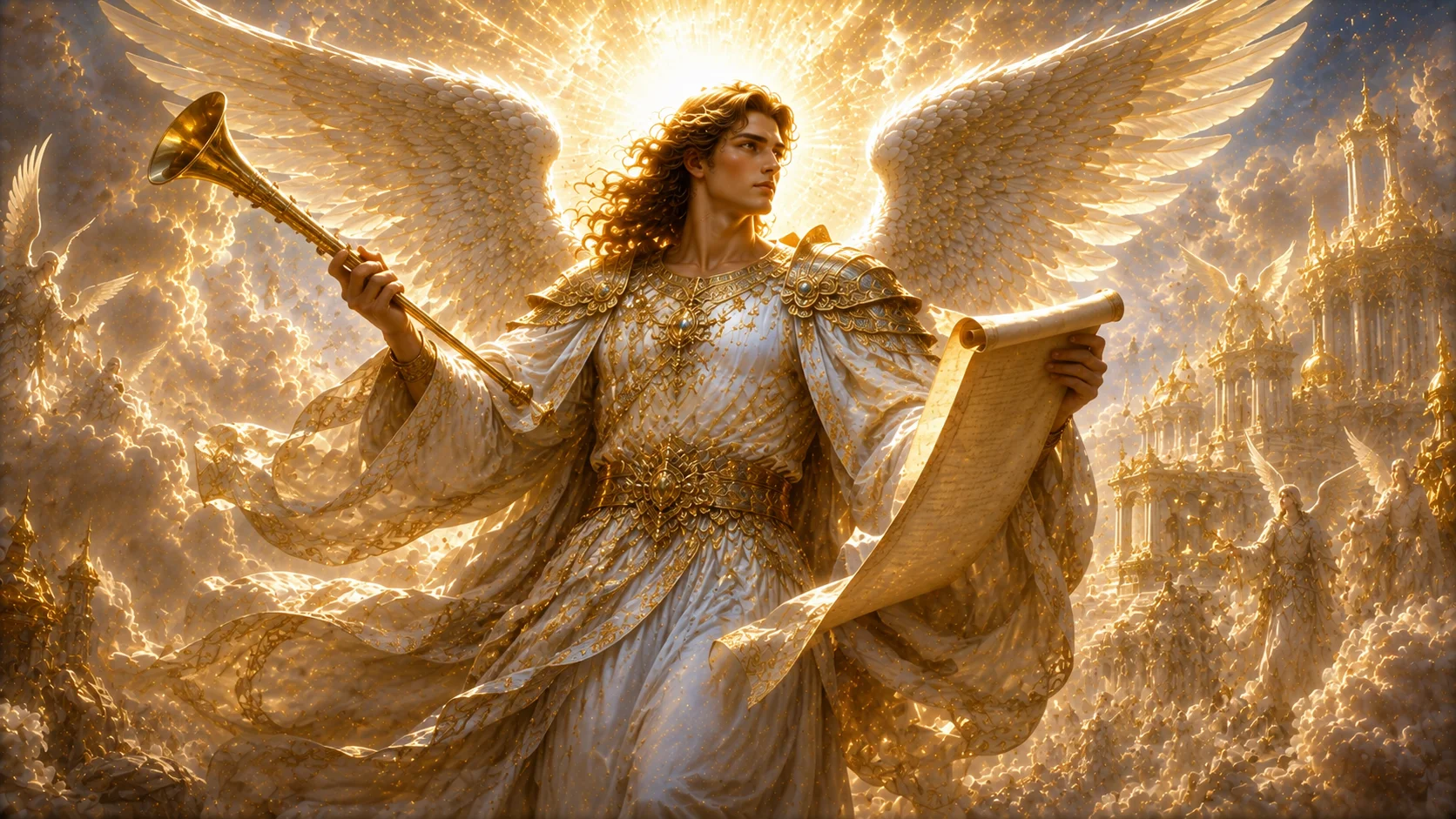
A man lies face-down on the ground, struck senseless, and does not rise for days. He has just been told what his vision meant. This is Daniel, and the being who stood over him, wearing the likeness of a man, was Gabriel — Gavri'el, "God is my strength." If Michael is the sword of heaven, Gabriel is its voice: the herald who carries the most momentous tidings from the throne to the earth, and who alone seems able to make mortals understand what they see when heaven shows itself to them.
The Vision That Made a Prophet Fall
Gabriel's first named appearance in scripture comes in the Book of Daniel, in the third year of the reign of King Belshazzar. Daniel has seen a vision of a ram and a goat locked in violence, and cannot make sense of it. A voice from within the vision calls out an instruction — "Gabriel, make this man understand the vision" — and the angel comes to him, unfolding what the beasts mean: the ram is the kings of Media and Persia, the goat is the kingdom of Greece. It is exact, historical, political interpretation, delivered by a being whose arrival Daniel cannot withstand.
The encounter is not gentle. Daniel falls on his face in terror at the sight of him. Gabriel sets him upright and speaks the vision's meaning, and afterward Daniel is left physically ill, unable to rise for days. Understanding, in this first meeting, comes at a cost. Gabriel does not simply explain; he overwhelms, and only then instructs.
A Mystery Twelve Years Unresolved
Gabriel returns to Daniel a second time, roughly twelve years later, this time arriving while Daniel is at prayer. The vision from chapter eight had remained a genuine mystery in the intervening years — even a prophet touched once by an angel did not fully grasp what he had been shown. Gabriel's second visit exists to finish the first: he delivers the fuller "seventy weeks" prophecy, closing a gap in understanding that had stood open for over a decade. It establishes something important about Gabriel's office — he is not a being who drops a riddle and departs. He returns to complete what he started.
The Interpreter of Visions
From these two encounters, Jewish tradition builds Gabriel's defining office: he is the supreme angel of revelation and understanding, the one who makes the divine word intelligible to a mind that cannot decode it unaided. He is, together with Michael, one of the very small number of angels the Hebrew Bible names at all — most of the angelic host moves through scripture anonymous, but Gabriel is singled out, called by name, given a face and a mission. That distinction is itself a kind of honor: to be named is to be trusted with something specific.
A Herald With a Man's Face
Every biblical description of Gabriel gives him the same form: he appears "having the appearance of a man," and Daniel hears "a man's voice" call out his name. There is nothing abstract or storm-wrapped about him in the text — he looks like someone Daniel could, in principle, have passed on a street, except for the terror his presence provokes. That masculine, human-shaped image is the one later Christian and Islamic tradition inherits and carries forward, however far beyond a man he actually is.
Three Guests at Abraham's Tent
Rabbinic tradition extends Gabriel's story past the biblical text. In the Talmud, the three visitors who come to Abraham's tent at Mamre are named: Michael, Gabriel, and Raphael, each carrying a separate mission. Michael comes to announce the birth of Isaac. Raphael comes to heal Abraham and to rescue Lot. Gabriel's mission is the darkest of the three — he is the one sent to overturn Sodom and Gomorrah.
It is worth being precise about what this makes Gabriel: not the sole architect of that judgment, but one of three angels dispatched together, each with a distinct and separate task. The destruction belongs to Gabriel's portion of the mission, not to him alone.
Fire, Fruit, and the Unborn
The rabbis extend Gabriel's role as an agent of divine power further still. Some traditions credit him with striking down the army of Sennacherib, the Assyrian king — though this is not settled; other rabbinic sources give that act to Michael instead, and the two attributions sit in real tension with each other in the literature. What is more securely attested is Gabriel's standing as the angel of fire itself. The Jewish Encyclopedia names him prince over fire, and from that same fiery nature flows an unexpected second office: he is also prince of the ripening of fruit, and of the maturing of the unborn child in the womb.
It is a striking pairing — the angel who executes the sternest decrees of judgment is the same angel presiding over grain ripening on the stalk and a child forming before birth. Destruction and gestation, both entrusted to one prince of fire.
Strength of God
The two faces of Gabriel — gentle interpreter of visions and fierce agent of divine power — are held together in his own name. He is "the strength of God" precisely because he does both: he reveals the divine will in words a person can carry away and understand, and he enacts that same will when action rather than explanation is what is required. The name is not decoration. It is the closest thing scripture gives to an explanation of who he is.
At the Left Hand of the Throne
In the angelological hierarchy that later Jewish tradition maps out around the divine throne, Michael stands at God's right hand and Gabriel at the left — the two paramount archangels, positioned as the closest and greatest of the entire heavenly host, flanking the throne itself rather than merely serving somewhere within its court. It is Michael and Gabriel who are consistently paired as the two chief archangels, above all others of the host.
Two Annunciations, Six Months Apart
Gabriel's role does not end with the Hebrew Bible. In the Gospel of Luke he appears twice, in two separate episodes six months apart. First he comes to a priest named Zechariah, serving in the Temple, to announce that his wife will bear a son — John the Baptist. Zechariah does not recognise him, and Gabriel introduces himself directly:
"I am Gabriel, who stands in the presence of God."
Six months later, in Nazareth, Gabriel comes a second time — to Mary, to announce the birth of Jesus. This second visitation is the Annunciation proper, traditionally commemorated on the twenty-fifth of March, and it is the encounter most associated with Gabriel in Christian memory. The two episodes are distinct events with distinct recipients, joined only by the messenger who delivers both and by the half-year that separates them.
Jibril and the Night the Quran Began
In Islam, the same angel is known as Jibril, and his office there is, if anything, even more central. Islamic tradition holds that it was Jibril who revealed the Quran to the Prophet Muhammad, across the whole span of his prophetic career — not in a single encounter but as an ongoing channel between heaven and the Prophet. The first of these revelations is traditionally identified with the opening verses of Surah Al-Alaq. Where Gabriel's biblical appearances are occasional and episodic, Jibril's relationship with Muhammad is sustained, running through the entire arc of the Quran's delivery.
A Second Annunciation, A Different Theology
The Quran gives Jibril an annunciation scene of his own: he appears to Maryam to announce the birth of Isa. The parallel with Luke's account is unmistakable — the same angel, a similar scene, a mother told of a coming son. But the theology diverges sharply. Islam does not affirm Jesus as the son of God; in the Quranic account he is understood as a prophet. The angel is shared across the two traditions; the meaning of what he announces is not.
The Title Scripture Never Gave Him
One fact about Gabriel is easy to assume and worth correcting: nowhere in the Hebrew Bible, and nowhere in the Book of Daniel itself, is he actually called an archangel. In the New Testament, the specific title "archangel" is used exactly once, and it names Michael, not Gabriel. Gabriel's familiar title as an archangel comes from later Christian tradition and liturgy — a designation the church settled on, not a word the biblical text ever applies to him.
Something similar has happened to the image of "Gabriel's trumpet," the herald who will sound the Last Judgment. It is a beloved image in Christian art, hymnody, and folk tradition, but it does not come from scripture describing Gabriel himself. The Book of Revelation does give seven angels trumpets to sound in turn — but none of the seven is named. The trumpet belongs to popular memory more than to the biblical text.
What Survives
Strip away the later embellishments and what remains is still extraordinary: an angel named across three Abrahamic traditions, entrusted each time with the hardest kind of message — the one a person cannot understand on their own, or cannot bear to hear, or cannot believe until someone stands in front of them and says it plainly. He interprets empires collapsing into beasts. He tells a childless priest and an unmarried young woman that they will each have a son whose names history will not forget. He carries, in Islamic tradition, the whole of a scripture down to a single man, verse by verse, across years.
- In Judaism — Gavri'el, interpreter of Daniel's visions, angel of fire, judgment, and gestation, left hand of the divine throne.
- In Christianity — Gabriel, herald of two annunciations, later honoured with the title archangel by tradition rather than scripture.
- In Islam — Jibril, the angel who delivered the Quran to Muhammad and who announced Isa to Maryam.
Three traditions, one messenger, and a name that explains him better than any title could: not merely an angel who happens to be strong, but strength itself, on loan from God, carried down to whoever is standing there when the message finally arrives.
Sources & traditions
- EncyclopediaWikipedia — Gabriel
- TraditionHebrew texts, grimoires and later commentary
Myths change from area to area and from time to time. This chronicle follows the most widely told versions; tellings in other villages, regions and eras may differ.