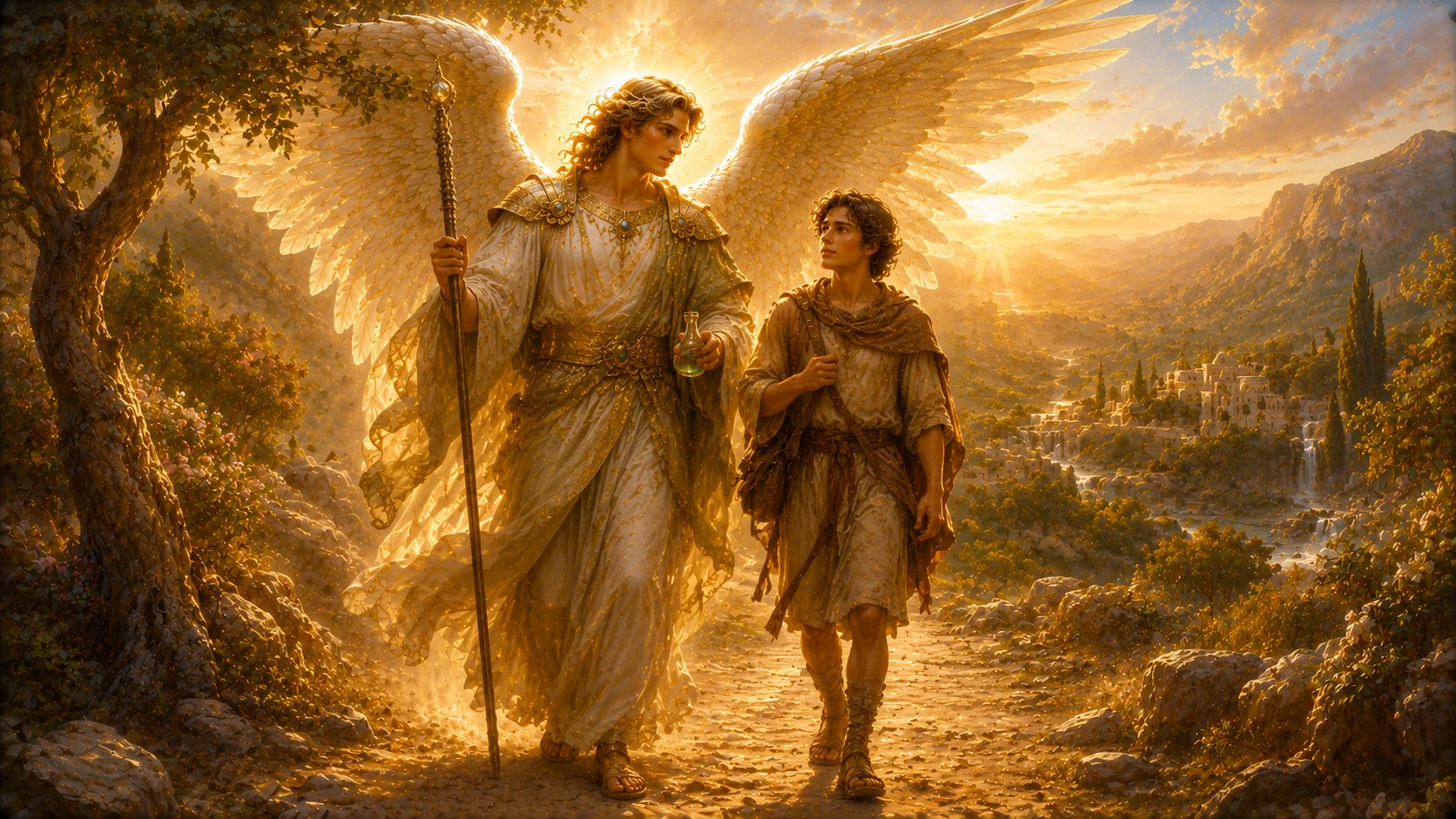
A young man sets out from Nineveh with a dog at his heels and a stranger for a guide, carrying nothing more than a debt to collect. He does not know that the stranger walking beside him is not a man at all. He does not know that the road ahead runs past a river with a monstrous fish in it, through a house shadowed by seven deaths, and back again to a blind old man waiting in the dark. He knows only that his father found this companion trustworthy, and that the journey must be made. This is how the archangel Raphael enters the world: not in thunder, not on a throne, but disguised, on foot, beside an ordinary boy who has no idea what he has been given.
The Name Is the Whole Theology
Raphael's name comes from the Hebrew rapha, to heal, joined to El, God — the same root that gives modern Hebrew its word for physician, rophe. It is not a title bolted on after the fact. It is a claim built into the syllables: this is the angel through whom God heals. Everything else told about Raphael — the disguise, the fish, the demon driven off, the blindness cured — is essentially a single name unfolding into a story.
That is worth sitting with, because the angels most often pictured stand for judgment, for war, for the sounding of trumpets. Raphael's entire portfolio is the opposite instinct: not to strike but to mend. In an order of beings more often armed with swords, he carries a fish's gall and a traveler's staff, and the tradition built around him insists that this, too, is a heavenly power — not a lesser one.
A Household in Exile
The story that carries Raphael's name is the Book of Tobit, and it opens not in glory but in hardship. Tobit is a devout, blinded Israelite living in exile in Nineveh, far from home, his sight gone and his household strained. He has one asset left in the world: ten talents of silver, left years earlier for safekeeping with a kinsman named Gabael, in the distant land of Media. Someone must go and retrieve it. That someone is his son, Tobias, who has never made such a journey and cannot make it alone.
So a guide is found — a companion who gives his name as Azarias, meaning "Yahweh helps," and who agrees to accompany Tobias on the road to Media. Neither Tobias nor his father knows that Azarias is Raphael. The angel travels the entire journey in disguise, indistinguishable from any hired companion, walking beside Tobias step for step. Even the dog goes with them.
The Fish in the Tigris
The journey's turning point comes almost immediately, camped beside the river Tigris. A great fish attacks Tobias out of the water, and it is Azarias who tells him what to do: catch it, and keep its heart, its liver, and its gall. Nothing about this seems useful yet. It is only instruction, given calmly, by a guide who already knows what lies ahead and says nothing more than is needed.
Those three organs will matter twice before the story ends, and the two uses must never be confused with each other. The heart and liver, burned, produce a smoke that drives off a demon. The gall, applied directly, cures blindness. One is for banishing what should not be present; the other is for restoring what has been lost. Raphael hands Tobias both cures on the riverbank and lets the journey carry them to where they are needed.
The House of Seven Silent Weddings
In Ecbatana, a city in Media, Tobias and his guide lodge with a man named Raguel, whose daughter Sarah has a history no one in the household says aloud easily. She has been married seven times. Each husband died on the wedding night, before the marriage could be completed, slain by a demon named Asmodeus — jealous, tradition holds, and unwilling to let Sarah belong to any man but him.
Tobias is drawn into this house as a suitor, which means he is drawn into Sarah's danger as well. It is here that the fish's heart and liver are put to their purpose. On the wedding night, Tobias burns them as Azarias instructed, and the smoke drives Asmodeus away — not killed, not destroyed, but banished, fleeing to what tradition remembers as the uttermost parts of Egypt, where Raphael afterward binds him. The marriage that had cost seven bridegrooms their lives, Tobias survives.
The Gall and the Blindness
With Sarah as his wife and Gabael's silver recovered, Tobias makes the journey home to Nineveh, where his father Tobit still waits in darkness. The second use of the fish's organs falls to that homecoming: Tobias anoints his father's eyes with the gall, and the blindness that has defined Tobit's household for the length of the story lifts. The healer's promise embedded in Raphael's own name — God heals — closes the story exactly where it began, on the one person the whole journey was undertaken to help.
The Unveiling
Only then, task complete, does the guide reveal what he has been all along. He is not Azarias. He tells Tobit and Tobias that he is Raphael, one of the seven who stand before the Lord — one of the seven holy angels who, in the account's own words, present the prayers of the saints and enter into the presence of the glory of the Holy One. Having said this, he ascends and is no longer visible.
The concealment is not incidental to the story; it is close to the point of it. For the length of the entire journey — the fish, the demon, the wedding, the cure — Raphael let himself be mistaken for a hired traveling companion, doing the work without the credit, present at every danger without ever claiming the authority that would have made the danger easier to face. The revelation at the end does not add anything to what happened. It only tells the reader, at last, whose hand had been steering it.
Set Over Every Wound
Tobit is not the only early text that names him. In the Book of Enoch, an early Jewish text older than much of what survives from this period, Raphael appears among the archangels charged with overseeing the world, and there his commission is stated plainly: he is set over all disease and every wound of the children of the people. Not one ailment, not one class of suffering — all of it. The Tobit narrative can be read as a single case study of a mandate this wide.
Enoch also gives Raphael a harder task, distinct from healing altogether: binding the fallen angel Azazel and casting him into a pit of fire in the desert. It is the same figure who cures blindness with a fish's gall who also carries out this binding — a reminder that the tradition never made him purely gentle. Healing, in this angel, sits beside the authority to restrain what threatens to harm.
Among the Great Named Few
Scripture and its surrounding tradition are sparing with angelic names. Michael, Gabriel, and Raphael are the only three angels named across the Christian biblical and deuterocanonical canon, and Tobit's own language — one of the seven who stand before the Lord — places Raphael among the great princes who attend the divine presence directly, Michael and Gabriel among them. No source ranks him above or below the other two; he stands alongside them, not over or under.
The number seven in that description is itself worth noting, because other traditions count differently. Enoch's various chapters name anywhere from four to seven archangels depending on which passage is read — Michael, Gabriel, Raphael, Uriel, and further figures such as Raguel, Sariel, and Remiel appear across different lists. There was never a single fixed roster; Raphael's presence, though, is constant across nearly all of them.
Scripture for Some, Apocrypha for Others
The Book of Tobit occupies an unusual place in religious tradition. It is accepted as canonical scripture by the Catholic and Eastern Orthodox churches, and read there as part of the Bible proper. Protestant traditions place it instead in the Apocrypha, outside the canon. And in Judaism, Tobit was never part of the Hebrew Bible at all — Raphael's great story belongs to the deuterocanonical tradition, not to the Tanakh. His name appears there and in Enoch, not in Jewish canonical scripture.
This matters for understanding why Raphael is remembered so differently across communities that all, in some sense, inherited him. A reader raised on the Catholic lectionary and a reader raised on the Hebrew Bible are not encountering the same shelf of books, and Raphael's most detailed story — the fish, Sarah, the healing of Tobit — sits on the shelf only one of them was handed.
The Traveler in Paint and Stone
Christian art remembers Raphael almost entirely through the Tobit story, and it settled early on a recognisable image: a young traveler or pilgrim, staff in hand, a fish carried or resting beside him, sometimes a small flask or gourd for the gall, sometimes a wallet for the road. He is very often shown walking directly beside the youth Tobias — the pairing became its own subject in Renaissance painting, "Tobias and the Angel," repeated across generations of artists who returned to the same scene: an angel and a boy, walking together, one of them still in disguise.
What that image preserves, more than any single doctrine, is the posture of the whole story — companionship. Not an angel descending to intervene from above, but one who puts on the shape of an ordinary guide and simply walks the distance.
Patron of the Journey and the Cure
Devotion to Raphael grew directly out of what he did in the story, not from anything added afterward. He is venerated as patron of travelers, because he walked the whole road with Tobias. Patron of the blind, because he gave the cure that restored Tobit's sight. Patron of physicians, nurses, and medical workers generally, because healing is the office his very name declares. And patron of happy or chance meetings — matchmaking — because it was his guidance that brought Tobias and Sarah together and saw the marriage survive where seven before it had not.
The Roman Catholic Church kept a feast day for Raphael on October 24 in its older calendars; after the 1969 calendar reform, his feast was combined with Michael's and Gabriel's on September 29, the Feast of the Archangels. Either date, the devotion behind it traces back to the same handful of chapters in Tobit.
Behind the Sleeper, Beside Abraham
Jewish tradition kept Raphael close as well, if not through Tobit itself, then through custom and legend running alongside it. A bedtime liturgical practice, recited after the Shema, positions four archangels around the sleeper for protection: Michael to the right, Gabriel to the left, Uriel in front, and Raphael behind — a guardian posted at the one direction a sleeping person cannot watch themselves.
Jewish legend also numbers Raphael among the three angels said to have visited Abraham in Genesis, alongside Michael and Gabriel, with Raphael's particular task there remembered as healing Abraham after his circumcision — the same office, healing, following him even into a story where he is not named outright.
I am the angel Raphael, one of the seven who stand before the Lord.
A Contested Echo in Islam
Outside the Jewish and Christian traditions, Raphael's identity grows less certain rather than more. Islamic tradition sometimes identifies him with Israfil, one of four major archangels alongside Jibril, Mikhail, and Azrael — but where Raphael's whole character is healing, Israfil's defining task is entirely different: sounding the trumpet that announces the Day of Judgment. This identification is traditional in some quarters but not a settled equivalence the way Gabriel is settled as Jibril; it is best held as a claimed connection rather than a confirmed one, and the trumpet role belongs to that separate tradition, not to the healing angel of Tobit and Enoch.
What the Name Still Means
Strip away the demon, the fish, the seven weddings, and what remains is the plainest claim in the whole story: that the God who judges and commands armies is also the God who heals — and that this healing has a face, a name, and a habit of walking beside the people it is sent to help. Raphael's story is not one of raw power on display. It is a story of a companion who conceals himself for the length of an entire dangerous road, hands out cures at exactly the moment they are needed, binds what threatens harm, and only afterward says who he was.
That is the shape the tradition kept returning to across Tobit, Enoch, the bedtime liturgy, the Renaissance canvases, and the patronages still invoked today. Not a distant office. A guide on the road, present the whole way, whose name was always, quietly, the answer.
Sources & traditions
- EncyclopediaWikipedia — Raphael (archangel)
- TraditionHebrew texts, grimoires and later commentary
Myths change from area to area and from time to time. This chronicle follows the most widely told versions; tellings in other villages, regions and eras may differ.