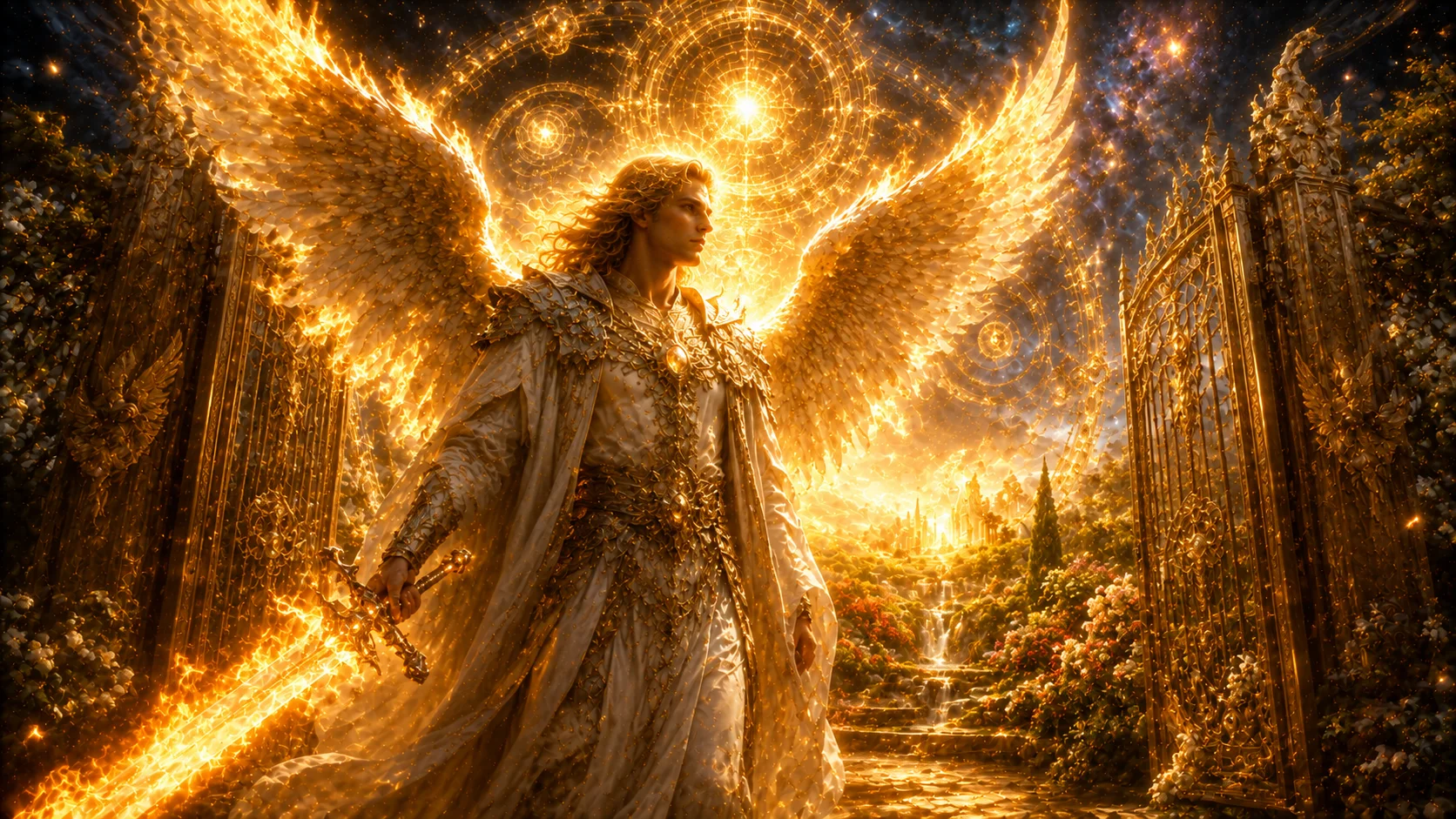
Uriel — Uri’el, “God is my light” or “Fire of God” — is the archangel of light, wisdom, and the mysteries of the cosmos: the fierce illuminator who guards the gates of Eden, reveals the secrets of heaven, and presides over the lights of the firmament. He is the most enigmatic of the four great archangels, an angel of fire and revelation.
The Fire of God
Uriel’s name binds him to flame and to illumination alike. Jewish tradition names him as the angel who stands at the gate of the lost Garden with a fiery sword, the guardian of the threshold of paradise. He is the angel of thunder and terror, who watches over the underworld in some texts and over the host of heaven in others — a being of searing brightness whose very glance is fire.
The Revealer of the Heavens
It is in the Book of Enoch that Uriel comes most fully into his own. There he is the angel who guides Enoch through the secrets of the cosmos, explaining the courses of the luminaries, the movements of the sun and moon and stars, and the ordering of the calendar. “Uriel, whom the Lord set over all the lights of heaven,” reveals the divisions of the year and the laws by which the heavenly bodies move. He is the archangel of astronomy and of the hidden order of creation, the interpreter of the wheels of the sky.
Light and Wisdom
Across the traditions, Uriel is the angel of light in both its senses: the physical radiance of fire and star, and the inner light of wisdom and understanding. He is invoked as a bringer of insight, a warner of coming judgment (some legends make him the angel who warned Noah of the Flood), and a keeper of cosmic secrets. Counted with Michael, Gabriel, and Raphael as one of the four archangels who stand at the four corners of the divine Throne, Uriel completes the great quartet — the fire that illuminates, set against the darkness of ignorance and night.
An Angel the Bible Never Names
Open a Bible and look for the archangel Uriel: he is not there. Michael intervenes in the book of Daniel; Gabriel greets Mary in Luke; Uriel appears as an angel in neither the Hebrew Bible nor the New Testament. The name itself surfaces only in Chronicles, where it belongs to a Levite and to the father of a king’s mother — men, not messengers. Everything the tradition knows of the archangel comes from outside the canon, from the restless library of visionary literature Jewish communities produced around the turn of the era and never admitted into scripture. His oldest home is the Book of Enoch, whose Astronomical Book and Book of the Watchers are commonly dated to around the third century BCE, which makes Uriel’s earliest appearances older than the final editing of several books that did make the cut. Enoch survives complete only in Ge’ez, the liturgical language of Ethiopia, because the Ethiopian church alone kept it in continuous use; its Aramaic original is known only from fragments recovered among the Dead Sea Scrolls at Qumran. Uriel entered Jewish and Christian imagination through a book most of the ancient world eventually let go of.
The Angel Sent to Noah
In the Book of the Watchers, heaven does not stay silent while the fallen angels ruin the earth. God dispatches his lieutenants to clear the wreckage: one to bind the ringleader of the rebellion in darkness, one to turn the monstrous offspring of angel and woman against each other, and one — Uriel, in the Ethiopic text — sent ahead of the rest with a quieter errand: go to the son of Lamech, tell him a flood is coming, and tell him to hide himself. It is the private warning delivered days before the news becomes public, and it became Uriel’s signature. What the story does not advertise is how unsettled it is. Earlier Aramaic material recovered at Qumran gives the same errand to an angel called Sariel, and later Christian and magical texts add a third form, Suriel. Scholars generally read the three as names scribes exchanged for one another rather than as three separate beings, even though their etymologies pull apart — Uriel turns on ’ur, light or flame, while Sariel turns on sar, prince. The same instability runs through the roster of the four great archangels: the Book of the Watchers counts Uriel among them, while the Similitudes of Enoch put a different angel, Phanuel, in the fourth place. Uriel was never quite one fixed figure so much as a name several scribal traditions kept reaching for whenever they needed the angel who stands nearest to hidden knowledge.
Ezra’s Relentless Interrogator
The fullest personality Uriel is ever given belongs to the book known as 4 Ezra, or 2 Esdras — a work no Jewish or Protestant canon accepts, printed in some Bibles only among the apocrypha. Its narrator, grieving over the ruin of Jerusalem, will not stop demanding an answer to one question: if God is just, why does Israel suffer while its enemies prosper? Uriel is the angel sent to answer him, and their exchange runs across three long dialogues that read less like scripture than like a philosophical argument refusing to resolve. Uriel does not console. He sets impossible tasks instead: weigh me the weight of fire, measure me a measure of wind, call back for me the day that is past. Gather the scattered raindrops, count those not yet born, make the withered flower bloom again — and then, only then, ask me why the wicked prosper. He answers riddle with riddle until his questioner is out of breath rather than out of grief. And when Ezra finally breaks off to weep beside a mourning woman on an open field, it is Uriel he calls for by name, and Uriel who tells him the woman is Zion herself, moments before she is transfigured into a built city in front of him. It is a very different Uriel from the astronomer of Enoch: not a teacher of star-charts here, but a sparring partner for grief.
Condemned in Rome, Kept Alive in Ethiopia
Uriel’s popularity outran his official standing. In 745, a council held in Rome under Pope Zachary examined the teaching of a wandering preacher named Aldebert, whose devotions invoked eight angels by name. The council upheld only the angels named in scripture — Michael, Gabriel, and Raphael — and rejected the remaining names, Uriel among them, as unfit for liturgical invocation. It did not end his cult. In the Ethiopian Orthodox Tewahedo Church, which preserved the Book of Enoch in the first place, Uriel remains one of the great archangels, honoured with his own place in the calendar of commemorations and with churches consecrated in his name. What one council in Rome ruled inadmissible, a church that had never stopped reading his story simply went on venerating.
Guardian of the Sleeper, Regent of the Sun
Two later traditions gave Uriel a post. In Jewish custom, a prayer recited at bedtime for centuries surrounds the sleeper with the archangels like a small honour guard: Michael at the right hand, Gabriel at the left, Uriel in front, Raphael behind, and the divine Presence above the head. Uriel takes the forward position — the one who faces whatever the dark brings before it reaches the sleeper. In English literature he was given a grander station. In Milton’s Paradise Lost he is Regent of the Sun, held “the sharpest sighted Spirit of all in Heav’n,” watching creation from its brightest vantage point. Satan, newly escaped from Hell and disguised as a young cherub, finds Uriel at that post and simply asks him the way to the new-made world — and the angel famed for seeing everything sees through no disguise at all, and points the way. Only later, watching from the sun, does Uriel catch the tell: a face contorted by passions no happy spirit’s face should show. He glides down a sunbeam to warn Gabriel at Eden’s gate, too late. Milton’s irony is exact, and he says so outright — goodness thinks no ill where no ill seems, and so the sharpest-sighted being in the poem is the one whose vision fails first.
Earth and North
Later devotional and ceremonial-magical tradition arranged the four archangels into a compass and a set of elements — Michael to fire and the south, Gabriel to water and the west, Raphael to air and the east, and Uriel to earth and the north, the direction of cold and hidden ground rather than open sky. It is a strange placement for an angel first defined by fire and starlight: the figure who explains the burning courses of sun and moon ends up assigned the element least like flame of all, as though the later system wanted him to complete the set more than it wanted him to stay consistent. Where art gives him a fixed attribute, it is usually a flame resting in an open palm — fire made small enough to carry, and held out rather than swung.
Sources & traditions
- EncyclopediaWikipedia — Uriel
- TraditionHebrew texts, grimoires and later commentary
Myths change from area to area and from time to time. This chronicle follows the most widely told versions; tellings in other villages, regions and eras may differ.