Michael — whose name is itself a battle-cry, the Hebrew question Mi ka’El, “Who is like God?” — is the greatest of the archangels in Jewish tradition: the celestial prince and warrior who commands the armies of heaven, guards the people of Israel, and stands as the chief adversary of the powers of evil. Where lesser angels carry messages or tend the spheres, Michael wields the sword.
Prince of Israel
In the Book of Daniel, Michael appears as “one of the chief princes,” the great heavenly guardian who contends on behalf of the Jewish people, and as “the great prince who stands guard over the sons of your people.” He is the patron and protector of the nation of Israel, its advocate in the courts of heaven, doing battle against the angelic princes of the hostile nations. In this role Michael is less a herald than a defender — the captain who fights when the chosen people are threatened.
The War in Heaven
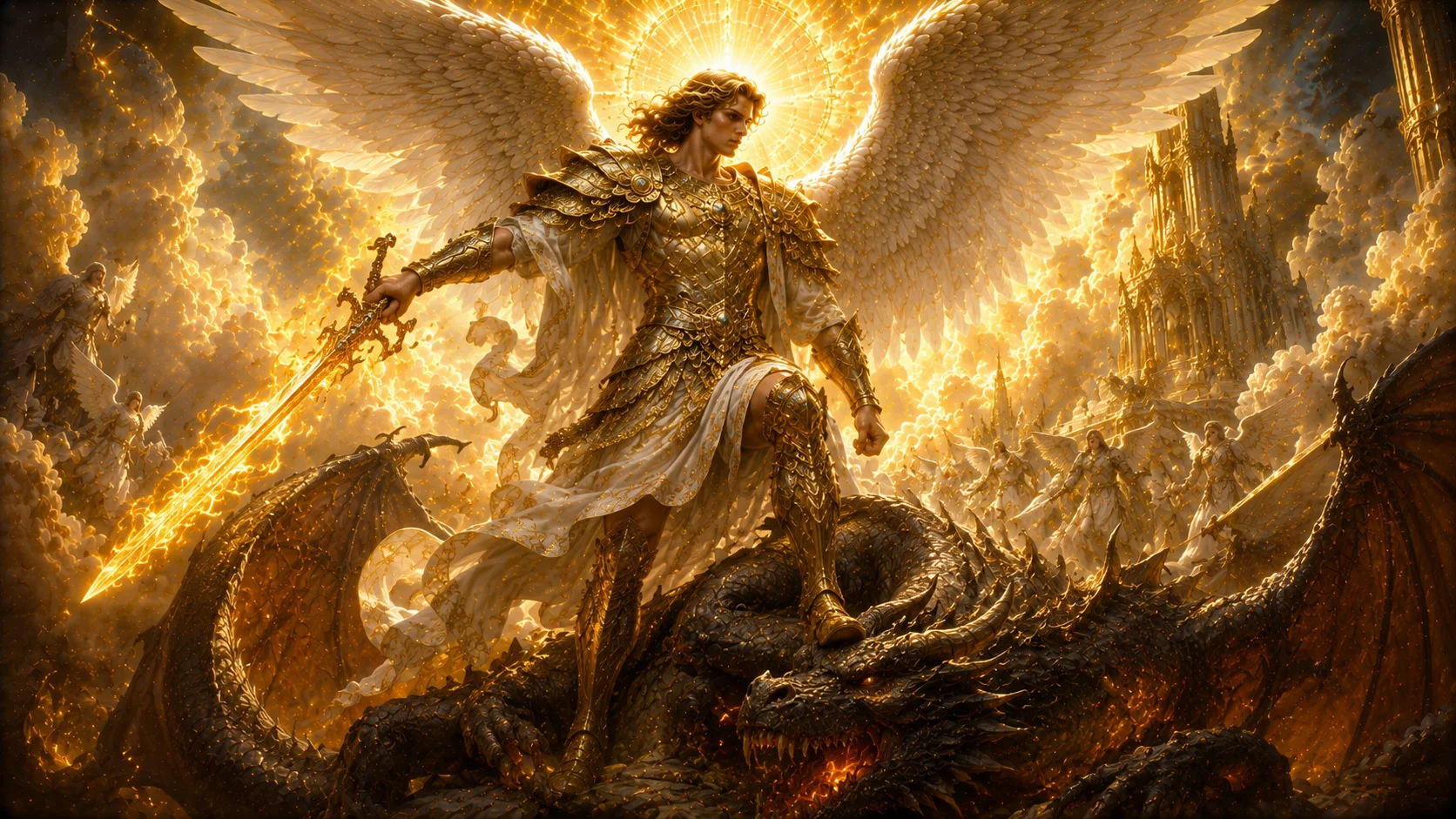
Later tradition crowns Michael as the commander of the loyal angels in the primordial war against the rebel host. It is Michael who leads the heavenly armies against the great dragon and his fallen angels, casting them down from heaven. He is the vanquisher of Semyaza and the rebellious Watchers, the binder of demons, and the eternal opponent of the accuser. In the apocalyptic imagination he is the field-marshal of the final battle, the one who will rise up in the time of the end.
Weigher of Souls and Guardian of the Dead
Beyond the battlefield, Michael holds a tender office: he is a psychopomp and an intercessor, said to receive the souls of the faithful and to weigh them in the balance, pleading their cause before the divine judgment. Jewish legend makes him the angel who stayed Abraham’s hand, who buried Moses, and who ministers as the great high priest of the heavenly Temple. Fierce in war and merciful in judgment, Michael stands first among the archangels — the sword and the shield of heaven, forever asking of every pretender to divinity: who is like God?
Where Michael Comes From
Michael arrives in the written record late, and in a hurry. His name appears nowhere in the older strata of the Hebrew Bible; he steps into it fully armed, in the Book of Daniel, at a moment of national emergency — the persecution under Antiochus IV, when the Temple had been desecrated and it was no longer obvious that God intended to intervene in person. Daniel’s answer is startling: history has a second storey. Every nation on earth has an angelic prince fighting for it in heaven, and the outcome of a battle in Judaea depends on the outcome of a battle no one can see. Michael is Israel’s.
The idea did not come from nowhere. An older tradition preserved in Deuteronomy 32 — read in the Qumran manuscripts, and in some Greek witnesses, as the nations being apportioned “according to the number of the sons of God” rather than the sons of Israel — already imagined the peoples of the world distributed among heavenly beings. Daniel takes that quiet cosmology and turns it into a war map. The prince of Persia resists; the prince of Greece is coming; Michael holds the line. Michael and Gabriel are the only two angels the Hebrew Bible names at all, and both of them are named in this one book — Michael with a rank, an enemy and a nation to lose.
He is everywhere in the literature of the following two centuries. In the Enochic writings he stands among the small circle of great angels who look down at the blood on the earth and carry the cry of the dead upward; it is Michael who receives the order to bind Semyaza, chief of the fallen Watchers. Among the Dead Sea Scrolls, the War Scroll of the Qumran community promises that God will raise up the kingdom of Michael among the gods, and the same scroll’s Prince of Light, who leads the sons of light against the sons of darkness, is widely identified with him. A related text from the same library describes a heavenly Melchizedek who presides over the last judgement and proclaims liberty to the captives — a figure many readers have taken to be the same being under a priestly name. In these texts Michael is not a character in a story so much as a hinge: the point where the moral order and the political order are welded together.
The Body of Moses, and the Angel Who Would Not Curse
The strangest thing said about Michael in the Christian New Testament is also the briefest. The Epistle of Jude recalls that Michael, “when contending with the devil he disputed about the body of Moses,” did not dare bring a railing accusation against him, but said only: “The Lord rebuke thee.” It is the only place in the entire New Testament where anyone is actually called archangel by name.
The episode itself is in no book of the Bible. Jude is quoting something his readers evidently knew — a Jewish apocryphon about the death of Moses whose ending is now lost — and the detail that survives is the theologically loaded one. Michael, commander of the armies of heaven, wins his argument with Satan by refusing to insult him. He defers the rebuke upward. For a figure otherwise imagined with a drawn sword, this is a deliberate portrait of restraint: authority that does not have to raise its voice, because it does not belong to him in the first place.
The same combination — enormous power, curiously gentle manners — runs through the Jewish and early Christian writings that circulated outside the canon. In the Testament of Abraham, Michael is sent as God’s archistratēgos, his commander-in-chief, to tell Abraham that his life is over; Abraham simply refuses to go, and Michael, unable to force the patriarch and unable to deliver the news, weeps — and his tears fall as precious stones. In the Adam and Eve literature he is the angel of the expulsion who later becomes the angel of the burial, interceding for Adam’s soul and laying the first human bodies in the earth. Across all of it, Michael keeps being handed the jobs that require both force and tact: the arrest of a rebel, the death of a saint, the argument with the accuser.
Michael in Jewish Prayer and Mystical Tradition
Rabbinic tradition sets Michael and Gabriel opposite one another as the two halves of divine government. Gabriel is fire and severity, the angel of judgement and destruction; Michael is snow and water, and chesed — loving-kindness, the advocate. The midrashic image is exact and lovely: the angel of snow and the angel of fire stand side by side before the throne, and neither quenches nor scorches the other, because in heaven mercy and severity do not cancel out.
In the Talmudic map of the seven heavens, Michael officiates in Zevul, the heaven that holds the celestial Jerusalem and its Temple, where he stands and offers upon the altar. The office matters: it means his intercession at the judgement is not merely a favour but a liturgy. He is not lobbying; he is serving.
Ordinary Jewish practice met him nightly. The bedtime recitation of the Shema, printed in prayer books to this day, places the four great angels around the sleeper like the four walls of a room — Michael at the right hand, Gabriel at the left, Uriel in front, Raphael behind, and the Divine Presence overhead. The same names appear inked into the Aramaic incantation bowls buried beneath the floors of Jewish houses in Babylonia, and on amulets in Greek and Coptic. Long before he was a saint with basilicas, Michael was a name people wrote down and slept on top of.
Mika’il, Angel of Rain and Sustenance
Islam knows him as Mika’il, named in the Qur’an alongside Jibril in a single verse of Surat al-Baqarah that makes enmity toward the angels enmity toward God himself. Islamic tradition assigns him an office quite different from the Western warrior: Mika’il is the angel entrusted with provision — rain, plants, the material sustenance of creation, the mercy that arrives as weather. Where Jibril carries revelation and Israfil will sound the trumpet, Mika’il carries the harvest. It is a striking reallocation of the same figure, and a reminder that “who is like God?” can be a question answered by feeding people as easily as by fighting a dragon.
The Cave, the Rock and the Mountain
Michael’s cult in the Christian Mediterranean has a consistent geography: he is met on high ground, and usually in a hole in it.
The oldest important shrines are eastern. At Chonae in Phrygia — the town beside ancient Colossae — the celebrated legend has hostile neighbours diverting two streams to sweep away a healing spring and its church, until the archangel appears and splits the rock with his staff so the flood pours harmlessly into the chasm; the Orthodox churches still keep the commemoration of the Miracle at Chonae on 6 September. Around Constantinople, Michael’s sanctuaries were places of incubation, where the sick slept in the precinct hoping for a healing dream. He inherited, in effect, the working practice of the ancient healing gods.
In the West the decisive site is Monte Gargano, the limestone spur on the heel of Italy, where at the end of the fifth century a cave was recognised as an apparition site of the archangel and became the model for every later Michael sanctuary in Europe. It needed no consecration, the tradition insists, because Michael had consecrated it himself. The Lombards took him as their patron, pilgrims from as far as Scandinavia and the British Isles cut their names into its walls — some of them in runes — and the shrine gave the Western calendar a second Michael feast, on 8 May.
From Gargano the pattern travelled: the sanctuary on the tidal rock at Mont-Saint-Michel, begun in 708 after the archangel reportedly pressed his finger into the skull of Aubert, bishop of Avranches; St Michael’s Mount in Cornwall; the Sacra di San Michele on its crag above the Val di Susa; the beehive cells of Skellig Michael out in the Atlantic. Islands, summits, caves, cliff edges. Whatever else the medieval imagination believed about Michael, it believed he belonged where the ground runs out.
Michaelmas: the Archangel in the Farming Year
Because his Western feast falls on 29 September, at the close of the harvest, Michael ended up embedded in the practical calendar of northern Europe far more deeply than any other angel. Michaelmas was one of the four English quarter days, when rents came due, accounts were settled, civic offices changed hands and servants were hired at the autumn fairs. Its residue is still visible: the Michaelmas term at the older universities and in the English legal year, the Michaelmas daisies that flower purple at exactly the right week, the Michaelmas goose fattened on the stubble and eaten for luck.
English folklore even gave him a seasonal enemy story. The devil, thrown out of heaven on this day, is said to have landed in a bramble bush and spoiled the blackberries in revenge — which is why country wisdom forbids picking them after Michaelmas, when in sober fact autumn damp has begun to rot the fruit anyway. In the Byzantine tradition the great commemoration falls instead on 8 November, the Synaxis of the Archangel Michael and all the Bodiless Powers, gathering the whole invisible army into one feast.
How to Recognise Him
Eastern and Western art draw two different Michaels from the same texts.
The Byzantine Michael is a courtier, not a soldier: robed in the ceremonial dress of the imperial palace, holding an orb and a staff-standard inscribed with the thrice-holy hymn, standing at attention before the throne he serves. He is the divine court made visible, and his beauty is the point.
The Western Michael is a knight. From the later Middle Ages onward he wears full armour, treads a dragon or a horned, half-human Satan underfoot, and raises a sword or spear. Two attributes identify him beyond doubt. The first is the scales — the psychostasia, the weighing of the soul, carved over the doorways of medieval cathedrals and painted across the chancel arches of English parish churches, where a small naked figure sits in one pan and a devil hangs off the other trying to cheat. The second is the wings: Saint George also kills a dragon, but George is a mounted human saint, and Michael is winged and usually on foot. The type has never stopped working — Guido Reni’s serene, contemptuous Baroque Michael and Jacob Epstein’s enormous bronze on the wall of Coventry Cathedral are separated by three centuries and a world war, and they are recognisably the same character.
Living Devotion
Michael’s cult is not a medieval relic. In the Ethiopian Orthodox Tewahedo Church he is commemorated on the twelfth day of every month, his great feast is among the most widely kept in the country, and the miracles attributed to him circulate in dedicated collections of homilies and wonders. In the Coptic Orthodox Church of Egypt he is honoured monthly as well, and one of his summer commemorations has long been associated with prayers for the rise of the Nile — the archangel of provision invoked over the flood on which the year’s food depends. Among Catholics, the short prayer to Saint Michael for defence in battle, composed at the end of the nineteenth century and for decades recited after Mass throughout the Latin church, has returned to widespread private and parish use. He remains the patron invoked by soldiers, police officers, paramedics and paratroopers, and by the city of Kyiv, whose golden-domed monastery and civic emblem both bear him.
The Afterlife of the Archangel
Because he is the angel of the last stand, Michael attaches himself to literature about dying well. In the Chanson de Roland it is Michael — named as Michael of the Peril, the archangel of the sea-rock — who comes with Gabriel to carry the dead hero’s soul away. Joan of Arc told her judges at Rouen that Michael was the first of her voices. Milton gave him the two roles that fixed him for English readers: the duellist whose sword first teaches Satan what pain is, and afterwards the patient teacher who shows Adam the whole future of human misery and mercy before leading the first couple out of the garden. Modern fantasy has inherited the character wholesale, and screen fiction about the end of the world reaches for him almost reflexively as heaven’s last, unbending soldier — the one angel guaranteed to be terrifying rather than comforting.
He has also been the subject of serious dispute. Some Christian bodies, reading Daniel, Jude and Revelation together, identify Michael not as a separate angelic being but as a name borne by Christ himself; most of Christianity rejects the identification outright. The argument is old and unresolvable from the texts, and it is worth noticing what drives it: Michael keeps doing things that look too large for a servant.
Why the Question Keeps Being Asked
Every other great angel is defined by an errand. Gabriel announces, Raphael heals, Uriel illuminates. Michael is defined by an opposition — and that is why he outlasts them all in the popular imagination. Cultures that no longer agree on much still agree that evil is organised, that it has ambition, and that ambition is the specific sin: the will to occupy a place that is not yours.
What is easy to miss is that the tradition never lets him win by superior power alone. He binds rather than destroys. He refuses to trade insults with the accuser. He weighs rather than condemns, and even his victories are provisional, always deferred to an end that has not come. That restraint is the whole design. A defender who could simply overpower the enemy would eventually become one, and the literature seems to know it — which is why the angel of the sword is also the angel who would not curse.
Sources & traditions
- EncyclopediaWikipedia — Michael (archangel)
- TraditionHebrew texts, grimoires and later commentary
Myths change from area to area and from time to time. This chronicle follows the most widely told versions; tellings in other villages, regions and eras may differ.