The Dominions, also called Dominations or Lordships — from the Greek kyriotētes, "lordships" — are named among the ranks of creation in the New Testament, subject to Christ: Ephesians 1:21 sets them alongside "principality and power," and Colossians 1:16 lists "thrones, or dominions, or principalities, or powers" as orders through whom and for whom all things were created. The term appears once more, in the singular, in 2 Peter 2:10 and Jude 1:8, warning of those who defile the flesh and "despise dominion" — a phrase that only makes sense if the dominion being despised is a legitimate, honored authority, not an illegitimate one. Later Christian tradition would gather this scattered scriptural language into a fixed order within the ninefold celestial hierarchy, giving the Dominions a settled place among the choirs of heaven.
A Name Drawn from Scripture, Not Invented After It
Unlike orders whose names arose entirely from later theological system-building, the Dominions carry a name lifted directly from Paul's own vocabulary. Ephesians and Colossians do not explain what a "dominion" is or does; they simply name it as one rank among several that the exalted Christ stands above. That sparseness left room for later writers to ask what such a lordship might consist of, and their answers, arrived at centuries apart, arrived at something remarkably consistent: an angelic order defined by governance rather than by nearness to the divine throne.
Pseudo-Dionysius and the Shape of the Highest Triad
The fullest treatment comes from Pseudo-Dionysius the Areopagite's De Coelesti Hierarchia, which organizes the nine choirs into three triads of three. The Dominions occupy the lowest position of the first, highest triad — beneath the Seraphim and the Cherubim, yet still above the entire second triad of Virtues, Powers, and the ranks below them. Their position matters: they are not merely administrators dispatched from a distant heaven, but members of the innermost circle, close enough to the highest orders to receive command directly from them, and positioned to carry that command outward and downward into the rest of the celestial economy.
Lordship Without Servility
Pseudo-Dionysius describes the Dominions' defining quality as a freedom from every trace of earthly or servile concern. Where lower orders are occupied with particular tasks and particular charges, the Dominions exercise what he calls true and unshakable lordship — a governance not anxious, not laboring under compulsion, but stable and assured because it flows from a source that cannot be shaken. Their work is to mediate and regulate the authority of the orders beneath them, receiving the divine command from above and passing it down in a form the lower ranks can act upon. In this reading, the Dominions are less like rulers who originate policy and more like a channel of exact and faithful transmission — authority relayed rather than authority invented.
Aquinas and the Angels Who Prescribe
Thomas Aquinas, in the Summa Theologiae (Ia, q.108), follows the Dionysian placement and sharpens its function. For Aquinas, the Dominions are those who command and prescribe what the subordinate orders — the Virtues, the Powers, and the ranks beneath — are to carry out. He casts them, in effect, as the executive governors of the celestial hierarchy's middle and lower ranks: not the source of the command, which remains God's alone, but the office through which that command becomes a directive, assigned and specific. It is a picture of governance as a discipline rather than a privilege — authority understood as the capacity to see that the right thing is done, by the right order, at the right time.
Gregory's Alternate Ordering, and an Honest Uncertainty
Not every patristic voice agreed on where exactly the Dominions belonged. Gregory the Great, in his Homiliae in Evangelia (34), offers his own ninefold ordering that also includes the Dominions, but arranges the nine choirs in a different sequence relative to the Virtues and Powers. The variation between Gregory's ordering and the Dionysian scheme that would later dominate through Aquinas is worth stating plainly rather than smoothing over: the precise rank of the Dominions, while consistently high, was never uniformly fixed across the tradition. The Catholic Church itself has never dogmatically defined the exact rank or membership of the angelic choirs — the ninefold hierarchy is received theological tradition, carried forward through Pseudo-Dionysius and Aquinas, not binding doctrine. That the Dominions belong somewhere near the top is a matter of broad consensus; exactly where, and in what order relative to their neighbors, was left for centuries as an open question among the very theologians who took angelology most seriously.
Orb, Scepter, and Sword
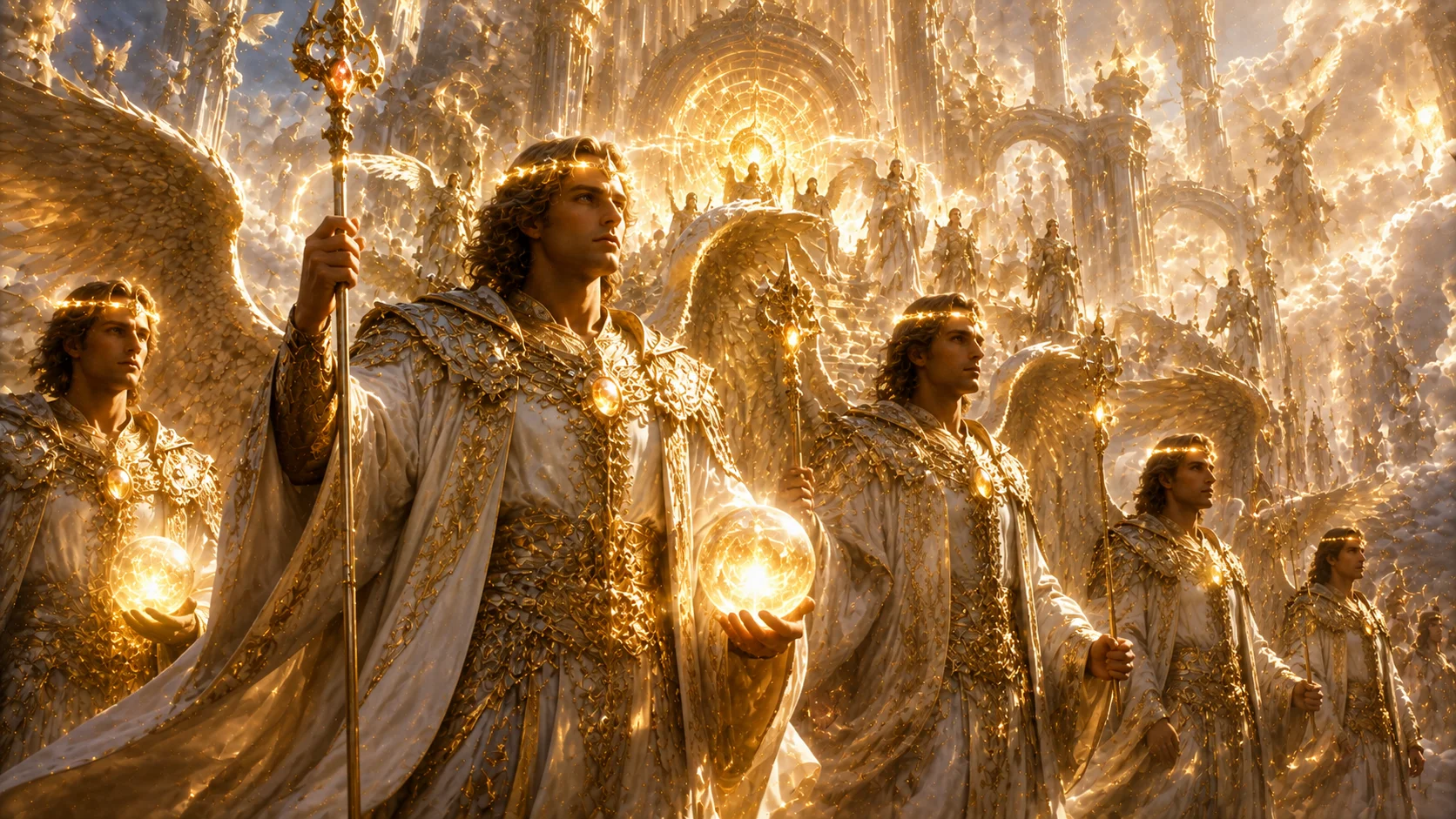
Traditional iconography gave the Dominions a visual language fitted to their office: they are depicted carrying orbs or scepters, the ordinary emblems of governance and lordship in any royal court, and sometimes swords as well, marking an authority that could enforce as well as command. Some artistic traditions go further, robing them in ecclesiastical-style vestments — the visual grammar of bishops and prelates rather than warriors — to emphasize that theirs is an authority of office and blessing rather than force. Together these images distinguish the Dominions at a glance from the lower ranks: not wings bent to combat, not instruments of protection, but the regalia of a court whose sovereignty is entirely borrowed.
A Term the Hebrew Bible Does Not Quite Contain
Because the Dominions belong to the broader orbit of Hebrew angelology, it is worth being precise about what the older Jewish sources do and do not say. The Hebrew Bible offers vivid heavenly-court imagery — the divine council seated in judgment in Psalm 82, the thrones set and the Ancient of Days taking his seat amid ten thousand times ten thousand in Daniel 7:9-10 — and Second Temple literature, especially the Book of Enoch, describes ranked classes of angels, among them the Watchers and various throne-attendants. But 1 Enoch itself never uses "Dominions" as a named order. The term as a fixed angelic rank is a Christian systematization, built from Paul's Greek vocabulary and elaborated by patristic writers who drew on Enochic and other Second Temple imagery without inheriting its specific categories. The comparable concept in Jewish tradition is real, and older, but it is not identical, and the two textual traditions should not be folded into one another.
The Unnamed Regent
No specific angel is canonically or broadly identified, in mainstream patristic sources, as ruler or prince of the Dominions. Later esoteric and occult angelological compendia — early modern grimoire traditions among them — do name figures such as Zadkiel or Hashmal as presiding over this order, but these attributions arrive centuries after the Dionysian and Thomistic accounts, sit outside the established theological tradition, and remain disputed rather than received. The honest account, then, leaves the governors of the Dominions themselves ungoverned by any single named regent — an order defined by its function and its rank, not by a figurehead.
The Discipline of Delegated Power
What gives the Dominions their lasting theological weight is not the vividness of their portrayal — they are, by every account, among the least visually elaborated of the nine choirs — but the moral shape of what they represent. Ordered, selfless governance: authority held and exercised without any grasping after domination, power understood entirely as a trust rather than a possession. In Christian moral theology this makes the Dominions a working model for how legitimate command ought to function among creatures answerable to a higher order — magistrates, prelates, anyone entrusted with authority over others. The lordship is real, the office is genuine, and none of it originates with the one who holds it.
A Rank Neither Overstated Nor Forgotten
The Dominions occupy an unusual place in the wider imagination of angels: too administrative to inspire the fear a Seraph might, too high in rank to be treated as a mere functionary, and too sparsely documented in scripture itself to have accumulated the layered legend attached to, say, the Cherubim guarding Eden. What remains, across Pauline epistle, Dionysian treatise, and Thomistic commentary alike, is a consistent picture: an order stationed at the border between the throne and the wider governance of creation, charged with seeing that what is commanded above is carried out faithfully below — lordship exercised, and lordship in constant service to something greater than itself.
Sources & traditions
- EncyclopediaWikipedia — Dominion (angel)
- TraditionHebrew texts, grimoires and later commentary
Myths change from area to area and from time to time. This chronicle follows the most widely told versions; tellings in other villages, regions and eras may differ.