Semyaza is the leader of the fallen Watchers — the chief of the two hundred angels who descended to earth and broke their celestial trust. In the Book of Enoch he is the instigator and captain of the great angelic rebellion of desire, the one who bound his fellows to their fatal oath. His name is read as “the heaven sees” or “my name has seen,” a fitting irony for a watcher who fell.
The Captain of the Watchers
When the Grigori, beholding the beauty of mortal women, conceived their forbidden desire, it was Semyaza who led them — yet who also hesitated. “I fear,” he said, “that you will not agree to do this deed, and I alone shall have to pay the penalty of a great sin.” So he bound them all by a mutual oath upon Mount Hermon, that they should descend together and share the guilt as one. Two hundred angels swore the oath, and by it they were all condemned together — the very mountain’s name, Hermon, was said to commemorate the curse (herem) they swore upon it.
The Teacher of Corruption
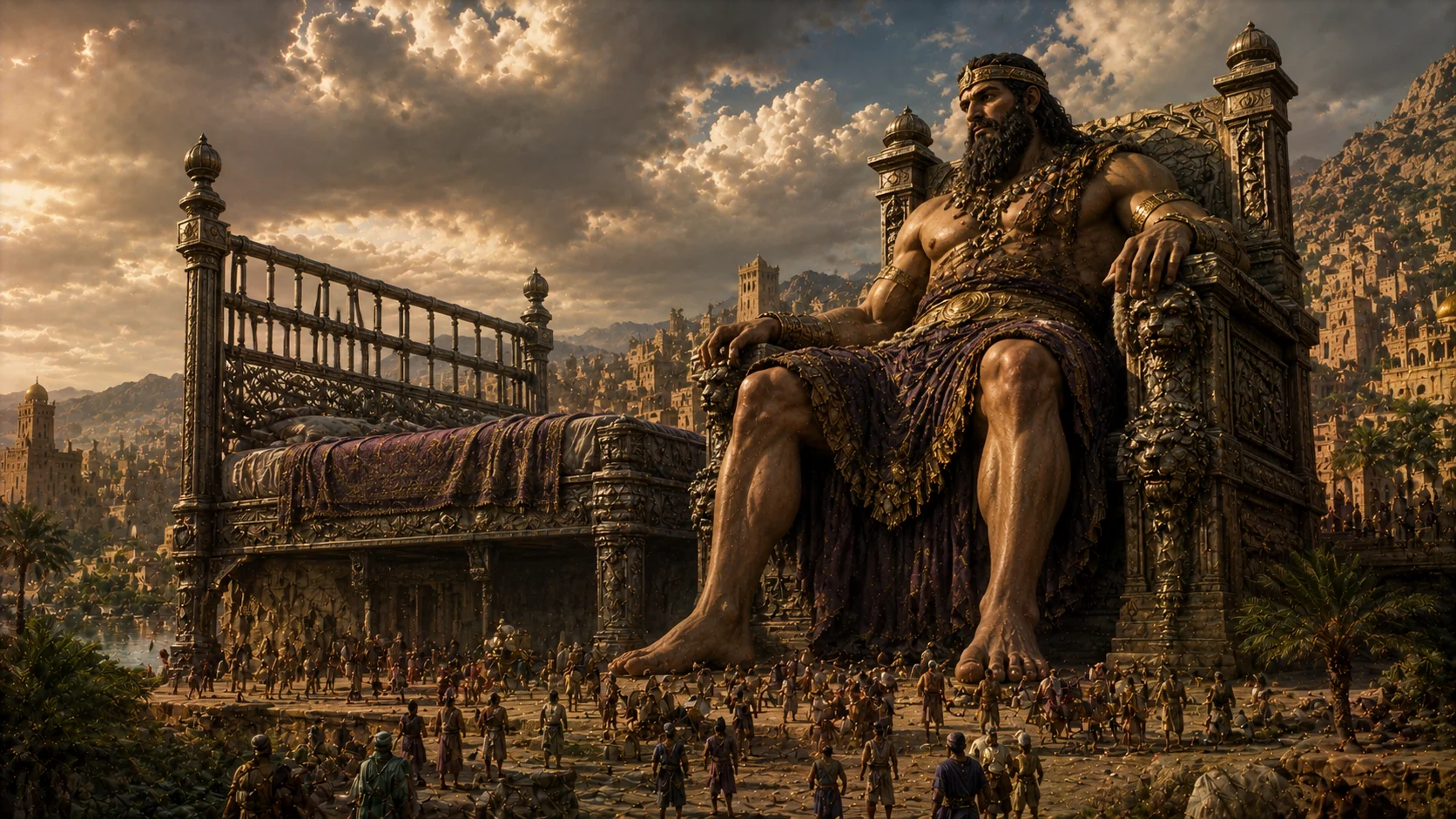
Having descended, Semyaza took mortal wives and, with his companion Azazel and the other chiefs, loosed ruin upon the world. Semyaza himself is named as the teacher of enchantments and root-cuttings — sorcery and the magical use of plants — while his fellows taught metalwork, weaponry, astrology, and the other forbidden arts. From the unions of the Watchers came the giant Nephilim, whose violence drowned the earth in blood.
The Hanging Judgment
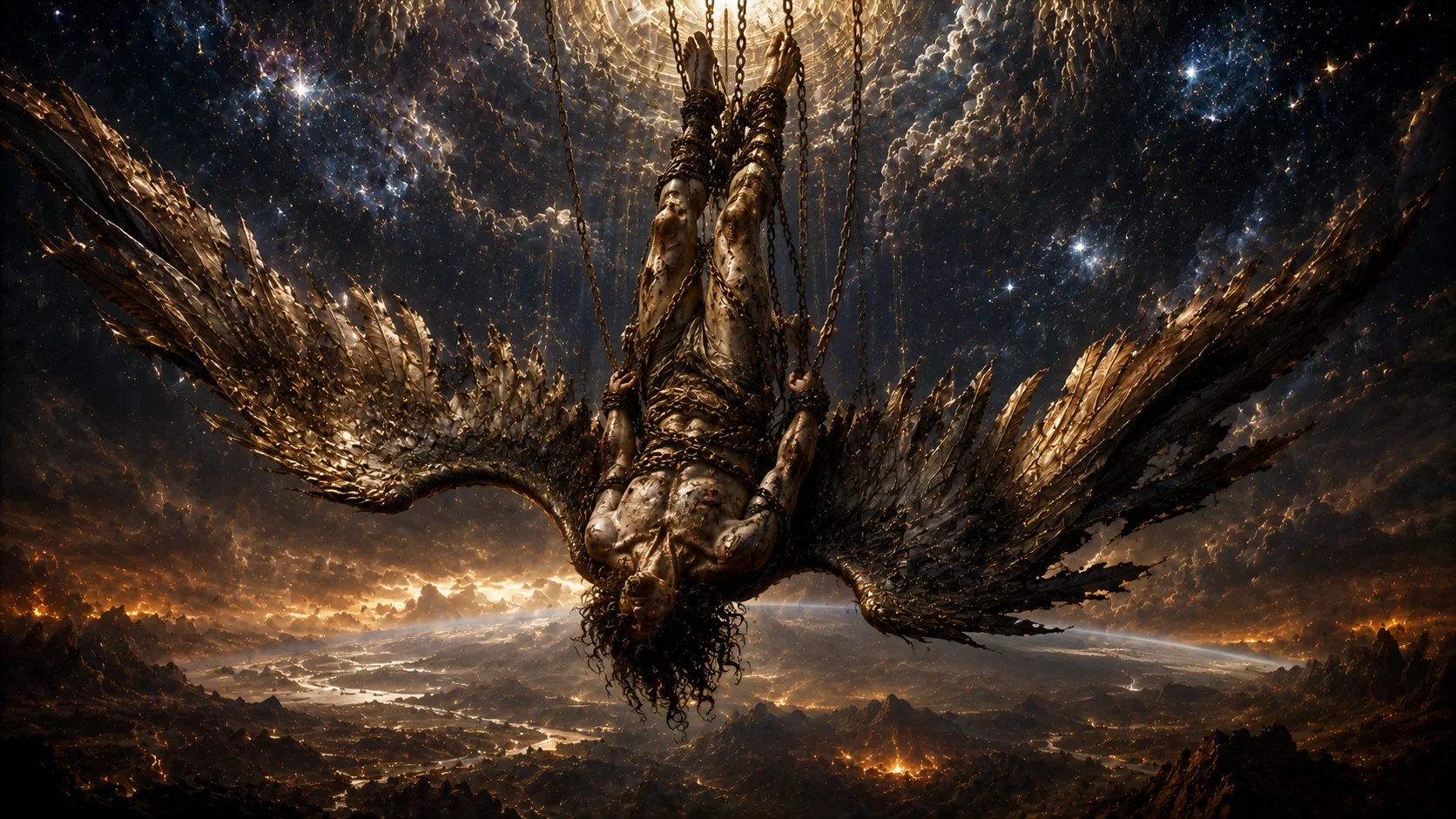
For his sin Semyaza suffered a fate as striking as his crime. Tradition holds that the fallen leader was bound and suspended head-downward between heaven and earth, hung in the sky as a perpetual sign of his fall — identified in some readings with the constellation Orion, the giant chained forever in the heavens he betrayed. As the first and foremost of the fallen angels, Semyaza stands as a prototype of Lucifer himself: the high one who, given the freedom to watch over creation, chose desire and dragged a host down with him into ruin.
Before Enoch, a Single Verse
The whole architecture of Semyaza’s story rests on four verses of Genesis that never once mention his name. “The sons of God saw the daughters of men, that they were fair,” the text says, “and they took them wives of all which they chose” — and from those unions came the Nephilim, giants and men of renown, in the days before the Flood. Genesis leaves it there: no leader, no oath, no motive beyond desire glimpsed and acted on. It is the Book of the Watchers — the oldest section of 1 Enoch, composed some time in the third century before the common era — that supplies everything the modern reader thinks of as Semyaza’s myth: the name, the mountain, the two hundred, the pact. Fragments of this expanded story, in its original Aramaic, were recovered from the caves at Qumran, in copies made well over two centuries before the scrolls were hidden away. Whatever else is arguable about the legend, its age is not: the fallen Watcher chief, with his name and his oath and his mountain, was already old when the scrolls were sealed, and is no medieval accretion on a bare biblical hint.
A Name Kept in Three Alphabets
No complete copy of 1 Enoch survives in the Hebrew or Aramaic it was first written in. The only complete text comes down in Ge’ez, the liturgical language of Ethiopia, where the book has never left scripture: the Ethiopian Orthodox Tewahedo Church holds 1 Enoch as canonical to this day, and that living use is the reason the story survived whole at all while every other tradition let it drop. It is this Ethiopic manuscript line that gives the familiar spelling Semyaza. The Aramaic fragments from Qumran carry the older form, Shemihazah. A third witness survives in Greek, preserved by the Byzantine chronicler George Syncellus, who copied long extracts of the Book of the Watchers into his chronicle around the turn of the ninth century under the spelling Semiazas. Three languages, three alphabets, one fallen captain: the manuscript trail is itself a small history of who kept this story alive, and why.
Bound in the Valleys of the Earth
The hanging-in-the-sky sentence is not the judgement 1 Enoch itself hands down. In the book’s own account of the clean-up, God sends four archangels to deal with the ruin the Watchers made, and each fallen figure gets a punishment suited to his particular crime. Raphael binds Azazel alone, hand and foot, sealing him beneath jagged rock in a desert pit to await judgement day. Gabriel is sent against the giant offspring, setting them against one another. Uriel goes ahead to warn Noah of the coming flood. And Michael is given Semyaza and the Watchers who took wives: they are to be bound, the text says, in the valleys of the earth for seventy generations — held under the ground itself until the appointed day when they are finally led out to the abyss of fire. It is a sentence of duration rather than display: not a body strung up for all to see, but a captain buried inside the world he corrupted, left to wait out a span of human generations almost too long to picture before facing the fire he had been warned of from the beginning.
Shemhazai and Azael: A Later Telling
Centuries after 1 Enoch, Jewish storytellers retold the fall under different names, as Shemhazai and Azael. In this version the two angels had objected when God proposed making mankind at all, protesting that mortals were too weak to be worth His attention; God answered that they would fare no better if they lived in bodies on the earth, and let them descend to prove otherwise. They fail almost at once, undone by a woman named Ishtahar, who agrees to nothing until Shemhazai teaches her God’s own Ineffable Name — and who then speaks it herself, rises clean out of his reach, and is set among the seven stars, the Pleiades as the tradition is usually read, sinless and forever beyond an angel’s grasp. Warned at last that the Flood is coming, Shemhazai repents; and here the head-downward hanging is not a sentence imposed on him but a penance he selects for himself and never leaves. Azael takes the opposite road, refuses all remorse, and is remembered as the angel behind ornament and rouge — the origin, in this telling, of vanity itself, and the reason his name is the one spoken over the goat driven into the wilderness on the Day of Atonement. The two Watchers become a matched pair: one repents into a fixed and silent punishment; the other never stops teaching what should never have been taught.
The Giants’ Nightmares
A separate text found among the Qumran scrolls, known today as the Book of Giants, tells the aftermath from an unexpected angle — not the Watchers, but their monstrous sons, who dream troubled dreams of coming annihilation and send a messenger to Enoch himself to ask what the visions mean. The answer offers no comfort: judgement is already decided. This text travelled further than anyone who first set it down could have guessed. Centuries later the prophet Mani drew on it to build a scripture of his own, and a version of the Book of Giants entered the sacred literature of Manichaeism, carried out of Mesopotamia along the trade roads into Central Asia. Fragments of it have turned up as far away as the Silk Road oasis towns of Chinese Turkestan — the Watchers’ children still dreaming their doom in languages the original Aramaic authors never knew existed.
Quoted Into Another Testament
Semyaza’s story left its clearest mark on a text that never once names him. The New Testament letter of Jude directly quotes “Enoch, the seventh from Adam,” attributing to him a prophecy of the Lord arriving in judgement with his holy ones — a citation drawn almost word for word from the opening chapter of the Book of the Watchers. That same letter, and its close relative 2 Peter, both speak of angels who overstepped their proper place and were bound in darkness to await judgement — language early Christian readers understood as pointing straight at the Watcher myth, even without ever using Semyaza’s name. That a book excluded from the Jewish and the mainstream Christian canon could still leave fingerprints on scripture that was kept says something about how completely the story of the falling angels had entered the imagination of the world that produced both.
A Different Bargain With Fire
Any tradition that imagines civilisation arriving from outside human effort tends to imagine a price attached to it, and it is worth setting Semyaza beside the nearest such figure in Greek myth, Prometheus, if only to see how differently two cultures could tell a related story. Prometheus steals fire out of pity for a species he judges unfairly treated, and pays for it alone, chained to a rock with an eagle at his liver, the wound closing each night so that it can be opened again each day. Semyaza gives his knowledge away out of a desire he could not master rather than out of pity, spreads the guilt deliberately across a host by way of the oath, and is sentenced not as an individual but as a class, for a span running to the end of the world itself. Where the Greek story isolates one rebel and half-admires his defiance, the Hebrew story indicts an entire order and simply waits, patiently, for the day it can be closed for good.
Why the Watchers Keep Falling
Strip away the oath and the mountain and what is left is an old, specific fear: that the arts which make a civilisation — metalwork, medicine, cosmetics, the reading of the stars — never belonged to human beings by right, and were only ever on loan from something that should have stayed at its post. Semyaza is not a monster threatening from outside the human world; he is a supervisor who abandons the post and hands out the keys. That is a harder thing to guard against than a monster, and a far more uncomfortable thing to have inherited a civilisation from. The story has outlasted every empire that copied it down because the anxiety underneath it has never actually gone away: every generation handed some new and dangerous power still wants to know who watched first, who wanted first, and who is still, somewhere, paying for having looked too closely and too long.
Sources & traditions
- EncyclopediaWikipedia — Samyaza
- TraditionHebrew texts, grimoires and later commentary
Myths change from area to area and from time to time. This chronicle follows the most widely told versions; tellings in other villages, regions and eras may differ.