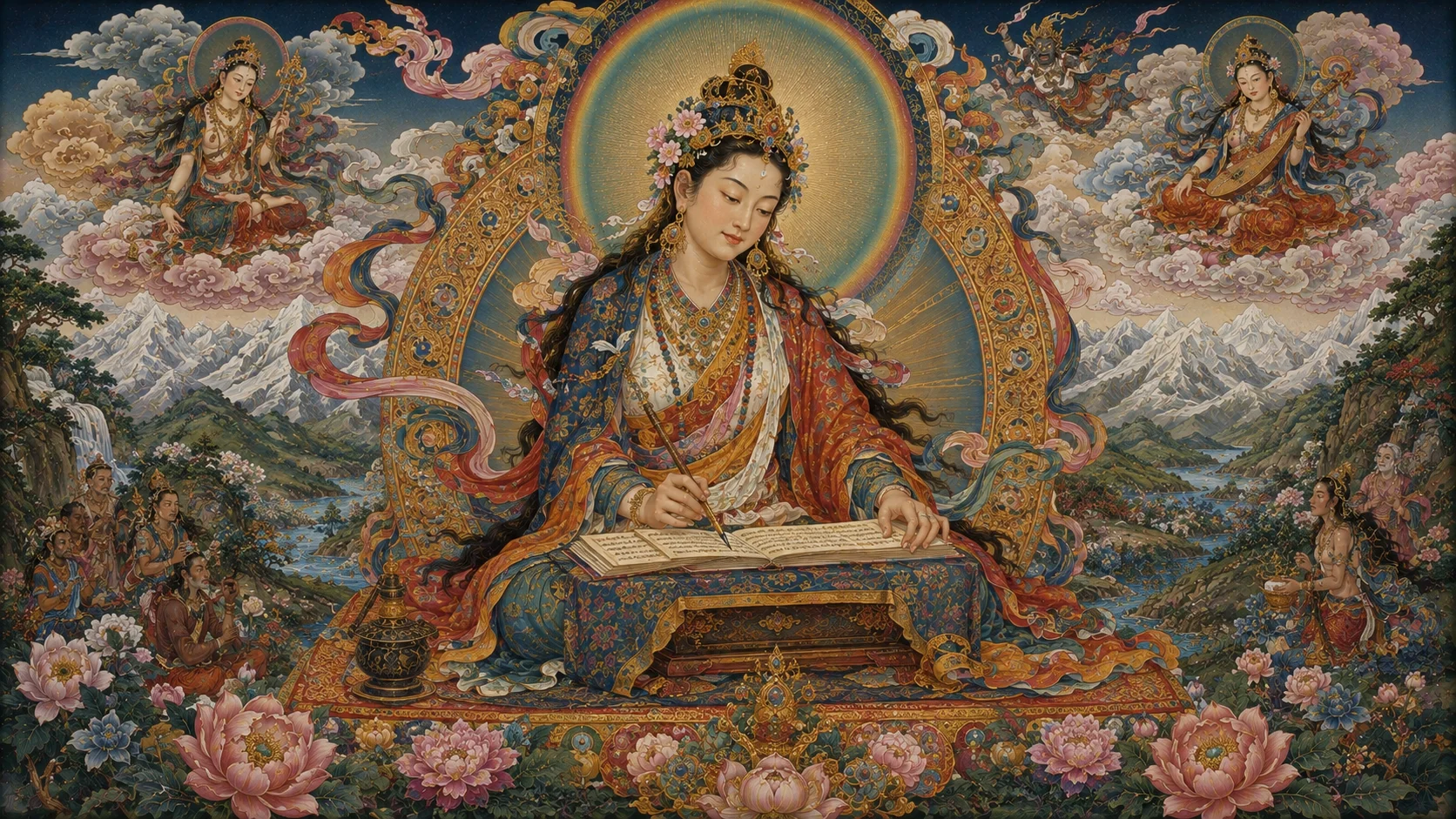
Yeshe Tsogyal, the Victorious Ocean of Wisdom, is revered in the Nyingma tradition of Tibetan Buddhism as the great female master and enlightened consort of Guru Padmasambhava — a woman held to have attained complete buddhahood within a single lifetime, who recorded and concealed her master's teachings for the ages still to come, and who stands as the supreme proof, within Vajrayana teaching, that full awakening is not withheld from women. She is honored as the Great Dakini, Khandroma Chenmo, and in devotional literature as Mother of Tibet.
Born of the Drag Clan, Under Signs
Nyingma tradition holds that Yeshe Tsogyal was born in the eighth century into the Drag, or Karchen, clan of the Tibetan region of Tsang, and she is honored in some sources by the clan-name Kharchen-za, Lady of Kharchen. Her life is transmitted chiefly through terma, the hidden treasure-texts that Nyingma tradition regards not as ordinary chronicle but as authoritative revelation, disclosed to the world only when the time for it has ripened. Several such termas describe her birth as attended by miraculous signs, marking her from infancy as a vessel of extraordinary realization. It is worth holding this genre distinction gently rather than as a matter of dispute: within the tradition, a namthar, a sacred life-story, carries a different kind of truth than a court record, and Yeshe Tsogyal's biography belongs entirely to that revealed lineage.
Queen of Trisong Detsen, Consort of the Guru
Before she became the foremost disciple of Padmasambhava, Yeshe Tsogyal is held in tradition to have been a consort, a wife, of the Tibetan King Trisong Detsen, the sovereign whose reign saw the deliberate establishment of Buddhism as the religion of Tibet. It was from within the king's household that she came to Padmasambhava, the great tantric master credited with subduing the obstacles to the dharma's spread across the Tibetan plateau and helping found its earliest institutions. She became his principal consort and closest disciple, and under his direct guidance undertook the deepest disciplines of tantric practice. Her devotion to him, and his instruction of her, form the axis around which the whole of her hagiography turns.
The Furnace of Hardship
Yeshe Tsogyal's path to realization was not gentle. Terma sources describe her enduring severe ascetic trials, including being sold or given away and suffering abuse, before she came into the fullness of her attainment. Nyingma tradition does not present these ordeals as misfortune alone but as part of a deliberate path of purification, the hardship itself becoming the ground on which her devotion and her practice were tested and proven. Her life-story, itself preserved as terma, recounts these sufferings alongside her eventual triumph, and it is this arc — from affliction endured to buddhahood attained in that very body, in that very lifetime — that gives her biography its central force within the tradition, and that makes her, above all other figures, the exemplar held up to demonstrate that a woman's realization can be complete and unsurpassed.
Retreat in the Caves of the Guru
Across Tibet and into the Himalayas, Yeshe Tsogyal undertook extensive retreat practice at the sacred sites bound to Padmasambhava's own activity. Among these, tradition names most prominently the caves of Tidro, also called Terdrom, and Paro Taktsang, the Tiger's Nest, in Bhutan — places still counted among the most sanctified in the Himalayan Buddhist world. She is also linked to Samye, Tibet's first monastery, raised through the collaboration of Padmasambhava, the abbot Shantarakshita, and King Trisong Detsen, and thus a site standing at the very foundation of institutional Buddhism in Tibet. In these places of austerity and power she pursued the tantric disciplines that carried her toward full realization, her practice inseparable from the landscape itself, which Nyingma tradition regards as blessed by the Guru's own presence.
Keeper of the Hidden Treasures
Alongside Padmasambhava, Yeshe Tsogyal is credited with concealing termas throughout Tibet and the Himalayas — texts, ritual implements, and teachings hidden against the day when future tertöns, treasure-revealers, would bring them back into the world at the moment they were needed. She herself is regarded as a tertön, not merely the guardian of another's revelation but a revealer in her own right. Tradition holds that she possessed a perfect, infallible memory, by which she heard and retained the whole of Padmasambhava's teaching, setting it down and hiding it so that the dharma he had brought to Tibet would not be lost to time, persecution, or forgetting, but would surface again across the centuries exactly when the world had need of it.
Scribe of the Guru's Word
Beyond her role as concealer of the termas, Yeshe Tsogyal is honored as a principal compiler and scribe of Padmasambhava's teachings, and as instrumental in the transmission and translation of tantric texts carried from Sanskrit and from Oddiyana into the Tibetan language during the imperial period. This labor of transcription and translation placed her at the very center of the imperial-era effort to root Buddhism in Tibetan soil, working alongside the great translators of the age. Among those named beside her in this labor of transmission is Vairotsana, one of the foremost Tibetan translators of that period, with whom her hagiography closely links her.
Foremost Among the Consorts
Yeshe Tsogyal is regarded as the foremost of Padmasambhava's consorts and disciples. Nyingma tradition names other consorts as well, among them Mandarava, yet it is Yeshe Tsogyal who is held as preeminent — the one whose realization, whose service to the teachings, and whose place in the guru's own regard mark her as first among them. Her closeness to Padmasambhava is remembered as a relationship of both profound devotion and equal spiritual attainment, an intimacy in which the disciple herself rose to stand, in the eyes of the tradition, beside her master rather than beneath him.
Emanation of the Wisdom-Dakini
In her deeper identity, Yeshe Tsogyal is venerated as an emanation, or embodiment, of Vajrayogini and of the wisdom-dakini principle, the feminine embodiment of enlightened awareness in Vajrayana practice. In her ultimate aspect she is often equated with the Great Mother, Prajnaparamita, the perfection of wisdom itself given form. This identification is not ornamental; it is the doctrinal ground on which her whole veneration rests, situating her not merely as an accomplished historical practitioner but as wisdom itself, moving through the world in a woman's body to teach that enlightenment knows no such limitation.
The Woman Who Attained Buddhahood in This Life
It is a central point of Nyingma doctrine, and of Vajrayana teaching on gender and realization more broadly, that Yeshe Tsogyal attained full buddhahood within that very lifetime. She is held up, above every other figure in the tradition, as the primary exemplar proving that women can achieve complete enlightenment, a teaching she embodies rather than merely illustrates. Her path — through hardship, through tantric discipline under Padmasambhava's guidance, through the labor of preserving and concealing the dharma — culminates in this single, unambiguous claim: that the highest attainment of the Vajrayana path was hers, entire and unsurpassed.
Skull-Cup, Blade, and the Union of the Guru
In iconography, Yeshe Tsogyal is typically shown as a red or white dakini figure, most often seated, bearing a skull-cup, a kapala, and a curved knife, a kartika, or in other depictions a vase of long life. She may also be shown holding a vajra and bell, the paired implements of skillful means and wisdom. In some images she appears in union, yab-yum, with Padmasambhava himself, a form expressing the inseparability of method and wisdom that her own attainment is said to embody. Each implement she carries speaks to an aspect of her activity — the blade that cuts through ignorance, the cup that transforms poison into nectar, the vase that grants life to the practice she safeguarded.
The Lady of the Lotus-Born
Yeshe Tsogyal's life is preserved chiefly through terma biographies, namthar, of which the best known is the Lady of the Lotus-Born. Tradition holds that this account was dictated by Yeshe Tsogyal herself and concealed as terma, to be revealed many centuries later, in the seventeenth century, by the tertön Taksham Nuden Dorje. Western scholarship has treated the historical layering of this text — the relationship between its core narrative and later redaction — as an open question, one worth noting rather than resolving, since the terma genre itself does not claim the kind of authorship history that ordinary historiography expects. Within the tradition, however, the text stands as her own voice, carried forward across the centuries to the moment it was destined to surface.
Invoked Still, in Guru Yoga and the Treasure Cycles
Yeshe Tsogyal remains a living presence in Nyingma practice today, invoked centrally in guru yoga and in dakini practices, and propitiated by practitioners for long life, for wisdom, and for the removal of obstacles on the path. She recurs as a central figure in the Rigdzin Dupa and in other liturgies belonging to the Longchen Nyingtik, a major Nyingma treasure cycle, her presence woven into the living ritual fabric of the tradition rather than confined to historical memory. As the enlightened consort of Guru Rinpoche, the compiler and concealer of his teaching, and the Mother of Tibetan Buddhism, she continues to be approached by practitioners across the Himalayan world as a source of blessing, above all for those who look to her as proof that the path to complete awakening lies open before them.
Sources & traditions
- EncyclopediaWikipedia — Yeshe Tsogyal
- TraditionTibetan Buddhist texts, oral tradition and village tellings
Myths change from area to area and from time to time. This chronicle follows the most widely told versions; tellings in other villages, regions and eras may differ.