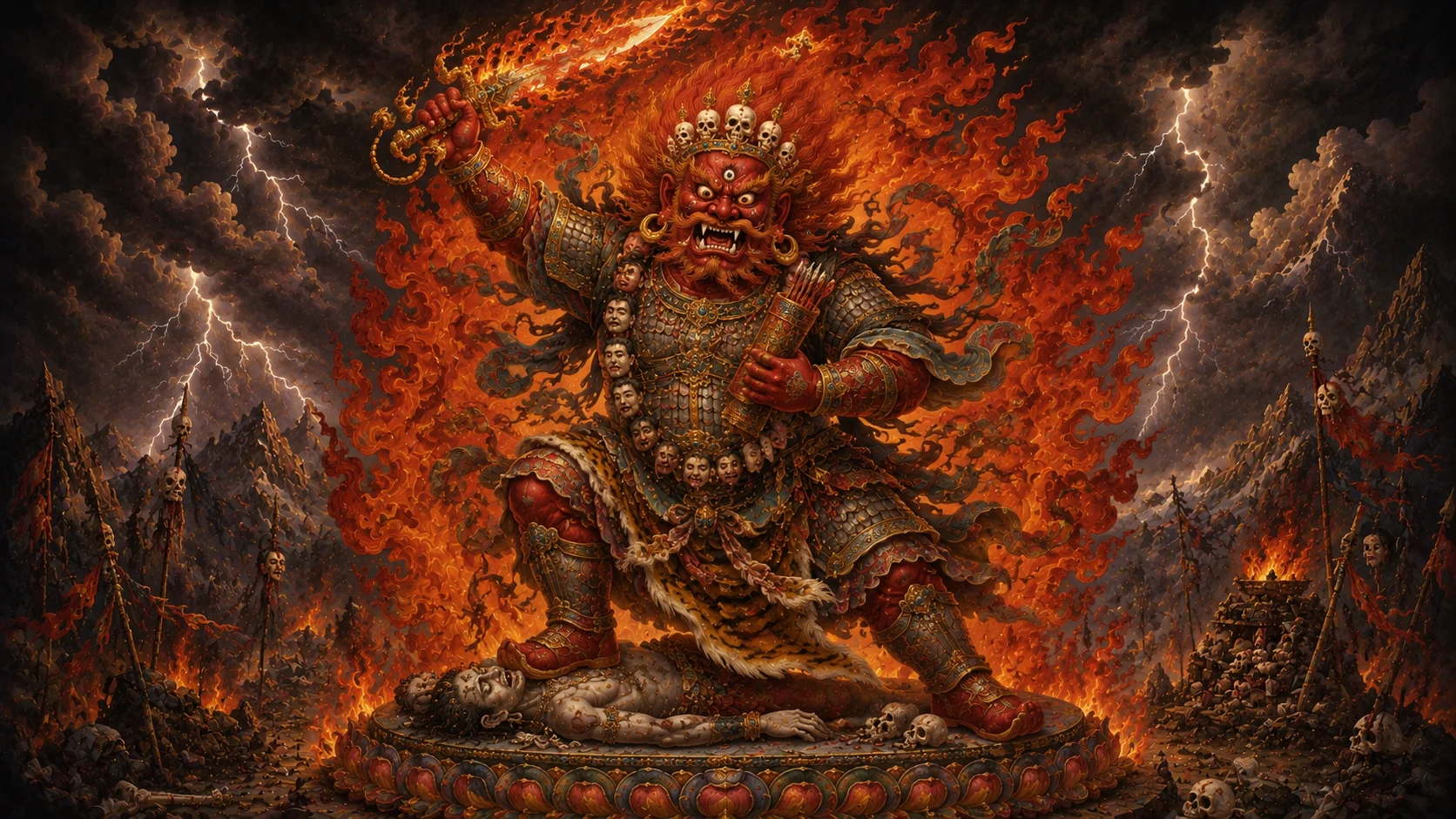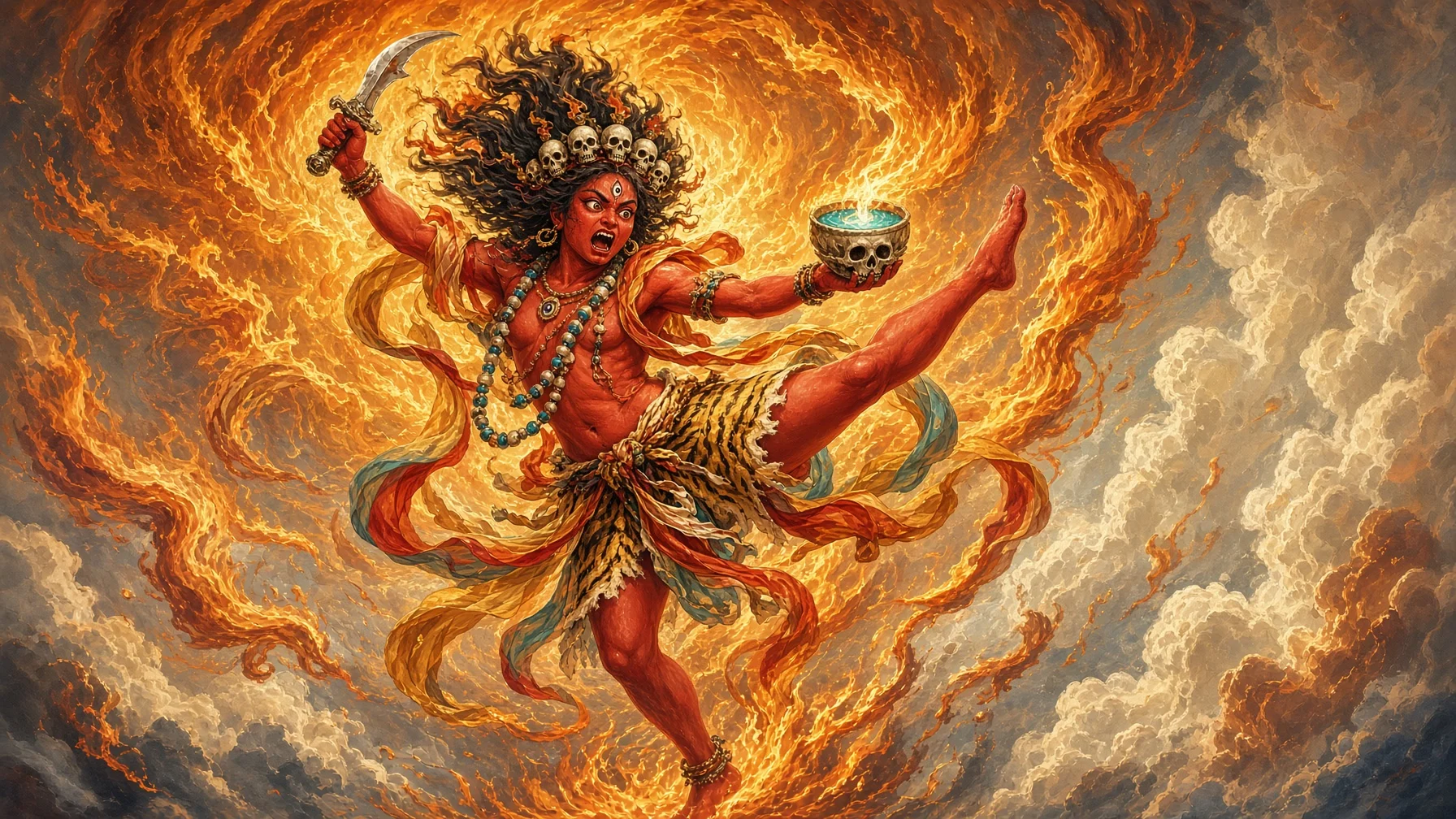
The Dakini — the “sky-dancer,” in Tibetan khandroma, “she who moves through space” — is the female embodiment of enlightened wisdom-energy in Tibetan Buddhism: a class of powerful, dynamic, often fierce female deities and spirits who dance through the open sky of awakened awareness, the inspirers, protectors, and revealers of the deepest teachings. The dakini is the dynamic feminine principle of enlightenment itself.
The Sky-Dancers
The dakinis (Tibetan khandroma, “sky-goer” or “space-dancer”) are female embodiments of enlightened energy — the active, dynamic, transformative aspect of wisdom, dancing freely through the “space” (the openness, the emptiness) of awakened awareness. They range from the fully enlightened wisdom-dakinis (such as Vajrayogini and Senge Dongma) who are buddhas in female form, through the great human female masters who are recognized as dakinis (like Yeshe Tsogyal), to worldly dakinis and protective spirits. The dakini embodies the principle that enlightenment’s wisdom is dynamic, fluid, and often appears in female form.
Inspirers and Revealers
The dakinis play a vital role in the Vajrayana as inspirers, guides, protectors, and revealers of teachings. They appear to practitioners and masters — sometimes in beautiful form, sometimes fierce, sometimes as ordinary women who are secretly enlightened — to test, to instruct, to grant initiations and teachings, and to bestow the “dakini teachings” that come from the realm of pure awareness. Many of the hidden treasures (terma) and secret transmissions are guarded and revealed by dakinis, and they communicate in a “secret dakini-language” understood only by the realized. To meet a dakini is a momentous event on the path.
The Dynamic Feminine
The dakini embodies a profound principle of the Vajrayana: that wisdom (traditionally feminine) is not static and passive but dynamic, energetic, and active — the dancing, transformative power that turns the energies of life into the path of enlightenment. Often depicted dancing, naked or lightly adorned, fierce or blissful, wreathed in the flames of wisdom, the dakini is freedom and transformative energy made manifest. She is honoured as one of the “Three Roots” of refuge in the Vajrayana (guru, yidam, and dakini), the source of enlightened activity. In the Dakini, Tibetan Buddhism gave form to the dynamic, dancing wisdom of the enlightened feminine — the sky-dancers who move through the open space of awareness, the inspirers and revealers of the deepest teachings, the active energy of awakening itself.
Before Tibet: The Dakini in Indian Tantra
Long before Tibetan painters set her dancing inside a ring of flame, the dakini already had teeth. She entered Vajrayana Buddhism out of the tantric and folk religion of medieval India, where dakinis were something closer to what the word still carries across much of South Asia — flesh-eating female spirits, attendants of the fierce goddess Kali, who haunted the cremation grounds and fed on the dead. In the Shakta and Kaula currents that grew up alongside early Buddhist tantra, they belonged to a wider sisterhood of untamed female powers, the sixty-four yoginis, whose roofless circular temples — the one at Hirapur in Odisha among the best preserved — still stand open to the sky in central and eastern India. Their blessing was sought as eagerly as their appetite was feared. They were not gentle, and they were not safe. That original danger is the seed the Tibetan tradition never entirely burned away.
The Taming of the Charnel-Ground Spirit
As Buddhist tantra absorbed these figures, it did not file down their ferocity so much as turn it around to face the practitioner instead of the corpse. This belongs to a much larger pattern in the spread of Vajrayana across the Himalaya: fierce local spirits and goddesses were ritually subdued and bound over as protectors and teachers of the dharma, a transformation credited above all to Padmasambhava’s subjugation of Tibet’s indigenous deities. The dakini’s hunger for flesh was kept, but its object was inverted — she no longer devours the body, she devours ego, concept, and the practitioner’s pride in their own understanding. Her nakedness stopped signalling danger to be fled and became a teaching in itself: reality with nothing draped over it, no concealment, no comfortable story. What she demands of anyone who meets her is exactly what made her terrifying in the first place — that they not flinch.
The Eight Great Charnel Grounds
Vajrayana practice maps a symbolic geography of eight great charnel grounds, wild cremation sites strewn with bone, prowled by jackals and vultures, where the dead are burned or left exposed rather than buried away out of sight. These are not merely settings for grim imagery. They are where dakinis are said to gather, dance, and hold court, and in the mandalas of tantras such as Chakrasamvara they form the outer ring through which a practitioner must pass to reach the centre — in visualization, and historically in person. The logic is direct rather than morbid: a mind that can sit undisturbed among the actual wreckage of a body has nowhere left to hide its belief in its own permanence. The dakini presides over that confrontation as both the fiercest thing in the ground and the guide who walks the frightened mind through it.
Machig Labdron and the Practice of Severance
Among the great human masters recognised as living embodiments of the dakini, one figure stands apart for founding an entire lineage of her own. Machig Labdron, born in Tibet in the eleventh century, is the source of Chöd — the word means simply “to cut,” and is usually rendered “severance” — one of the very few major Vajrayana transmission lines founded by a woman rather than merely populated by one. In the practice, a solitary Chöd practitioner goes at night to a charnel ground, a haunted crossroads, or any place that provokes real fear, and there sounds a hand-drum and a trumpet fashioned from a human thighbone while visualising their own body cut open, cooked, and offered as a feast — flesh, blood, bone, everything — to hungry ghosts, demons, and the dakinis themselves. The point is not self-harm but self-dissolution: by giving away the body one is most frightened of losing, the practitioner starves the grasping that Buddhism identifies as the root of suffering. Chöd is not a historical curiosity. It is still practised across the Himalayan world and in Buddhist centres abroad, its transmission understood to run directly through dakini inspiration.
The Old Woman Who Laughed at Naropa
The Kagyu lineage preserves one of the tradition’s most quoted encounters with a dakini in disguise. Naropa, by then an eminent scholar at the monastic university of Nalanda, was reading when a shadow fell across the page: an old woman, hideous and hunched, with the thirty-seven ugly features his biographies list in unflinching detail. She asked whether he understood the words of the text or its meaning. He answered that he understood the words — and she laughed and danced with delight. Encouraged, he added that he understood the meaning too, and at that she wept and threw down her stick, because the second answer was a lie. Her brother Tilopa, she told him, was the one who understood the meaning; then she was gone. A lifetime of scholarship had given Naropa the words without the realisation underneath them, and that single humiliation sent him out to find Tilopa and endure the hardships that finally brought him to awakening. The tradition identifies the old woman as a dakini, and the story is told precisely because it is not flattering. Dakinis test the proud in the least dignified form available, and a practitioner who cannot recognise wisdom wearing an ugly face has already failed.
Reading Her Face: Dakini Iconography
A dakini in Himalayan art announces herself before a viewer knows any of the doctrine behind her. She dances rather than stands, one leg lifted and bent across the other in the posture painters call ardhaparyanka, as if caught mid-turn and unwilling to be still. Flames curl around her body — not fire that burns her, but the fire of wisdom burning ignorance from the inside — and she dances on a sun disc set upon a lotus, the fiercest forms trampling prone figures underfoot. The attributes she carries are a vocabulary rather than decoration:
- the kapala, a skull-cup brimming with blood or nectar, raised in one hand
- the kartika, a curved flaying knife, hooked for stripping away what clings
- the khatvanga, a trident-topped staff cradled against the shoulder, marking a hidden consort
- a crown of five skulls, bone ornaments, and a garland of severed heads
Colour is read the same way. A dakini painted white, yellow, red, green, or deep blue is being tied to one of the five buddha families, so her hue alone tells a trained eye which quality of awakened energy she manifests before a single object in her hands has been identified.
The Dance That Is Still Danced
None of this lives only in paint. At monasteries across Tibet, Bhutan, Nepal, Ladakh, and the wider Tibetan Buddhist diaspora, monks who have trained for years perform cham, the masked ritual dances held during annual festivals, and dakinis are among the figures brought into the courtyard behind elaborate costume and carved masks. The choreography is not folk entertainment: each gesture and turn belongs to a specific meditation, and the dance as a whole commonly enacts the subjugation of obstructing forces and the triumph of awakened energy over confusion. Lay communities gather in their thousands not merely to watch but to receive blessing from the act of witnessing, a merit understood to reach the audience simply through being present. Where the dakini appears in cham, she is danced with the same seriousness she was danced centuries ago — a living transmission, not a memory of one.
Why the Sky-Dancer Cannot Be Tamed
Underneath the iconography sits a very old human problem: what to do with power that will not hold still and will not be made safe, especially when it arrives in a female and often sexual form. Traditions tend to resolve that discomfort in one of two ways — by demonising the wild feminine into something to be destroyed, or by domesticating her into something ornamental and harmless. Vajrayana Buddhism took neither route. It kept the dakini as frightening as the cremation-ground spirit she descended from, and then declared the fright itself to be the doorway. She still eats flesh, still tests the proud in ugly disguise, still dances where the bodies are burned — and none of it has been softened, because the softening was never the point. She endures in paint, in festival, and in solitary practice on a cold mountainside at night because she refuses to resolve into anything comfortable: enlightenment as it looks when it declines to be predictable, asking nothing of the practitioner except the willingness not to look away.
Sources & traditions
- EncyclopediaWikipedia — Dakini
- TraditionTibetan Buddhist texts, oral tradition and village tellings
Myths change from area to area and from time to time. This chronicle follows the most widely told versions; tellings in other villages, regions and eras may differ.