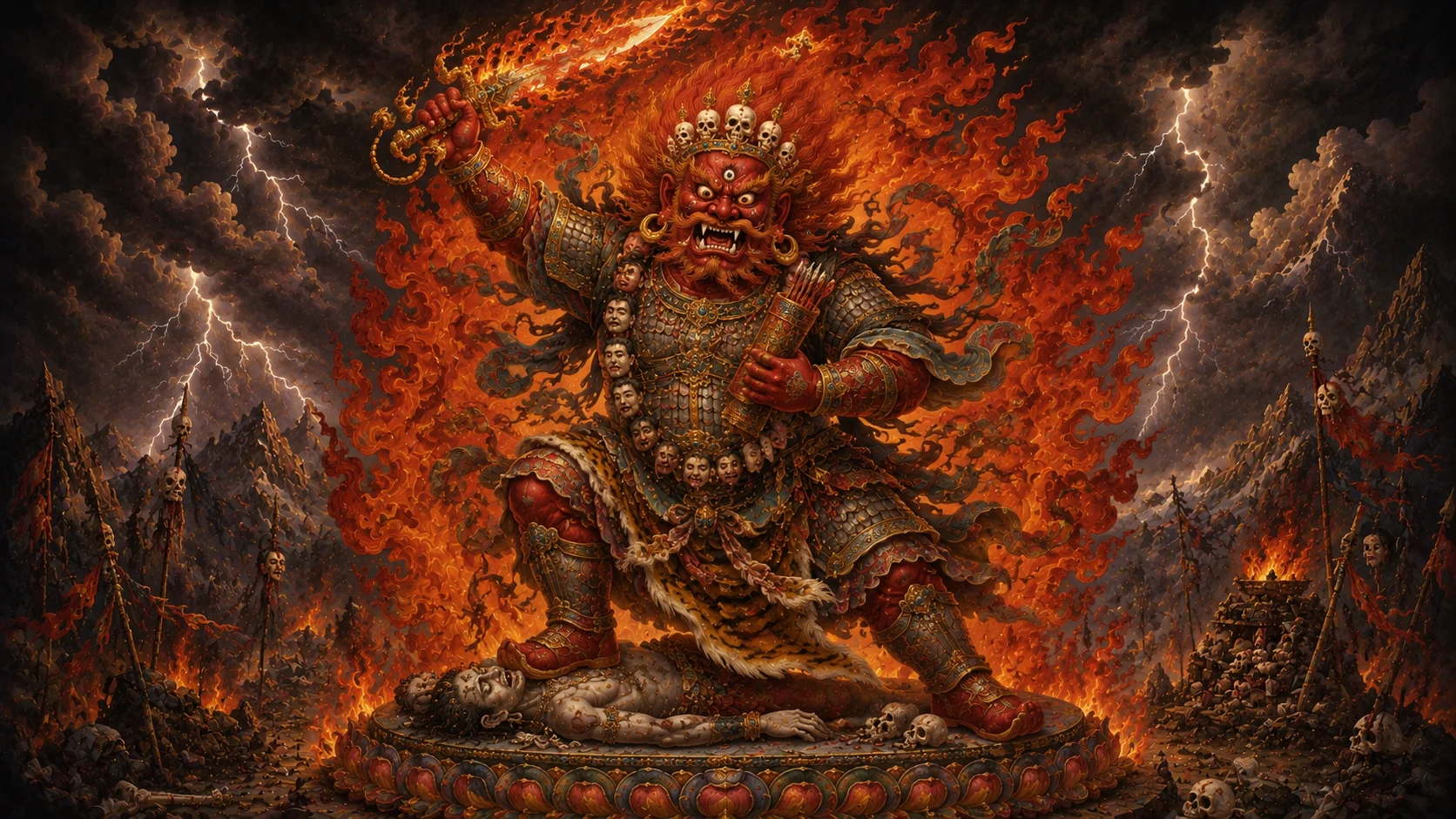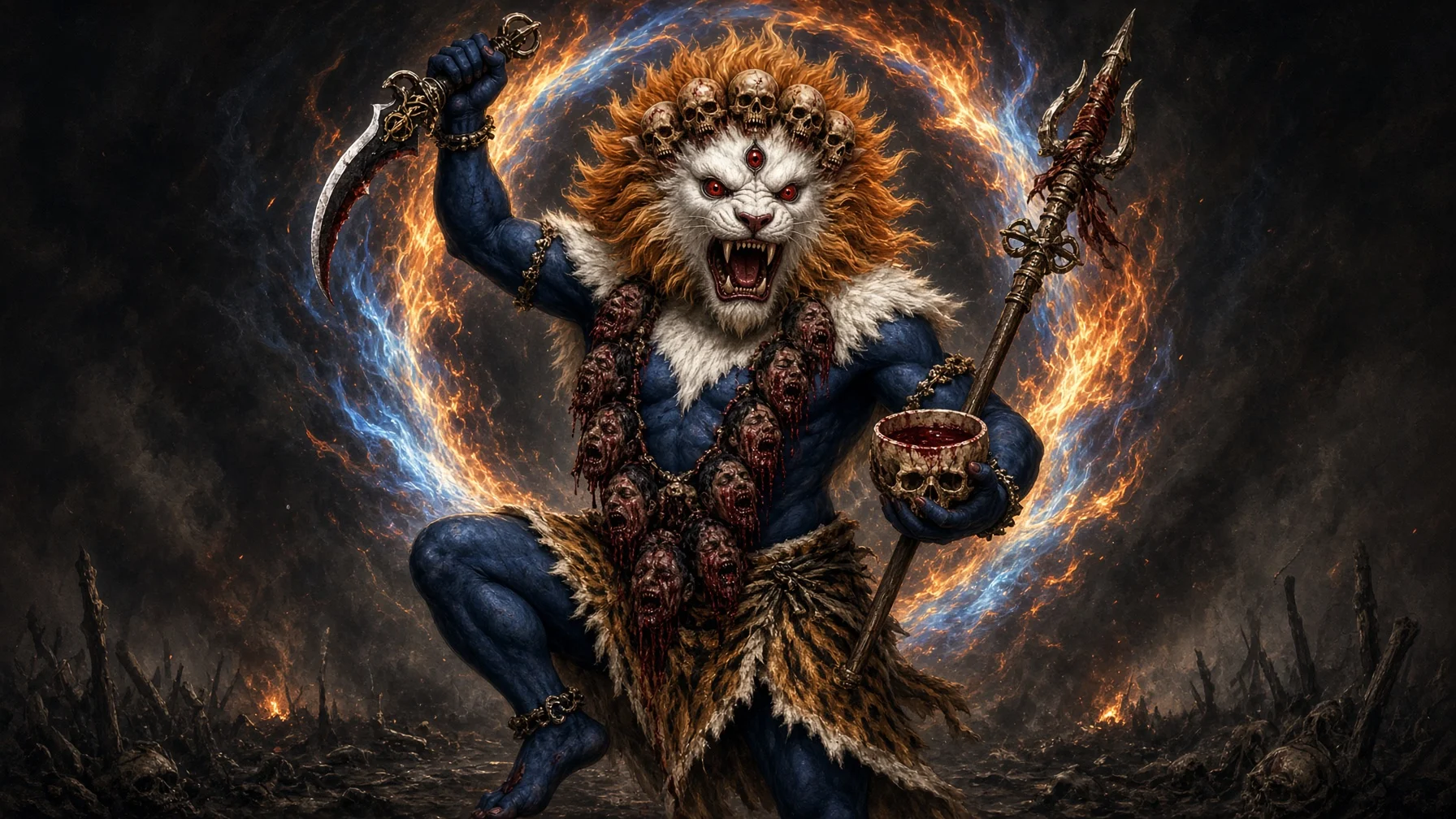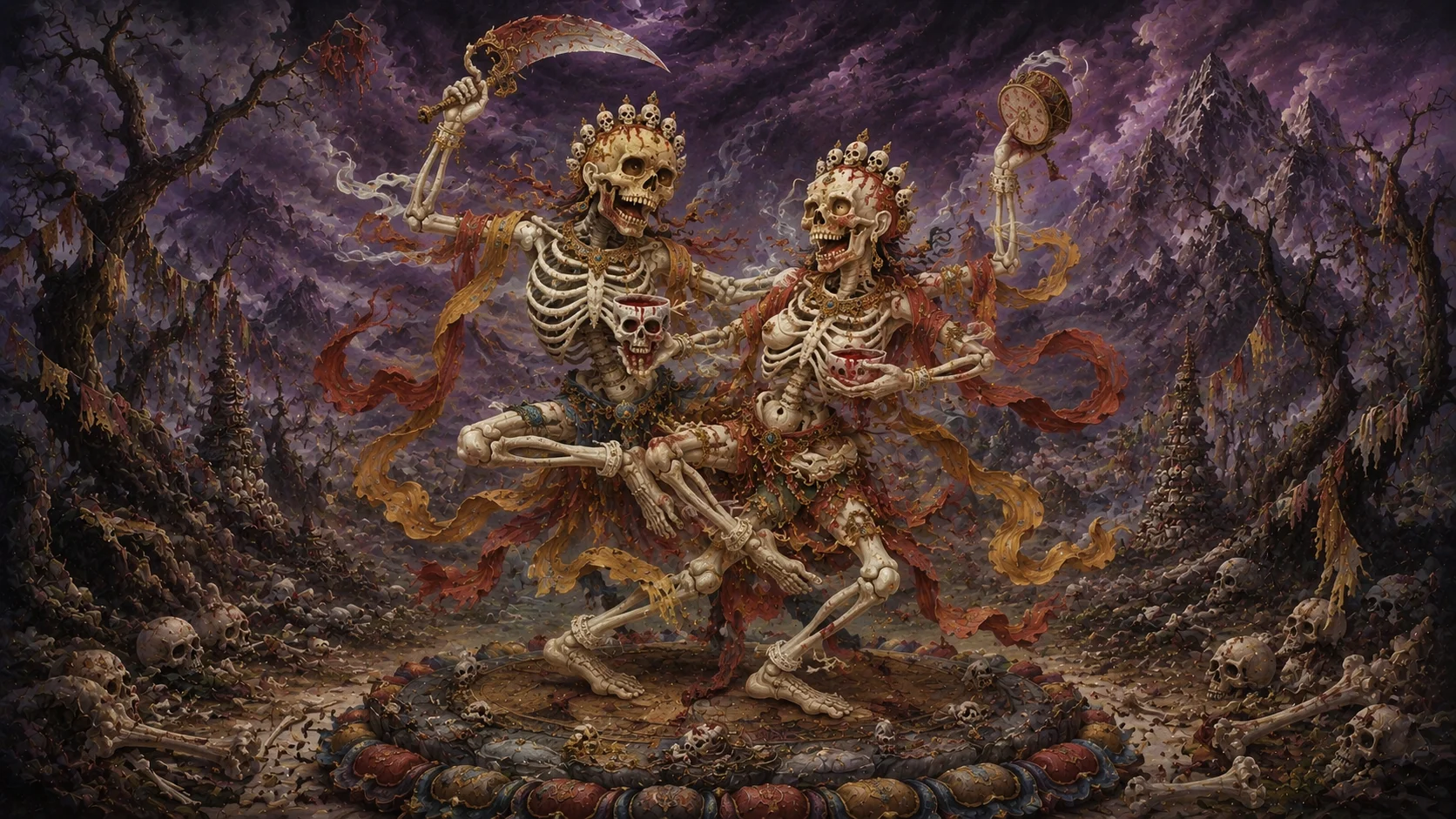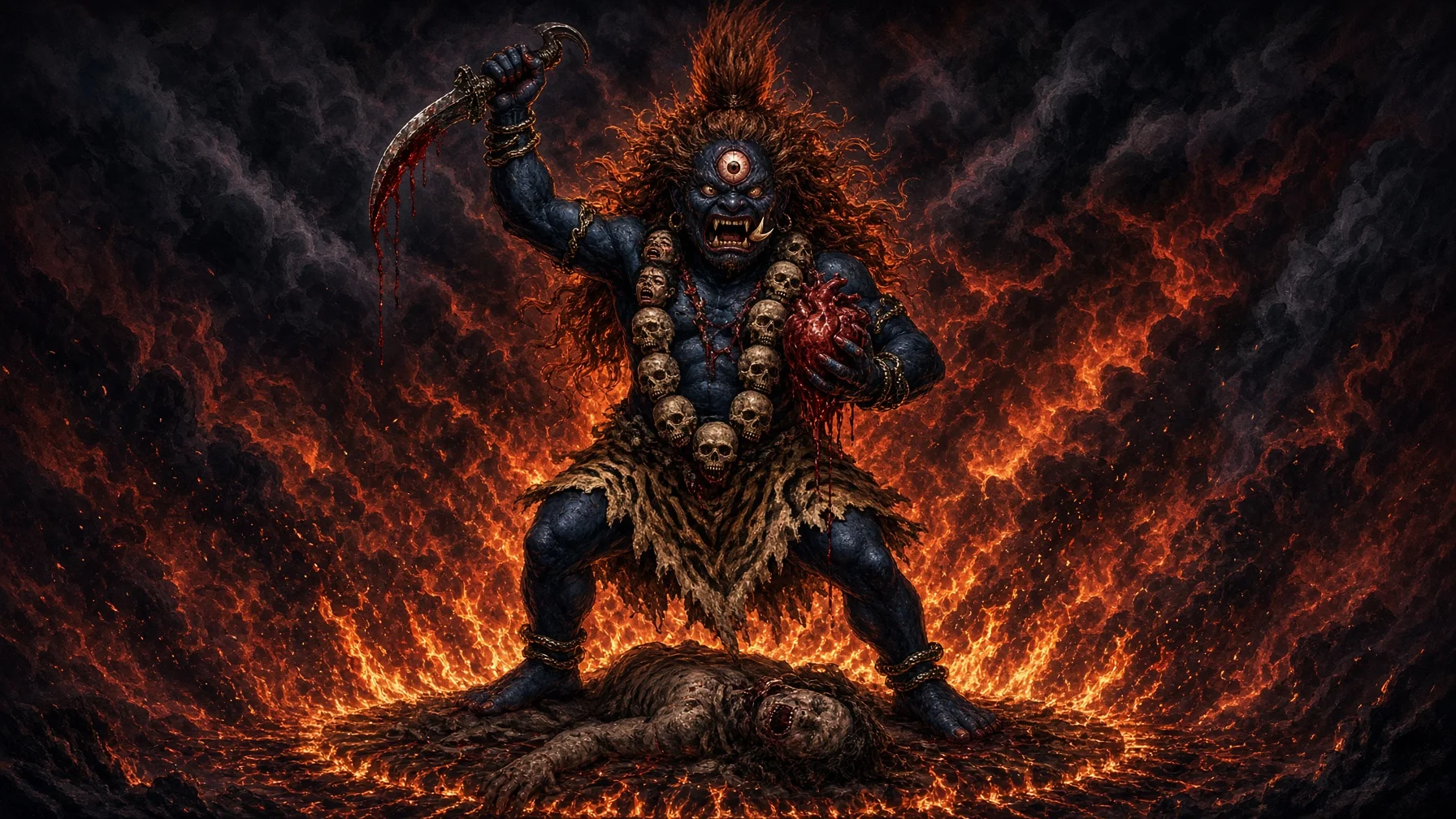
Ekajati, the One Braid, the one-eyed, one-fanged, one-breasted guardian, is a supremely fierce protectress of Tibetan Buddhism: the foremost guardian of the secret mantras and the most profound teachings, especially of the Nyingma school and the Dzogchen tradition, a wrathful deity of singular and terrifying form whose single attributes signify the non-dual, absolute nature of reality she protects. In Tibetan she is called Ral gcig ma, and in Sanskrit Ekajaṭā or Ekajaṭī, names that all turn on the same fact of her form: a single standing lock of hair, flaming, unmistakable, and utterly her own.
Born from the Primordial Consort
Tradition traces Ekajati's origin to the highest source conceivable within the Nyingma cosmology: she is held to be an emanation of Samantabhadri, the primordial consort of the primordial buddha Samantabhadra, the very ground from which enlightened awareness is said to arise before any division into subject and object. Other lineages within the tradition trace her instead to Vajravarahi, the diamond sow, or to Vajrayogini, and she is in places identified with a wrathful emanation of Tara herself. These are not treated as competing claims to be resolved but as different lineages seeing the same ultimate nature through different transmissions, each arriving at a being whose ferocity is inseparable from wisdom rather than opposed to it.
The One of Singular Form
Ekajati's name and form turn on the number one: she is depicted with a single eye in the middle of her forehead, a single fang, a single breast, and a single lock or braid of hair, standing upright, often shown wreathed in flame. These singular features are not deformities but profound symbols: the one eye that sees the single, non-dual nature of reality; the one braid, the one fang, all signifying the absolute, undivided truth, the single sphere of reality, that she guards. She is a dark blue-black or blue wrathful goddess of terrifying aspect, adorned with a tiger-skin skirt, ornamented with snakes, and wearing a garland of freshly severed heads. In her hands she may hold a human heart, a vajra-chopper known as a kartika, a skull cup or kapala, and at times a trident or a serpent-noose, the full wrathful array of a being who has turned the fiercest possible form toward the protection of what is most sacred.
Wisdom Wearing a Wrathful Face
Within the classification of Tibetan Buddhist protectors, a crucial distinction separates the worldly protectors, spirits and deities bound to service through subjugation, from the wisdom protectors, enlightened beings whose wrathful appearance is itself an expression of realization rather than a mask over mundane power. Ekajati belongs unambiguously to this second and higher class. She is counted among the yeshe kyi srungma, the wisdom guardians, and this classification matters: her ferocity is not the anger of a spirit that must be placated or controlled, but the natural radiance of a fully awakened mind meeting whatever would threaten the teachings with a force equal to the threat. Her practice is accordingly approached as an encounter with a buddha in wrathful form, not as a negotiation with a lesser power.
Guardian of the Three Great Oath-Bound Protectors
Ekajati is traditionally counted as one of the three principal protectors of the Nyingma school's inner practices, standing alongside Rahula, Gza', and Dorje Legpa, Vajra Sadhu, as the great oath-bound guardians of the terma tradition, the lineage of teachings said to have been concealed to be revealed at their appointed time. Together the three are entrusted with safeguarding the treasure transmission across the centuries between concealment and revelation, and Ekajati's role within this triad is regarded as especially close to the heart of the Dzogchen teachings themselves, making her not merely one guardian among several but the principal protectress of the innermost tradition.
Keeper of the Treasures Until Their Hour
Among her most celebrated responsibilities is the guardianship of terma, the revealed treasure teachings traditionally credited to Padmasambhava, Guru Rinpoche, and his consort Yeshe Tsogyal, who are said to have concealed these teachings for future generations and empowered specific protectors to watch over them until the time appointed for their revelation. Ekajati is entrusted with securing these texts and transmissions, holding them safe through the long interval between concealment and disclosure, and ensuring that when a terma is finally revealed, it emerges intact and at the moment its revelation was destined to occur. This function places her at the very center of how the Nyingma tradition understands the continuity of its own teachings across time.
Protectress of the Great Perfection
Ekajati is regarded as the principal guardian of the Dzogchen teachings, the Great Perfection, the highest and most direct of the paths transmitted within the Nyingma school. Her guardianship here is not incidental to her identity but definitional: she is above all the protectress of these teachings, standing at the threshold between the ordinary practitioner and the innermost instructions, ensuring that what is most direct and most easily misused remains properly held. In the sadhanas and ritual texts of the tradition, she is invoked as a wisdom dakini, a yeshe khandro, called upon to remove obstacles, bar chad, that stand between a practitioner and realization, and to protect the longevity and unbroken continuity of the practice itself.
Vow and Consequence
Dzogchen lineage narratives describe Ekajati as having taken a vow to guard the secret mantra teachings with absolute fidelity, and to respond to any breach of samaya, the sacred bond between teacher, teaching, and practitioner, with consequences fitting the transgression. A practitioner who breaks samaya or who wrongly discloses esoteric teachings to those unprepared to receive them is traditionally described as coming under her corrective attention, afflicted, in some accounts, with illness, and particularly with ailments of the eye, a consequence whose symbolism folds back upon her own one-eyed form. This is understood within the tradition not as arbitrary punishment but as the natural working-out of a broken vow, with Ekajati as the guardian who ensures that vows made are vows kept.
The Wrathful Protectress
Ekajati is invoked as a powerful protector against obstacles, against those who would violate or misuse the sacred teachings, and against the enemies of the dharma. Her terrifying form and her singular attributes mark her as a deity of the absolute, the fierce guardian of the non-dual truth at the heart of the highest teachings. Practitioners approaching her do so with the understanding that her wrath is protective rather than destructive in its ultimate purpose, clearing away what obstructs realization rather than obstructing realization itself.
A Distinct Figure, Not to Be Merged
Some later or syncretic sources note a visual kinship between Ekajati and Palden Lhamo, another fierce blue-black wrathful female protector of the Tibetan Buddhist world, sharing similar ornaments and a similarly terrifying aspect. This resemblance is real but superficial: Ekajati and Palden Lhamo are distinct figures with separate origin narratives, separate lineage roles, and separate places within the broader system of protectors. The tradition itself maintains this distinction clearly, and it is one worth preserving rather than collapsing, since each deity's specific narrative and function are what give her practice its particular meaning.
A Living Practice in Monastic and Lay Life
Ekajati's practice and visualization remain active within contemporary Nyingma monastic and lay ritual life. Protector pujas, srungma pujas, continue to be performed to invoke her for the safeguarding of the teachings and of the practitioners who hold them, a living continuity between the ancient vow described in the lineage narratives and the ritual life of the tradition today. Her presence in these pujas is not a historical footnote but an ongoing relationship, renewed each time her practice is performed, between the community of practitioners and the guardian who has watched over their innermost teachings since the primordial time of her origin.
The Singular Truth She Guards
In Ekajati, Tibetan Buddhism gave form to the fierce guardianship of the deepest truth, the one-eyed, one-braided protectress whose singular form signifies the non-dual nature of reality, the supreme guardian of the secret mantras and the Great Perfection teachings, who keeps the deepest secrets of the path with terrifying and absolute devotion. Every feature of her form, every implement in her hands, and every account of her vow points toward the same single truth: that the most direct path to realization must be held by a guardian whose own nature is undivided, and that in Ekajati, the Nyingma tradition found a protectress equal to that task.
Sources & traditions
- EncyclopediaWikipedia — Ekajati
- TraditionTibetan Buddhist texts, oral tradition and village tellings
Myths change from area to area and from time to time. This chronicle follows the most widely told versions; tellings in other villages, regions and eras may differ.