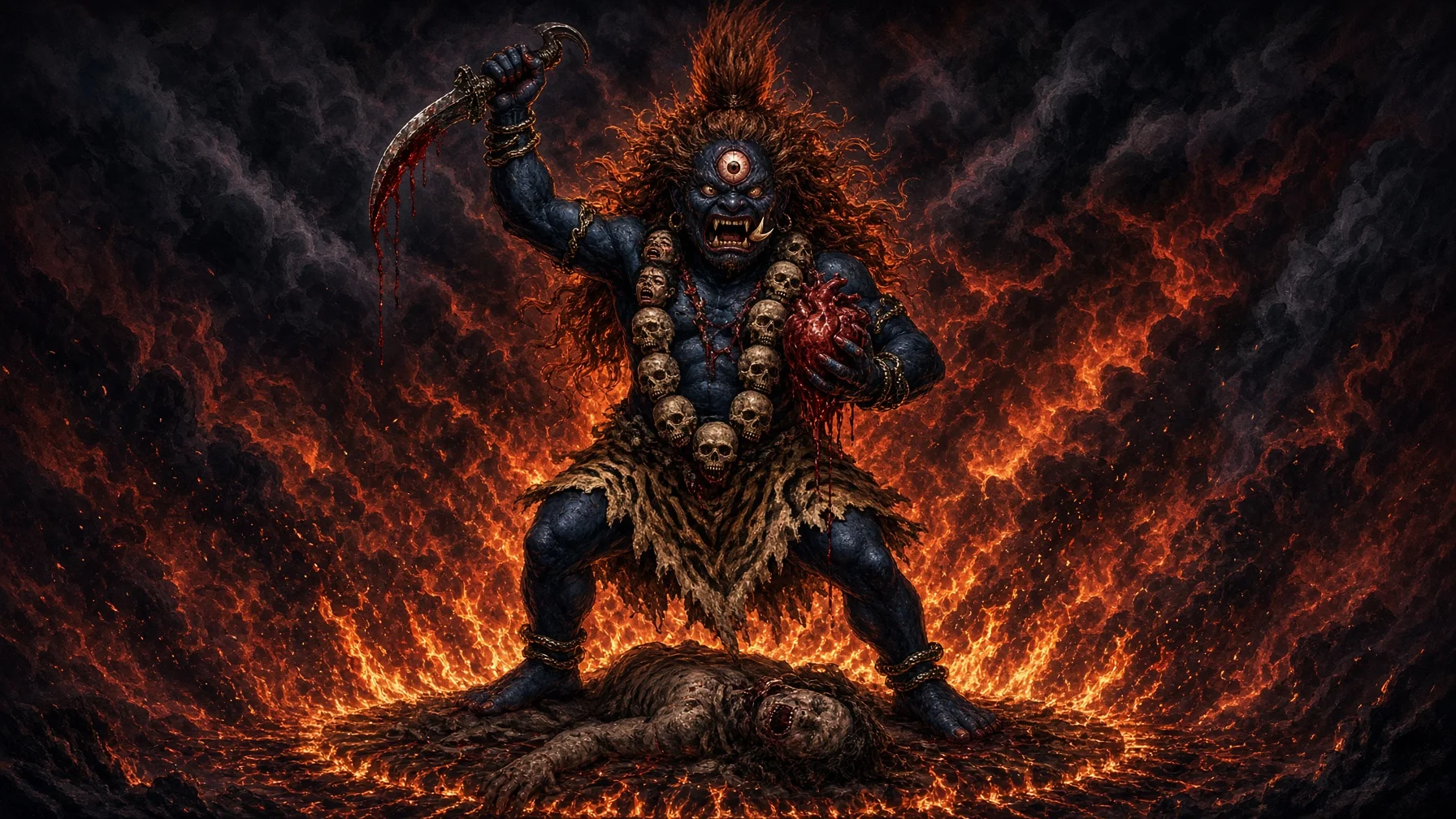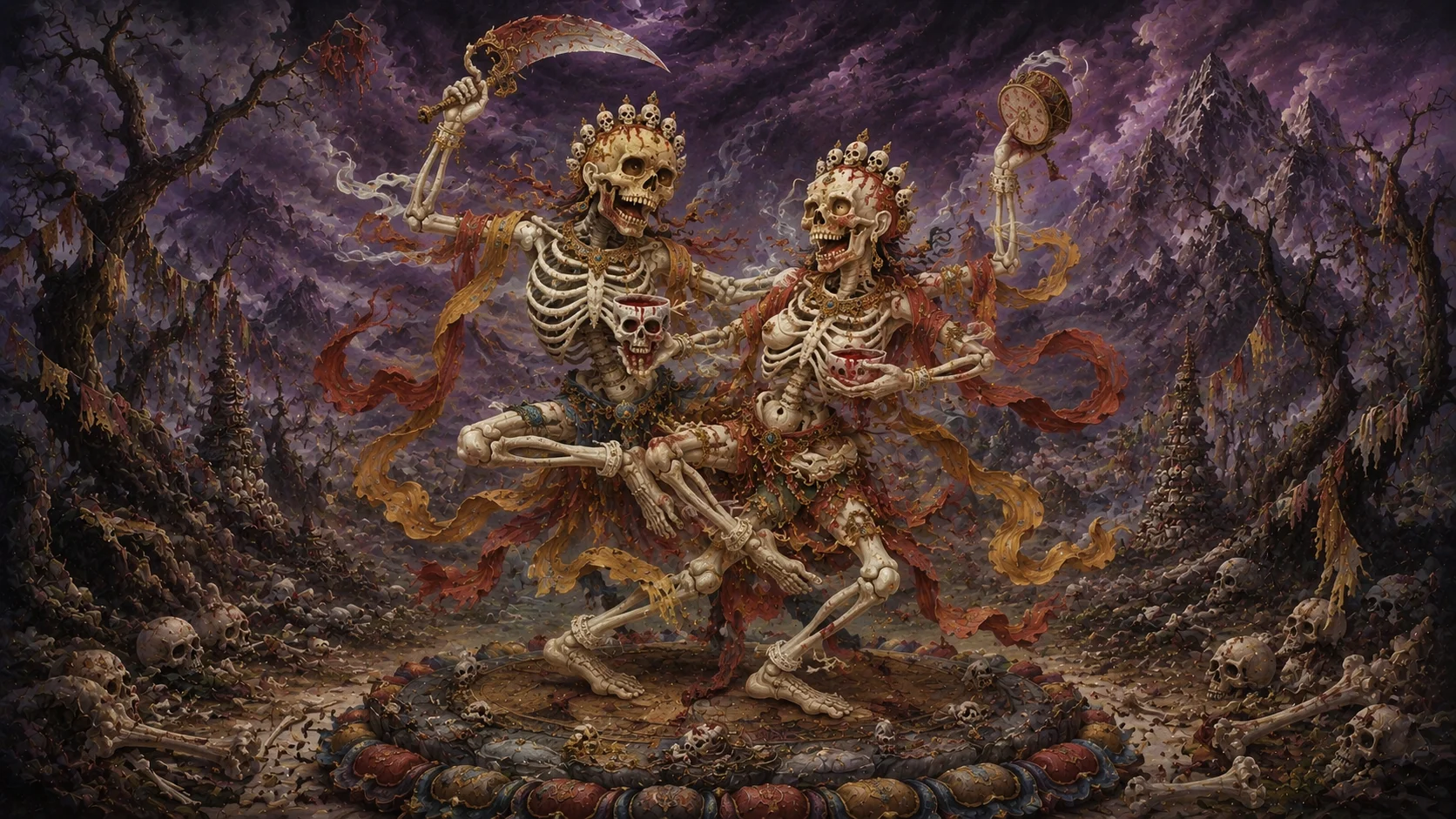
The Citipati, the Lords of the Cemetery, the dancing skeletons, are a pair of skeletal deities of Tibetan Buddhism: two intertwined, dancing skeletons, male and female, who are the protectors of the charnel grounds and powerful guardians, their joyful dance amid the bones a profound symbol of the bliss that transcends death and the impermanence of all things.
Two Bone-White Figures Locked in Dance
In Tibetan the Citipati are called dur khrod bdag po, which means simply "Lord of the Charnel Ground" — a name that describes function before it describes form. And the form, once seen, is unforgettable: two skeletons, one bearing the posture read as male and one as female, caught in mirrored, dynamic motion, limbs echoing limbs, dancing as a single couple rather than as two separate figures accompanying one another. Each is crowned, typically, with a small tiara set with five skulls. Each dances within, or before, a ring of flames, and the pair is frequently shown beside or even standing atop a corpse laid out on the ground of a cremation site — the literal charnel ground for which they are named and which they never leave.
A Dance That Refuses to Be Grim
What distinguishes the Citipati from a simple memento mori is the character of the dance itself. These are not skeletons frozen in the stillness of death, nor are they figures of horror meant to repel the viewer. They dance — knees bent, arms flung wide, the whole bony frame given over to rhythm and motion — and the dance is read, within the tradition, as one of joy rather than menace. The wrathful and the ecstatic sit side by side in their iconography: the flames that surround them are the same flames that surround many protector deities, signifying transformative wisdom rather than punishment, and the dance itself becomes an assertion that liberation and celebration are possible even here, even now, upon the bones.
Guardians Made From Grief and Vow
The story most often told of how the Citipati came to be is a monastic tale passed down through oral transmission rather than fixed in any single scripture: an ascetic couple, so absorbed in meditation that they took no notice of the world around them, were beheaded by a thief while still seated in practice. Rather than passing simply into death, the couple's fury and their vow transformed them — they arose again as the skeletal lords of the charnel ground, sworn from that moment to stand watch over such places forever. It is worth being honest about the shape of this story: it survives as lineage teaching and oral legend, carried monastery to monastery and teacher to student, rather than as a passage fixed in one authoritative text. That does not make it any less alive within the tradition — many of the most vivid figures in Vajrayana practice are known this way, through telling rather than through a single page.
Wardens of the Places the Living Avoid
Within the formal classification of Vajrayana Buddhism, the Citipati belong to the class of dharmapala — protector deities, beings whose role is to defend the practice and the practitioner from obstacles. More specifically, they are counted among the guardians of the charnel ground itself, the śmaśāna deities who preside over the cremation sites where bodies are given to fire and where, in the Vajrayana world, serious practitioners have long gone to meditate precisely because such places strip away comfortable illusions. A charnel ground offers no distraction from the fact of death; sitting in one, a practitioner cannot pretend the body is permanent. The Citipati stand watch over exactly this confrontation, invoked traditionally against thieves and obstacles alike, ever vigilant because vigilance was the vow they made in the moment of their own death.
Set Among the Eight Great Charnel Grounds
The Citipati are closely associated with a broader cosmological structure well known in Vajrayana iconography: the eight great charnel grounds, dur khrod chen po brgyad, a set of legendary cremation sites that populate the outer rings of many mandalas, particularly within the Nyingma tradition. In this arrangement the charnel grounds are not painted as a single undifferentiated horror but as a ring of distinct, named places, each with its own guardian presences, forming the outermost boundary a practitioner passes through before approaching the mandala's sacred center. The Citipati, as cremation-ground quarter guardians, take their place within this ring — skeletal watchmen stationed at the threshold between the ordinary world and the realm the mandala represents.
The Bone as Teacher
To dwell on what the skeleton itself communicates is to arrive close to the heart of why the Citipati matter within practice. Stripped entirely of flesh, they are the plainest possible image of anitya — impermanence — the truth that every compounded thing, including the body a person calls their own, will eventually come apart. This is not incidental symbolism; it echoes a much older thread within Buddhist practice generally, the discipline known as maraṇasati, mindfulness of death, understood as a way of sharpening rather than dulling one's engagement with life. The Citipati, appearing in wrathful and death-suffused form, function as a meditation support consistent with this inheritance: to look upon the dancing skeletons is to be handed, in a single image, both the fact of mortality and a suggestion of how one might meet it.
Wisdom and Method, Read Into the Pairing
Because the Citipati are always shown as a couple, a common interpretive thread in Vajrayana thought has sometimes been applied to their dance: the pairing of two complementary principles, often glossed as wisdom and method, whose union is a recurring theme wherever paired deities appear in this tradition. It is worth flagging plainly that this particular reading of the Citipati's dance is an interpretive gloss rather than settled, uniform doctrine — a lens brought to the image by some teachers and commentators, not a single fixed meaning carried by the figures themselves across every lineage. The image tolerates more than one layer of meaning, and honest description keeps that layer visibly optional rather than presenting it as fact.
A Presence at the Edge of the Mandala
Within the practice of dharmapala rites and within the construction of mandalas more broadly, the Citipati tend to appear at the periphery rather than at the center — quarter guardians of the cremation ground, invoked as protection against obstacles that might interrupt practice, and as a standing prompt toward death-awareness of the kind taught in lamrim instruction. Their placement at the edge is itself meaningful: they mark the boundary a practitioner must cross, the reminder that has to be passed before the deeper practice can begin. As for exactly which other named protector figures or dakinis they are paired or grouped with, this varies by lineage and is not fixed across the tradition as a whole — the Citipati are understood generally as belonging to the wider class of charnel-ground protectors and dakini-associated figures, without a single doctrinally fixed set of companions attached to their name.
Names Given by Different Tongues
Across the regions and lineages where they are venerated, the Citipati carry several epithets that all point toward the same essential identity. They are called the Lord and Lady of the Cemetery, and sometimes simply the Skeleton Lords or Skeleton Kings, and often just "the Citipati couple." The Tibetan root of their formal name, dur khrod bdag po, translates with plain directness as "charnel ground master" or "charnel ground lord" — a title that, unlike many honorifics, describes exactly what the bearer does rather than gesturing at some more abstract quality.
Onto the Festival Ground, in Mask and Bone-Print
Beyond the mandala and the meditation hall, the Citipati have a life in public ritual as well. In some Himalayan monastic traditions, skeleton-dancer figures appear within cham, the masked ritual dances performed at monastery festivals — costumed performers taking on the bone-white, skull-crowned form, dancing before assembled communities as a visible, embodied reminder of mortality. Where the mandala's Citipati exist as painted or sculpted guardians encountered in solitary practice, the cham performance carries the same figure out into public festival life, where an entire community, not only the individual meditator, is invited to sit for a moment with the fact of the charnel ground and the joy that Vajrayana teaching insists can still be found there.
What the Texts Do and Do Not Fix
It is worth closing on a note of honest scholarly caution, because it is part of what makes the Citipati distinctive among Vajrayana figures. Many of the great yidams and protector deities of Tibetan Buddhism can be traced to a specific tantra or a clearly identified textual source. The Citipati are different: their presence is carried chiefly through ritual art — painted thangkas, mandala peripheries, sculpted festival masks — and through oral, lineage-transmitted teaching, rather than through one settled textual attestation. Any claim that pins the Citipati to a particular named tantra or source text should be treated as needing lineage-specific verification rather than accepted as fixed across the tradition as a whole. This is not a gap in the figures' importance; it simply reflects how they have actually been transmitted, image and story carried hand to hand rather than page to page.
The Dance That Remains
What endures, across all of this — the varying tellings of the beheading legend, the shifting company they are said to keep, the interpretive layers laid over their embrace — is the image itself: two skeletons, crowned, wreathed in flame, dancing at the threshold of the charnel ground. In that single image Tibetan Buddhism holds together two things that might seem, anywhere else, impossible to hold together at once — the unflinching fact of death and the possibility of joy in its presence. The Citipati do not turn away from the bones. They dance among them, and in dancing, they teach.
Sources & traditions
- EncyclopediaWikipedia — Citipati (Buddhism)
- TraditionTibetan Buddhist texts, oral tradition and village tellings
Myths change from area to area and from time to time. This chronicle follows the most widely told versions; tellings in other villages, regions and eras may differ.