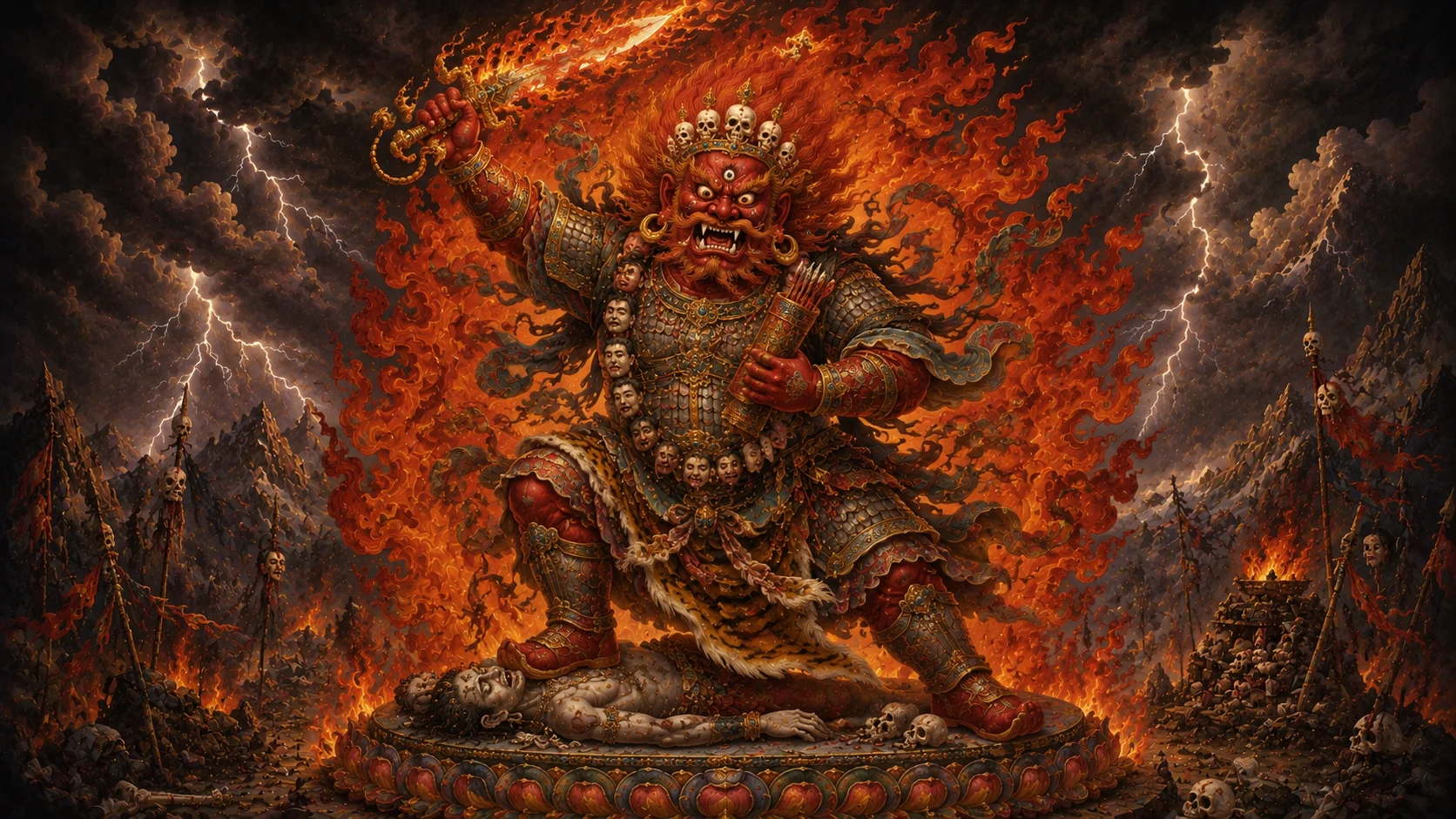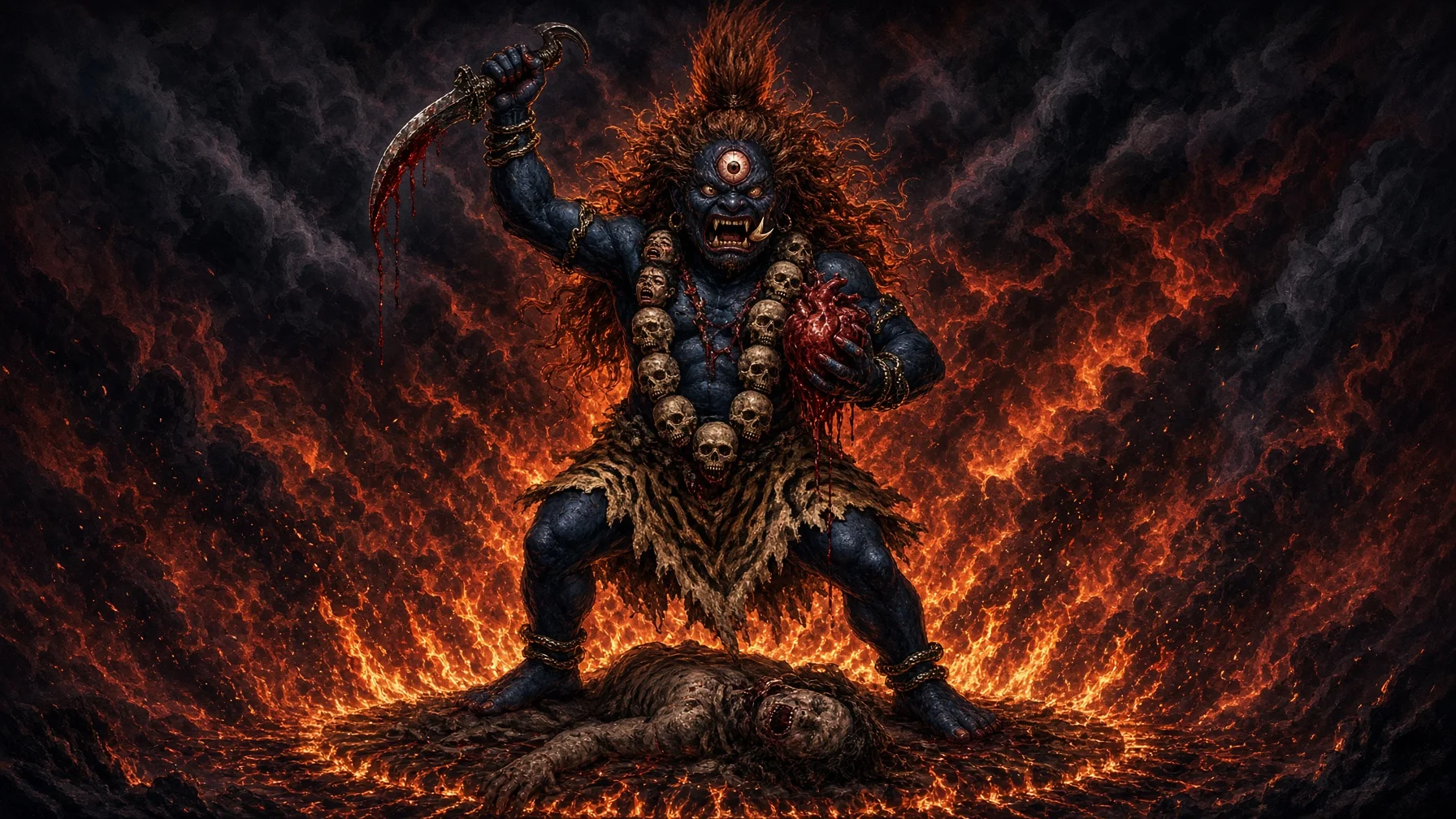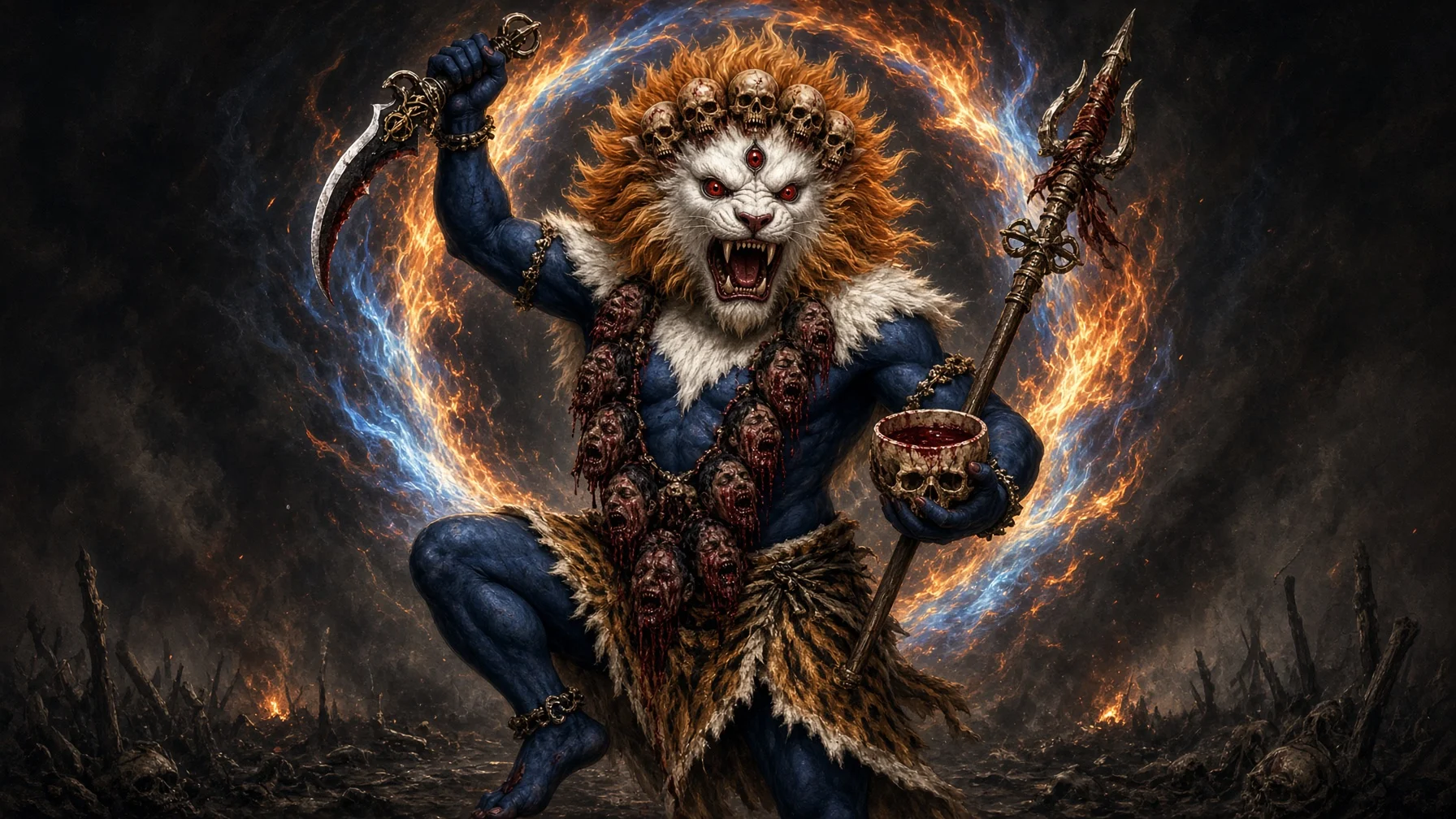
Vajrayogini — “the Diamond Yogini” — is the supreme female tantric deity (yidam) of Tibetan Buddhism: a fierce and dazzling red dakini who embodies the wisdom of emptiness and the transformation of desire into enlightenment, one of the most important meditational deities of the highest tantras. She is the very essence of the enlightened feminine, blazing with the fire of wisdom.
The Diamond Yogini
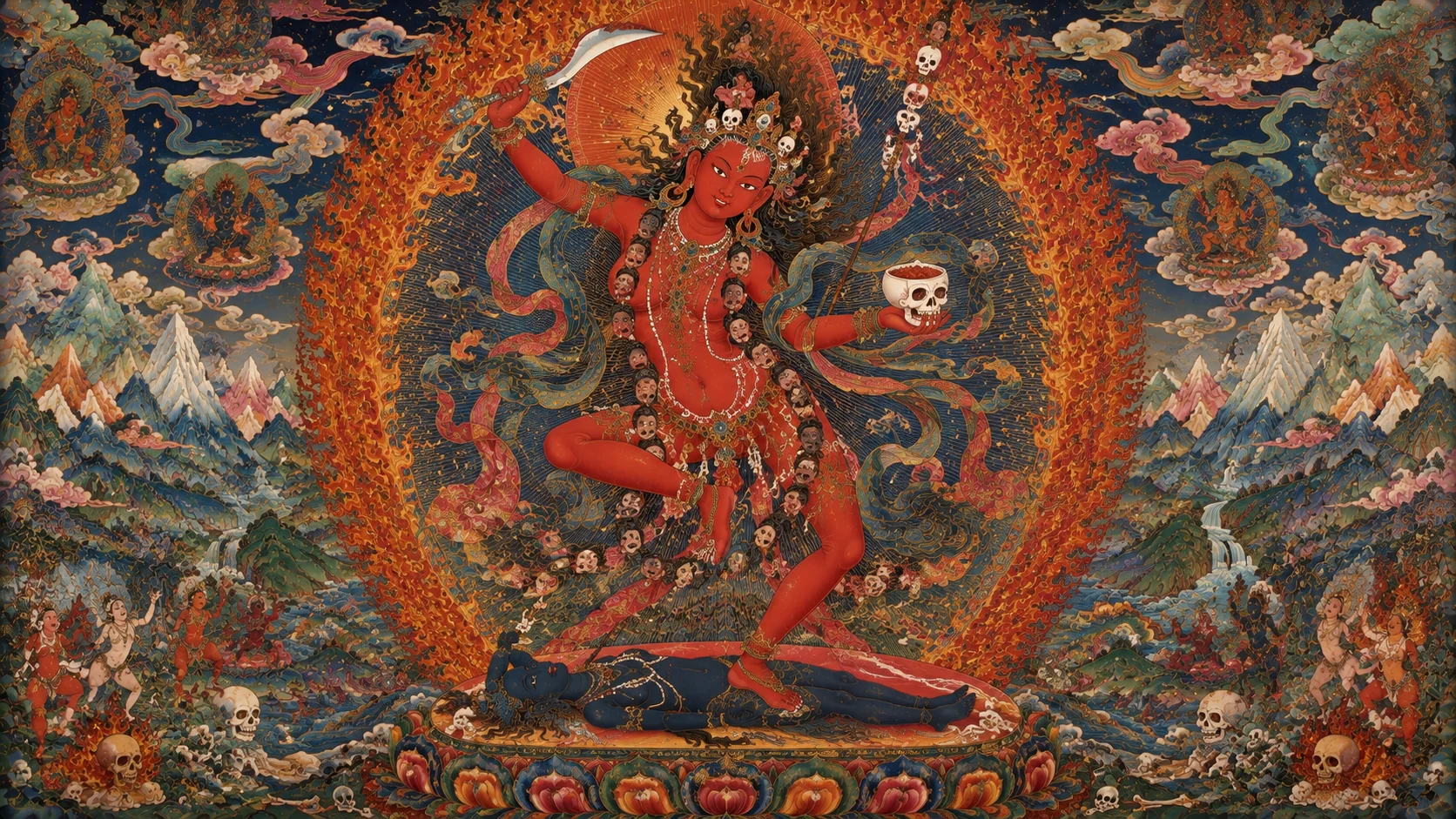
Vajrayogini is depicted as a brilliant red, naked or lightly adorned female deity, youthful and beautiful yet fierce, dancing in a posture of dynamic energy amid a blazing aura of wisdom-fire. She holds a curved flaying-knife (kartika) in one hand and a skull-cup (kapala) of blood in the other, with a skull-topped staff (khatvanga) resting on her shoulder; she wears a garland of severed heads and is crowned with skulls. These fierce attributes are not horror but profound symbol: the knife that cuts through ego-clinging, the skull-cup of the nectar of bliss-emptiness, the severed heads of the destroyed delusions. She tramples upon the forms of ignorance, dancing the dance of enlightenment.
The Transformation of Desire
Vajrayogini is a central deity of the highest tantras, and her practice embodies the transformative path of the Vajrayana — the “diamond vehicle” that does not suppress the energies of desire and passion but transforms them directly into the fuel of enlightenment. She is the personification of the wisdom of great bliss united with emptiness, the realization that the energies which bind us in samsara are, transmuted, the very energies of awakening. As a dakini — a female embodiment of enlightened wisdom-energy — she is the supreme example of her kind, the “queen of the dakinis.”
The Queen of the Dakinis
Vajrayogini is among the most widely practiced personal meditational deities (yidams) in Tibetan Buddhism, especially in the Kagyu and Sakya traditions, and her practice is held to lead swiftly to enlightenment. She is closely associated with the deity Chakrasamvara, as his consort and his equal, and with the realm of pure bliss. Fierce, free, dancing, and utterly awakened, she embodies the dynamic, transformative, blissful wisdom at the heart of the tantric path. In Vajrayogini, Tibetan Buddhism gave form to the enlightened feminine in its most powerful aspect — the Diamond Yogini, the dancing red dakini blazing with wisdom-fire, who transforms desire into enlightenment and embodies the great bliss of the awakened mind.
The Sow Beneath the Skull
Look closely at a well-painted thangka of the Diamond Yogini and, tucked against the right side of her skull just above the ear, you may find a second face pressed flat: a small snout, two tusks, the profile of a pig. This is not an error of the painter’s hand. It is Vajrayogini in her guise as Vajravarahi, the “Vajra Sow” — a name and form so close to her own that Tibetan tradition often treats the two as interchangeable, two faces of one wisdom, and frequently gives them the same red body, the same knife, the same dance.
The choice of a sow was not arbitrary, and it did not begin in Buddhism. In the older Hindu pantheon, Varahi — boar-headed, fierce, one of the seven Matrikas or “Mother” goddesses — already carried the same animal face and the same association with unruly, earth-shaking power, herself the female counterpart of Vishnu’s boar avatar. Vajrayogini’s sow-headed form is one of the clearest places where the iconography of Buddhist tantra can be seen growing out of, and alongside, an existing Hindu goddess cult rather than inventing its imagery from nothing.
The Abbess Who Turned Her Monastery Into Pigs
The sow is not only a symbol; in Tibet it produced an institution. At Samding Monastery, on a ridge above the turquoise arms of Yamdrok Lake, sits the seat of the Samding Dorje Phagmo — “Dorje Phagmo” being simply the Tibetan for Vajravarahi. Each holder of the seat is recognised as an emanation of the sow-headed goddess, and the line, traced back to a fifteenth-century princess of the Gungthang kingdom named Chökyi Drönma, became the highest-ranking female incarnation lineage in Tibet: a woman whose authority derived not from a husband, a father or a male teacher, but from being held to be the goddess herself.
Samding’s best-known story turns on the pig. When Dzungar Mongol armies swept through central Tibet in the early eighteenth century, the tale goes, their commander sent word that the famous abbess should present herself to be inspected. He arrived to find the monastery apparently abandoned and full of pigs rooting through the halls — and withdrew without looting it, either in awe or in disgust. The disguise is the whole point of the story. Real attainment does not announce itself, and the ignorant will keep mistaking wisdom for something low and animal until they are ready to see otherwise.
The Old Woman Who Un-taught a Scholar
Naropa had spent years as a celebrated pandita at the great monastic university of Nalanda — so the traditional life-story has it — when an old woman interrupted his reading. She was, by that account, hideously ugly, and she asked him a single question: did he understand the words of the book in his hands, or did he understand its meaning? Naropa said he understood the words. She laughed with delight. Then, hoping to please her further, he added that he understood the meaning too. At that she wept, because he had lied, and true understanding was nowhere near him yet.
The old woman is remembered in the lineage histories as a dakini in her most disorienting form, and in many tellings as Vajrayogini herself, testing a proud scholar by refusing to look anything like wisdom. The encounter undid Naropa completely. He abandoned his position and titles and spent years searching for the guru she had pointed him toward, the wandering siddha Tilopa. What he received from Tilopa, and passed to his Tibetan student Marpa, became the root of the Naro Khachö lineage — “Naropa’s sky-goer” — the most widely transmitted of the Vajrayogini practice lines. Two further transmissions run beside it, named for the Indian masters Maitripa and Indrabhuti. Nearly a thousand years on, all three are still passed hand to hand in Sakya and Kagyu retreat centres, and now in a scattering of others far outside Tibet.
The Woman Who Cut Off Her Own Head
In one of her most startling forms, Vajrayogini turns the flaying-knife on herself. She severs her head at the neck with a single stroke and lifts it, still living, in her upraised hand. From the open throat three jets of blood spring upward: one arcs into the mouth of the severed head she holds aloft, and one each into the mouths of the two attendants dancing at her sides, Vajravarnani and Vajravairocani, drinking from her as she is so often shown drinking from a skull-cup. All three continue to dance, commonly above a copulating couple trampled underfoot.
This form is called Chinnamunda, “she whose head is severed,” and it pushes the logic of the tantric path to its limit. The self is the last thing anyone is willing to surrender, so the wisdom-deity is shown surrendering it literally, cutting away her own head and finding on the other side of that stroke not annihilation but a fountain of bliss she immediately shares out. The image sits very close in spirit to Chöd, the practice of “cutting” given its Tibetan form by the yogini Machig Labdrön in the eleventh century, in which the practitioner visualises their own body dismembered and offered as a feast to hungry spirits and enlightened beings alike.
A Twin Across the Border
Step into a Hindu temple dedicated to the ten Mahavidyas and the resemblance becomes almost exact. Chinnamasta, one of the ten, stands naked and red, having beheaded herself with her own hand; she holds the severed head, which drinks from a jet of her own blood, while two female attendants at her sides catch the other two streams in their mouths, and all three stand on a couple locked in union beneath their feet — in her case named as Kama and Rati, desire and pleasure. Even the attendants’ names carry across the religious border: the Hindu goddess’s companions are Dakini and Varnini, against the Buddhist Vajravairocani and Vajravarnani.
Which tradition’s self-beheading goddess came first has never been settled. The likeliest answer is that neither strictly did — that both drew on a shared world of charnel-ground practice in which Hindu and Buddhist adepts worked side by side in medieval India, trading imagery as freely as they traded techniques. Whatever the sequence, this remains one of the closest points of contact anywhere between the two religions’ most esoteric art.
Dancing Alone
Vajrayogini appears as Chakrasamvara’s consort, but that is not where her own practice puts her. Almost every other deity of her rank in the highest tantras is depicted locked in union with a male buddha, the pair read as one indivisible symbol of method and wisdom. In her principal meditational form she is not. She dances by herself — complete, requiring no partner to complete her, wisdom generating its own bliss rather than receiving it from outside. Tibetan commentators treat the solitary dance as itself doctrinal: ultimate realisation is not a gift bestowed by somebody else.
She is often shown within a downward-pointing triangle, the dharmodaya or “source of phenomena,” a shape that recurs throughout her iconography — in her mandala, in the shrines and huts built for her retreats — and is understood as the womb-space from which every buddha and every appearance whatsoever is born. Her nakedness belongs to the same logic: not exposure but the absence of anything left to hide behind. Her hair, unbound and flying loose in the wind of her own dance, marks the same freedom — no braid, no binding, nothing tying her to the conventions of an ordinary life.
A Teaching Kept Behind a Locked Door
No one simply picks up a manual and begins visualising Vajrayogini. Her sadhana sits among the most restricted teachings of Tibetan Buddhism, and a student may not read the liturgy at all until a qualified lineage-holder has granted the formal empowerment for it. Once granted, the practice is typically taken into sustained retreat, monastics and lay tantrikas alike sealing themselves away for a fixed period to do nothing else.
Even the mechanics of doing it correctly have been argued over for centuries. Tibetan schools disagreed sharply over the technique known as the “body mandala,” in which the deities of the retinue are visualised as residing at specific points within the practitioner’s own subtle body; different masters mapped the mandala onto the channels and centres in different and mutually incompatible ways, and defending one’s own lineage’s method became a genuine scholastic battleground rather than a footnote.
None of that secrecy has kept her out of ordinary devotional life. Thangkas of the dancing red dakini hang in monasteries and household shrines across the Tibetan Buddhist world, venerated and prostrated to by people who hold no empowerment to practise her sadhana at all — much as a flag can be honoured by people who will never serve in the army that carries it.
Why She Dances in the Cremation Ground
Every element of her placed her where respectable religion did not go: the charnel ground rather than the temple, the naked body rather than the robe, the severed head rather than the serene one. What she offers is not a lesson about desire — her tradition had that already — but a demonstration about fear. A goddess who dances in the burning grounds drinking from her own opened throat is showing what is left when there is nothing further to lose, because everything losable has already been given away. That is the nerve she still touches, a thousand years on from the cremation grounds of medieval India: not the fear of desire, and not quite the fear of death, but the older fear underneath both — what remains of a person once the self they were guarding is finally, completely let go.
Sources & traditions
- EncyclopediaWikipedia — Vajrayogini
- TraditionTibetan Buddhist texts, oral tradition and village tellings
Myths change from area to area and from time to time. This chronicle follows the most widely told versions; tellings in other villages, regions and eras may differ.