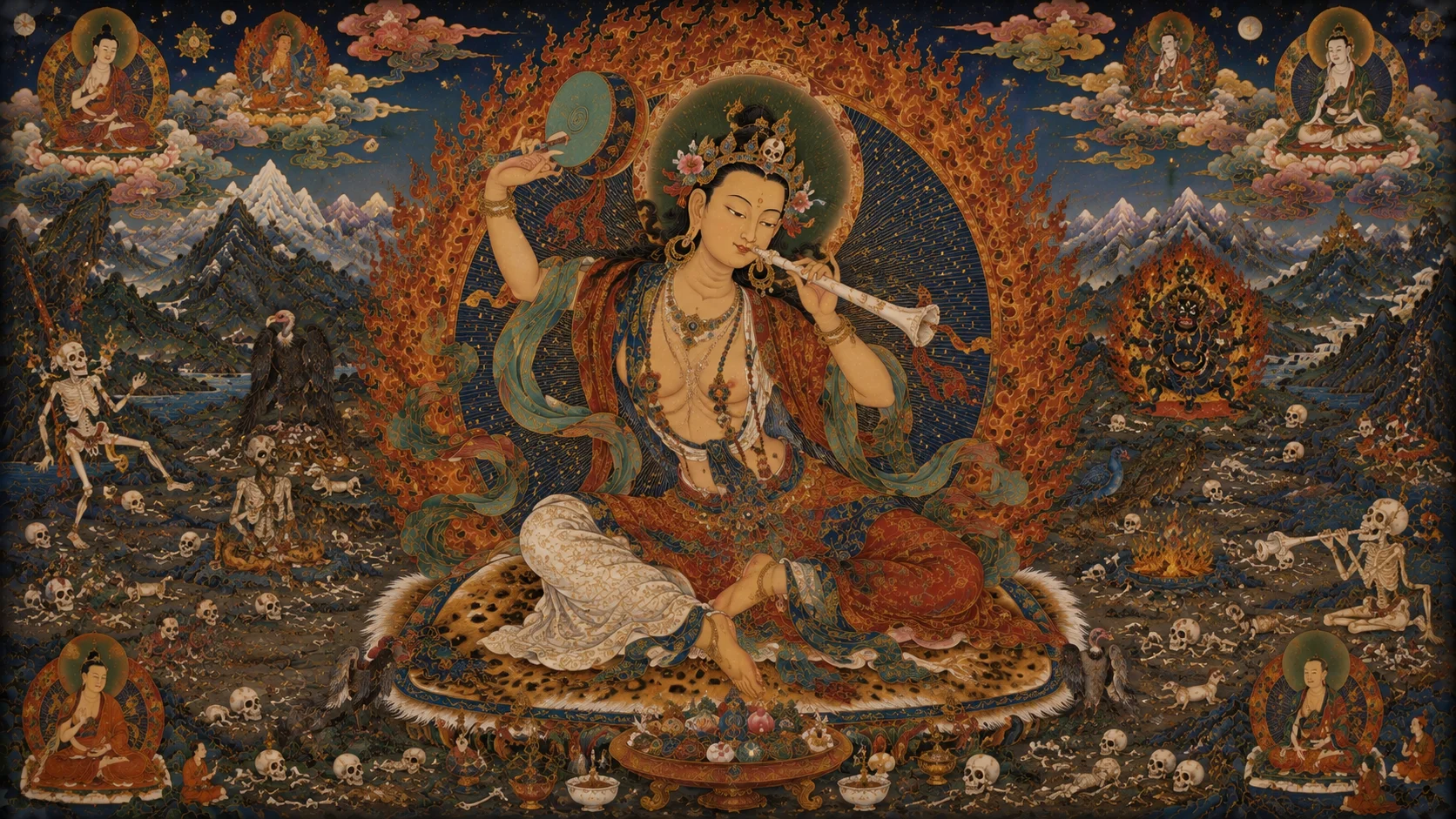
Machig Labdron — “the Singular Mother, Lamp of Lab” — is the great female master and founder of the Chöd (“Cutting”) tradition: an enlightened Tibetan woman of the eleventh-twelfth century who developed a unique and powerful tantric practice and stands as one of the very few women to originate a major lineage of Buddhist teaching. She is revered as a fully realized master and an emanation of the wisdom-mother.
The Singular Mother
Machig Labdron was a Tibetan woman of extraordinary spiritual gifts, renowned from childhood for her remarkable ability to recite and understand the sacred texts. She became a great practitioner and yogini, and through her realization she developed and systematized the practice of Chöd, drawing on the “Perfection of Wisdom” teachings on emptiness. She is one of the rare figures — and the rare woman — to be the source and founder of a distinct lineage that spread through all the schools of Tibetan Buddhism, an accomplishment of singular importance.
The Practice of Cutting
The practice Machig founded, Chöd (“Cutting” or “Severance”), is one of the most striking in all of Buddhism. Its aim is to cut through the root of all suffering — the clinging to a self — through a radical visualization: the practitioner mentally offers up their own body, visualizing it cut up and given as food to all beings, to the demons and the hungry ghosts and the buddhas alike, severing forever the attachment to the body and the ego. Practiced often in terrifying places — charnel grounds, cemeteries, haunted sites — to the sound of a drum, bell, and thigh-bone trumpet, Chöd confronts and transforms fear itself, using the body as the offering that cuts the bonds of self-clinging. It is a fearless, transformative practice of generosity and the realization of emptiness.
The Mother of a Lineage
Machig Labdron is revered as an emanation of Yeshe Tsogyal and of the wisdom-goddess, a fully enlightened master whose teaching transcended sectarian boundaries and endures as a living practice to this day. As one of the few women to found a major Buddhist lineage, and as the source of the profound and fearless practice of Chöd, she holds a place of supreme honour in Tibetan Buddhism, an inspiration especially to women and to all who would cut through the root of fear and self. In Machig Labdron, Tibetan Buddhism honoured the great mother of Chöd — the enlightened woman who founded the “Cutting” practice that severs the attachment to self, offering the body to all beings in the charnel grounds, a singular female master and the source of a fearless and transformative path.
The Reciter Who Became a Revolutionary
Before she carried a drum into the charnel grounds, Machig Labdrön earned her bread reading aloud. As a young woman she worked as a professional reciter of the Prajnaparamita — the vast scriptures on the “Perfection of Wisdom” — performing them for patrons who could not read the texts themselves, sutra after sutra, until what she recited was no longer merely something she said. Her traditional biographies place the decisive moment inside that working routine rather than in any retreat cave: she is said to have broken through to direct realization while reading the chapter on Mara, the demon who assails the meditator — the very figure her later practice would learn to feed rather than fight. It is a strikingly ordinary origin for one of Tibetan Buddhism’s most radical teachers: not years of monastic seclusion but a working life spent inside a single relentless philosophical idea until it broke open. Chöd, in this light, is less an invention than an extraction — a way of enacting with the whole body a truth the Prajnaparamita had until then only stated in words.
A Mother Among the Masters
Machig Labdrön was not a celibate renunciate. She took as her consort a wandering yogi remembered as Töpa Bhadra, and her namthars — the traditional life-stories — agree that they had children together, though they differ on how many. Householder masters are not unusual in Tibet: Marpa the Translator, at the head of the Kagyu, kept a farm and a family. But a woman who was wife and mother and also the source of a lineage is very nearly without parallel. The accounts do not pretend this was easy. Her union drew disapproval from a society that expected a woman of her religious standing to remain apart, and the shape of her life story is partly the shape of that judgement being outlived. She did not set family aside in order to pursue realization; she folded it into the same life as her retreats and her teaching, and the transmission of Chöd ran onward through her disciples and her own descendants alike.
Two Streams Made One
Machig Labdrön did not build Chöd out of nothing. Tibetan tradition describes her synthesis as the meeting of two separate transmissions: the philosophical lineage of the Prajnaparamita — the teachings on emptiness that had shaped her years as a reciter — and the Zhijé (“Pacification”) tradition of the Indian adept Padampa Sangyé, a teacher famed across Tibet in her own lifetime for methods aimed at pacifying suffering at its root. Zhijé supplied a way of working directly with affliction; her own realization of the Prajnaparamita supplied the philosophical spine. The result, distinguished in the literature as Mahamudra Chöd, welded a rigorous doctrine of emptiness onto a practice so visceral that it could never be mistaken for abstract philosophy.
The Teaching Tibet Sent Back
For centuries the traffic in Buddhist teaching ran one way only: south to north, out of India and into Tibet. Chöd is the exception tradition most often points to. The namthars tell of Indian panditas arriving to examine Machig, sent to determine whether what she taught was the Lord Buddha’s doctrine or a Tibetan invention wearing its clothes — a suspicion sharpened by the fact that it had come not from a monk trained in Sanskrit scholasticism but from a Tibetan laywoman working in her own language, with no Indian text standing behind her to vouch for it. She is said to have answered by showing precisely how the practice followed from the Prajnaparamita she had spent her youth reciting: the strangeness of its form did not place it outside the Lord Buddha’s teaching, it expressed that teaching. Afterwards, tradition holds, Chöd was carried south into India — the rare case of Tibet handing a teaching back to the land that had given it Buddhism.
Recognising Her in Art
Where she is painted, Machig Labdrön is almost never seated in quiet meditation. She is dancing: white-bodied, one leg raised, wearing little but bone ornaments and light silks, the small double-sided hand drum — the damaru — held high in her right hand, a bell in her left. A kangling, the trumpet cut from a human thighbone, is often shown tucked at her waist or set beside her. Her hair lifts upward as though caught by heat rather than falling with gravity, and she dances above a lotus and sun-disc in a charnel ground. Lineage paintings of the Chöd refuge field place Prajnaparamita herself — Yum Chenmo, the “Great Mother” whose scriptures Machig once recited for hire — at the summit, above her: a composition that marks Machig not as a solitary visionary but as one visible link in a chain of transmission.
A Practice with No Fixed Address
Chöd refused to stay inside a single school. Over the centuries it was absorbed by the Kagyu, the Nyingma, the Sakya, the later Gelug and the Bon tradition alike, each producing its own liturgies, melodies and commentarial literature around her core practice — so that a Chöd performed in one lineage and a Chöd performed in another can sound markedly different while enacting the identical offering. It travelled with Tibetan Buddhism into Bhutan, Nepal and Mongolia. Unusually for a tradition tied so tightly to one named founder, Chöd never hardened into a single fixed liturgy; it kept being rewritten, generation after generation, by masters who treated Machig’s insight as a living seed rather than a finished text to be preserved unchanged.
The Charnel Ground Comes West
Chöd is still actively transmitted by Tibetan lamas today, not a historical curiosity revived for study. In recent decades it has also found an audience far from the Himalayan cremation grounds where it took shape. The American Buddhist teacher Tsultrim Allione has adapted its central move — inviting what frightens you to the feast instead of fighting it — into a lay method set out in her book Feeding Your Demons, framed in contemporary language about anxiety, grief and self-criticism, and requiring neither a charnel ground nor a thighbone trumpet to work. That the practice travels this well is itself a comment on what Machig built: not a rite anchored to one deity or one place, but a mental operation portable enough to outlive the particular fears of twelfth-century Tibet.
Why the Demons Must Be Fed
Nearly every technique humanity has devised for handling what haunts it is a technique of defence: wards, exorcisms, salt lines, protective circles, the demon driven out or sealed away. Machig Labdrön’s move was the exact inversion of that instinct. She did not banish the hungry thing at the edge of the firelight; she called it forward and fed it, on the premise that what is starved of attention grows monstrous because it is starved, and that what is fed without fear no longer needs to threaten. That the inversion came from a woman working out of her own body and her own frightened mind, rather than from a scripture translated whole from Sanskrit, is why she is remembered less as a distant saint than as the proof of a method.
Sources & traditions
- EncyclopediaWikipedia — Machig Labdrön
- TraditionTibetan Buddhist texts, oral tradition and village tellings
Myths change from area to area and from time to time. This chronicle follows the most widely told versions; tellings in other villages, regions and eras may differ.