Begtse, the Hidden Coat of Mail, is a fierce protector deity of Tibetan Buddhism: an armored, sword-wielding red war-god who, according to tradition, was once a hostile deity of battle before being subdued and bound by oath into the service of the dharma. Counted among the worldly protectors, the jigten pai srungma, and known also as Begtse Chen, Chamsing, Gyalpo Begtse, and Legden Tenpai Gonpo, he is venerated above all as the Red Lord of the Tent, a guardian whose martial fury has been turned wholly toward the defense of the teaching.
A Name Forged in Armor
The name Begtse, sometimes rendered Beg-tse, means in Tibetan something close to "hidden coat of mail" or "secret armor," a name that refers directly to the lamellar mail he is shown wearing in his wrathful form. It is not a poetic flourish but a description worn as identity: the deity is, quite literally, named for the shirt of iron plates that shields him in battle.
Titles That Travel With Him
Alongside this core name, tradition knows him by several honorific titles. Begtse Chen, the "Great" or "Greater" Begtse, emphasizes his stature among protectors. Chamsing, rendered in Tibetan as Lcam sring, is an older epithet whose precise etymology is less settled than that of Begtse itself but which has long traveled alongside it in liturgical usage. Gyalpo Begtse situates him among the gyalpo class of protector spirits, kingly and forceful. Legden Tenpai Gonpo binds him explicitly to the dharma, "Gonpo" here echoing the wider family of protector titles used across the Tibetan pantheon. And the epithet "Red Lord of the Tent" evokes both his blood-red body and the martial encampments of the steppe cultures from which his cult is thought to have entered Tibetan practice. Each name is a facet of the same figure: armored, red, and terrible in the defense of what he protects.
A War-God of the Steppe
Scholars examining Begtse's origins have widely concluded that he derives from a Mongolian war deity, a martial spirit of the open steppe absorbed into the Tibetan Buddhist pantheon during the sixteenth century, a period of intense religious and political exchange between Tibet and the Mongol khanates. This was an era in which Tibetan lamas traveled deep into Mongol territory to establish the dharma among peoples whose own spiritual world was populated by fierce local and ancestral gods, and in which those local gods were, again and again, incorporated into Buddhist practice rather than simply displaced by it. Begtse's cult bears the marks of that history clearly: his cult remains especially strong in Mongolia and among Mongol-linked Tibetan Buddhist communities, and depictions of him on horseback, distinct from his more standard standing warrior pose, reflect specifically Mongolian artistic influence. It should be said plainly, however, that the precise pre-Buddhist identity of Begtse, which specific war god of the Mongolian or wider Central Asian steppe he derives from, is not a settled question in the scholarship. What is agreed upon is the broader pattern: a foreign war deity, powerful and unconverted, made to serve the dharma through the ritual act of subjugation that Tibetan Buddhism applied again and again to the spirits of the lands it entered.
The Deity Who Opposed the Dalai Lama
The conversion narrative most closely associated with Begtse ties him to one of the defining religious events of the sixteenth century: the mission of the Third Dalai Lama, Sonam Gyatso, to convert the Mongol court of Altan Khan to Tibetan Buddhism in the late fifteen-hundreds. Tradition holds that Begtse, still a hostile and unconverted war deity at that time, moved to obstruct this mission, standing in the way of the Dalai Lama's efforts to bring the Mongols into the dharma. The confrontation did not end in Begtse's favor. He was subdued and bound by oath, the ritual act known in Tibetan practice as damtsig, a binding that transforms a once-hostile spirit into a sworn protector who is compelled, and in the fullness of Buddhist teaching also willing, to serve the very tradition he once opposed. From that moment, by tradition, the war god of the Mongol steppe became a guardian of the Buddhist teaching, his ferocity no longer a threat to the dharma but a weapon wielded in its defense.
The Pattern of Taming
Begtse's story is not an isolated tale but a clear instance of a doctrinal pattern that runs throughout Tibetan Buddhism: the taming of pre-Buddhist, local, or foreign deities, and their binding by oath into Dharma service. This pattern reflects a particular theological logic. Rather than denying the power of the old gods encountered as Buddhism spread across Tibet, Mongolia, and the wider Himalayan and Central Asian world, the tradition instead subdued that power and redirected it, converting fierce, uncontrolled forces into fierce, controlled ones, sworn protectors whose original ferocity becomes the very quality that makes them effective guardians. Begtse's transformation from Mongolian war god to Buddhist Dharmapala exemplifies this pattern with unusual clarity: nothing about his wrathful, armored, blood-red appearance was softened in his conversion. What changed was allegiance, sealed by oath, not temperament.
Clad for War, Armed for the Dharma
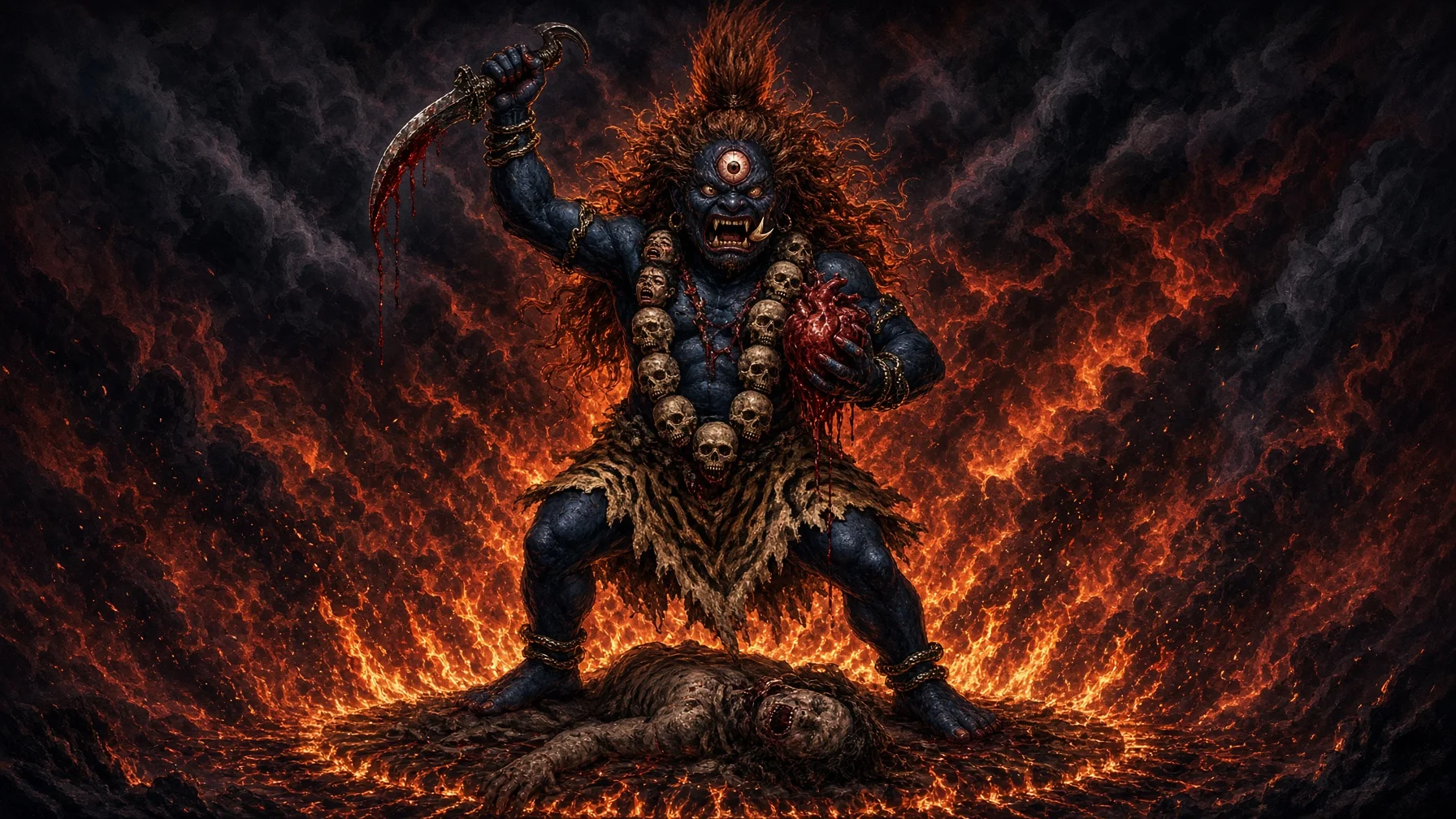
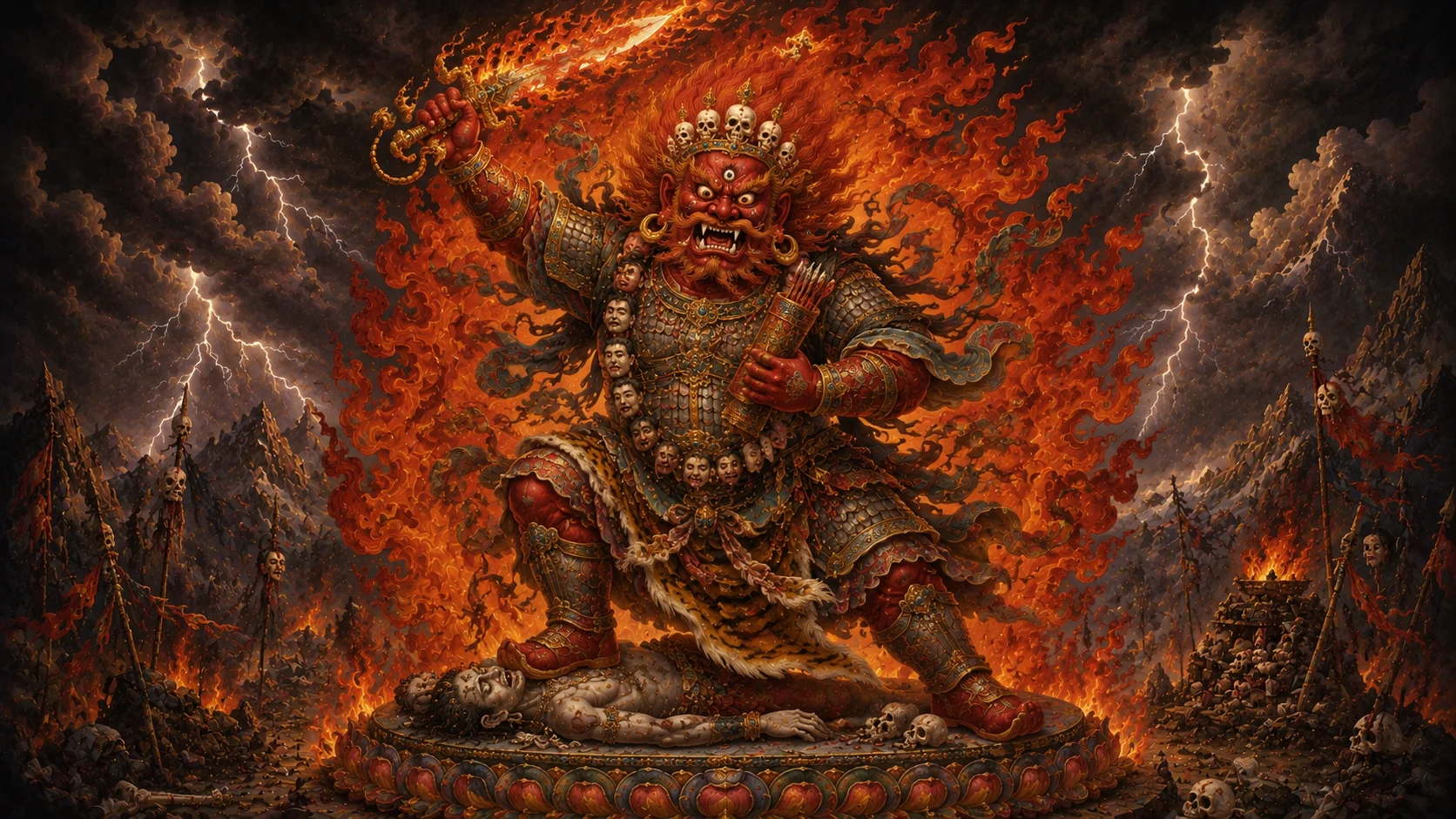
In iconography, Begtse is shown as a fierce, red-skinned warrior deity, his body the deep red of blood and battle, clad in a full coat of lamellar armor and a helmet suited to war rather than to peaceful ritual. Atop this martial dress he often wears a wide-brimmed hat, itself surmounted by an ornament in the shape of a makara or a victory banner, a detail that marks him unmistakably as a lord of conflict claimed for a higher purpose. In his right hand he typically wields a sword, in some depictions bearing a hilt shaped like a scorpion, a weapon poised to cut down obstacles and enemies of the dharma. In his left hand he holds, depending on the depiction, a bow and arrow, or the heart and lungs torn from a Dharma-enemy, an image of unmistakable severity that stands, within the visual language of wrathful Buddhist deities, as a symbol of the destruction of ego and the obstacles it throws up rather than as a literal act of violence for its own sake.
A Stance of Conquest
Begtse's posture reinforces the same message his attributes carry. He is most often shown standing or striding in a warrior's stance, his feet planted atop a corpse or a prostrate figure beneath him, a visual shorthand, common across wrathful protector iconography, for obstacles already conquered and enemies of the teaching already subdued. In depictions shaped by Mongolian artistic tradition, he appears instead on horseback, a mounted warrior rather than a standing one, a variation that speaks to the specific cultural roots of his cult among the horse-riding peoples of the steppe.
A Retinue Not Fixed by Rule
Around Begtse, his mandala grouping is sometimes shown with attendant figures and a consort, part of the wider assembly gathered around a wrathful protector in certain depictions. Yet the specifics of this retinue are not fixed uniformly across lineages: which attendants appear, and in what configuration, varies according to the particular tradition or monastery in which he is propitiated. This is characteristic of protector iconography generally, where a core identity, name, color, weapon, stance, remains stable while the surrounding company shifts from one lineage's practice to the next.
A Presence in the Protector Chapels
Begtse is especially prominent as a protector within the Gelug school of Tibetan Buddhism, and he holds dedicated gonkhang, protector chapels, in numerous Gelug monasteries, spaces set apart from the main halls of worship and reserved specifically for the propitiation of wrathful dharma protectors. His cult is particularly noted in Mongolia and among Mongol-linked Tibetan communities, a geographic pattern that traces directly back to his origins as a steppe war deity and to the historic mission that, by tradition, first bound him to the dharma. Within these gonkhang, he is honored with torma offerings, ritual cakes shaped and consecrated for protector deities, and with dedicated liturgical texts composed specifically for his propitiation, texts that call upon his martial power in service of the community that invokes him.
Invoked Against the Enemies of the Teaching
Begtse is propitiated above all for protection in matters of warfare, for the removal of obstacles, and for the defense of the dharma itself against its enemies, whether those enemies take the form of external hostility, internal obstruction, or the countless hindrances that can obstruct a practitioner's path.
Tradition-Dependent, Not Uniform
Begtse's classification among the worldly protectors, the laukika dharmapala, situates him within a specific tier of the Tibetan Buddhist protector pantheon. Yet it should be noted plainly that his exact status varies somewhat from lineage to lineage and is best understood as tradition-dependent rather than fixed uniformly across every school and monastery that venerates him, a caution that applies to much of what is said about him: name, origin, retinue, and rank alike are held with more or less certainty depending on which lineage is asked.
The Warrior Bound by Vow
What endures in Begtse's story, across the variations of name, posture, and lineage, is the shape of the vow that binds him: a once-hostile war god, subdued not by erasure but by oath, made to serve the very teaching he had opposed. His armor was never removed in that binding, nor his sword laid down. He remains the Hidden Coat of Mail, red and terrible, mounted or standing, treading the conquered beneath his feet, his fury no longer aimed against the dharma but wielded entirely in its defense, a guardian whose ferocity is itself the proof of his devotion.
Sources & traditions
- EncyclopediaWikipedia — Begtse
- TraditionTibetan Buddhist texts, oral tradition and village tellings
Myths change from area to area and from time to time. This chronicle follows the most widely told versions; tellings in other villages, regions and eras may differ.