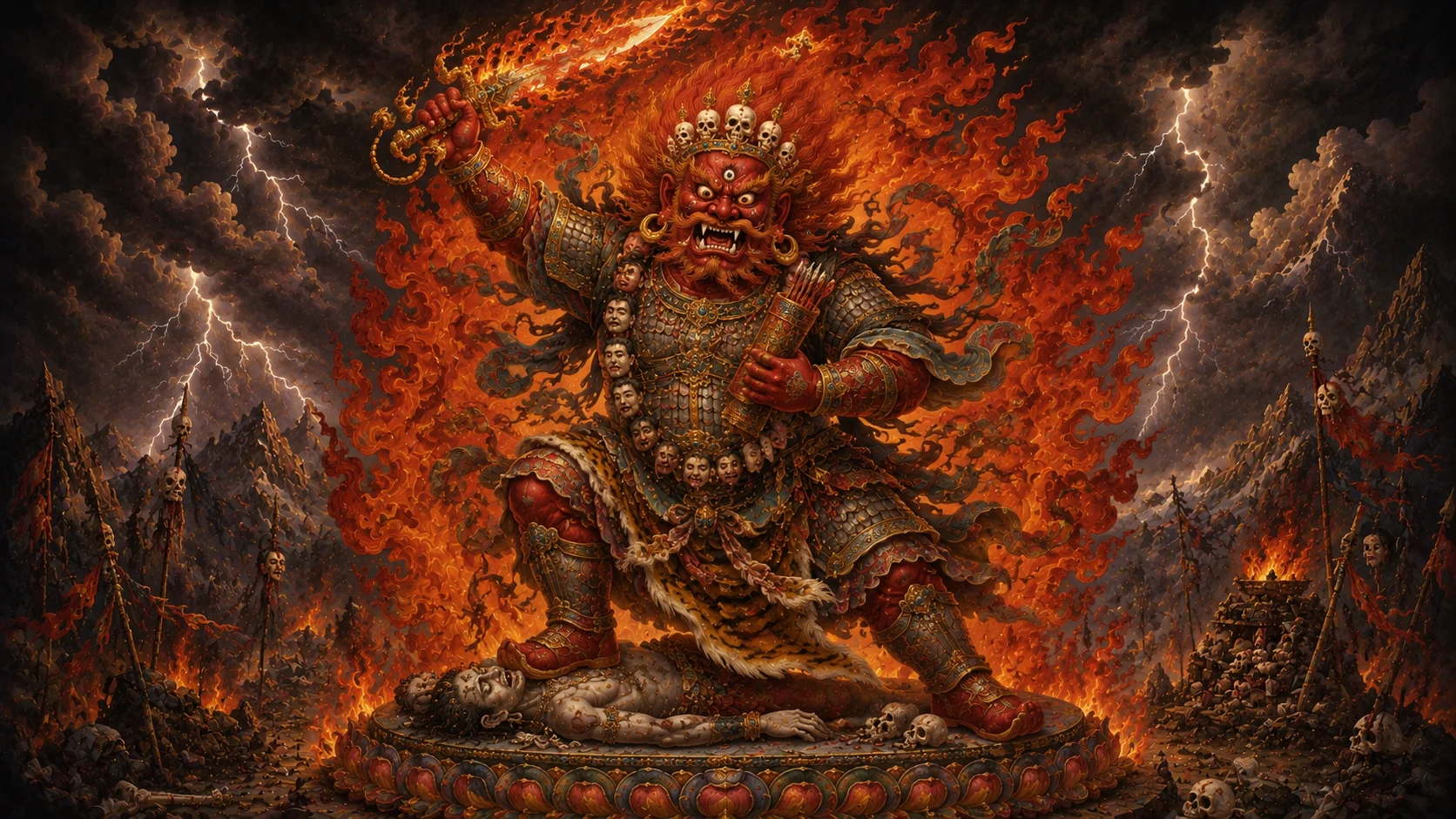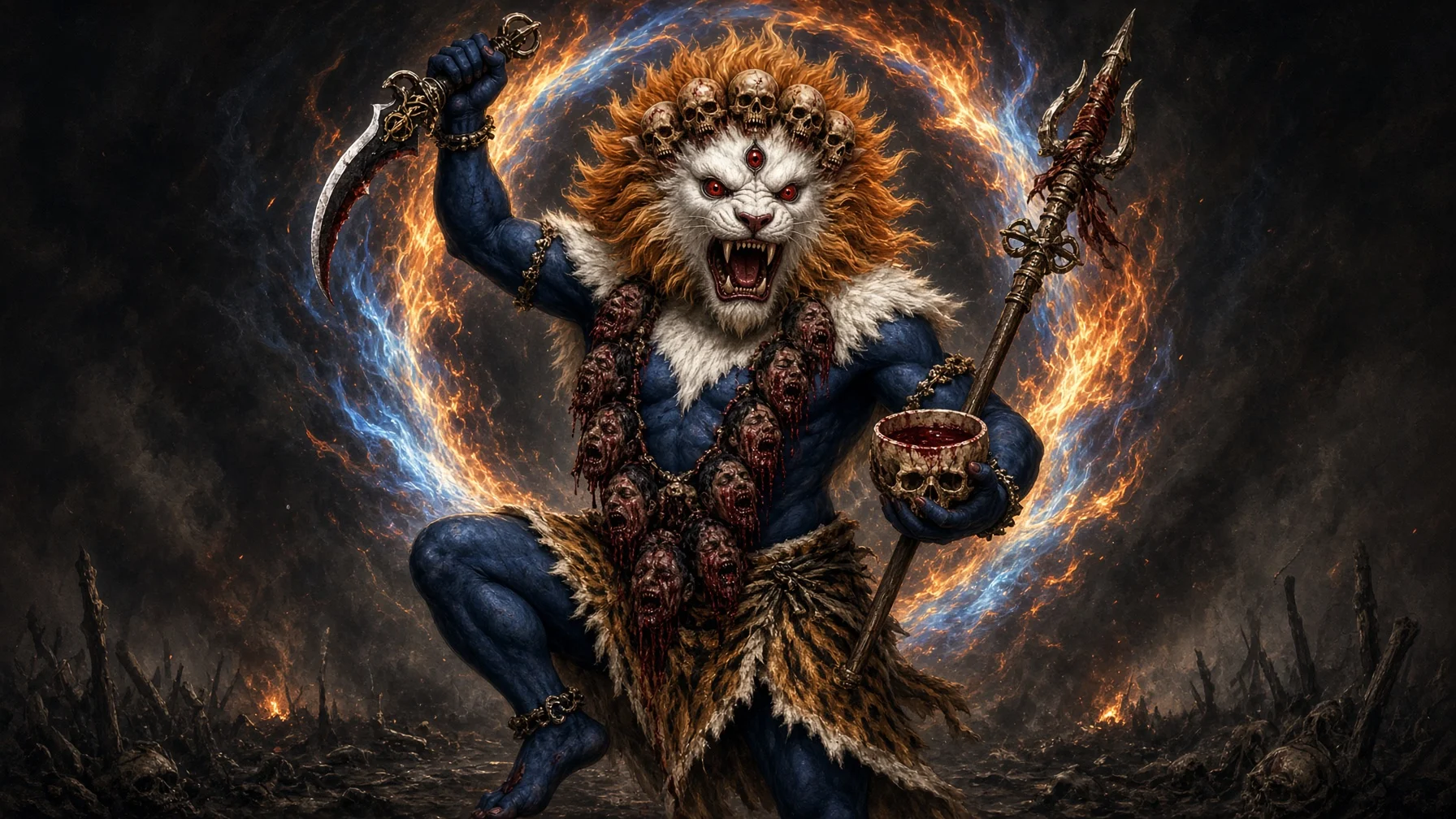
Pehar, also known as Pehar Gyalpo, is revered in Tibetan Buddhism as the principal protector deity, the dharmapala who stands as chief of the gyalpo, the class of powerful king-spirits whose fierce and unpredictable nature was, by tradition, bound to the service of the dharma. He is most widely known today as the deity who possesses the Nechung Oracle, the state oracle historically consulted by the Dalai Lamas and the Tibetan government on the gravest matters facing the land, and his story is one of the clearest Tibetan accounts of a wild power transformed, through sacred oath, into a sworn guardian of the teachings.
A King-Spirit from Beyond the Land of Snows
Tradition holds that Pehar did not originate within the settled Buddhist landscape of Tibet but arrived from elsewhere, associated by various accounts with the Bön and pre-Buddhist sphere or with the Hor region of Central Asia, sometimes named as Bhata Hor. This foreign origin is treated in Tibetan sources as historically significant and, in places, debated rather than settled in every particular, but the broad shape of the narrative is consistent: Pehar entered the Tibetan spiritual world as an outsider, a spirit of formidable and dangerous power whose nature did not belong to the ordered structures the dharma would later impose upon it. His iconography carries traces of this foreign inheritance, with martial and kingly elements that recall Central Asian imagery of rulership and warfare, elements that scholars and traditional commentators alike have long recognized as evidence of a deity absorbed from beyond Tibet's borders and given new meaning within it.
Subdued at the Founding of Samye
The pivotal moment in Pehar's story belongs to the founding of Samye Monastery in the eighth century, Tibet's first monastery and the site where Buddhism first took durable institutional root in the Land of Snows. It was there, according to traditional accounts, that Padmasambhava, Guru Rinpoche, encountered Pehar in his wild and untamed state and subdued him, binding him by sacred oath. This act of taming was not destruction but transformation: the dangerous power of the spirit-king was not annihilated but redirected, converted from a force that threatened the new religion into one sworn to defend it. This pattern, a local or worldly spirit bound by oath and turned protector, recurs throughout Tibetan religious history, and Pehar's binding stands among its most consequential instances, for the deity thus tamed would go on to occupy one of the most significant protective offices in the entire tradition.
Guardian of Samye's Treasury
Having been bound to the dharma, Pehar was installed as guardian of Samye Monastery itself, and in some accounts specifically as protector of its treasury or storehouse. This appointment placed him at the very center of Tibet's first great Buddhist institution, entrusted with watching over what the monastery held most precious. It is a role that reflects the broader function assigned to gyalpo spirits once bound: their formidable and sometimes wrathful power, once a threat, becomes a form of vigilance, deployed now in defense of the sacred wealth and teachings they once might have imperiled. Samye's treasury under Pehar's watch stands as the earliest chapter of a guardianship that would, in time, expand far beyond the monastery's walls.
The Long Journey to Nechung
Pehar's seat did not remain fixed at Samye. Tibetan historical and hagiographic sources describe the transfer of his cult to Nechung Monastery, situated near Drepung Monastery, and it was there that his institutional identity was most fully codified, in association with the rise of the Gelug establishment. Nechung became, and remains in Tibetan religious memory, the seat of the oracle that bears its name, and the move from Samye's treasury to Nechung's shrine marks the deity's transformation from a monastery's guardian into something considerably larger: the voice consulted at the very center of Tibetan governance.
Protector of Both Doctrine and State
As the Dalai Lamas' government, the Ganden Phodrang, adopted Nechung as its state oracle, Pehar's role expanded correspondingly. He is counted among the chief protectors bound to defend the Buddhist teachings, the chokyong, but through Nechung's adoption he became protector of the Tibetan state as well as of the doctrine, a dual guardianship rarely matched among Tibet's protective deities. This is a significant elevation for a being whose origin lay in a wild, foreign, and dangerous power: the oath sworn at Samye had, by the time of the Ganden Phodrang, grown into a bond understood to safeguard not merely a monastery but the governance of the land itself.
Five Faces of a Single Power
Pehar is not confined to one fixed likeness. Tibetan protector literature describes him as displaying multiple emanation forms, often enumerated as five, presenting different aspects such as a monk's guise and a warrior's guise among others. This multiplicity is not incidental but reflects his true function: he stands as head of a retinue of gyalpo spirits, and his many faces express the range of a king-spirit's power rather than confining it to a single static image. A protector charged with matters as varied as monastic order and martial defense fittingly appears in more than one form, each suited to a different register of his authority.
The Rider on the Snow Lion
Among Pehar's iconographic forms, one of the most recognized depicts him mounted upon a snow lion, though other emanations show him upon different mounts, a mule among them, depending on the aspect invoked. In this common depiction he wears a distinctive round hat and robes that suggest a monk's or minister's bearing, a visual echo of his role as counselor as much as guardian. He is shown holding an arrow or implements associated with mo, the divinatory rites long practiced in Tibet, attributes that tie his visual form directly to the oracular function for which he is best known. Every element of this iconography, the mount, the hat, the divinatory arrow, speaks to a deity who is at once warrior, minister, and diviner.
Dorje Drakden and the Question of the Minister
Closely bound to Pehar within the gyalpo class is Dorje Drakden, understood in the standard Nechung tradition as Pehar's chief minister or emanation, and it is specifically this aspect who is said to possess the medium during the Nechung Oracle's trance. The precise relationship between Pehar himself and Dorje Drakden is a point where Tibetan sources show some variation, and this divergence is worth noting honestly rather than resolved into a single tidy account: whether the oracle speaks with Pehar's own voice or that of his minister-emanation is treated differently across traditions, even as both readings agree on the deity's centrality to what unfolds in the trance.
The Trance and the Kuten
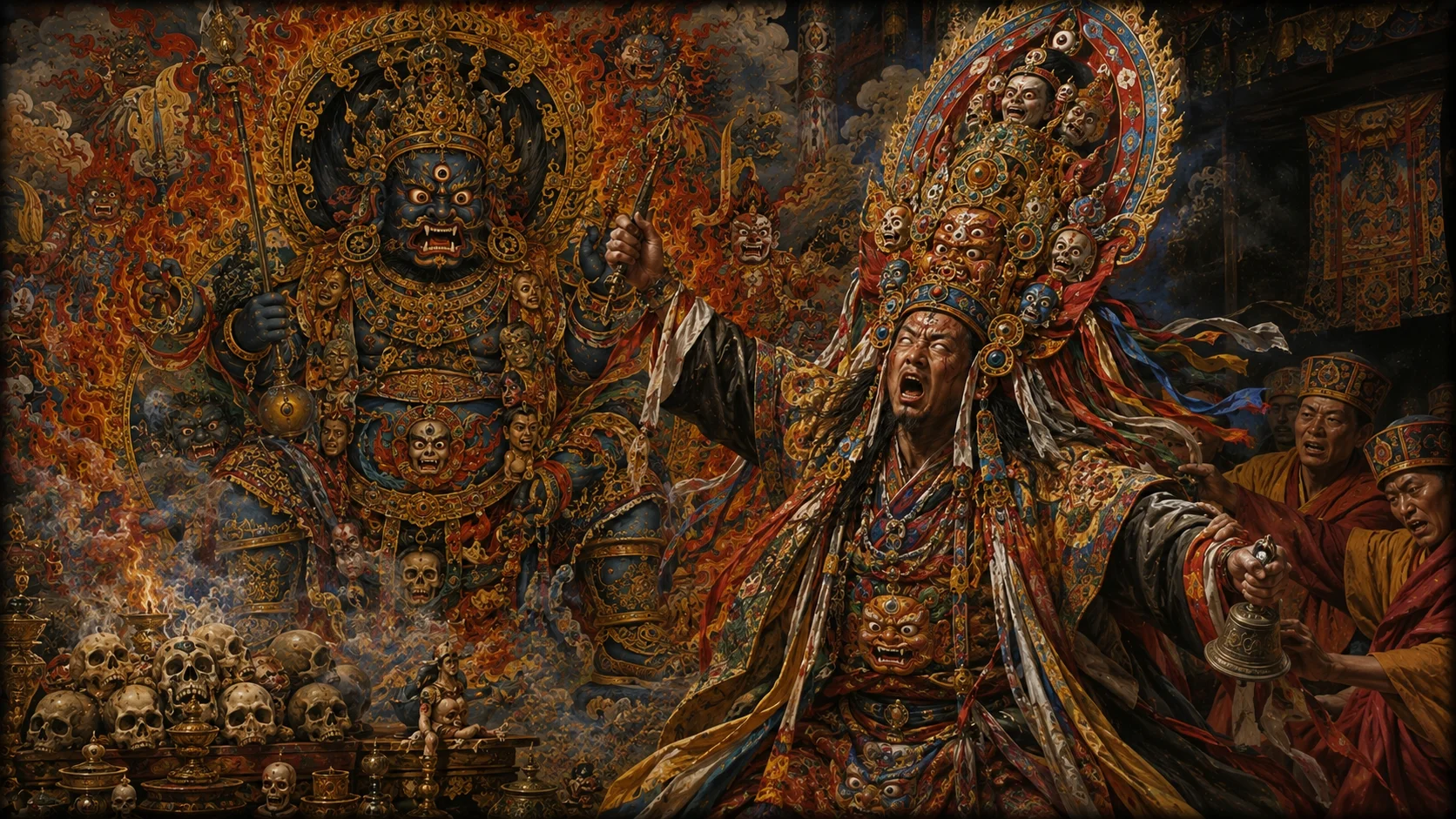
The Nechung Oracle's possession is Pehar's most vivid manifestation in Tibetan religious life. A human medium, the kuten, undergoes trance and becomes the vessel through which the deity, in the person of Dorje Drakden, delivers prophecy and counsel. Historically, this consultation extended to matters of the gravest institutional weight, including the search for and recognition of reincarnate lamas, among them consultations associated with recognizing predecessors of the Dalai Lama lineage. In this the oracle's function reached directly into the continuity of Tibet's spiritual leadership, a role no ordinary protector deity is entrusted with.
A Worldly Protector, Bound but Not Enlightened
Within the doctrinal framework of Vajrayana Buddhism, Pehar is properly classed among the jigten pai srungma, the worldly protectors, beings bound by oath, damcan, to defend the dharma and its practitioners. This places him in a distinct category from the yeshe kyi srungma, the fully enlightened wisdom protectors, a distinction Tibetan Buddhism maintains with care even where popular devotion, given Pehar's immense practical importance through the oracle, has at times elevated his standing in the lived religious life of Tibet well beyond what his formal doctrinal category alone might suggest. He remains, in essence, a great and mighty spirit under oath rather than a buddha or bodhisattva, and this distinction is part of what makes his story meaningful: it is precisely because he was once wild that his binding, and his subsequent service, carry weight.
Where Two Worlds Meet in a Single Deity
Pehar's cult stands as one of Tibetan Buddhism's clearest illustrations of the tradition's characteristic absorption of foreign and pre-Buddhist power into its own religious order. A spirit-king of contested but plausibly Central Asian origin, captured in a narrative of subjugation at Buddhism's first Tibetan monastery, given multiple faces and a divinatory mount, and ultimately entrusted with the fate of reincarnate lamas and the counsel of the Tibetan state, Pehar embodies the pattern by which Tibetan Buddhism has long made room for older, untamed powers within its framework, not by erasing them but by binding them to new and sacred purpose. In the halls of Nechung, where his oath still holds and his oracle still speaks, that ancient binding remains a living presence in Tibetan religious life.
Sources & traditions
- EncyclopediaWikipedia — Pehar Gyalpo
- TraditionTibetan Buddhist texts, oral tradition and village tellings
Myths change from area to area and from time to time. This chronicle follows the most widely told versions; tellings in other villages, regions and eras may differ.