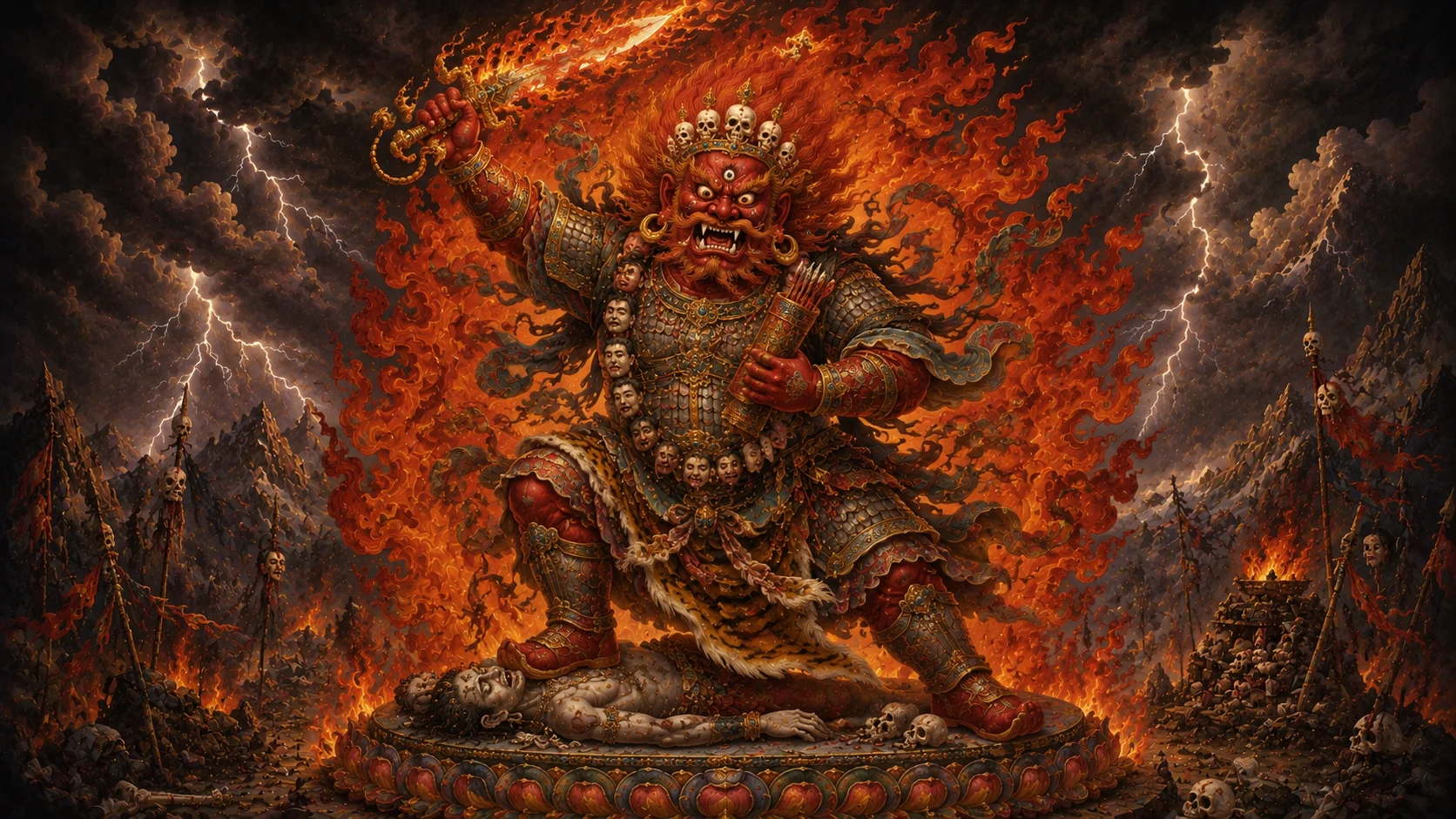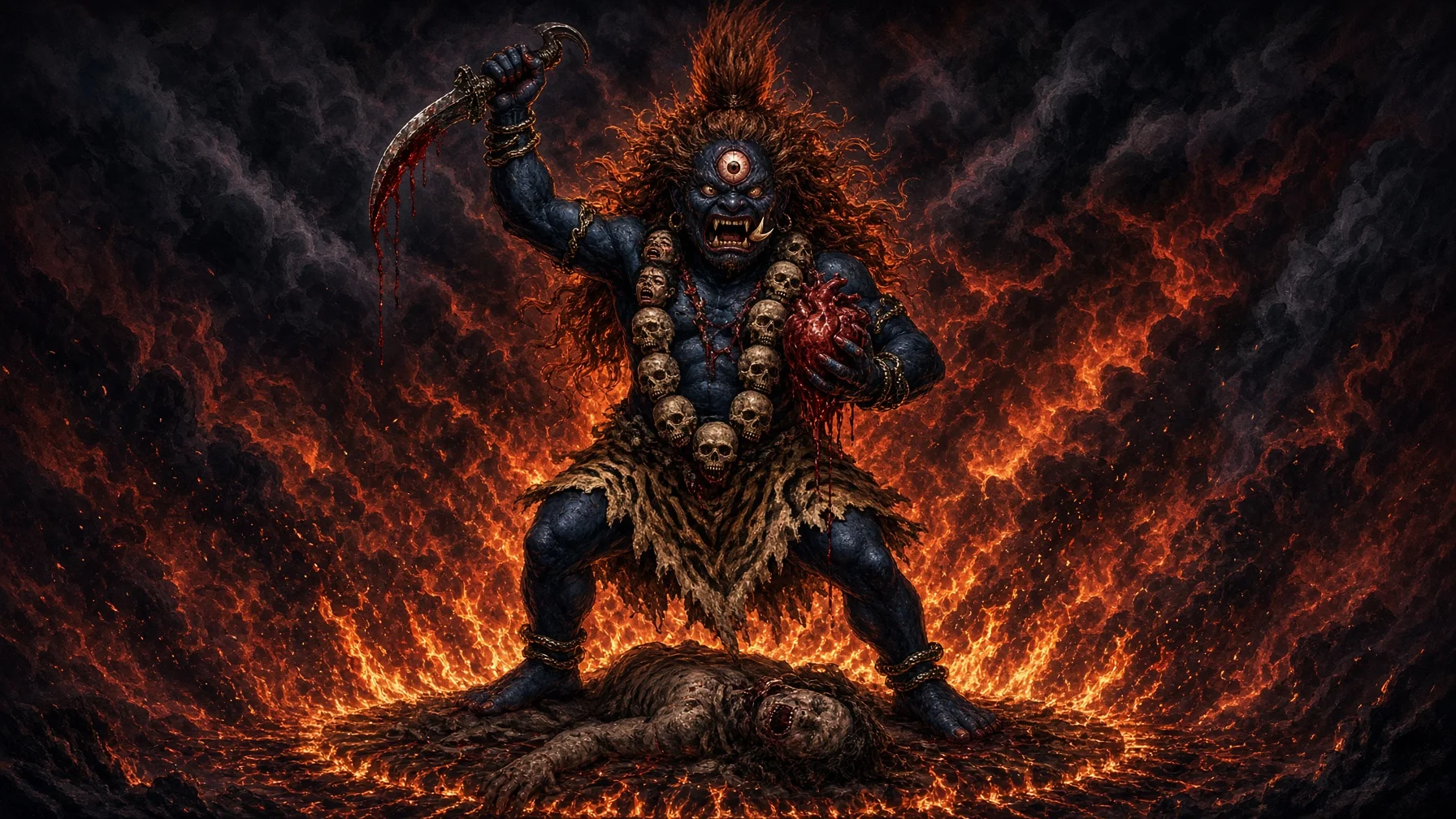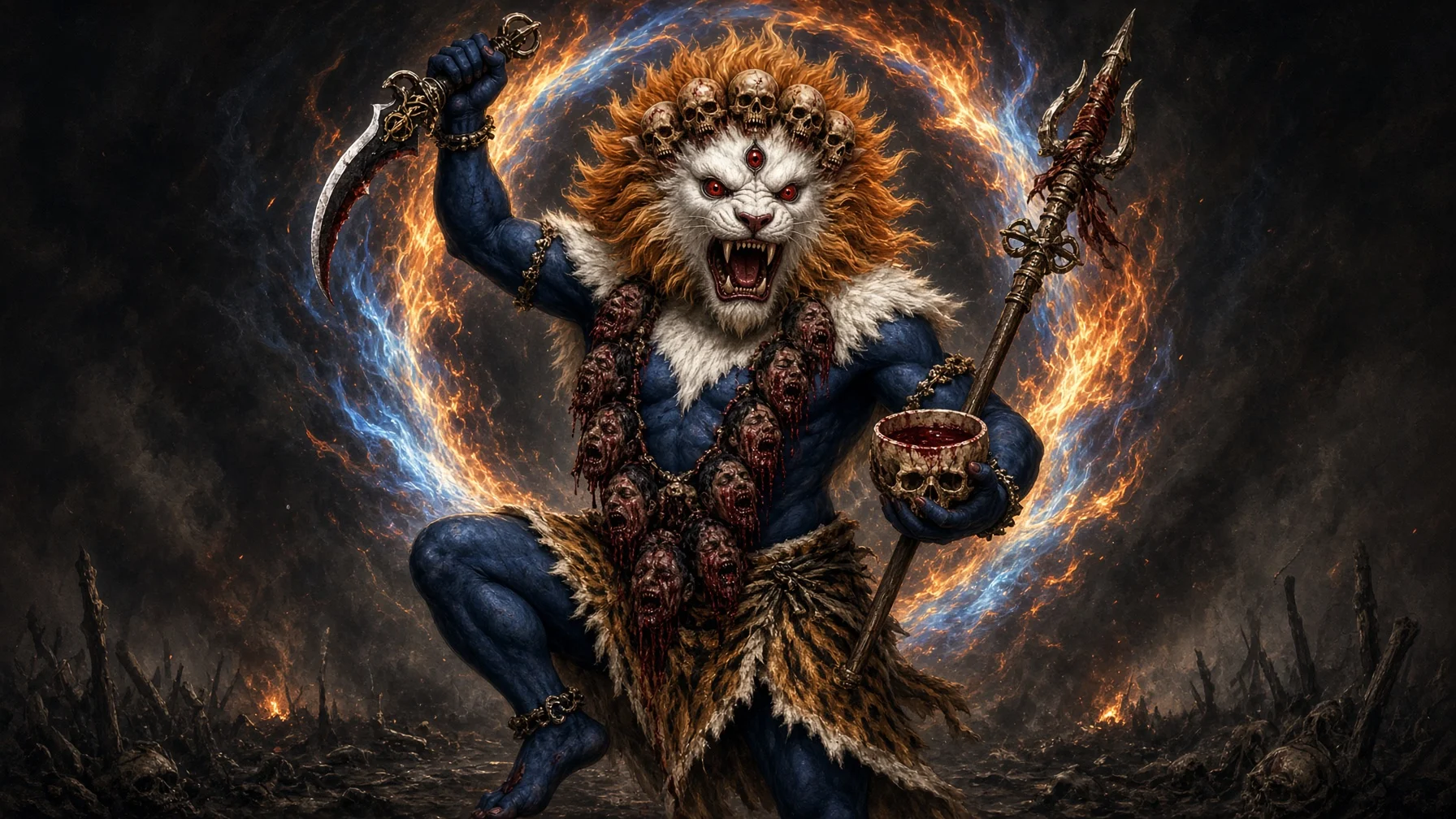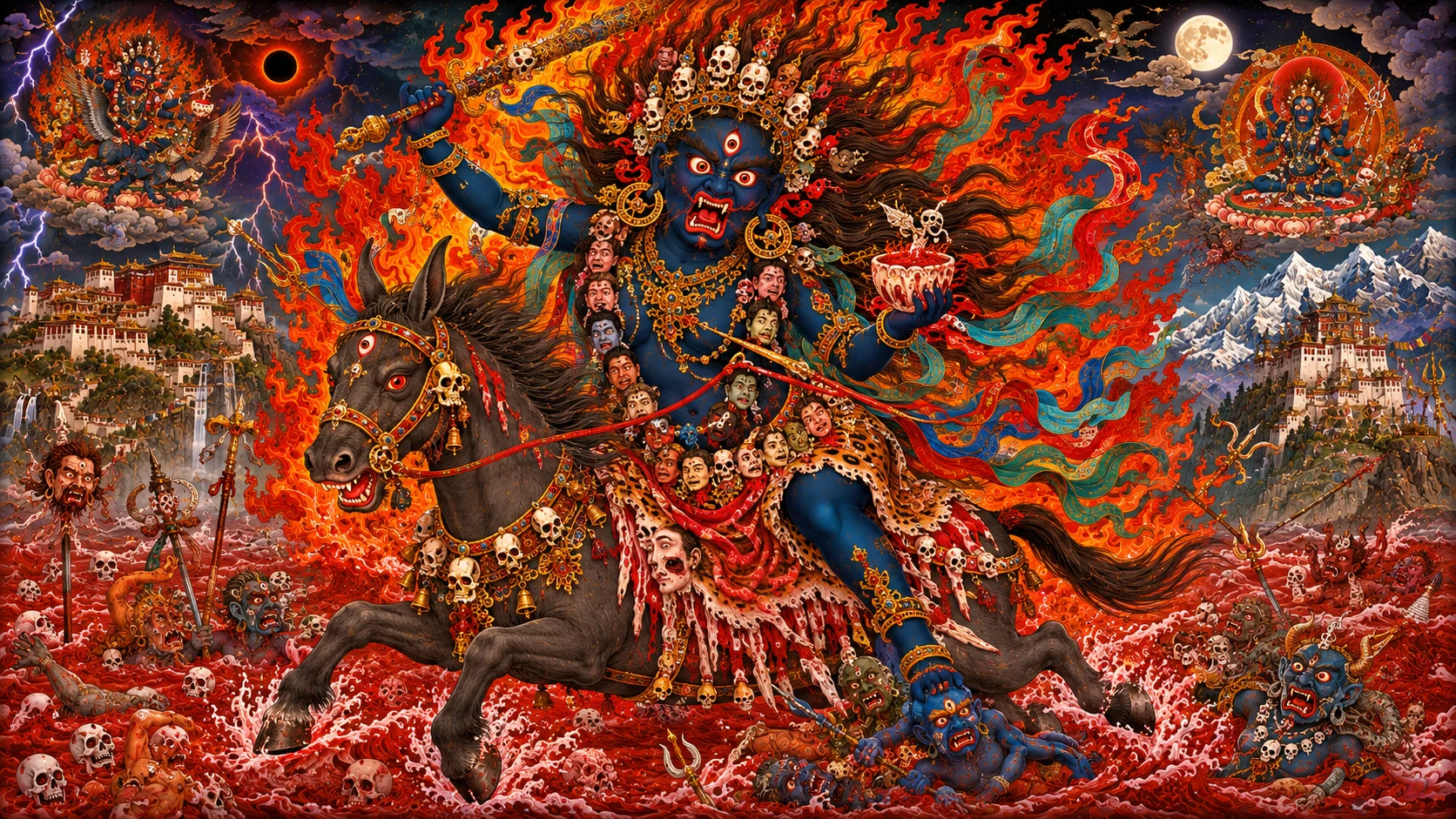
Palden Lhamo, the Glorious Goddess, is the great wrathful protectress of Tibetan Buddhism: the only female among the Eight Great Dharmapalas, a fierce dark deity who rides a mule across a sea of blood, the supreme guardian of Lhasa, and — in a role of particular weight within the Gelug school — the protectress bound up with the Dalai Lama lineage and the Ganden Phodrang government. She is the most important of the protective goddesses, terrible in aspect yet, in the standard reading Vajrayana practitioners give to wrathful deities, wholly devoted to the defense of the dharma and those who uphold it.
The Glorious Goddess and Her Sanskrit Name
In Tibetan she is Palden Lhamo, "the Glorious Goddess"; in Sanskrit she is known as Shri Devi, a name that carries the same sense of splendor married to terror. Some tantric texts associate her with a closely related wrathful form called Remati, though the exact relationship between the names varies by lineage and should not be flattened into a single fixed identity. She also bears the epithet Magzor Gyalmo, "Queen Who Repels Armies," a title that speaks directly to her role as a defender against hostile forces, worldly and otherwise.
Riding Side-Saddle Across a Sea of Blood
Palden Lhamo's central image is unforgettable: a dark blue-black wrathful goddess riding side-saddle upon a mule, crossing a lake or sea of blood. The mule itself carries a mark of its own legend — its rump bears an eye, said to have been placed there so that Palden Lhamo could see behind her as she fled a scene of great violence. Some tellings describe her saddle-cover as made from flayed skin, an image bound up with the story of her fiercest deed. She wears a crown and garland of skulls, and the visual totality of her wrathful form — the blood-lake, the marked mule, the skulls — is meant to be read symbolically, as an expression of ferocity in service of protection rather than as ordinary violence.
Implements of a Wrathful Protectress
In her hands Palden Lhamo holds a skull-cup, or kapala, and a wrathful implement — variously described as a club or a sword — instruments that mark her as a dharmapala rather than a peaceful meditational deity. A sun-disc rests upon her belly, one further mark among many that distinguish her particular form. It is worth noting that across the many tantric cycles devoted to her, multiple specific emanation forms exist, each with its own variations in implements, retinue, and color; no single description should be taken as the one universal likeness of the goddess, and different lineages transmit different sadhanas describing her appearance in detail.
A Hagiography of Grief and Resolve
Palden Lhamo's most striking story concerns how she came to ride across the sea of blood at all. As it is told — and it is told in more than one variant, so it should be approached as hagiography rather than settled history — she was once a Buddhist queen or protectress married to a king whose rule was cruel and hostile to those who practiced the dharma. When she could not turn her husband from harming Buddhist practitioners, she took the drastic step of killing her own son, so that the child could not be used by the king to continue that harm, and then fled the kingdom to become a wrathful protector of the teaching. The precise details — who the king was, where the kingdom lay, the exact manner of the deed — differ from telling to telling within the tradition, and no single version should be presented as the definitive account. What remains constant across the variants is the shape of the story: a mother's sacrifice, made in defense of the dharma, transforming her into the fierce guardian she is venerated as today.
Reading Wrath as Compassion
It would be a misunderstanding to take Palden Lhamo's terrifying appearance and the violence of her hagiography as ends in themselves. Within the standard hermeneutic of Vajrayana Buddhism, wrathful deities such as Palden Lhamo are understood as compassion taking a fierce form precisely because gentler forms would not suffice against the obstacles, dangers, and enemies of the dharma that practitioners face. Her ferocity is protective, not predatory — turned outward against threats to the teaching and those who uphold it, never against the practitioners themselves who take refuge in her.
Sole Woman Among the Eight Protectors
Palden Lhamo holds a singular place among the Eight Dharma Protectors, known in Tibetan as the Chokyong Gyepa: she is the only female deity in that company. The list traditionally includes figures such as Mahakala, Yama Dharmaraja, Yamantaka, Kubera or Vaishravana, Beg-tse, and Rahula, though the exact composition of the eight can vary somewhat by lineage and textual tradition. In some tantric contexts she is described as linked to Mahakala as a protector paired with him, but this pairing is lineage-specific rather than a fixed, universal relationship, and should be understood as one strand among several rather than the whole picture.
Guardian of Lhasa and the Dalai Lama Lineage
Beyond her place among the eight, Palden Lhamo carries a distinct and especially weighty role as the special guardian of the holy city of Lhasa. She is bound up, historically, with the protective pantheon of the Ganden Phodrang government and with the Dalai Lama lineage itself — a role that sits alongside, but is distinct from, the institution of the Nechung Oracle. Her protection of Lhasa and of the government tied to the Dalai Lamas made her one of the most politically significant protector deities in the Tibetan tradition, her guardianship extending from the individual practitioner to the fate of the city and its leadership.
The Oracle Lake and the Search for a Reincarnation
Central Tibet holds a lake consecrated to her: Lhamo Latso, the Oracle Lake. Tradition holds that regents and high lamas have sought visions in its waters to help identify the reincarnation of a new Dalai Lama, a practice that continues to be observed within the tradition. The lake stands as one of the clearest points of contact between Palden Lhamo's mythic role as protectress and the living institutional life of Tibetan Buddhism, a place where her guardianship is understood to make itself visible to those who come seeking guidance at a moment of great consequence for the tradition.
Her Circuit Through Old Lhasa at Losar
Palden Lhamo is propitiated during Losar, the Tibetan New Year, when she receives particular ritual attention as protectress of the city and the teaching. Historically, the observance included a public procession — an effigy ritual honoring her circuit around old Lhasa, held around the fifteenth day of the tenth Tibetan month. Rituals of this kind situate Palden Lhamo not only as a distant wrathful figure invoked in tantric practice but as a protector whose presence was, and in various forms continues to be, marked in the shared life of the city she guards.
Foremost Protector of the Gelug School
While Palden Lhamo is venerated across the Nyingma, Sakya, Kagyu, and Gelug schools of Tibetan Buddhism, each transmitting its own lineage-specific forms and sadhanas devoted to her, she holds particular prominence within the Gelug school, where she is regarded as a principal protector. This standing runs alongside, and helps explain, her close historical association with the Dalai Lama lineage and the government that lineage headed, since the Gelug school has long been closely tied to that institution. Her cult therefore spans the full breadth of Tibetan Buddhist practice while carrying a special density of meaning within one particular tradition.
The Supreme Guardian of Tibet
Taken together, the strands of Palden Lhamo's tradition — her fearsome iconography, the hagiography of a mother's sacrifice, her place as sole woman among the Eight Dharma Protectors, her guardianship of Lhasa and the Dalai Lama lineage, the Oracle Lake, and her continuing ritual observance — describe a deity understood as the supreme protectress of Tibet. She is invoked as the great defender against dangers to the dharma and to those who practice it, terrible to behold and, within the tradition that reveres her, utterly devoted to that protection. In Palden Lhamo, the fierce protective feminine is given lasting form: the Glorious Goddess upon her mule, crossing the sea of blood, standing as guardian of a city, a lineage, and a living tradition of faith.
Sources & traditions
- EncyclopediaWikipedia — Palden Lhamo
- TraditionTibetan Buddhist texts, oral tradition and village tellings
Myths change from area to area and from time to time. This chronicle follows the most widely told versions; tellings in other villages, regions and eras may differ.