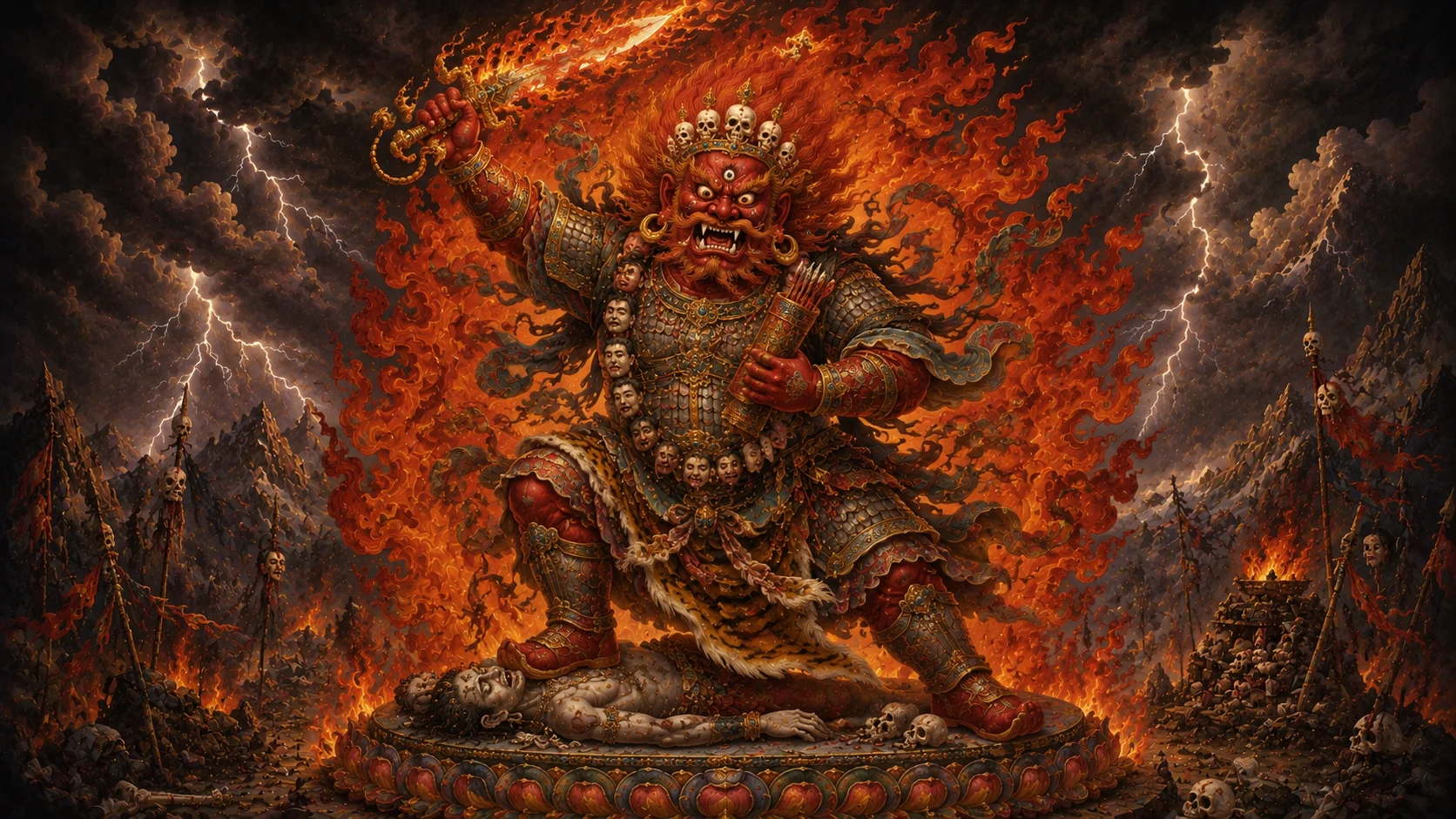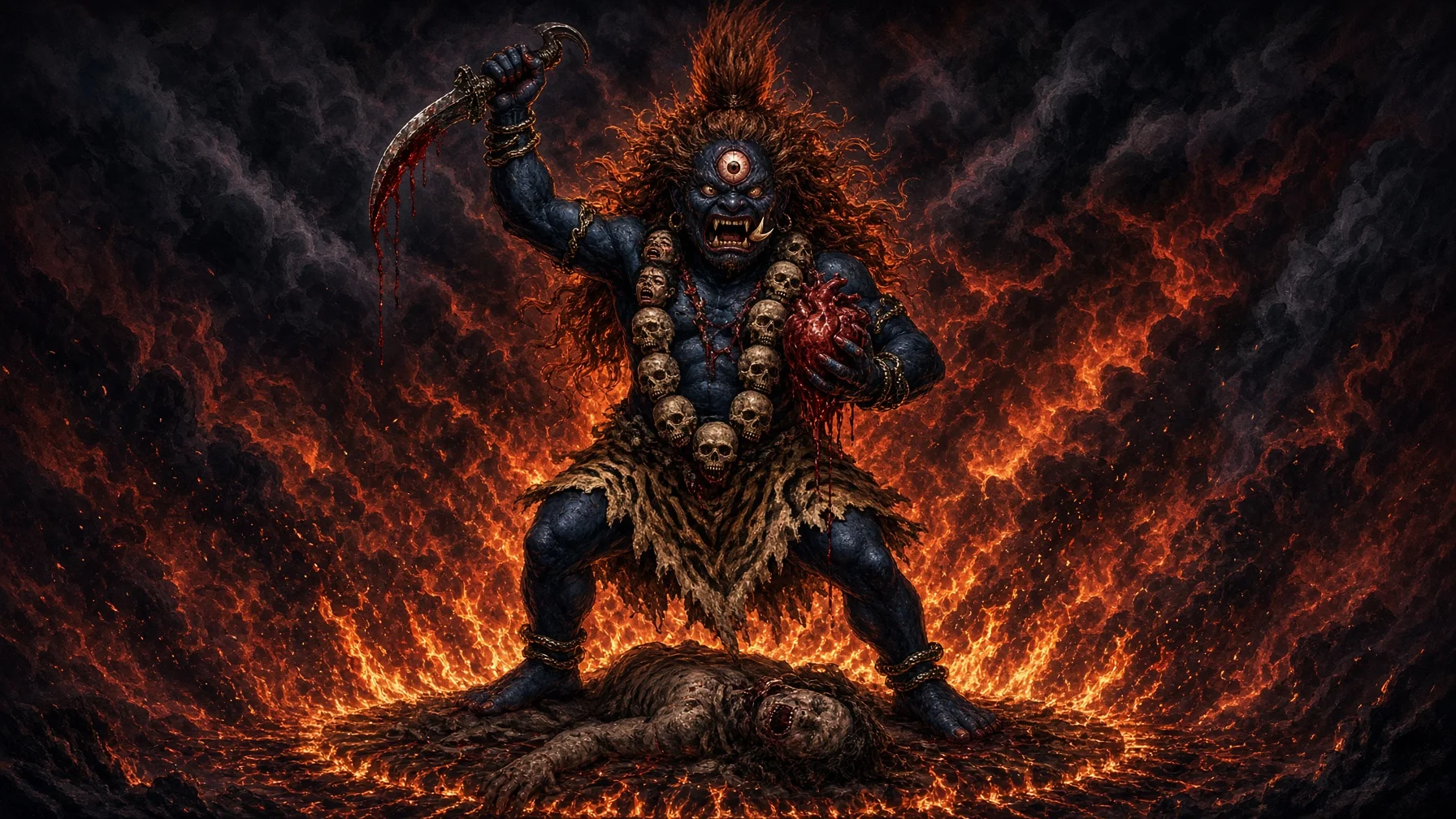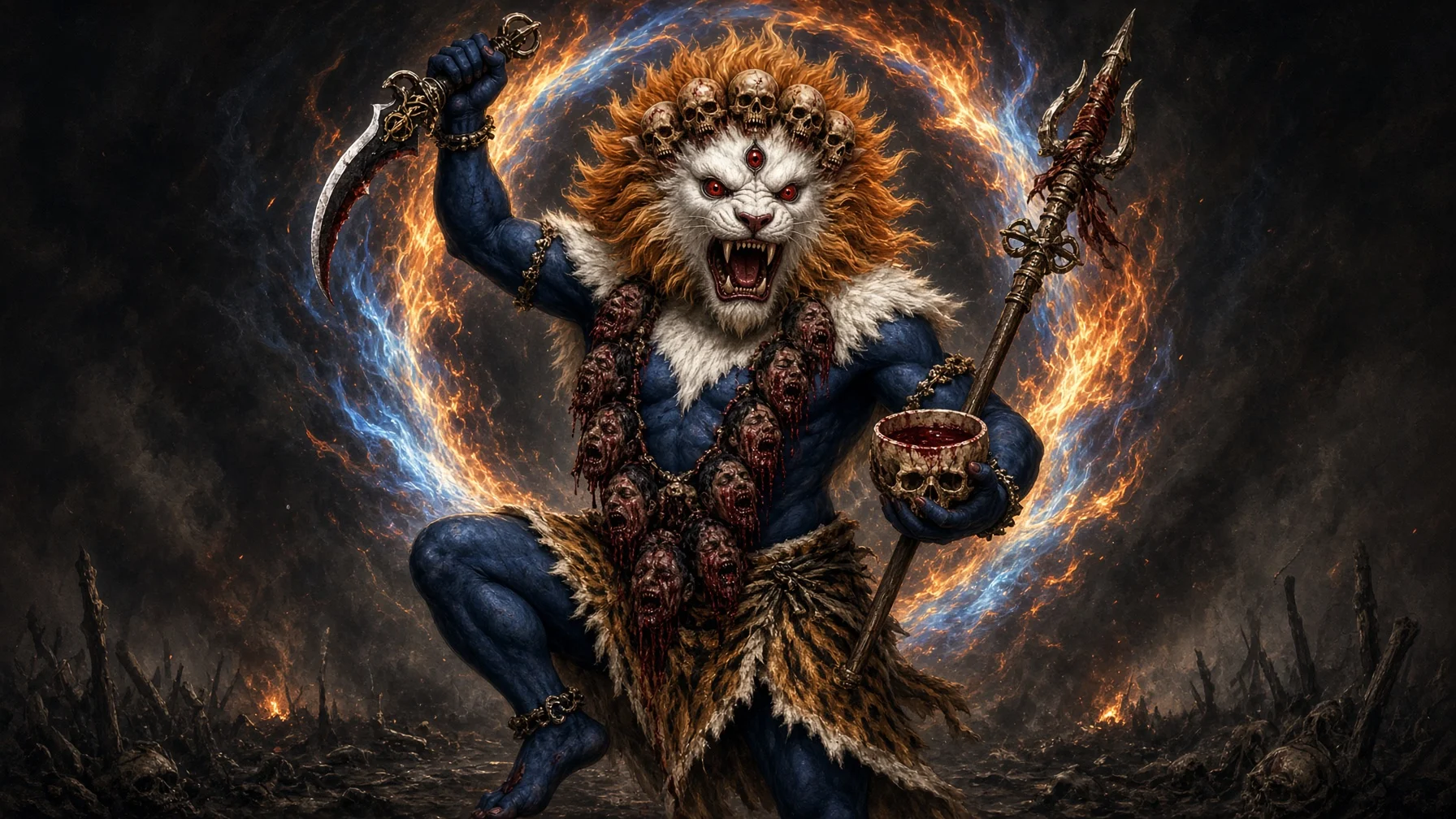
Yamantaka — “the Destroyer of Death,” also called Vajrabhairava — is a supremely wrathful tantric deity of Tibetan Buddhism: the terrifying buffalo-headed conqueror of Yama, the Lord of Death, and a meditational deity (yidam) of the highest tantras. He is the wrathful emanation of the bodhisattva of wisdom, Manjushri, whose ferocity destroys death itself and the ignorance that is its root.
The Conqueror of Death
Yamantaka’s name means “the ender (or terminator) of Yama” — Yama being the Lord of Death — for he is the deity who conquers death itself. The myth tells that the death-god Yama was ravaging the world, and to subdue him, the gentle bodhisattva of wisdom Manjushri took on a form even more terrifying than Yama: the colossal, buffalo-headed, many-armed wrathful deity Yamantaka, who overpowered and subdued the Lord of Death. To conquer death, wisdom assumed the most fearsome form of all.
The Buffalo-Headed Terror
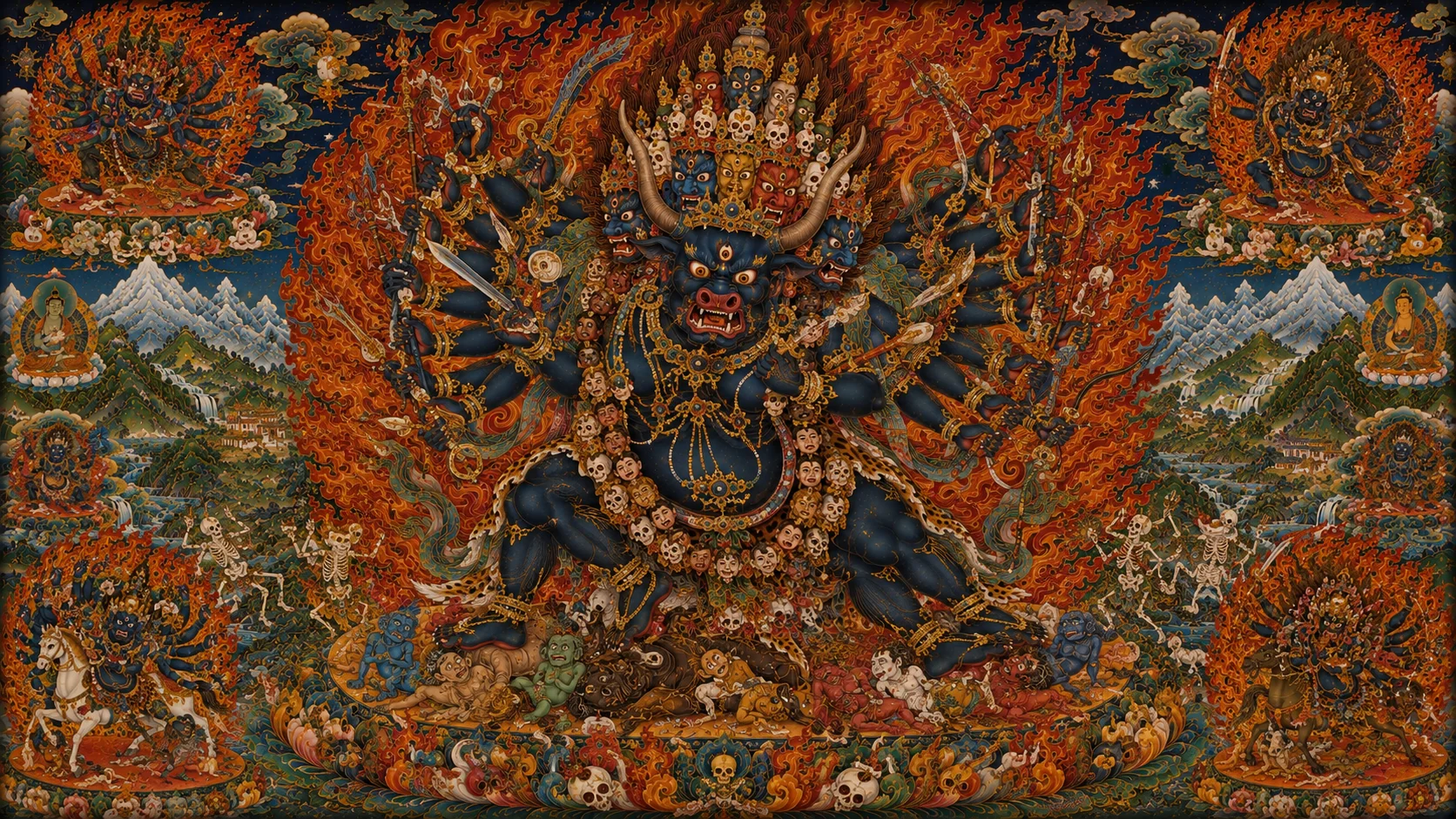
Yamantaka is depicted as one of the most fearsome of all the deities: a huge, dark-blue figure with the head of a buffalo (and often many other heads, including the head of Manjushri at the crown), with many arms wielding many weapons, many legs trampling gods and demons and beasts, wreathed in flames, fanged and terrible. Every detail of his overwhelming form is symbolic — his many heads, arms, and legs representing the many aspects of the path and the powers of enlightenment, his buffalo head recalling Yama, whom he conquered, his ferocity the wrathful energy of wisdom destroying ignorance and death.
The Wisdom That Ends Death
As the wrathful form of Manjushri, the bodhisattva of wisdom, Yamantaka embodies the truth that it is wisdom — the realization of emptiness and the true nature of reality — that ultimately conquers death, for death has its root in ignorance and the clinging to a self, and wisdom cuts that root. His practice is among the most important of the highest yoga tantras, especially in the Gelug school (the tradition of the Dalai Lamas), undertaken to overcome death, destroy obstacles, and attain swift enlightenment. In Yamantaka, Tibetan Buddhism gave form to the conquest of death by wisdom — the buffalo-headed Destroyer of Death, the supremely wrathful emanation of the bodhisattva of wisdom, who took on a form more terrible than death itself to subdue the Lord of Death and destroy the ignorance at the root of all dying.
Before Yamantaka: Yama and the Wheel of Rebirth
Long before Yamantaka existed, Yama himself did — and not as a demon. In the Rig Veda he is the first man to die, the pathfinder who crosses into the realm beyond death and, by virtue of having gone first, becomes its king. Early Buddhism absorbed him rather than inventing a death-figure of its own: Yama Dharmaraja, King of the Law, the judge who weighs a soul’s deeds by holding up a mirror in which its karma is reflected back to it, unable to lie. He is the figure who clamps the great wheel of rebirth — the bhavacakra, traditionally painted at the entrance of Tibetan temples — in his jaws and claws, not tormenting beings so much as demonstrating, with total indifference, that everything born into the six realms will be devoured by time. That is the problem Yamantaka exists to solve: not a monster invented for drama, but the personification of impermanence, standing in the doorway of a religion whose entire purpose is escaping it.
The Monk Who Became the Butcher
Alongside the tantra’s own account of Manjushri subduing Yama through wisdom, Tibetan tradition preserves a second, earthier origin story — the one told to explain why the deity looks the way he does. A monk, so the story goes, had spent decades in solitary retreat in a cave, meditating toward the very edge of enlightenment, needing only a single night more to complete the practice. Two thieves broke in that night dragging a stolen ox to butcher for meat. They beheaded the animal, and then, finding the meditator and fearing a witness, cut off his head just as casually. In his final instant the monk’s consciousness, robbed of the liberation he had spent his life earning, erupted in fury: the headless body rose, took up the ox’s severed head and set it on its own shoulders. He killed the thieves where they stood, and did not stop there, rampaging across the countryside and drinking the blood of everyone he met until all of Tibet lived in terror of him. It was to check this rampage — not an abstract cosmic Yama, but a very literal, very recent horror — that Manjushri manifested a form more monstrous still, matching the butcher head for head and limb for limb, until the creature had no room left to resist and submitted, bound thereafter to guard the very teaching that had once cost him his life.
Nine Heads, Thirty-Four Arms, Sixteen Legs
In his full Vajrabhairava form the numbers themselves are doctrine, encoded so that a practitioner who has received the teaching can read the deity’s anatomy the way others read a text. His nine faces — a central buffalo head, seven further wrathful faces, and Manjushri’s own serene golden face at the crown — correspond to the nine divisions of the Buddhist scriptures. His thirty-four arms, added to the body, speech and mind of the deity himself, make thirty-seven: the thirty-seven factors said to ripen into enlightenment. His sixteen splayed legs stand for the sixteen kinds of emptiness catalogued in Mahayana philosophy, and beneath them he tramples a menagerie of animals and birds on one side and a row of prostrate human and divine figures on the other — the standard grammar of wrathful tantric art, in which even the old gods of the pre-Buddhist order are shown humbled underfoot. He wears a crown of five skulls for the five transformed poisons, a garland of freshly severed heads for the syllables of the Sanskrit alphabet — speech itself, purified — a flayed elephant hide across his back and a tiger skin at his waist, and he embraces his consort Vajravetali, a wrathful dakini whose name means, roughly, the reanimated corpse-spirit, locking method and wisdom together at the dead centre of the mandala.
Two Ways to Meet Him: The Solitary Hero and the Mandala of Thirteen
Practitioners of the Vajrabhairava tantra most commonly approach the deity in one of two forms. The simpler is the Solitary Hero, Yamantaka alone, one face and two arms, used for daily practice once initiation has been given. The elaborate form surrounds the full nine-headed, thirty-four-armed body with twelve further deities arranged around him in a thirteen-deity mandala, the configuration used in the empowerment ceremonies and group rituals still performed in Gelug monasteries. Neither form may be practised without that empowerment: the visualisation is considered too powerful, and too easily misapplied, to be attempted from a book. This is not a myth to be read for pleasure so much as a technology to be transmitted, teacher to student, inside a lineage the tradition holds to be unbroken.
Tsongkhapa’s Own Yidam
Vajrabhairava sits alongside Guhyasamaja and Chakrasamvara as one of the three principal meditational deities of the Gelug school, the tradition Je Tsongkhapa established at the turn of the fifteenth century — a reformer who was himself regarded, fittingly, as an emanation of Manjushri. Tsongkhapa’s reliance on the Vajrabhairava practice, and its place at the centre of Gelug tantric training, is a large part of why the deity carries the weight he does across the Gelug world to this day: everywhere that lineage took root, Yamantaka’s fierce, buffalo-headed form went with it, guarding the monasteries’ gates in paintings and the practitioners’ minds in meditation alike.
A Family of Enemies of Yama
Vajrabhairava is not the only tantric figure built to defeat Yama. An older and related cluster of practices, the Yamari cycle — the name means simply “enemy of Yama” — centres on Red Yamari and Black Yamari, wrathful deities aimed at the same target in far less elaborate forms: a single wrathful face rather than nine, and the buffalo beneath them as a mount rather than fused to their shoulders. Tibetan classification systems group the Yamari tantras together with Vajrabhairava as a single family within the father tantras, and in the Gelug world Vajrabhairava came to overshadow the older cycle without displacing it — the same project throughout: teaching the practitioner to face death not by denying it but by becoming, ritually, more terrible than it is.
Onto the Steppe
The cult travelled as far as the school that carried it. When the Mongol nobility turned to Gelug Buddhism in the late sixteenth century — the conversion sealed by the meeting between Altan Khan and Sonam Gyatso in 1578, which produced the title Dalai Lama — they took up its tutelary deities with it, and Yamantaka’s cult took hold across the Mongolian steppe with the same force it had in Lhasa. The tradition never became a historical curiosity: initiations are still given, retreats still undertaken, and the thirteen-deity mandala still constructed today wherever the lineage Tsongkhapa founded has practitioners left to teach it.
Sources & traditions
- EncyclopediaWikipedia — Yamantaka
- TraditionTibetan Buddhist texts, oral tradition and village tellings
Myths change from area to area and from time to time. This chronicle follows the most widely told versions; tellings in other villages, regions and eras may differ.