Manjushri, whose Sanskrit name means "Gentle Glory," and who is honored in fuller form as Manjushrikumarabhuta, "Manjushri the Youthful" or "Manjushri Made Prince," is among the great bodhisattvas of Mahayana and Vajrayana Buddhism, the personification of prajna, transcendent wisdom, the insight that cuts through ignorance to perceive the true nature of reality. He is one of the earliest bodhisattvas attested in Mahayana sutra literature, appearing prominently across the Lotus Sutra, the Vimalakirti Nirdesha Sutra, and the vast body of Prajnaparamita, Perfection of Wisdom, teachings. Across these different scriptural streams his character remains remarkably consistent: a youthful, radiant presence whose entire purpose is to press a teaching to its sharpest, clearest point.
The Flaming Sword That Severs Delusion
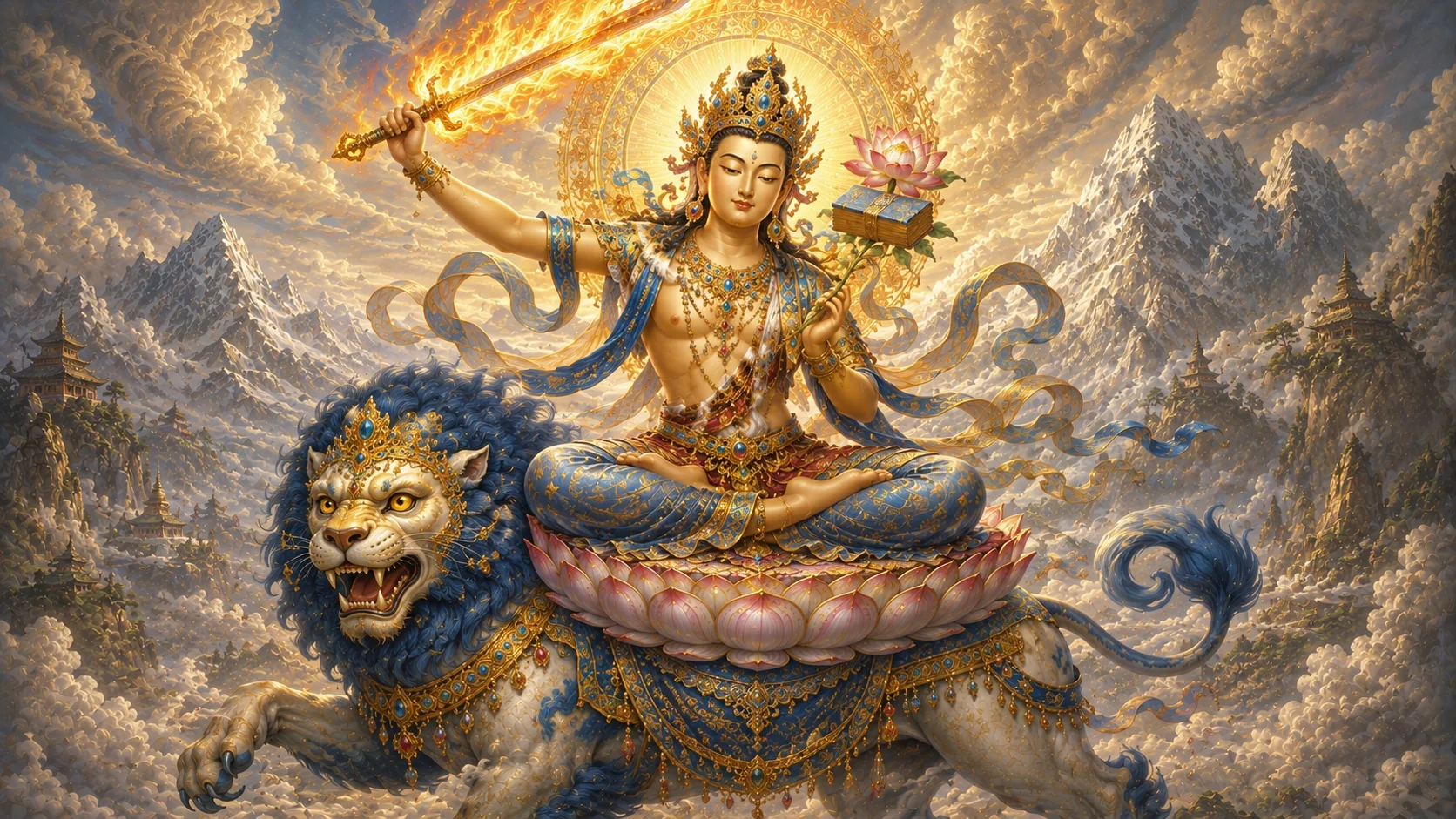
Manjushri is conventionally shown as a youthful, princely figure, forever young, for wisdom does not age or dull. In his right hand he raises a flaming sword, the khadga, blazing with the fire that consumes ignorance, delusion, and false views at the root, cutting the knot of suffering with a single stroke of clarity. At his left shoulder, resting upon an open lotus, rests the Prajnaparamita, the scripture of the Perfection of Wisdom, the profound teaching on emptiness that the sword itself serves to reveal. Sword and book together form his signature: the cutting edge of insight, and the text that insight illuminates. Neither attribute stands alone in the iconography; the blade without the book would be mere aggression, and the book without the blade would be knowledge that never cuts through anything at all.
Mounted Upon the Roaring Lion
Manjushri is very often depicted riding, or seated upon, a lion, at times described as blue, its mane roaring. The lion is fearlessness given form, and its posture beneath the bodhisattva expresses the confidence and power that true wisdom carries: wisdom that does not hesitate before ignorance, does not flatter delusion, and roars where lesser understanding falls silent. Sword, book, and lion together compose the full image of Manjushri as he is most widely recognized across the Buddhist world, three attributes reinforcing a single idea from three different directions.
The Silence at Vimalakirti's Bedside
In the Vimalakirti Nirdesha Sutra, when the layman Vimalakirti lies ill and every other bodhisattva hesitates to visit him, fearing the sharpness of his wisdom, Manjushri alone agrees to go. Their meeting becomes one of the most cited episodes in all Mahayana literature: a debate on non-duality carried to its furthest point, until Vimalakirti, asked to state the teaching of entry into non-duality, answers with nothing at all. That thunderous silence, praised by Manjushri as the truest possible expression of the teaching, has been read for centuries as one of the sharpest available images of wisdom beyond words. It is telling that Manjushri, the bodhisattva whose own emblem is a sword of words and concepts, is the one who recognizes and praises a silence that outstrips every concept he might otherwise have offered.
The Voice Behind the Deepest Teachings
Across the Mahayana scriptures, Manjushri frequently appears as the chief interlocutor in the exposition of the deepest doctrines, the one whose questions draw the profoundest teachings of the dharma into the open. In the Lotus Sutra and throughout the Prajnaparamita literature, his presence at the side of the Lord Buddha, questioning, clarifying, and pressing toward the heart of a teaching, has shaped how those texts have been read and taught in Mahayana tradition ever since. He functions less as a passive listener than as the figure whose incisive questions give a sutra its shape, drawing forth explanations that might otherwise have remained unspoken.
Wisdom's Place Beside the Lord Buddha
In East Asian Buddhist iconography, Manjushri forms a canonical triad together with Lord Shakyamuni Buddha and the bodhisattva Samantabhadra. Manjushri, representing wisdom, is conventionally placed at the Lord Buddha's left, opposite Samantabhadra, who represents practice and action. Together the three express a completed teaching: the Lord Buddha at the center, wisdom and practice as its two inseparable wings, neither sufficient without the other, both necessary to the path the Lord Buddha himself walked and taught.
The Clear Cold Mountain of the Northeast
Mount Wutai, Wutaishan, in Shanxi, China, has been venerated since at least the Tang dynasty as Manjushri's earthly abode and a major site of pilgrimage. The association rests on a prophecy in the Avatamsaka Sutra, the Flower Garland Sutra, which locates a bodhisattva of wisdom dwelling upon a "Clear Cold Mountain" in the northeast. Over many centuries Wutaishan has become one of the most enduring and widely attested cult sites associated with any bodhisattva in the Buddhist world, drawing pilgrims across dynasties and across borders, its five terraced peaks understood by generations of pilgrims as the very ground on which wisdom's bodhisattva continues to abide.
Yamantaka, the Wrathful Face of Wisdom
Within Vajrayana and tantric practice, Manjushri possesses a wrathful emanation named Yamantaka, also called Vajrabhairava, "Destroyer of Death." This fierce form is venerated especially within the Tibetan Gelug tradition, where it is engaged in advanced tantric practice. Where Manjushri's peaceful form cuts ignorance with a sword of light, Yamantaka confronts death itself, wisdom's ferocity turned directly against the greatest fear a being can hold, the fear that keeps ignorance in place by making the truth too frightening to face.
Among the Eight Great Bodhisattvas
Manjushri is counted among the Eight Great Bodhisattvas found in various Mahayana and tantric enumerations, a grouping that, depending on the source text, gathers him alongside figures such as Avalokiteshvara, Samantabhadra, Kshitigarbha, Akashagarbha, Maitreya, Vajrapani, and Sarvanivaranaviskambhin. The exact eight vary somewhat from text to text, but Manjushri's place among them is constant, wisdom counted as indispensable wherever the great compassionate and active forces of the bodhisattva path are enumerated together.
Om A Ra Pa Ca Na Dhih
The mantra most closely associated with Manjushri, om a ra pa ca na dhih, is widely recited in Tibetan Buddhist practice for the cultivation of wisdom and memory. It derives from the Arapacana syllabary, a sequence attested in certain Prajnaparamita and tantric textual traditions, in which each syllable was held to open onto a facet of the teaching on emptiness. Students, scholars, and practitioners seeking clarity of mind, eloquence, and retention have turned to this mantra for generations, invoking in sound the same sharpness the sword expresses in image, carrying into recitation the same cutting clarity that the iconography carries into paint and bronze.
Emanations Named by Devotion
Tibetan Buddhist tradition has, at various points in its history, identified certain major figures as emanations of Manjushri. Je Tsongkhapa, founder of the Gelug school, is widely regarded by his followers in this way, and later hagiographic traditions extended similar language, in Qing-era Tibetan Buddhist political rhetoric, to the institution of the Chinese emperor. These identifications belong to devotion and hagiography rather than to verifiable history, and they are best understood as expressions of reverence, ways communities have sought to locate wisdom's presence in a living teacher or a ruling institution, rather than as claims of documented fact. They speak to how deeply the figure of Manjushri came to stand, within the tradition, as the very shape that wisdom takes when it appears among human beings.
Wenshu, Monju, Munsu: Wisdom Across East Asia
Manjushri's name and cult extend deeply through East Asian Buddhism, known as Wenshu in Chinese tradition, Monju in Japanese tradition, and Munsu in Korean tradition, as well as within Nepalese Newar Buddhism. In each setting his sword, his book, and his lion have carried the same core meaning across different languages and different centuries: wisdom, sharp enough to cut, gentle enough to be called glory. The persistence of that same triad of attributes across so many distinct linguistic and cultural settings is itself a measure of how central Manjushri became to the way Mahayana Buddhism pictured wisdom.
The Sword That Opened the Valley
Within Nepalese Newar Buddhism, a distinct legend, recorded chiefly in the Swayambhu Purana, holds that Manjushri drained a primordial lake that once filled the Kathmandu Valley by cutting a gorge through the surrounding hills with his sword, thereby creating the habitable land on which the valley's civilization would later rise. This account is a regionally specific tradition belonging to Newar Buddhist heritage rather than a part of universal, pan-Buddhist canonical sutra material, and it is honored here as such: a distinct and treasured story rather than a doctrine shared by the whole of the Mahayana world. It stands alongside the pan-Buddhist material as a reminder that a bodhisattva revered across so many cultures naturally gathers local traditions particular to the communities that hold him dear.
The Ever-Youthful Patron of the Seeking Mind
As bodhisattva of wisdom, Manjushri is the patron of scholars, students, and all who seek knowledge and understanding, invoked for clarity of mind, eloquence, memory, and the sudden breakthrough of insight. In him, the tradition gave lasting form to transcendent wisdom itself: the gentle, ever-youthful figure whose flaming sword severs ignorance at its root, whose book holds the perfection of insight, and whose lion carries fearlessness beneath the calm of true understanding, the guide of all who seek to see, truly, the nature of reality.
Sources & traditions
- EncyclopediaWikipedia — Manjushri
- TraditionBuddhist texts, oral tradition and village tellings (South/Southeast Asia)
Myths change from area to area and from time to time. This chronicle follows the most widely told versions; tellings in other villages, regions and eras may differ.