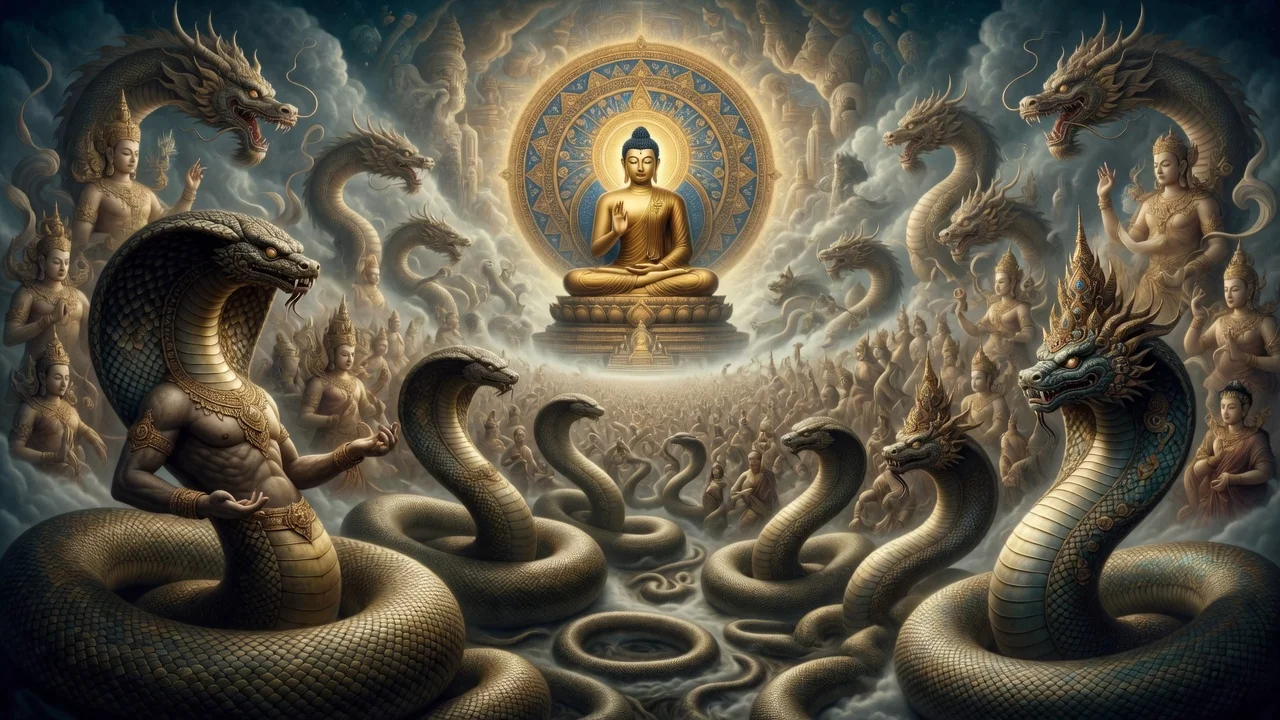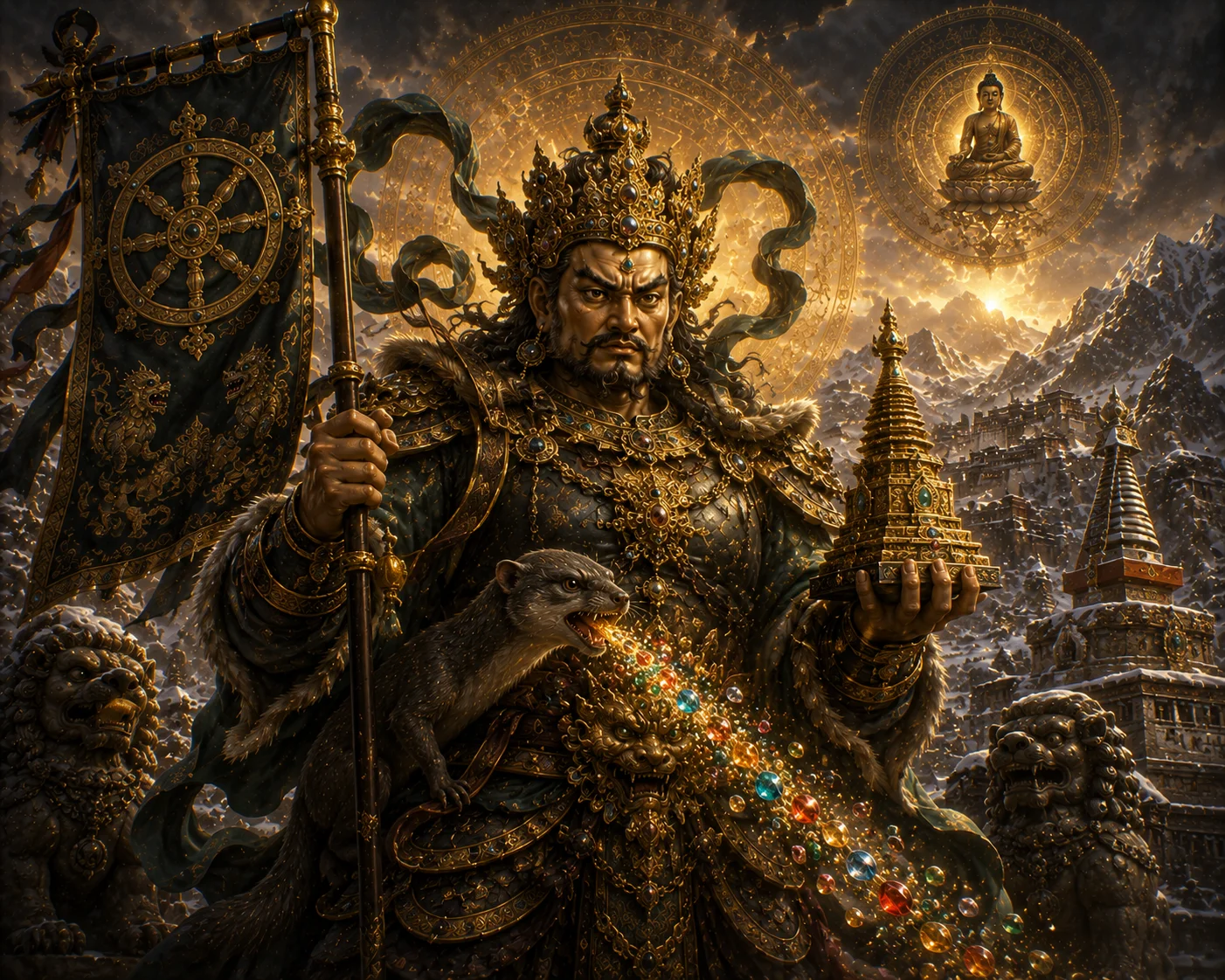
Vajrapani, the Holder of the Vajra, is the great bodhisattva of spiritual power and the fierce protector of the Lord Buddha and the dharma: the wielder of the thunderbolt-diamond, the embodiment of the energy and might of all the Lord Buddhas. Across the long unfolding of the Buddhist tradition, from the stone reliefs of Gandhara to the temple gates of Japan, he stands as the guardian whose wrath is compassion turned outward, clearing the path of every obstacle that would bar a being from awakening.
The Thunderbolt Given Form
Vajrapani's name and nature are bound to the vajra, the thunderbolt-diamond, the indestructible weapon and the symbol of the irresistible, adamantine power of enlightenment. He bears the vajra as a sign that he holds the spiritual force and might of all the Lord Buddhas, the power to overcome every obstacle on the path. The vajra cuts, but what it cuts is ignorance; it strikes, but what it strikes down are the inner and outer forces that would keep a being from liberation. In this way the weapon in his hand is never a weapon of conquest for its own sake, but the visible sign of an indestructible clarity, the diamond nature of awakened mind itself, wielded on behalf of all who still struggle in delusion.
An Attendant Beside the Awakened One
Vajrapani is counted among the earliest bodhisattvas to appear in Buddhist art, present already in the sculpture of Gandhara and Mathura in the early centuries of the common era, standing as an attendant figure at the Lord Buddha's side. In these earliest images he was given a powerful, muscular form, shaped in a manner that drew on the Hercules and Heracles imagery familiar to the Greco-Buddhist artistic world of Gandhara, where Hellenistic sculptors and Buddhist patrons worked within a single shared visual language. Long before he was rendered as a wrathful tantric deity blazing in flame, he was imagined simply as strength incarnate, the physical and spiritual bodyguard walking in the shadow of the Awakened One, present at his side to guard him from danger and to clear the way before him.
The Thunderbolt-Bearing Spirit of the Ambattha Sutta
In the Pali Canon's Ambattha Sutta, found within the Digha Nikaya, a yakkha, a spirit of formidable power, appears above the head of a brahmin youth named Ambattha, wielding a blazing thunderbolt and threatening to strike his skull to pieces should he refuse to answer the Lord Buddha honestly. This spirit is named Vajirapani, thunderbolt-in-hand, and scholars of Buddhist art and literature, among them Alfred Foucher, have long argued that this fierce yakkha of the early canon is a proto-form, a textual precursor standing behind the later Mahayana bodhisattva who bears the same name and the same weapon. The connection between the two is a scholarly reconstruction rather than an explicit doctrinal lineage laid out within a single canonical text, and it should be honored as such: an inference built from the shared name, the shared thunderbolt, and the shared role as an enforcer of truth and protector at the Lord Buddha's side, rather than as settled scripture. Even so, the resemblance is striking, and it offers a rare glimpse of how the wrathful protector may have entered the tradition first as a spirit compelling honesty, only later blossoming into a bodhisattva embodying the power of every Lord Buddha.
The Taming of Mahesvara
Among the narrative traditions of Vajrayana Buddhism is told the account of Vajrapani's subjugation of Mahesvara, a wrathful form of the Hindu deity Shiva, along with other deities who stood outside the Buddhist fold. In this taming myth, Vajrapani does not destroy these powerful beings but forcibly subdues them, binding them into service as protectors of the dharma, their fierce energy redirected from opposition into guardianship. This subjugation narrative appears across a number of Vajrayana sources, though its details shift from text to text and from lineage to lineage, and it should be understood as tradition-specific rather than as a single fixed account shared identically by every school. What the story preserves, in whatever form it is told, is a memory of how local and Brahmanical deities came to be absorbed into the Buddhist pantheon: not erased, but tamed, their power recognized and turned in service of the teaching rather than against it.
Wrath Without Anger
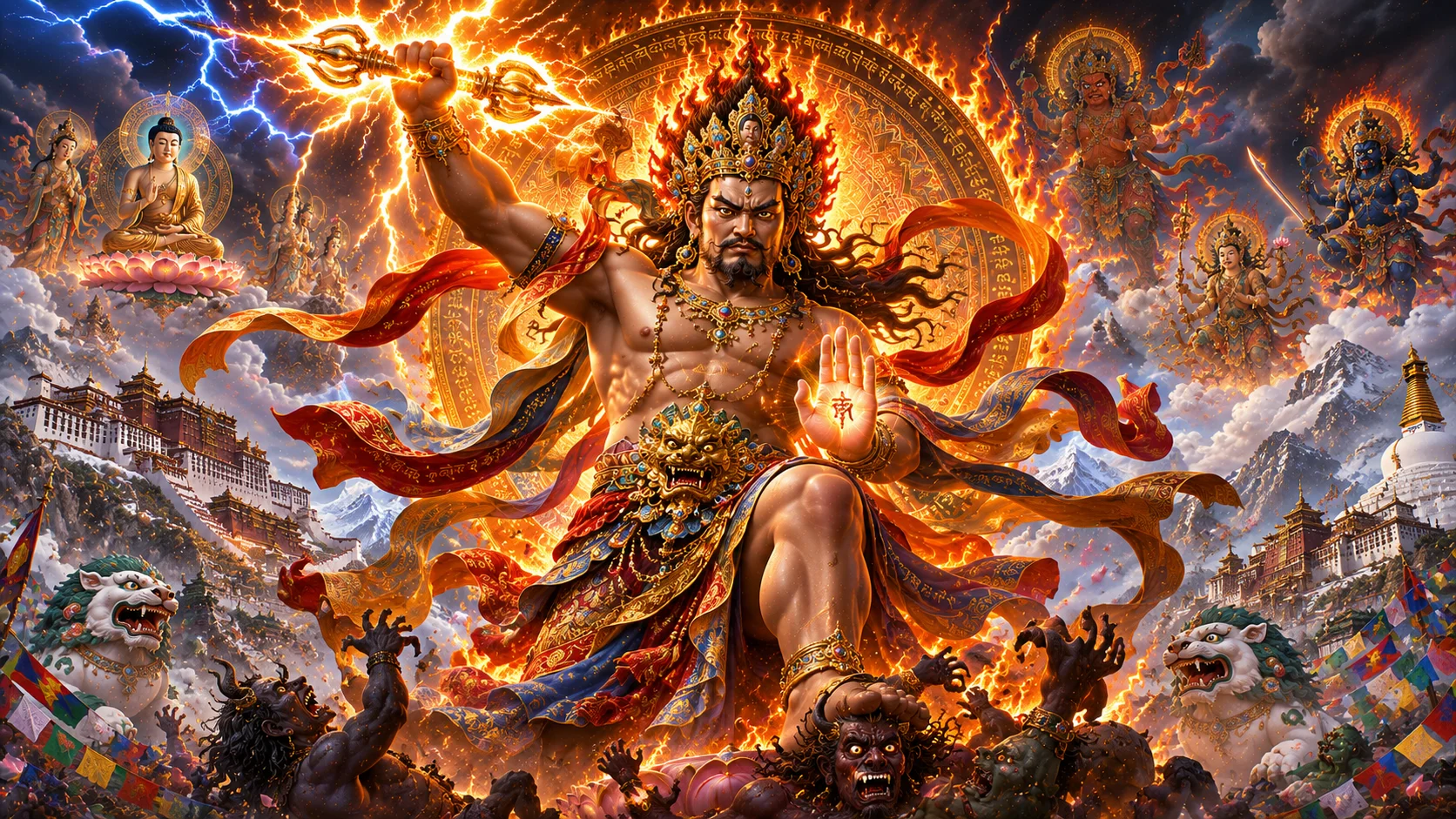
Vajrapani is most often depicted in a wrathful, fearsome form: blue or dark-skinned, muscular, blazing with surrounding flame, his face fierce, the vajra raised aloft, sometimes adorned with a flayed tiger skin or serpents coiled about his limbs, his stance one of active aggression directed at obstacles and demons. This fierceness is not anger in the ordinary sense. It is the dynamic, compassionate power that protects the teaching and the practitioner, subduing evil beyond the self and the inner demons of delusion and ignorance within the self alike. The wrath serves a single purpose: to clear away whatever stands between a being and awakening, whether that obstacle wears the face of a hostile spirit or the quieter, more persistent face of one's own confusion.
Guhyapati, Lord of Secrets
In certain Vajrayana texts, Vajrapani is identified as Guhyapati, the Lord of Secrets, keeper of the esoteric tantric teachings entrusted only to those prepared to receive them. This epithet places him not only as a protector who wards off external danger but as a guardian of the innermost teachings themselves, the one who holds and safeguards what is most hidden and most potent within the tradition. Alongside Guhyapati, he is known across the many linguistic traditions of Buddhism by names that all circle back to the vajra he bears: Channa Dorje, or Chakna Dorje, hand-holding-vajra, in the Tibetan tongue; Kongoshu, or Shukongoshin, in Japanese. Naming conventions for his various wrathful forms, among them Vajrapani Mahabala and forms adjacent to the fierce protector Ucchushma, vary considerably from lineage to lineage, and cross-tradition equivalences between these named forms should be treated as approximate rather than exact.
One of the Three Family Protectors
In Tibetan Buddhism, Vajrapani is honored as one of the three great protector bodhisattvas, the Rigsum Gonpo, standing alongside Avalokiteshvara, who embodies compassion, and Manjushri, who embodies wisdom. Together the three represent the full nature of Buddhahood in a single triad: wisdom to see clearly, compassion to act gently, and power to protect and to overcome. Vajrapani's place within this trinity is the power and energy of all the Buddhas, the force that makes wisdom and compassion effective in a world that does not yield easily. He is also numbered in some tantric systems among the Eight Great Bodhisattvas, and is regarded more broadly as the spiritual manifestation of the bala, the power, of every Lord Buddha who has ever attained awakening.
Named for the Diamond Vehicle
Vajrapani holds particular importance within Vajrayana, the Diamond Vehicle, whose very name echoes the indestructible thunderbolt-diamond he carries. As a dharmapala, a protector of the teachings, he stands at the threshold of the esoteric path, associated with the taming of wrathful and hostile forces both mythological and psychological, the obstacles that rise up from without and the afflictions that rise up from within. His presence in this tradition is not incidental. The Diamond Vehicle takes its name and its central symbol from the very weapon he bears, and his wrathful, protective energy is woven into the fabric of how that vehicle understands the path to awakening: a path that requires not only wisdom and compassion but also the unbreakable power to cut through every obstruction in the way.
The Guardians at the Temple Gate
In the Buddhist traditions of China and Japan, Vajrapani's guardian function passed into a striking later development: the Nio, or Kongorikishi, the two wrathful temple-gate guardians whose muscular, fearsome statues flank the entrances to Buddhist temples across Japan, among them the great gate at Todai-ji. These two figures, known as Agyo and Ungyo, one with mouth open and one with mouth closed, are understood as emanations or dual manifestations of Vajrapani, his single protective power divided into a pair standing eternal watch. This development is widely attested in the art and architecture of East Asian Buddhism, and it is distinct from, though descended from, the original Indian bodhisattva of the earlier tradition, a testament to how far a single protective figure could travel and how many forms his guardianship could take while carrying forward the same essential function: to stand between the sacred and whatever would threaten it.
The Power That Clears the Way
Across every form he takes, from the muscular attendant of Gandharan stone to the flame-wreathed wrathful deity of the tantras to the paired guardians at a temple gate, Vajrapani's role remains constant: he is the power of enlightenment made active in the world, clearing the way for beings to walk the path the Lord Buddha opened. Where Manjushri gives the path its clarity and Avalokiteshvara gives it its tenderness, Vajrapani gives it its strength, the unbreakable will that does not falter before obstruction. He does not fight for the sake of victory. He fights, when he fights, because the dharma must reach those who need it, and because the demons of ignorance, whether they wear a fearsome outer form or hide quietly within the mind, must be met with a force equal to their resistance.
The Enduring Vajra
In Vajrapani, the tradition gave form to the protective power of enlightenment: the fierce, vajra-wielding bodhisattva who once walked beside the Lord Buddha as guardian, who in the old canon threatened a thunderbolt against dishonesty, who in the tantric imagination tamed even hostile deities into guardianship, and who came to stand, in stone, at temple gates across Asia. He embodies the irresistible, adamantine might of all the Lord Buddhas turned wholly to the protection of the teaching and the liberation of beings, a power that destroys nothing it need not destroy and yields to nothing that would stand in the way of awakening.
Sources & traditions
- EncyclopediaWikipedia — Vajrapani
- TraditionBuddhist texts, oral tradition and village tellings (South/Southeast Asia)
Myths change from area to area and from time to time. This chronicle follows the most widely told versions; tellings in other villages, regions and eras may differ.