Marīci, whose name means "ray of light" and also "mirage," is a Buddhist goddess of the dawn, invoked as a protectress who moves before the sun and can be neither seen, seized, nor harmed. Drawn originally from an earlier Brahmanical solar-associated figure, she was reconceived within Vajrayana and Mahayana traditions as a bodhisattva-protectress rather than a Vedic deity proper, and she is venerated under her many names: Mārīcī in Sanskrit, Mo-li-zhi-tian in Chinese, and Marishi-ten in Japan, where she is honored with the further title Tenkō, "Queen of Heaven," a designation of later Japanese elaboration rather than canonical Indian usage.
Ray of Light, Shimmer of Mirage
Marīci's very name holds two meanings at once: a ray of light, and the shimmering illusion of a mirage on the horizon. Both senses converge in her identity as goddess of the dawn, the herald who runs before the rising sun. She is not the sun itself but its outrider, the brightening at the edge of night that announces the sun's coming without yet being sunlight in full. This dual nature, of true radiance and elusive illusion together, is the foundation of everything she is asked to do for those who call upon her. A ray can travel where nothing solid can follow; a mirage cannot be walked into and taken hold of. Devotion to Marīci begins from this simple, almost riddling image and builds an entire protective cult upon it.
The Goddess No Enemy Can Seize
The central claim of Marīci's cult is soteriological in a very practical sense: because she is light and mirage, she cannot be seen, caught, known, deceived, bound, or harmed by any adversary. One cannot lay hands upon a ray of light or capture a mirage in a net. Her devotees hold that this same imperceptibility can extend to them. She is therefore invoked above all as a goddess of concealment, protection, and swift, unhindered movement, sought for safety in travel and in combat rather than for wisdom teachings or paths to liberation. This is not a minor accent among her attributes; it is, in her tradition, described as the core soteriological and protective claim of her entire cult — the single idea from which her scripture, her iconography, and her later reception all radiate outward.
From Brahmanical Sun to Buddhist Protectress
Marīci did not begin inside Buddhist cosmology. She is understood to descend from an earlier Brahmanical figure associated with solar light, absorbed over time into Vajrayana and Mahayana pantheons and given a new identity there. Within Buddhist reckoning she is not treated as a Vedic deity carried over unchanged, but reconceived specifically as a bodhisattva-protectress, her older solar association repurposed toward the particular work of shielding the devotee from harm. This kind of adoption and transformation, rather than simple borrowing, is characteristic of how her cult took shape, and it is worth holding in mind whenever her iconography seems to echo something older: the echo is real, but the identity underneath it has changed.
The Dhāraṇī That Renders the Practitioner Unseen
Marīci's principal scripture belongs to the Mārīcī-dhāraṇī corpus, most notably the Fo shuo Mo li zhi tian jing, the Sutra of the Goddess Marīci, preserved in the Chinese Buddhist canon in multiple translations, including one attributed to the eighth-century master Amoghavajra. Chanting her dhāraṇī is said to render the practitioner invisible and unharmable, a protection sought especially in the peril of battle or danger. That these translations span from the Tang dynasty onward, in several distinct renderings, shows a cult that was actively transmitted and expanded across East Asia over centuries, rather than fixed to a single unchanging text. Each new translation was less a replacement of the last than a fresh vessel for the same recitative promise, carried forward by successive generations of practitioners who found the dhāraṇī's protection worth preserving in their own tongue and time.
Three Faces Turned Toward the Threat
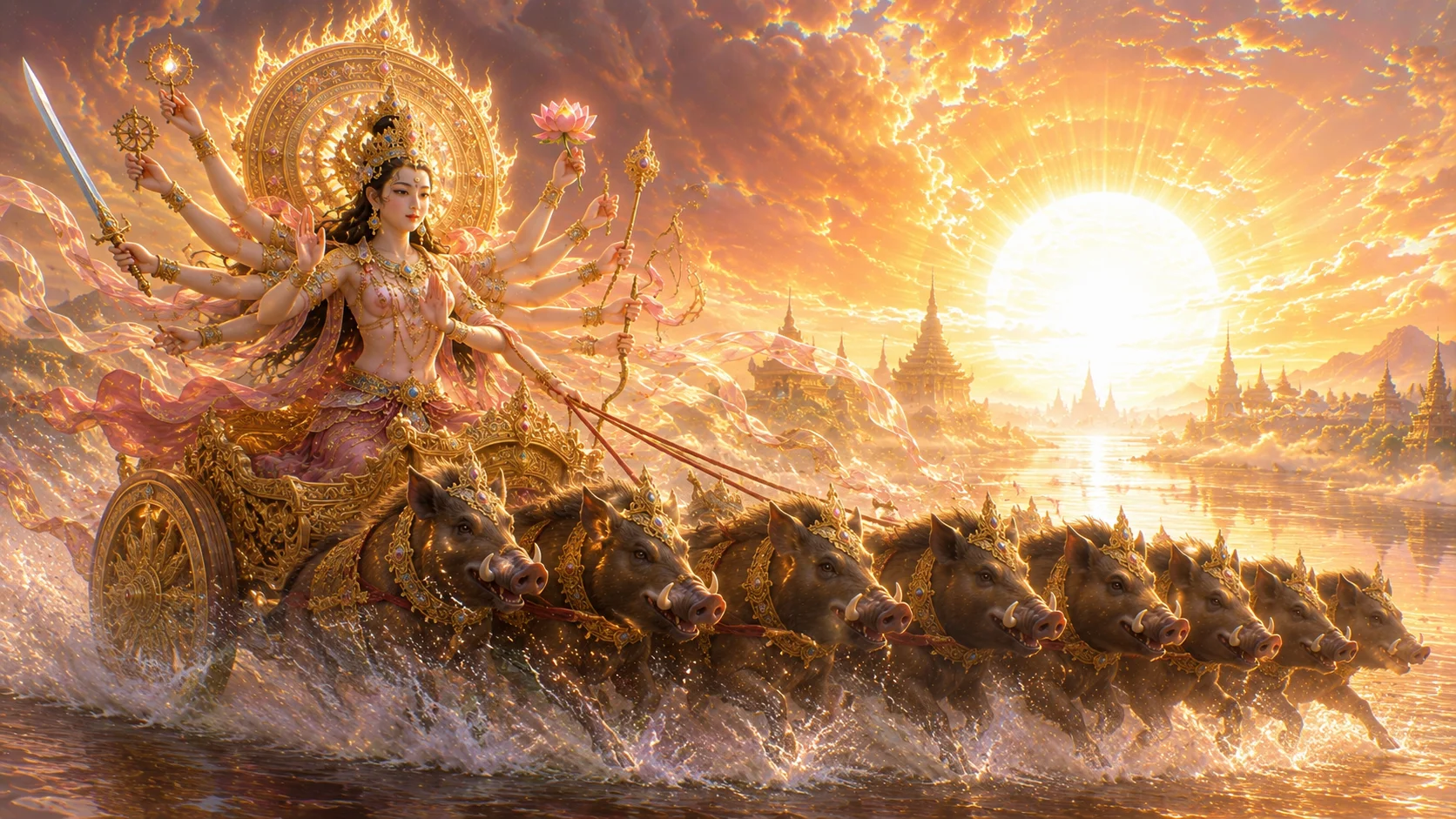
Marīci's most common iconographic form gives her three faces, one of them boar-faced and at times wrathful, and eight or sometimes six arms, a body built for vigilance in every direction at once. The multiplicity of faces mirrors her function: a protectress who watches on behalf of the traveler or the warrior against dangers that may come from any side, seen or unseen. Where a single face can only look one way, three faces refuse any blind angle, and the wrathful cast of the boar face signals that her protection, gentle as its underlying logic of light and mirage may be, is prepared to meet real danger with real ferocity.
The Chariot of Seven Boars
She is most often shown riding a chariot drawn by seven boars, or in some renderings a single sow, racing ahead of the sun's own passage across the sky. The boar as her vehicle links her iconographically, though not doctrinally, to the Hindu boar-goddess Vārāhī, a resemblance scholars such as Elizabeth English have noted in studies of Vajrayana goddesses as a case of iconographic convergence between traditions rather than any identity between the two figures. Marīci's boars root and burrow and are notoriously hard to catch, an apt mount for a goddess defined by being uncatchable herself. The image of seven boars in harness, straining ahead of the dawn, gives visible, almost kinetic form to an abstract claim: that she is always already moving faster than whatever pursues her.
Needle, Bow, and Fan: The Tools of Concealment
In some depictions Marīci holds a needle and thread, said to sew shut the eyes and mouths of enemies in symbolic blinding and silencing, alongside a bow, an arrow, a vajra, and a fan. These attributes vary considerably between Chinese, Japanese, and Tibetan renderings of her, and no single fixed set of implements should be taken as universal across the tradition; what remains constant is their character as instruments of concealment, obstruction of the enemy's senses, and swift protective force. The needle and thread in particular render her core promise almost literally: an enemy who cannot see or speak is an enemy who cannot find or curse the one under her protection, the goddess's own imperceptibility turned outward as a weapon against those who would do harm.
Among the Protective Goddesses
Within some Vajrayana enumerations, Marīci is classed among a group of protective and wrathful goddesses that includes Ekajaṭā and Kurukullā. She is at times associated as well with the solar imagery surrounding the retinue of Lord Vairocana Buddha, though she herself is not counted among the eight great bodhisattvas. Her place, rather, is among the guardian figures whose office is protection and swift intervention rather than the exposition of doctrine. This positioning matters for understanding her correctly: she stands alongside other fierce, defending goddesses as a peer in function, not beneath or above them in a hierarchy of realization, and her nearness to Vairocana's retinue is a matter of shared solar imagery rather than any closer doctrinal bond.
A Deity Distinct From the Sun She Precedes
Despite her deep association with dawn and light, Marīci is textually and iconographically distinct from other luminous figures within Buddhist cosmology. She is not an epithet of Vairocana, the cosmic Lord Buddha of light, nor of Prabhūtaratna. Conflating her with these solar Buddha-figures is a common but mistaken simplification; Marīci precedes and heralds the sun, but she is not herself a solar Lord Buddha, and her particular cult of protection and invisibility belongs to her alone. The distinction is not a fine scholarly point but a matter of properly honoring who she is: a protectress with her own scripture, her own iconography, and her own devotional history, not a poetic stand-in for a Lord Buddha of greater cosmological rank.
Marishi-ten and the Way of the Warrior
In Japan, Marīci was received as Marishi-ten and became, from roughly the Kamakura period onward, a major protective deity for the samurai class. Warriors of lineages including the Minamoto and those who followed venerated her for the promise of battlefield invisibility and invincibility, a devotion well attested in Japanese religious history, even where the specific anecdotes attached to individual warriors vary from source to source and some remain legendary or unverifiable rather than documented fact. For a class of men whose lives depended on being faster and less visible than the enemy's blade, a goddess who outran the sun itself and could not be seized was a natural and enduring object of devotion, and her cult among the samurai stands as one of the clearest examples of how a protective dhāraṇī tradition could take root in the particular anxieties of an entire warrior culture.
Syncretic Threads in Later Esoteric Practice
In certain later Japanese esoteric, or mikkyō, traditions, Marishi-ten came to be merged or associated with Sarasvatī or with particular star deities in locally specific syncretic developments. These associations belong to particular lineages and localities and should not be presented as pan-Buddhist doctrine; they illustrate how a cult transmitted across centuries and regions naturally gathered new resonances in each community that received it, without those local elaborations becoming universal teaching. A practitioner encountering Marishi-ten linked to Sarasvatī in one mikkyō lineage should understand this as that lineage's own devotional development, not as a fact about Marīci that holds everywhere she is venerated.
Light Invoked for the Road and the Battlefield
Across her many forms and names, Marīci's devotees have turned to her for one consistent purpose: safety in motion, whether the motion of a merchant's caravan on a dangerous road or a warrior advancing into battle. She is not approached primarily for insight into the nature of suffering or the path to awakening, but for the immediate and practical grace of arriving unharmed, unseen by what would do one harm, moving as swiftly and as elusively as the light that outpaces the rising sun. This practical, almost workaday character of her cult — invoked before a journey or before a fight, not before a long retreat of contemplation — is part of what has kept her devotion alive and specific across so many centuries and regions.
The Dawn That Cannot Be Held
Marīci endures in Buddhist devotion as the goddess who cannot be caught, precisely because she is made of the two things that slip through every grasp: light and mirage. She rides before the sun on her chariot of boars, three-faced and many-armed, sewing shut the eyes of danger and offering to those who invoke her dhāraṇī a share in her own unseizable nature. In her, an ancient solar figure was carried into Buddhist practice and given a purpose entirely her own: protector of the traveler, guardian of the warrior, the first light that no enemy can hold.
Sources & traditions
- EncyclopediaWikipedia — Marici (Buddhism)
- TraditionBuddhist texts, oral tradition and village tellings (South/Southeast Asia)
Myths change from area to area and from time to time. This chronicle follows the most widely told versions; tellings in other villages, regions and eras may differ.