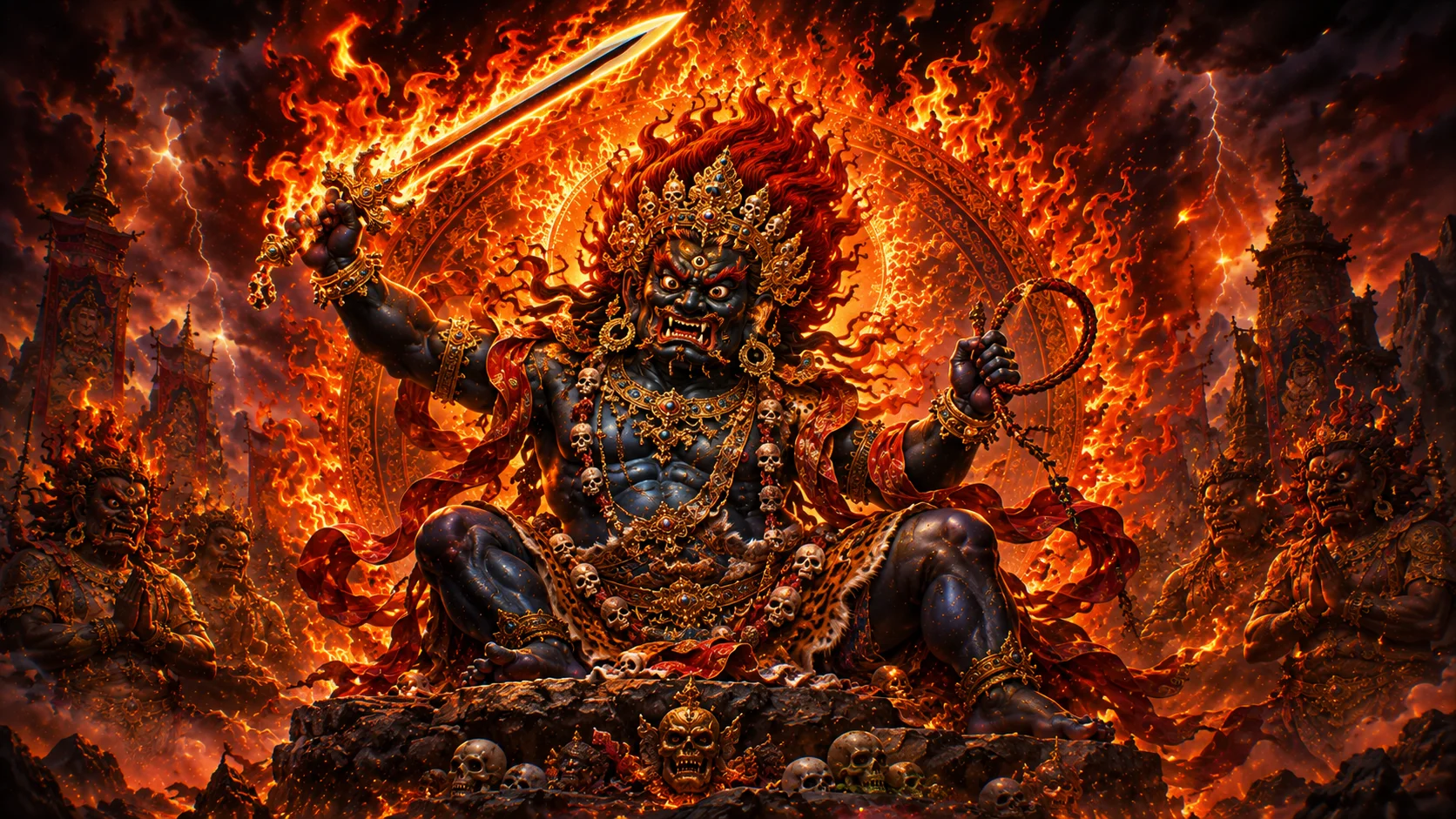
Acala, the Immovable One, is the fierce, wrathful protector of the dharma, the foremost of the Wisdom Kings, Vidyaraja: a terrifying deity wreathed in flame, wielding a sword and a noose, who burns away delusion and binds the wicked, the unshakable guardian of the Buddhist path.
A Name That Means Unshaken
Acala's name, from the Sanskrit, means the immovable, the unshakable, and it names both his posture and his purpose: he does not waver, does not retreat, does not soften his resolve to carry every being toward awakening. In Japan he is known as Fudō Myōō (不動明王), and in China as Bùdòng Míngwáng, both titles carrying the same sense of fixed, rocklike steadfastness. Devotees in Japan often address him simply as Fudō-son (お不動さん), an honorific of great warmth that sits oddly beside his terrifying appearance, and speaks to how deeply personal his cult became even as his iconography stayed fearsome.
Wrath in the Service of Compassion
Acala is the foremost of the Five Wisdom Kings, the Vidyārāja, who in Vajrayana and East Asian Esoteric Buddhism are understood not as independent gods but as wrathful emanations of the Buddhas themselves, called forth when peaceful teaching alone cannot reach a being. Acala in particular is held to manifest from Lord Mahāvairocana Buddha, known in Japan as Dainichi Nyorai, the cosmic Lord Buddha whose radiance is said to fill the universe. Where Mahāvairocana teaches with serenity, Acala acts with force, turning to subdue obstacles, hostile beings, and above all the inner defilements, the kleshas, that resist gentler persuasion. This is the standard Vajrayana logic of the wrathful deity: ferocity as compassion wearing armor, a skillful means, upāya, deployed only because the situation demands it.
Roots in the Tantric Texts of India
Acala's textual lineage begins in Indian Vajrayana sources, most notably the Mahāvairocana Tantra, known in Chinese translation as the Dari jing, along with related esoteric scriptures that describe his form and function. These teachings crossed into China in the eighth century, carried and rendered into Chinese by the translator-monks Śubhakarasiṃha and Amoghavajra, whose work anchored the esoteric Zhenyan tradition. From China the transmission continued to Japan in the early ninth century through Kūkai, posthumously honored as Kōbō Daishi, the founder of the Shingon school, who brought the teachings, rituals, and iconography of Acala into a Japanese context where they would flourish for over a thousand years.
The Rock, the Flame, and the Blade
Standard iconography renders Acala with a fierce, glaring expression built to unsettle rather than reassure: in many depictions one fang points upward while the other points down, or one eye is squinted where the other stares wide, an asymmetry that unbalances the viewer on purpose. He is shown seated or standing upon a rock, a base that embodies his immovability, his refusal to be shifted from his purpose. Around him roars a great halo of flame, understood as the purifying fire of wisdom that consumes worldly desire and delusion rather than the being caught within it. In his right hand he holds a sword, called in Japanese tradition the kurikara-ken, meant to cut through ignorance at its root; in his left he carries a lasso or rope, the kensaku, used to bind and subdue those who resist the dharma, or, read more mercifully, to pull suffering beings back from harm.
The Two Youths at His Side
Acala is frequently shown attended by two youthful figures, dōji, most commonly identified as Kongara Dōji, corresponding to Kiṃkara, and Seitaka Dōji, corresponding to Cetaka. Together with Acala this pair forms the standard triad found throughout Japanese Fudō imagery, a grouping so familiar that a triptych of the three figures is instantly recognizable at Shingon temples. Shingon iconographic texts also attest a fuller retinue, the Eight Great Youths, Hachi Dai Dōji, an expanded court that surrounds the Wisdom King in more elaborate ritual paintings and mandalas, though the two-youth triad remains the form most widely venerated.
First Among the Five Great Kings
As head of the Five Great Wisdom Kings, known in Japanese as the Godai Myōō, Acala stands at the center of a fivefold formation that also includes Gōzanze, corresponding to Trailokyavijaya, Gundari, corresponding to Kuṇḍali, Daiitoku, corresponding to Yamāntaka, and Kongōyasha, corresponding to Vajrayakṣa. Each of the five guards a cardinal direction, with Acala typically occupying the center, a placement that mirrors the five directional Buddhas of the Vajradhātu and Garbhadhātu mandala systems that sit at the heart of Shingon cosmology. In this arrangement Acala is not merely one wrathful figure among several but the axis around which the entire protective mandala turns.
A Presence Beyond Japan's Shores
Acala's name and cult extend beyond Japan into Chinese esoteric Buddhism, known there as Tangmi, and, through separate transmission lines, into Nepalese Newar Buddhism and Tibetan Vajrayana, traditions that venerate wrathful protector figures sharing overlapping iconographic features: the flaming aureole, the sword, the noose. Even so, it is within the East Asian Shingon and Tendai esoteric traditions that Acala as a distinct, systematically elaborated figure receives his fullest and most consistent treatment, rather than appearing uniformly under that exact identity across every Vajrayana lineage. Scholars have also noted a related wrathful tantric figure, Caṇḍaroṣaṇa, the Violent Wrathful One, whose iconography overlaps with Acala's in some contexts; whether the two represent a single identity or two distinct but resonant figures remains a genuine area of scholarly caution rather than settled fact, and is best held as an open question rather than a resolved equivalence.
Patron of the Mountain Ascetics
In Japanese religious history Acala, as Fudō, became closely bound to Shugendō, the tradition of mountain ascetic practice followed by the yamabushi. These practitioners adopted him as a patron deity for austerities that draw directly on his fire and purification symbolism, most visibly the practice of standing beneath sacred waterfalls, takigyō, and the fire rituals known as goma or homa. Waterfall austerity places the practitioner's body directly beneath falling water as an act of purification and endurance, while the goma fire ritual invokes Acala's flame in a structured liturgical setting rather than in the open air. In both practices Acala's flame is not merely depicted but enacted: the ascetic seeks, through cold water or consuming fire, the same burning away of defilement that the deity's halo represents in painted and sculpted form, undertaking the discipline under his protection and in imitation of his unmoving resolve.
The Sticks That Feed the Flame
Among Shingon and Tendai's living liturgical practices, the goma fire ritual holds a central place, and within it Acala is the deity specifically invoked to burn away the kleshas, the mental afflictions that bind beings to suffering. These afflictions are given physical form in the ritual as wooden sticks, gomagi, inscribed with the practitioner's aspirations or troubles and offered into the ritual fire. As the sticks burn, the rite enacts, in miniature and in the present moment, the same purifying fire that wreathes Acala's painted and sculpted image, turning iconography into lived practice rather than leaving it as static symbol.
Words Spoken in His Name
Acala occupies a central place in Shingon ritual practice as an object of daily recitation, associated in later Sino-Japanese doctrinal schemes with specific mantra formulas. Among practitioners, the Fudō Myōō shingon, rendered as "Nōmaku sanmanda bazaradan kan," is recited as part of regular devotional and ritual life, a verbal counterpart to the goma fire and the waterfall austerity: three different disciplines, water, fire, and voice, all oriented toward the same unmoving figure and the same aim of burning through delusion.
Temples Where the Flame Still Burns
Numerous cult sites and temple traditions grew up around Fudō Myōō in Japan, among them the grouping known as the Five Fudō, Godai Fudō, found in temples across Kyoto, each housing its own image of the Wisdom King. Acala is also closely associated with Narita-san Shinshō-ji, one of Japan's most visited Shingon temples, whose enduring popularity reflects a devotional life that runs alongside, and sometimes ahead of, his formal tantric doctrinal role. Where the mandala systems and the Five Wisdom Kings belong to the structured cosmology of Shingon theology, the crowds at Narita-san reflect something more immediate: a protector figure people turn to directly, in the present, for present concerns.
An Image Carried Into the Present Day
Modern popular reception of Fudō Myōō in Japan is extensive, and it is worth holding apart from the canonical doctrinal role described above. His fierce image appears widely in tattoo art, irezumi, is found on statuary at temples associated with the martial arts, and surfaces in contemporary media referencing his fire and blade. This popular-culture presence is best understood as a folk and cultural extension layered atop the older tantric tradition rather than a part of it, evidence of how far a wrathful protector's image can travel once it leaves the mandala, even as the doctrinal figure it descends from continues to be venerated in temple and liturgy exactly as it always was.
Sources & traditions
- EncyclopediaWikipedia — Acala
- TraditionBuddhist texts, oral tradition and village tellings (South/Southeast Asia)
Myths change from area to area and from time to time. This chronicle follows the most widely told versions; tellings in other villages, regions and eras may differ.