Vairocana — “the Illuminator,” the Great Sun Buddha — is the supreme cosmic Lord Buddha of the Mahayana and Vajrayana traditions: the primordial, all-illuminating Lord Buddha who embodies the dharmakaya, the very body of ultimate truth, and from whom all other Lord Buddhas emanate. He is the radiant centre of the Buddhist cosmos, the Lord Buddha as the eternal principle of enlightenment itself.
The Universal Illuminator
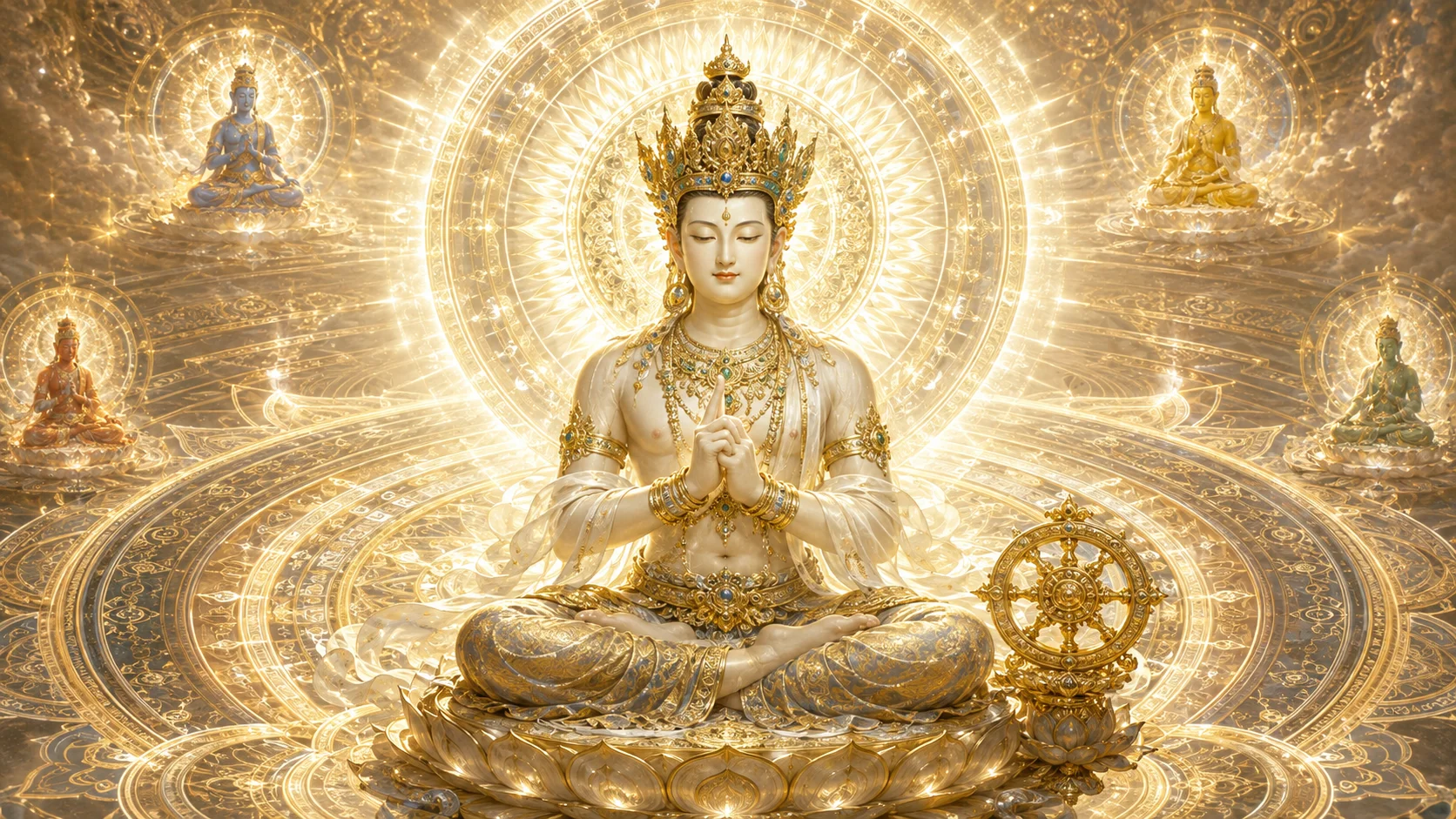
Vairocana’s name means “belonging to or coming from the sun,” the “Illuminator” or “the one who is like the sun.” He represents the dharmakaya — the “truth body” of the Lord Buddha, the absolute, formless reality of enlightenment that underlies all things and from which all phenomena and all Lord Buddhas arise. He is not a historical teacher but the cosmic, universal Lord Buddha, the embodiment of sunyata (emptiness) and of the all-pervading light of awakening. In the Five Wisdom Buddhas (the Dhyani Buddhas), Vairocana most often occupies the centre, the source from which the other four radiate.
The Great Sun of the East
Vairocana rose to supreme prominence in East Asian Buddhism. In the esoteric (Shingon) Buddhism of Japan he is Dainichi Nyorai, the “Great Sun Buddha,” the central and supreme Lord Buddha of the entire cosmos, of whom all other Lord Buddhas and deities are aspects. The colossal Great Buddha (Daibutsu) of Todai-ji in Nara is an image of Vairocana, one of the largest bronze images of the Lord Buddha in the world. In Chinese Buddhism he is Pilushena, and his image presides over many of the great temples. He is the Lord Buddha of the centre, associated with the colour white, the element of space or ether, and the wisdom of the dharmadhatu, the realm of ultimate reality.
The Body of Truth
To contemplate Vairocana is to contemplate the ultimate nature of reality itself — the truth that the enlightened mind perceives, the radiant emptiness and luminosity that is the ground of all existence. In the great cosmic mandalas of esoteric Buddhism, Vairocana sits at the centre, surrounded by the other Lord Buddhas and bodhisattvas who are his emanations, the whole forming a map of the enlightened cosmos. In Vairocana, the Mahayana and Vajrayana gave form to the supreme principle of Buddhahood — the Great Sun, the Illuminator, the cosmic Lord Buddha who is the body of truth itself, the radiant ground from which all the Lord Buddhas shine forth.
The Lord Buddha of the Flower Garland
Before Vairocana became the Great Sun of Japan, he was already the sun of an older text: the Avatamsaka Sutra, the “Flower Garland” scripture that Chinese Buddhists called the Huayan Jing. There, Vairocana does not simply sit at the centre of a mandala — he is the mandala, the whole of existence rendered as a single body. The sutra names his realm the Lotus Treasury World, an ocean of world-systems blooming outward from a single flower. A related scripture, the Brahma Net Sutra, sharpens that image into the form Japan would inherit: Vairocana enthroned on a thousand-petalled lotus, every petal a world of its own with its own Shakyamuni preaching inside it. The other image the tradition reaches for is Indra’s net — an infinite web strung with a jewel at every knot, each jewel reflecting, perfectly and without diminishment, every other jewel in the net. Nothing exists in isolation; everything interpenetrates everything else. This became Vairocana’s deepest teaching, and it produced its own school — Huayan in China, Kegon in Japan — built entirely around a universe in which every phenomenon contains all others.
It is this Vairocana, not the Vairocana of the later esoteric tantras, who was cast in bronze at Todai-ji. The temple belonged to the Kegon school, and its Great Buddha is formally Birushana — the Japanese rendering of Vairocana as the Avatamsaka knows him — a figure doctrinally distinct from, yet later identified with, the Dainichi Nyorai of Shingon esotericism. The two names mark two different roads by which the same cosmic principle entered Japan.
The Tantra That Founded an Esoteric Buddhism
Vairocana’s second, and for esoteric Buddhism far more consequential, arrival came through a single text: the Mahavairocana Tantra, translated into Chinese in 724 by the Indian missionary Subhakarasimha working alongside the monk-astronomer Yixing. Here Vairocana appears as Mahavairocana, the Great Vairocana, expounding the teaching to the bodhisattva Vajrapani, the “Lord of Mysteries,” from a realm that is not a physical location at all but reality itself, laid bare. Paired with a second body of teaching, the Vajrasekhara scriptures, the Mahavairocana Tantra became one of the two root texts of the entire esoteric tradition — called Zhenyan, “True Word,” in China and Shingon in Japan, both names taken from the mantras the tradition holds to be Vairocana’s own speech. Shingon goes further than most schools in the claim: its lineage of patriarchs does not begin with a human teacher at all, but with Vairocana himself, transmitting the teaching to the bodhisattva Vajrasattva before it ever reaches a mortal hand.
Two Mandalas, Two Hands
Esoteric Buddhism reads Vairocana through a pair of mandalas and depicts him differently in each. The Womb Realm mandala (Garbhadhatu, drawn from the Mahavairocana Tantra) shows him seated in meditation, hands folded in his lap in the dharmadhatu mudra, radiating compassion outward the way a womb nurtures what grows inside it. The Diamond Realm mandala (Vajradhatu, drawn from the Vajrasekhara teachings) shows him instead making the “wisdom-fist” — the raised index finger of his left hand sheathed inside his closed right hand — a gesture read as the indestructible clarity of enlightened knowledge closing around the world of appearances. Compassion and wisdom, womb and diamond: Shingon treats the two not as alternatives but as a single inseparable pair, the Ryokai, the two realms of one Lord Buddha.
Both mandalas reached Japan by the same route. The monk Kukai crossed to Tang China in 804, studied under the master Huiguo at Qinglong Temple in the capital, Chang’an, and received the transmission of both realms shortly before his teacher’s death in 805. Kukai returned to Japan in 806 carrying the mandalas, the texts, and the ritual implements of the lineage, and a decade later was granted Mount Koya, which became Shingon’s mountain seat. Everything the school teaches about Vairocana — his two aspects, his two mudras, his two mandalas — descends from that one transmission.
Casting a Nation’s Lord Buddha
The Todai-ji Daibutsu was not built as a devotional afterthought; it was built as an act of state. Japan in the 730s had been battered by a smallpox epidemic thought to have killed roughly a third of the population, carrying off four powerful ministers of the same clan within a single year, on top of famine and unrest. In 743 the Emperor Shomu ordered a colossal image of Vairocana raised, on the reasoning that if the sovereign gathered the resources of the entire realm behind one universal Lord Buddha, that Lord Buddha’s protection would in turn cover the whole nation. The choice of Vairocana was not incidental: a Lord Buddha who is the very source from which every other Lord Buddha and every corner of the cosmos emanates was the only figure whose authority could plausibly match an emperor claiming to rule the entire land. Todai-ji became the head of a nationwide network of provincial temples and convents, each a local outpost of the same cosmic order radiating outward from Nara.
The statue took the better part of a decade and was cast in eight successive stages. It was dedicated in 752 in the kaigen kuyo, the “eye-opening” ceremony, remembered as one of the largest religious gatherings of early Japanese history. An Indian monk, Bodhisena, who had travelled by land and sea to reach Nara, held the brush that painted in the statue’s eyes — the ritual act believed to bring the image to life — while monks, dancers, and musicians drawn from across Asia performed before the newly awakened Lord Buddha. The bronze that survives from that century is fragmentary, the head and hands having been recast after fire and war; but the petals of the lotus throne still carry engraved worlds, the Flower Garland cosmology hammered into metal at the Lord Buddha’s feet.
The Sun Buddha and the Sun Goddess
Centuries after Todai-ji’s dedication, Japanese religious thought closed a circle that the name Dainichi, “Great Sun,” had left invitingly open. Medieval theorists of honji suijaku — the doctrine that Japan’s native kami were local manifestations of Buddhist buddhas and bodhisattvas — identified Dainichi Nyorai as the honji, the “original ground,” of Amaterasu, the sun goddess and the divine ancestress claimed by the imperial line. The logic barely needed arguing: two solar sovereigns, one cosmic and one national, could be read as a single light wearing two faces. Shingon monks built an entire theology on the identification, known as Ryobu (“dual”) Shinto, binding the shrines of Ise to the mandalas of the esoteric tradition — the Inner and Outer Shrines read as the Diamond and Womb realms of a single Buddha-cosmos. The fusion held for centuries, until the Meiji government’s 1868 edict of shinbutsu bunri forcibly separated kami worship from Buddhist practice across Japan, dismantling Ryobu Shinto’s institutions with startling speed — though the older intuition, that the sun Buddha and the sun goddess were always two aspects of one light, has never entirely left Japanese religious memory.
Sources & traditions
- EncyclopediaWikipedia — Vairocana
- TraditionBuddhist texts, oral tradition and village tellings (South/Southeast Asia)
Myths change from area to area and from time to time. This chronicle follows the most widely told versions; tellings in other villages, regions and eras may differ.