The Pukwudgie is a small but dangerous and powerful being of the oral tradition of the Wampanoag people and the wider Algonquian-speaking nations of southern New England — a knee- to waist-high, troll- or gnome-like presence of the forests, at once mischievous, malevolent, and possessed of real supernatural power, who lures, torments, and sometimes destroys those who cross it. Among the most distinctive and feared beings of the Native storytelling of the northeastern woodlands, the Pukwudgie belongs to a living tradition, still carried, still told, still meaningful to the Wampanoag communities of Massachusetts today — and it is with that understanding that this account is offered.
The Little Being of the Woods
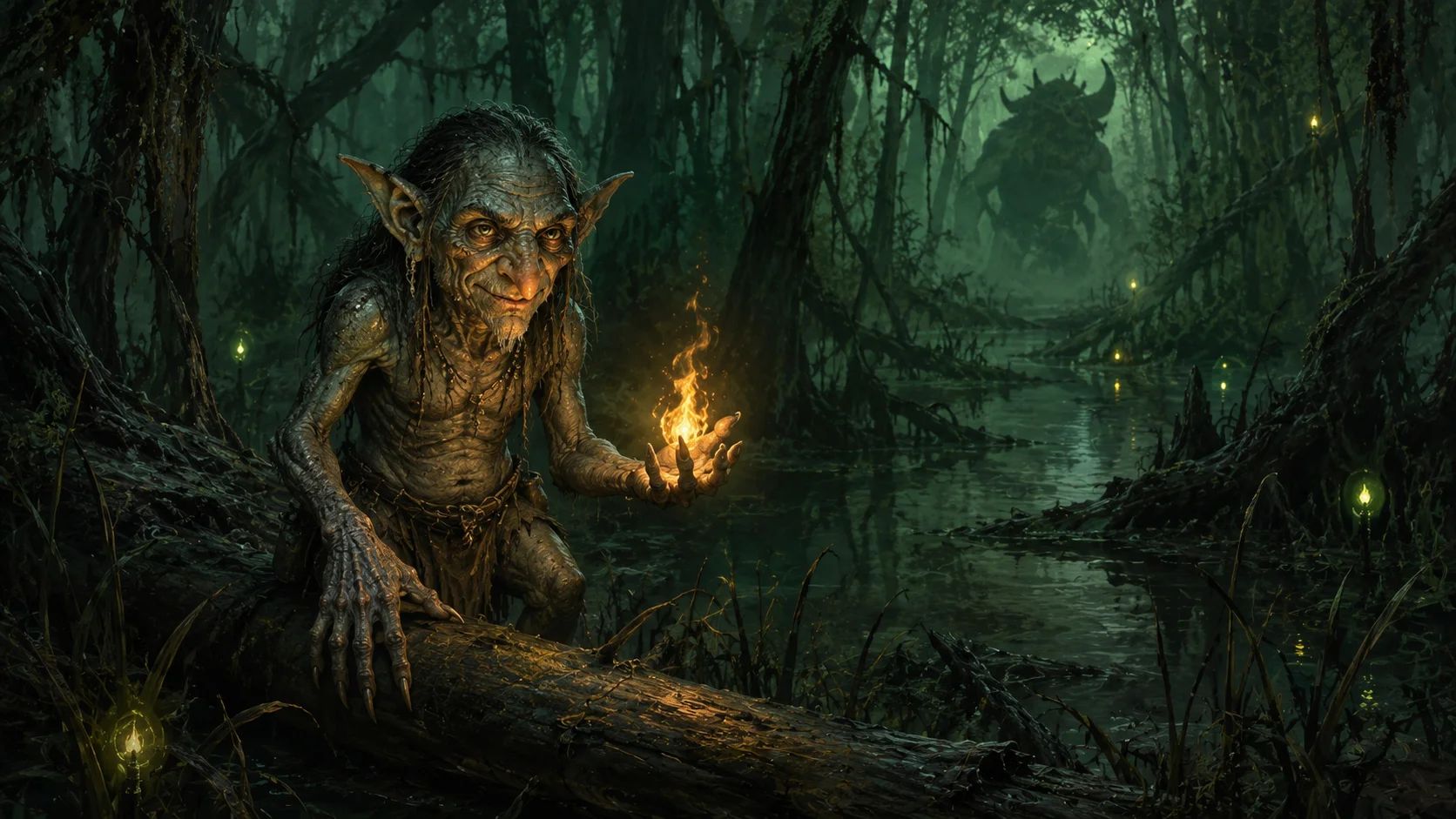
The Pukwudgie is described, across the many tellings that have carried it forward, as a small creature — roughly knee-high to waist-high, humanlike in shape but unmistakably other. Accounts speak of a large nose, oversized ears, and long, exaggerated fingers; skin that is grey or bark-rough, as though it had grown up out of the ground alongside the trees it dwells among; and, in some renderings, eyes that carry their own faint glow in the dark. It makes its home in the forest, and within Wampanoag-region storytelling it is bound most tightly to particular tracts of southeastern Massachusetts and Cape Cod — wooded, often swampy or hilly terrain tied to specific landmarks rather than to the woods in general. Though small enough to pass a traveler unseen, the Pukwudgie is no harmless woodland sprite. It is a being of genuine power, unpredictable temperament, and — in the great majority of tellings — real danger to anyone who meets it.
A Name Carried in the Mouth, Not the Page
Pukwudgie is generally understood to derive from an Algonquian root glossed as "little person" or "wild man of the woods," and like the being it names, the word itself has lived primarily on the tongue rather than in a fixed written text. As with most oral tradition, the primary attestation for the Pukwudgie is living storytelling, passed teller to teller and generation to generation, rather than any single ancient manuscript. The versions most widely available in English come from twentieth-century folklore collections and from retellings prepared in consultation with Wampanoag storytellers — and, as is expected and entirely appropriate for a tradition that lives in speech, the details shift from one telling to the next. A feature present in one account may be absent in another; this is not inconsistency to be resolved but the ordinary texture of a story still being told by living people rather than settled by a printed page.
Powers and Perils
The Pukwudgie is credited with a formidable range of abilities. It can appear and vanish seemingly at will, and can shift or alter its shape. It commands fire, and it is able to conjure a magical light — something like a will-o'-the-wisp — used to draw the unwary traveler from a safe path into danger. Its purposes in the stories are rarely gentle: it leads people astray in the woods, guiding them toward swamps or toward the edges of cliffs, sometimes to their deaths. In some tellings it goes further still, and is said to be capable of carrying people off outright. The consistent thread running through nearly every account, whatever its particular details, is that the Pukwudgie is a being to be avoided, and that the forest paths it favors are not casually safe after dark.
The Lure of the False Light
Among the Pukwudgie's most memorable attributes is its use of a glowing, deceptive light to draw travelers from their way — a device that places it within a wider Algonquian pattern of "little people" figures who mislead wanderers by false signs, though the Pukwudgie is typically described as considerably more overtly dangerous than many of its neighboring counterparts. A traveler who follows such a light in these stories does not find safety at the end of it; the light is not a beacon but a trap, and the tales built around it serve, among their other purposes, as a caution against straying from known paths in unfamiliar woods after nightfall.
Snake-Kin and Sharpened Points
Some tellings extend the Pukwudgie's mischief further, describing it as able to transform into, or command, animals — snakes above all — as agents of harm or disruption. A number of modern retellings also associate the Pukwudgie with poison-tipped arrows, though this detail is less universally attested than the being's shapeshifting or its false light, and is best understood as one regional variant among several rather than a fixed, universal trait of the figure. Where it appears, it reinforces the same core character: a small being whose danger is entirely disproportionate to its size, armed with means both magical and physical.
The Lore of the First Light
The Pukwudgie's story cannot be told apart from that of Maushop, also rendered Moshup, the great culture-hero and giant of Wampanoag tradition credited with shaping the land of Cape Cod and the Elizabeth Islands and with aiding the Wampanoag people in the earlier days of the world. In several tellings, it is Maushop himself who created, or gave life to, the Pukwudgies — bringing them into being to help the Wampanoag people, or to serve as companions and entertainment for them. This act of creation is one of the threads that recurs most consistently across the published retellings of this cycle, even as the finer details of how and why vary considerably from one version to another.
When Favor Turned to Grudge
What follows Maushop's act of creation, in the tellings that carry the story forward, is a falling-out. The Pukwudgies, the accounts say, grew jealous of the favor Maushop showed to human beings — resentful that the giant's care and attention flowed toward the people rather than toward the small beings he himself had made. That jealousy curdled into open hostility, and the Pukwudgies who had once been neutral, or even helpful, turned against the very people they had been created to serve. Maushop, in turn, is said in various tellings to have fought the Pukwudgies or to have banished them, driving them from the closer favor they had once held into the wilder, more marginal existence the stories now describe. This arc — creation, jealousy, betrayal, and Maushop's response — stands as one of the most consistently recurring elements in the whole body of Pukwudgie lore, even though the precise sequence of events differs from teller to teller, exactly as one would expect of a story still living in many mouths rather than fixed in one.
Squant and the Wounded Circle
The Pukwudgies' troubles are not confined to Maushop alone; they extend into the wider circle of his family as it appears in Wampanoag storytelling. Maushop's wife, known as Squant or, in some renderings, Granny Squannit, is a supernatural figure in her own right, associated with healing and with the protection of children. Accounts involving Maushop's children and his household place the Pukwudgies within this broader family story cycle as adversarial or troublesome presences — figures whose mischief and hostility touch not only Maushop himself but those bound to him. The precise shape of these encounters varies by telling, but the pattern is steady: wherever the Pukwudgies appear alongside Maushop's family, they arrive as a source of friction rather than help.
Hockomock and the Freetown Woods
Within Wampanoag-region storytelling, the Pukwudgie is bound with particular strength to certain wooded and wetland tracts of southeastern Massachusetts, above all the Freetown–Fall River State Forest. In more recent decades, a broader area encompassing this region has come to be known in popular paranormal writing as the "Bridgewater Triangle" — a label worth noting plainly as a name applied by later, non-Native, paranormal-interest writers, and not a traditional Wampanoag term for the land. The distinction matters: the forest and its swampy hollows carry genuine weight within Wampanoag tradition as a place where the Pukwudgie is said to dwell and to act, quite apart from whatever a more recent and largely external label has since layered on top of it.
The Weight Later Voices Have Added
Because the Pukwudgie has become a recognizable figure beyond its tradition of origin, it has also become material for paranormal television and web content built around the Bridgewater Triangle label — treatments that have, at times, sensationalized or stripped the being of the context that gives it meaning. Such secondary, popular sources are worth encountering with awareness of what they are, and should be held apart from, and given less weight than, accounts that originate with or have been consulted with Wampanoag storytellers themselves. The Pukwudgie is not primarily a paranormal curiosity; it is a figure that has done cultural work within a living nation's tradition for a very long time, and that work is the truer center of gravity for understanding it.
Reading the Warnings Rightly
Within Wampanoag oral tradition, the Pukwudgie functions as a cautionary figure — a way of accounting for disappearances that go unexplained, for misfortune met in the woods, and for the real hazards, both physical and unseen, that a swamp or a cliff edge or an unfamiliar stretch of forest can present. Stories of a being who lures travelers off the safe path with false light, who leads the careless toward the swamp or the fall, encode a practical respect for wild terrain alongside whatever deeper spiritual meaning they carry. This pattern of "little people" figures explaining the dangers and the unseen presences of the forest is found elsewhere among Algonquian-speaking peoples and in other Native nations' traditions as well; those parallel figures are structurally similar but distinct, belonging to their own separate traditions, and should not be folded into or conflated with the Wampanoag Pukwudgie specifically.
Living Memory, Not a Closed Book
The Wampanoag are a federally recognized living people — notably the Mashpee Wampanoag and the Aquinnah Wampanoag — and the Pukwudgie belongs to their currently practiced cultural and spiritual tradition, not to a vanished past preserved only in old collections. The variation between tellings, the differences in detail from one storyteller or one community to the next, are not flaws to be smoothed away but the ordinary and appropriate condition of a story that continues to be told, retold, and carried forward by the people to whom it belongs. To meet the Pukwudgie honestly is to meet it as exactly that: a small, dangerous, magically potent being at the heart of a story cycle still very much alive, deserving the same respect owed to any tradition that continues to matter to the people who keep it.
Sources & traditions
- EncyclopediaWikipedia — Pukwudgie
- TraditionWampanoag folk and village traditions (North America)
Myths change from area to area and from time to time. This chronicle follows the most widely told versions; tellings in other villages, regions and eras may differ.