Dzunukwa — recorded also as Dzonokwa, and known in English-language accounts as the Basket Ogress or the Wild Woman of the Woods — is one of the most extensively documented supernatural beings in Kwakwaka'wakw oral tradition. She belongs to the deep forest that lies beyond the last house of the village, and she belongs, too, to particular families, who hold the right to her mask and her image as inherited privilege rather than shared folklore. Much of what is known of her today reaches us through the fieldwork of Franz Boas, working across five decades from the 1880s into the 1930s in close collaboration with George Hunt, a Kwagu'ł ethnographer whose own knowledge of the tradition gave the record its depth. Their published collaborations, including Kwakiutl Ethnography and The Social Organization and Secret Societies of the Kwakiutl Indians, remain foundational to understanding who Dzunukwa is and what she means.
The Deep-Woods Giantess
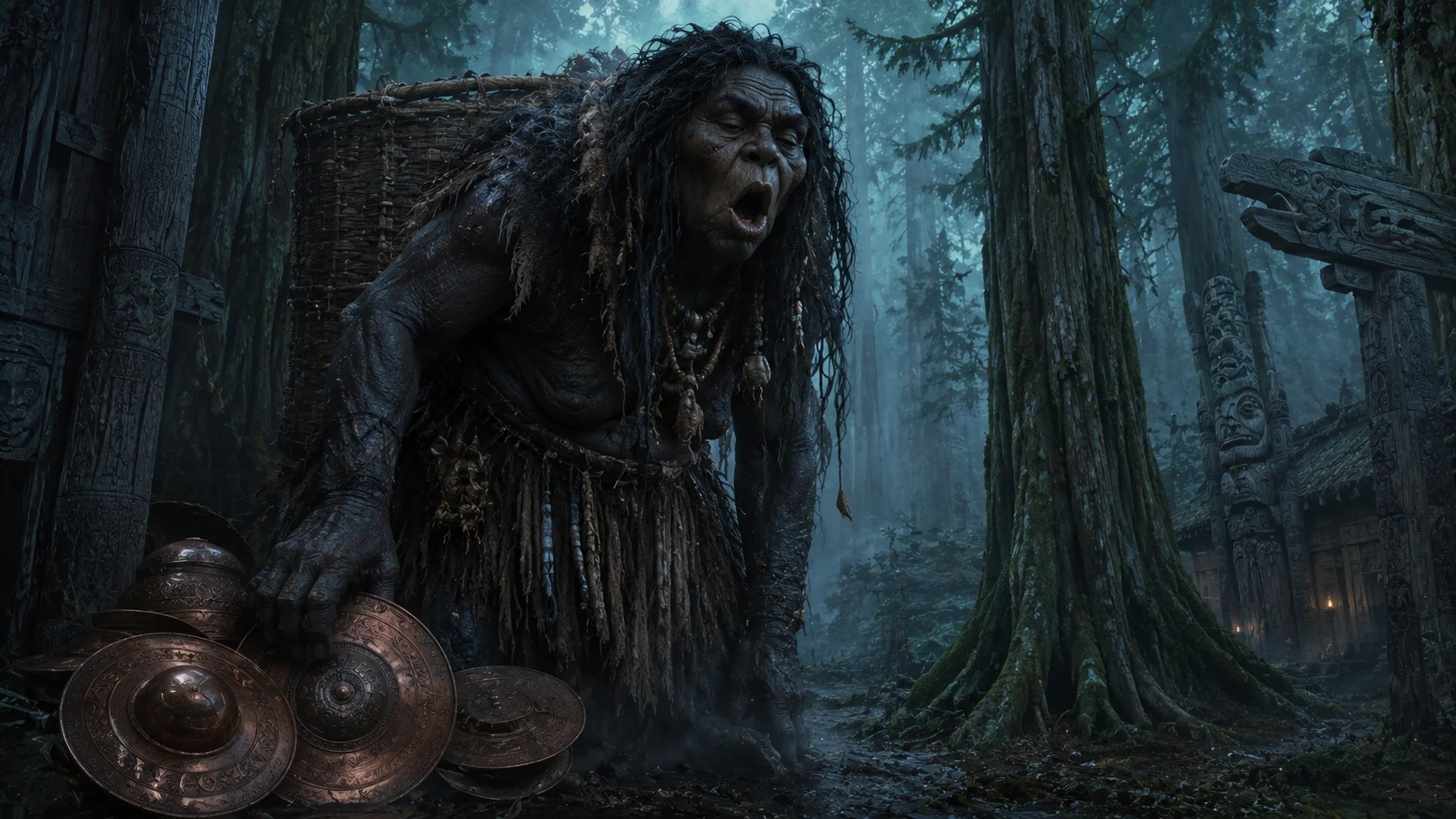
Dzunukwa is a giant. Every account agrees on this before it agrees on anything else. She is immense, dark-skinned, her body covered in hair, and she lives far from the cleared ground of the village, in the wilderness that Kwakwaka'wakw geography treats as a real boundary — not empty space but another country, governed by other rules. Her house stands somewhere in that interior, a place villagers do not casually walk into. She is, in this sense, the forest's own weight given a body: enormous, old, and indifferent to the scale of human settlements.
She is not swift. Recorded descriptions consistently give her a slow, heavy gait and a dull, half-waking manner, as though she has just been roused from sleep and never quite finishes waking. This slowness is not incidental to her character — it is the very quality that makes her survivable to encounter, and it is the hinge on which most of the narratives about her turn.
The Half-Shut Eyes and the Hooting Cry
The formal portrait of Dzunukwa, the one carried from storytelling into carved wood, is remarkably consistent. Her eyes are deep-set and nearly closed, often rendered as mere slits or fully shut lids in mask work. Her mouth is pursed into a rounded, almost O-shaped opening, the shape her lips take, tradition holds, when she calls out her cry — a low, booming "u… u…" or "hu… hu…" that carries through the trees. Her skin is dark, her body hirsute. These are not incidental artistic choices; they are the standardized features that identify a Dzunukwa mask on sight, across not only Kwakwaka'wakw carving but also among the neighboring Nuxalk and Heiltsuk traditions, where related versions of the figure and her image are known.
To see those closed eyes and that round mouth in a mask is to recognize her instantly — sleepy, dangerous, and only half-present in the ordinary waking world, the way the deep forest itself is only half-present to a village going about its daily business.
A Basket Built for Small Bodies
Her defining action, the one told and retold most often, is carrying a great basket on her back. Into it go children — those who have wandered too far from the houses, too far from the sight of the adults who should have been watching them. She is understood to intend to take them home to her forest house and eat them there. The basket itself is as much a part of her identity as her face; it is the instrument of the abduction, slung across her shoulders the way a woman might carry cedar bark or shellfish home from gathering, except that what she gathers is children who strayed.
Tales of the Outwitted Ogress
And yet — this is the turn every account makes — in the great majority of recorded tellings, the children in that basket do not die. They escape, or they are rescued, and almost always by cleverness rather than force. Dzunukwa's slowness and dull-wittedness are precisely what a resourceful child, or a resourceful hero acting on a child's behalf, exploits. She is powerful enough to be terrifying and yet unguarded enough to be beaten — a combination that makes her not simply a monster to be feared but a monster to be outsmarted, which is a very different kind of story to tell around a fire.
Fire, Trickery, and a Slow-Witted Power
In numerous documented tale cycles, the protagonist's victory over Dzunukwa is total: she is killed, often by being pushed or tricked into her own fire, and her power passes to the one who defeated her. This is not treated in the record as a minor local variant but as a recurring, structurally important shape of the story — one that Boas and Hunt recorded across multiple families and multiple tellings, each rooting the same essential pattern in a different lineage's own history.
Copper Born of a Terrible Encounter
Here the story does something that marks it as more than a cautionary tale. In the recorded tradition, the defeat of Dzunukwa — or the taking of her wealth and possessions — becomes an origin narrative for certain noble families' rights to display Dzunukwa masks and to hold the associated crest prerogatives, known as ᾱ'dᾱ. An ancestral encounter with the giantess, ending in her death or her being outwitted, is remembered as the founding event that gives a specific house the standing right to her image at potlatches thereafter. The fearsome ogress of the deep woods is, by this route, also the reason a particular family can rightfully claim copper — the supreme item of prestige in Northwest Coast potlatch economy — as part of its wealth. Her body or her possessions, in these accounts, become that wealth's very source.
The Water of Life and a House Restored
A related strand of recorded narrative has a protagonist trick Dzunukwa out of a different kind of treasure: what is described as the water of life, or other wealth objects held in her house. The hero who wins this from her does not simply enrich himself in some abstract sense — he uses it to revive dead kin, restoring loss within his own family. These are, again, house-origin narratives, what is known in the tradition as nuyam: stories that do not float free as generic folklore but anchor the legitimacy and history of specific families, explaining why a house holds what it holds and stands where it stands within the wider social order that the potlatch exists to display and confirm.
The Mask That Carries a Name
Because of this, a Dzunukwa mask is never a neutral object. It is a hereditary crest privilege, belonging to a specific numaym — a named kin group — and its appearance at a potlatch is a statement of that group's history and standing, not merely a dramatic performance. To wear the mask, or to have the right to commission and display it, is to assert a documented connection to one of these ancestral encounters. The mask's sleepy eyes and round, hooting mouth are the visible sign of a claim that runs back through specific named ancestors to the giantess herself.
Standing Among the Winter Dancers
Dzunukwa's public life is closely tied to the winter ceremonial season, the tseka complex, when masks and dances belonging to the great supernatural beings of the tradition are brought out and performed. She takes her place among these beings as an ancestral and crest figure rather than as part of the Hamatsa initiation cycle specifically — that particular role, tied to the eating of human flesh in ritual drama, belongs to a different and distinct being, Baxbakwalanuxsiwae. Dzunukwa's presence in the winter dances is of another kind: the appearance of a family's own ancestral wealth-bringer and forest-power, called forward in the season when such things are properly shown.
A Warning Told at the Village Edge
Alongside her place in family history, Dzunukwa carries out a second, more practical kind of work. Her image as a giant who steals unsupervised children functioned, in documented ethnographic context, as part of a living repertoire of cautionary storytelling — a way of teaching children not to wander from the village without saying so. This pedagogical use sits comfortably alongside her deeper mythic and crest significance rather than replacing it; the same figure who explains a family's right to a coppers-bearing mask is also the figure invoked to keep a child close to home before dusk.
One Being or Many, Depending on Whose Fire You Sit By
The ethnographic record itself preserves real variation rather than smoothing it away. In some tellings Dzunukwa is singular and clearly female, one giantess with one house in the forest. In others, she is better understood as a type — a class of similar giant forest-beings, among which male counterparts are sometimes named. Boas and Hunt recorded this variation as regional and family-specific rather than as confusion to be corrected: different houses, in different places, hold different versions of exactly who and how many she is, and both versions are part of the authentic record rather than one being a corruption of the other.
A Neighbor Sometimes Mistaken for Her
One distinction is worth holding carefully. Bakwas, the Wild Man of the Woods, associated in the tradition with ghosts and with those who have drowned, is a separate figure from Dzunukwa. Some popular retellings blend aspects of the two forest-dwelling beings together, but the more careful ethnographic record — Boas and Hunt's documentation among it — treats Dzunukwa and Bakwas as distinct. Where sources do equate them, that equation is a point of genuine inconsistency in the wider record rather than a settled fact, and it is worth flagging as uncertain rather than repeating as established tradition.
Carved Hands Still at Work
None of this belongs only to the past. Museum and scholarly documentation — including interpretive material held by the U'mista Cultural Centre in Alert Bay and the Royal BC Museum — confirms that Dzunukwa masks remain an actively used and respected crest privilege among Kwakwaka'wakw families today. Contemporary carvers continue to produce Dzunukwa masks under the hereditary right their families hold, meaning the giantess of the deep woods, sleepy-eyed and round-mouthed, still appears at potlatches now being held, carried forward by the same families whose ancestral stories first gave them the right to show her face.
Sources & traditions
- EncyclopediaWikipedia — Dzunukwa
- TraditionKwakwakawakw folk and village traditions (North America)
Myths change from area to area and from time to time. This chronicle follows the most widely told versions; tellings in other villages, regions and eras may differ.