Sisiutl is the great double-headed serpent of Kwakwaka'wakw tradition, a supernatural being of the sea and lake whose form and power are recorded in oral narrative and rendered again and again in the ceremonial art of the Northwest Coast. He is not a simple monster to be slain and forgotten; he is a crest being, belonging to particular lineages, carried on house-fronts and canoe-prows and dance regalia as a mark of ancestral encounter and hereditary right. To speak of Sisiutl is to speak of danger and of power in the same breath, because in the documented tradition the two are never separated.
A Serpent With No Single Face
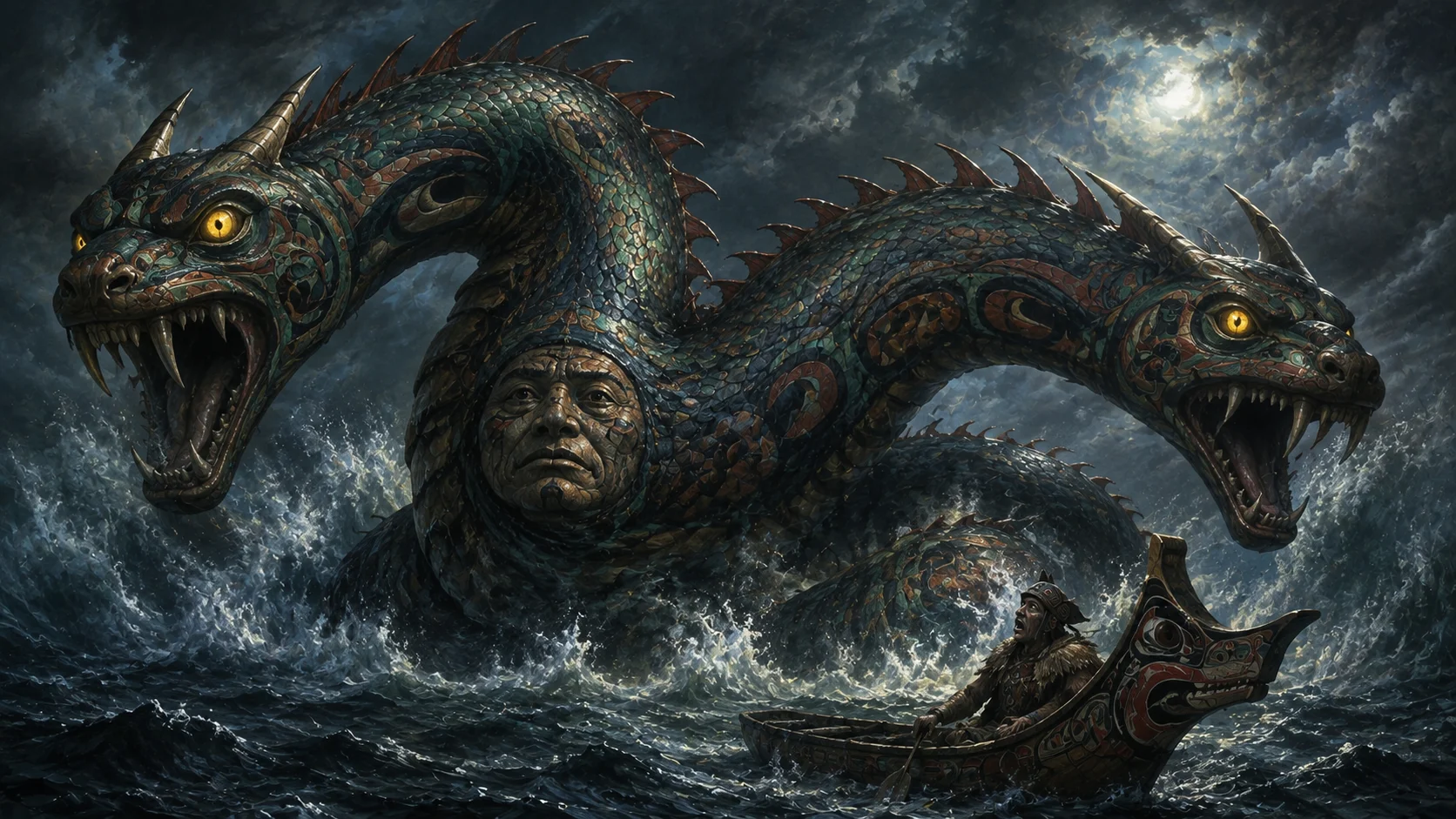
The canonical form of Sisiutl, as recorded by ethnographers working in Kwakwaka'wakw territory on northern Vancouver Island and the adjacent mainland coast, is a serpent's body stretched long between two heads, one at each end, each fanged and formidable. Between them, at the centre of the elongated body, sits a third face — human-like, watching. This tripartite arrangement, two serpent heads flanking a central visage, is the form that appears again and again in the careful ethnographic and art-historical record, and it is the form that should be treated as authoritative. Looser popular retellings sometimes flatten Sisiutl into a simple two-headed snake, dropping the central face entirely, but that simplification is a departure from the documented tradition rather than an equally valid variant of it. The three-part head is not decorative excess; it is the being's defining composition, repeated with remarkable consistency across carved house posts, painted screens, and woven regalia wherever his image is entitled to appear.
The Weight of Being Seen
Sisiutl belongs first to the water, moving through the sea and the lakes of the territory, though the record also describes him crossing onto land and, in places, passing through earth and rock as easily as through waves — a being whose nature is fundamentally about crossing boundaries other creatures cannot cross. What is consistent across the tradition is the danger of direct encounter. To look upon Sisiutl unprepared is recorded as being potentially fatal: his gaze carries the power to turn a person to stone, or to bring death or paralysis simply through the act of being seen. This is a documented motif in its own right within Kwakwaka'wakw tradition, and while it happens to resemble the deadly-gaze figures found in other world mythologies, that resemblance is coincidental rather than a borrowing — Sisiutl's power belongs entirely to the cosmology that produced him, not to any outside tradition he might superficially echo.
What Survives the Encounter Gains
The peril of Sisiutl is only half of what the record preserves. The other half is what happens to those who endure contact with him and live. Recorded narratives describe survivors of a Sisiutl encounter, warriors and heroes who met him through bravery, careful ritual preparation, or sheer cunning, gaining extraordinary things: invulnerability to weapons, great physical strength, or the right to carry Sisiutl as a crest passed down through their descendants. The being's danger is not incidental to his gift-giving; it is the price of it. In this tradition, supernatural power of the highest order is rarely handed over freely — it is won by facing something that could, with equal ease, have destroyed the one who approached it. This pairing of mortal risk and transformative reward is central to how Sisiutl is remembered, and it is what separates him from a being who is simply feared.
Girded in Serpent-Skin
Among the specific motifs recorded around Sisiutl, few are as vivid as the warrior's belt or garment made from his form. Tales describe fighters wearing or being girded with Sisiutl, taking on his invulnerability for the duration of battle, as though the serpent's own imperviousness could be borrowed and worn like armour. This ties Sisiutl not only to wealth and hereditary privilege but directly to war-power: a being whose image or substance, properly obtained through the encounter narratives that license it, could turn an ordinary fighter into something far harder to kill. The image of a warrior belted in the double-headed serpent is one of the tradition's most striking, and it underscores that Sisiutl's gifts were understood as practical as well as prestigious — protection meant for the battlefield, not only for the house front.
Canoes That Carry His Name
Sisiutl's association with the sea extends naturally into the vessels that travel it. Canoes painted or carved with his likeness, and in some recorded tellings canoes described as transformed from or otherwise bound up with Sisiutl himself, appear as a protective and prestigious motif throughout the tradition. A canoe marked with the double-headed serpent was not simply decorated; it carried an assertion of supernatural backing for the journey and the lineage undertaking it. House-front designs and canoe-prow carvings that specifically depict Sisiutl draw on this same logic, presenting him as a guardian figure positioned exactly where protection was most needed, at the threshold of the home and at the prow cutting into open water.
A Privilege, Not a Free Motif
Like the other great supernatural beings of Kwakwaka'wakw tradition, Sisiutl operates within a system of hereditary privilege. The right to display his image, whether on a mask, a house post, a canoe, or a button blanket, belongs to specific numaym, specific lineages, and traces back to a particular ancestral encounter narrative that earned that family the crest. Sisiutl imagery is not generic folklore available to any family that wishes to use it; it is a claimed and inherited prerogative, carrying with it the weight of the ancestor who survived the serpent and won the right to pass his likeness down. Understanding Sisiutl properly means understanding that his image on any given object is also a genealogical statement, an assertion of descent from a specific moment of supernatural contact.
The Shape That Defines a Design Tradition
Within the broader two-dimensional design tradition of the Northwest Coast, Sisiutl holds a place of particular importance. His symmetrical form, two serpent heads mirrored around a central face, has been cited by art historians studying the formline system as an exemplary case of the split and symmetrical representation conventions that define Northwest Coast art more broadly. Bill Holm's 1965 formal analysis of Northwest Coast design singles out this kind of balanced, mirrored composition as characteristic of the tradition's visual logic, and Sisiutl's design is among its clearest expressions. Few beings in the coastal artistic repertoire are rendered as frequently or as recognisably, and his image serves almost as a case study in how the formline system handles a being whose very anatomy demands symmetry.
Dancing the Ancestor's Meeting
Sisiutl also has a place in the winter ceremonial season, within the tseka dance complex that dramatizes crest-origin narratives for the community. Masks and transformation regalia built to represent him are used in performances that re-enact the ancestral encounters through which a family first won the right to his image. These dances are not simple retellings for entertainment; they are living dramatizations of the crest-origin stories that anchor a lineage's standing, performed within the same structured winter season that carries the deep narrative history of Kwakwaka'wakw ceremonial life. Watching such a performance is, in effect, watching a family's claim to Sisiutl being renewed in front of the community.
A Body That Will Not Hold One Shape
Some recorded variants of the Sisiutl tradition describe him transforming into a self-propelling canoe or into a fish, moving through the water in whatever form best suits the crossing he needs to make. This fluidity fits naturally with everything else recorded about him: a being defined by his refusal to stay within one boundary, equally at home as serpent, as vessel, or as creature of the depths. It reinforces his amphibious, boundary-crossing role within the cosmology, a being who does not simply live near the border between sea and land but seems to embody that border itself, moving across it as easily as he moves between the roles of destroyer and benefactor.
Where the Record Should Be Trusted
As with many widely known figures from indigenous oral traditions, popular retellings of Sisiutl have sometimes drifted from what the ethnographic record actually documents. Beyond the flattening of his three-part head into a simple two-headed image, some later accounts loosely gloss him as a generic lake monster or blur him together with unrelated cryptid traditions from other cultural contexts entirely. Neither reading is supported by the Kwakwaka'wakw-specific record gathered by Franz Boas, George Hunt, and those who followed their documentation, and neither should be presented as settled fact. The more careful and better-attested picture, the one preserved in detailed ethnographic accounts and confirmed through close study of surviving carvings and paintings, is of a specific, named, richly storied being: three-headed in his classic form, tied to particular lineages, and carrying a meaning far more precise than the word "monster" alone could convey.
A Guardian Carried Forward
What endures across every version of the Sisiutl tradition, ethnographic and artistic alike, is the sense of a being too large to be reduced to a single meaning. He is peril and protection at once, a figure whose gaze can end a life and whose favour can secure one, carved onto the fronts of houses and the prows of canoes not as ornament but as a standing claim of power passed down through generations. To encounter his image today, on a mask brought out during the winter ceremonial season or on a formline panel analysed for its symmetry, is to encounter the residue of a specific ancestral meeting, still carried forward by the families entitled to hold it, still telling the same story it was carved to tell.
Sources & traditions
- EncyclopediaWikipedia — Sisiutl
- TraditionKwakwakawakw folk and village traditions (North America)
Myths change from area to area and from time to time. This chronicle follows the most widely told versions; tellings in other villages, regions and eras may differ.