The Preta, the hungry ghosts, are the tormented spirits of one of the six realms of Buddhist rebirth: beings consumed by an insatiable hunger and thirst they can never satisfy, the karmic fruit of greed and miserliness in former lives. The word itself, Sanskrit and Pali alike, means simply "departed one" — a plain, almost administrative term for the dead that Buddhist teaching filled with one of its most vivid and unsettling images of suffering.
A Realm Among Six
Buddhist cosmology describes six realms, or gati, into which a being may be reborn according to the weight and shape of its karma: the realms of gods (devas), demigods (asuras), humans, animals, hungry ghosts, and hell-beings (naraka). The preta-loka, the realm of the hungry ghosts, sits among the three lower, unhappy destinies, though tradition is careful to distinguish it from the naraka realm beneath it. Hell-beings suffer more acutely and are described as more confined, bound to their torment with little room for intervention. The preta, by contrast, is described as still reachable by the living — hungry, and, crucially, capable of receiving what the living choose to offer, in a way the hell-being is not.
The Weight of Grasping Hands
Buddhist doctrine is specific about what produces this rebirth. It is not simply wrongdoing in general but karma rooted in greed, craving, attachment, and above all miserliness — macchariya in Pali, the stinginess that closes the fist against another's need. Hoarding wealth one could have shared, refusing to give alms to those who ask, jealousy that begrudges another's good fortune: these are named across Theravada and Mahayana sources alike as the seeds of preta-rebirth. The realm is, in this sense, a mirror held up to a particular failure of the heart — not cruelty exactly, but a narrowing, a refusal to let anything go.
The Swollen Belly and the Needle Throat
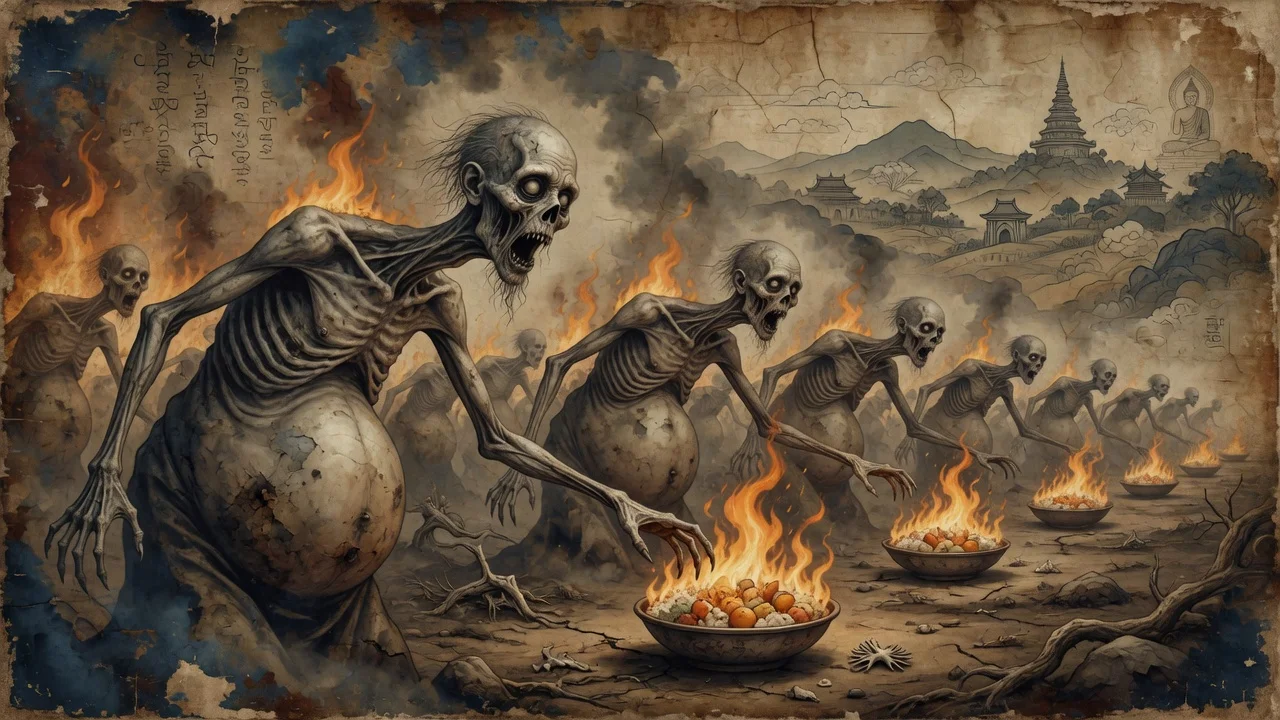
The classical image of the preta is unforgettable and deliberately grotesque: an enormous, distended belly, vast enough to hold a feast, joined to a throat no wider than a needle's eye. The body becomes an argument in flesh — hunger without any possible relief, capacity without a channel. Whatever the preta manages to swallow can never be enough to fill so cavernous an emptiness, and the needle-throat ensures that even the attempt is agony. The image did not arise to frighten for its own sake; it was built, plank by plank, to make craving visible, to give the abstract Buddhist teaching on tanha — thirst, desire, the engine of suffering — a shape that could be seen and remembered.
When Food Turns Against the Hungry
Later commentarial literature, elaborating on the canonical accounts, catalogues the preta realm into distinct classes of suffering, each a variation on the same cruel logic. There are pretas who eat nothing at all, sustained only by what living relatives offer on their behalf — the paradattupajivins, "those who live on what is given by others," entirely dependent on a stranger's or a descendant's generosity reaching across the boundary of death. There are pretas condemned to eat pus and vomit, and others who, in their hunger, are driven to consume their own flesh. And there are the flame-mouthed pretas, for whom even success becomes punishment: any food they manage to bring to their lips bursts into fire before it can nourish them. Each variant sharpens the same teaching from a different angle — that craving, followed all the way to its root, does not feed the one who craves. It burns them.
The Petavatthu: Stories of the Departed
The central scriptural home of these teachings is the Petavatthu, "Stories of the Departed," a canonical Pali text preserved in the Khuddaka Nikaya. It does not deal in abstractions; it tells stories, naming individuals, their past faults, and the suffering that followed them into their next existence. The Petavatthu is paired, deliberately, with its companion text the Vimanavatthu, the stories of heavenly beings — light set beside darkness, generosity set beside greed, so that the two collections together form a single, sustained lesson in karma and its consequence. To read one without the other is to see only half the teaching; the pretas exist in the canon not in isolation but as the dark half of a moral pair.
Sariputta's Mother, and the Debt That Reached Beyond Death
Among the Petavatthu-tradition's most widely told episodes is the story of the mother of Sariputta, the Lord Buddha's chief disciple — reborn, in a former life recounted within this tradition, as a preta, suffering the fate her past greed had earned her. Her relief comes not through her own effort, which as a preta she has no power to exert, but through merit generated by living relatives and formally transferred to her on her behalf. The story functions as the clearest illustration in the tradition of a claim that runs through the whole preta literature: that this particular suffering, unlike the deeper suffering of the hell-realms, remains open to intervention from the world of the living.
Pattidana: The Gift That Crosses the Boundary of Death
This is the doctrinal heart of the preta's place in Buddhist practice. Pretas are the paradigmatic beneficiaries of pattidana, the transfer of merit — sometimes called punyanumodana, the "rejoicing in merit" by which the deceased is said to participate in good done in their name. A living relative performs an act of merit — giving alms, chanting, an offering made with the deceased explicitly in mind — and dedicates its fruit to one who may have been reborn as a hungry ghost. This doctrine did not remain a scriptural curiosity; it became the theological foundation for entire traditions of ancestral offering across East and Southeast Asia, practices that persist wherever Buddhist teaching on the preta realm took root.
A Teaching Carried Across Language and Land
As Buddhism spread beyond South Asia, the preta travelled with it, translated rather than abandoned. In Chinese Buddhism the being is known as 餓鬼, pronounced èguǐ — "hungry ghost," a direct rendering of the concept's essential character. Japanese Buddhism carries the same term as 餓鬼, gaki. In Tibetan tradition the being appears as ཡི་དྭགས་, yidak or yi dags. Each of these is not a separate invention but an adaptation of the same doctrinal category, carried into a new language by traditions that recognised how much moral and cosmological weight the image already held, and saw no need to replace it.
The Festival of the Departed
Later Mahayana and East Asian tradition layered a further, related development onto the earlier Pali material: the Ghost Festival, known as Yulanpen or Ullambana, tied to the Mahayana Ullambana Sutra and its narrative of Mulian's effort to rescue his own mother from suffering after death. Japan's Obon season and its associated gaki-dō, the "way of the hungry ghosts," carry a parallel observance. These festivals, with their offerings of food and their rites for the wandering dead, are best understood as a related but textually distinct tradition — a Mahayana elaboration built atop the earlier Theravada Petavatthu material rather than identical to it, sharing the same root image of the hungry departed while developing their own scriptures, their own central story, and their own ritual calendar.
A Suffering Measured in Ages, Yet Not Beyond Reach
Buddhist cosmological texts describe the preta realm as involving suffering of long, karmically determined duration, spans of time the texts render in terms meant to convey near-incomprehensible length. Yet this is precisely where the doctrine draws its sharpest line beneath the hell-realms: hell-beings are confined in ways that leave little room for outside help, but pretas are still generally held capable of receiving benefit from merit dedicated by the living. Duration here is not the same as hopelessness. The realm is long and terrible, but it is not, by the tradition's own account, sealed shut.
Where the Traditions Disagree
Not every detail of the preta realm is settled doctrine shared uniformly across all schools. The exact classification of preta subtypes differs between the commentarial literature of the Theravada Abhidhamma, the Sarvastivada Abhidharma sources such as the Abhidharmakosa, and the further elaborations of later Mahayana thought. Even the boundary of the realm itself is disputed: some schemes treat the asuras, the demigods, as a distinct sixth gati in their own right, while others fold them in as a sub-category of either the deva or the preta realm. These are not contradictions to be smoothed over but genuine, acknowledged points of disagreement between traditions reasoning carefully about the same underlying teaching — a reminder that Buddhist cosmology, for all its vividness, was built through centuries of scholarly argument, not handed down as a single fixed map.
Hunger as a Mirror for the Living
Beneath the cosmology, the preta serves a steady didactic purpose that sermon and story return to again and again: it makes greed and stinginess visible as suffering, not merely as fault. The swollen belly and needle throat are not simply supernatural punishment for its own sake but a portrait of what unrestrained craving looks like carried to its natural end — appetite without the capacity for satisfaction, want that consumes the one who wants. Set against Jataka-adjacent teaching stories and woven through sermons on generosity, the preta exists in Buddhist literature above all to argue for dana, the practice of giving, by showing with unflinching clarity what its absence becomes.
The Ghost That Asks to Be Fed
What distinguishes the preta from so many other tormented dead across the world's traditions is this final turn: it is not only a warning but an invitation to compassion. The hungry ghost cannot feed itself, but it can be fed — by the merit of almsgiving, by chanting performed in its name, by the deliberate, remembered generosity of those still living. In the preta, Buddhist teaching gave craving itself a body: the vast empty belly, the throat too narrow to ease it, suffering without end by its own power alone. And in the same breath, across the Petavatthu's paired stories, the merit-transfer rites of pattidana, and the Ghost Festival's offerings, the tradition answered that image with its opposite — the claim that even the most consuming hunger can be reached, gift by gift, from beyond the boundary that hunger itself cannot cross.
Sources & traditions
- EncyclopediaWikipedia — Preta
- TraditionBuddhist texts, oral tradition and village tellings (South/Southeast Asia)
Myths change from area to area and from time to time. This chronicle follows the most widely told versions; tellings in other villages, regions and eras may differ.