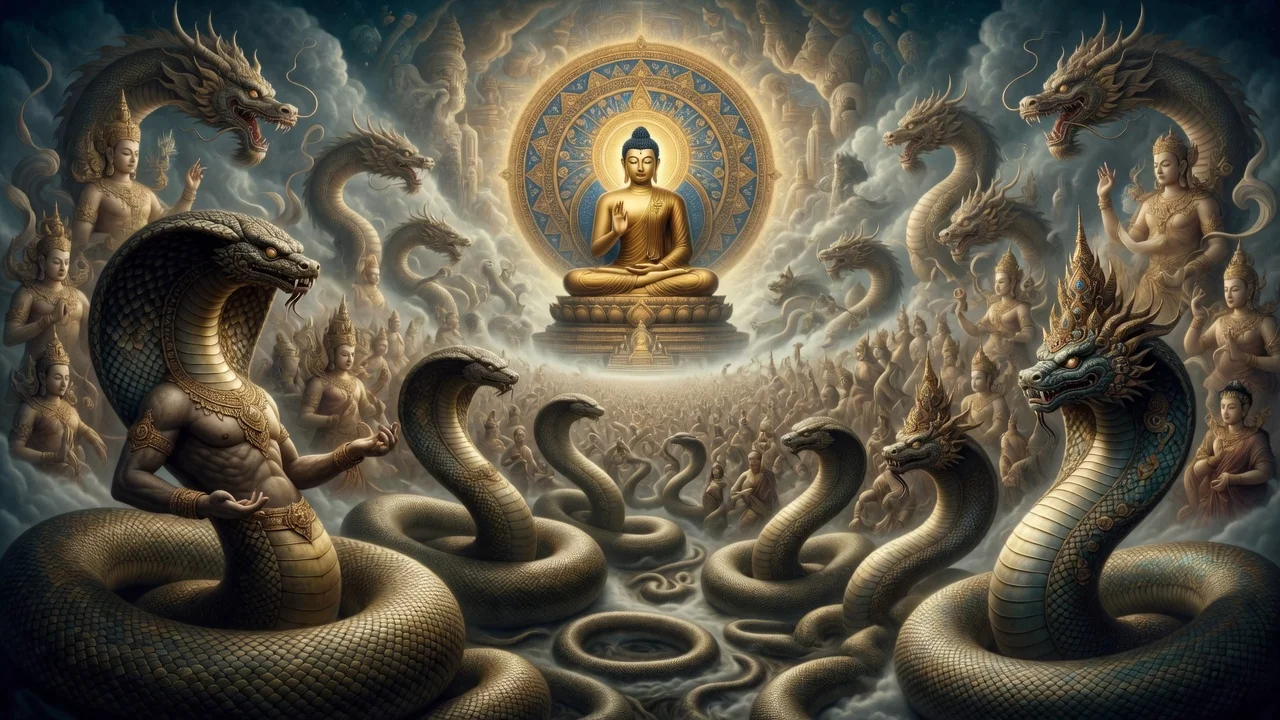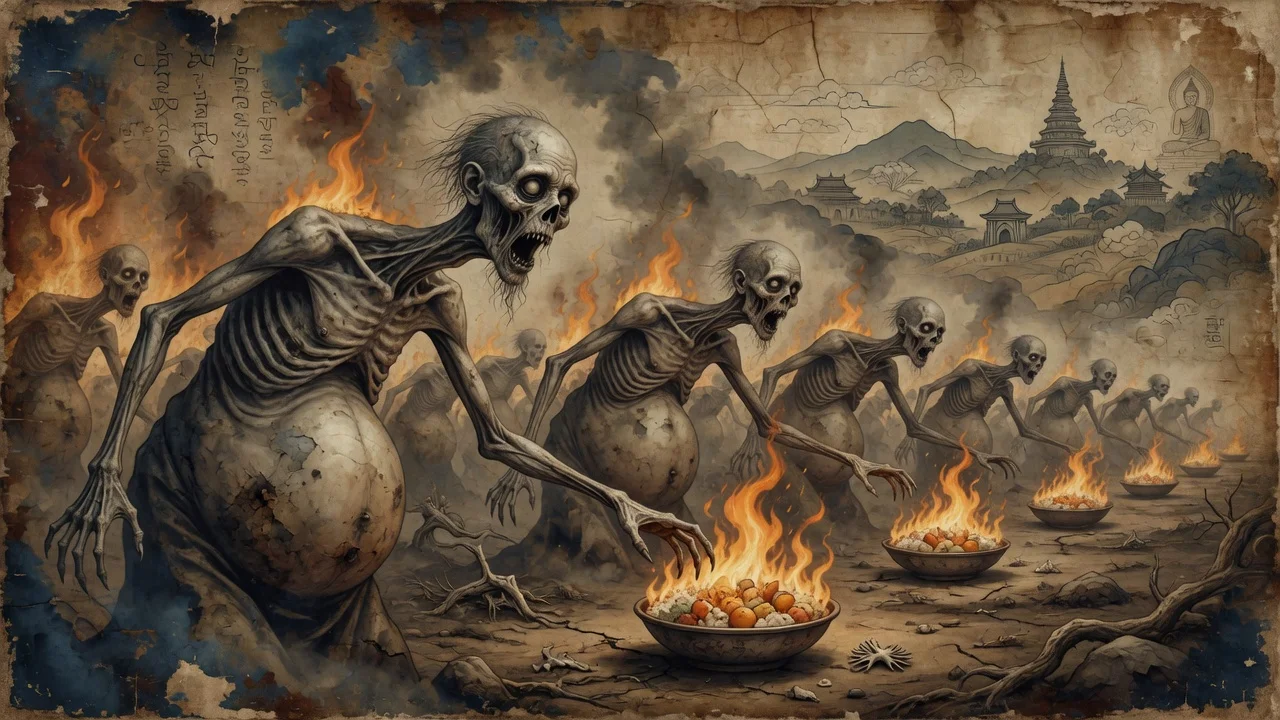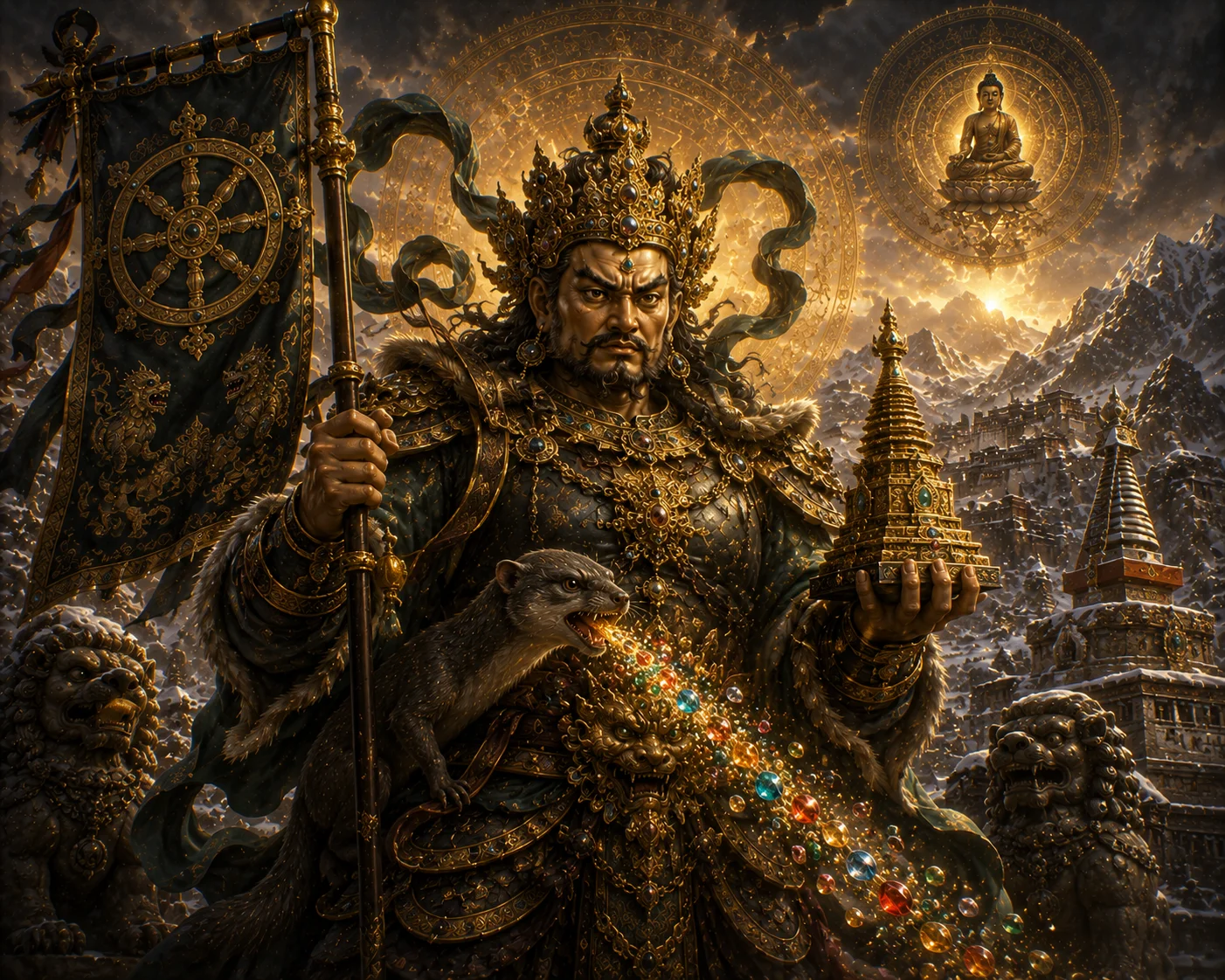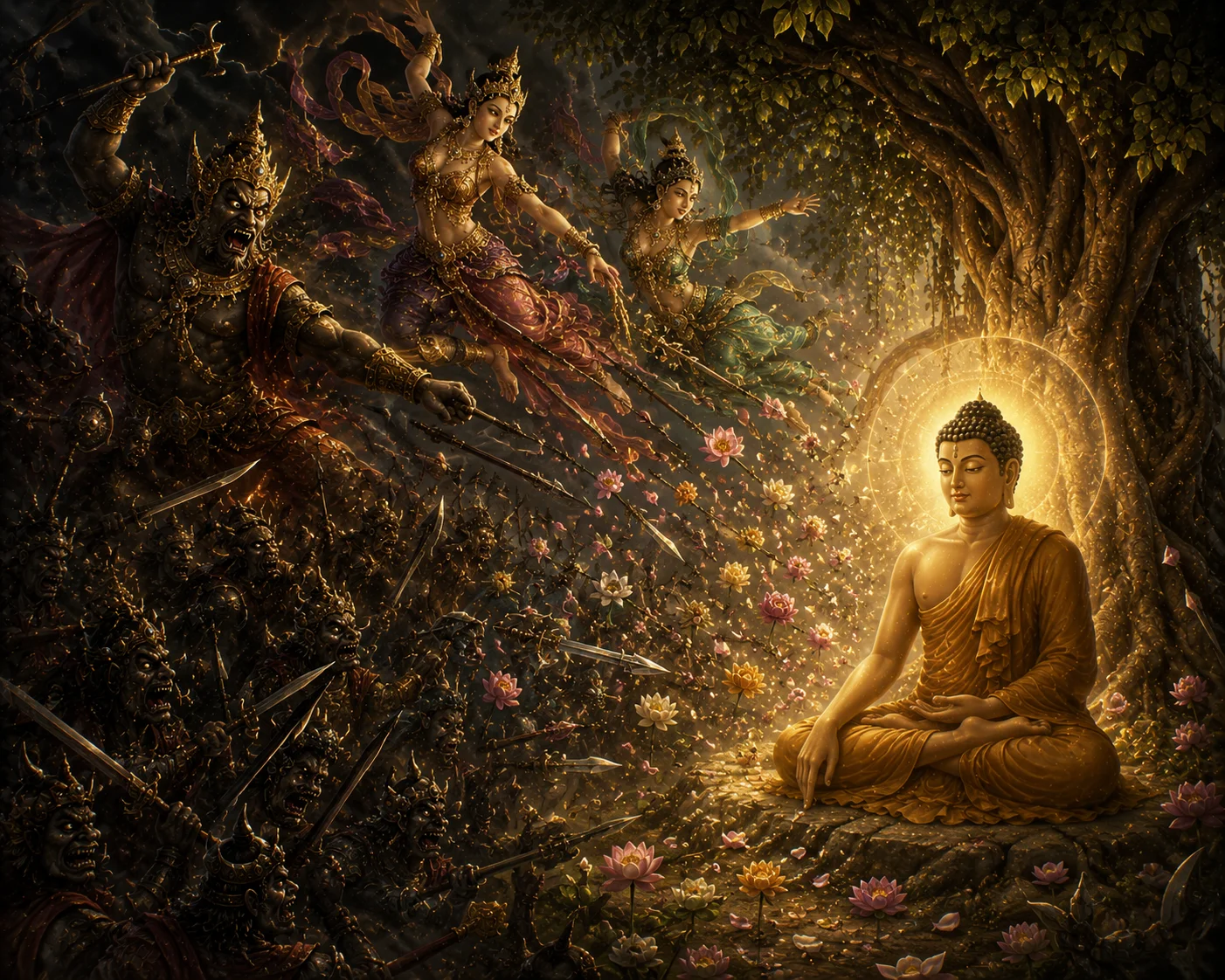
Mara is the great tempter of Buddhist tradition — death, desire, and delusion given form, the adversary who confronted the Lord Buddha on the night of his enlightenment beneath the Bodhi tree and who, in the telling of the earliest texts, never truly stopped confronting him afterward. He is not a myth held at arm's length; he is named, argued with, and rebuffed in scripture that Buddhist communities still recite, and the encounter beneath the Bodhi tree remains one of the most reproduced scenes in all of Buddhist art, from Gandhara to Sri Lanka to the temples of Southeast Asia and East Asia.
The Meaning Carried in a Name
Mara's name descends from the Sanskrit and Pali root mṛ, to die — he is, at root, the one who brings death, the killer. In Pali literature he is also called by the epithet Namuci, a name that reaches back further still into Vedic literature, where it belonged to an asura. That inheritance matters: Mara did not appear from nothing when Buddhist texts needed an adversary. He arrived already carrying the weight of an older struggle between order and a being who withholds what sustains life, repurposed by the Buddhist tradition into something more intimate and more psychological — an adversary who works as much through the mind's own currents as through open confrontation.
Ruler of a Heaven, Not an Outsider to the World
It would be a mistake to picture Mara as something wholly outside the Buddhist cosmos, a devil imported from beyond its borders. He is placed within it. Later commentarial tradition identifies him, in one of his aspects, as Devaputra-mara — literally the deity, the "son of the gods" — who rules over Paranirmita-vasavartin, the highest of the six heavens of the desire-realm, kamaloka. He is powerful, long-lived, and commands vast resources of illusion and seduction, but he is not outside karma and not outside impermanence. He is a being still bound to the very cycle of rebirth he works to keep others trapped within, which is part of what gives his opposition to the Lord Buddha its charge: he is not fighting from a position of final authority, but from the position of someone with the most to lose if beings learn to walk free of the realm he governs.
A Fourfold Adversary
Buddhist exegetical literature, working through the meaning of Mara across the centuries after the earliest sutras, arrived at a fourfold way of naming what he represents — not a single explicit list handed down in the earliest canon itself, but a systematization that later commentary and Abhidharma-era thought found necessary and durable. Klesha-mara is Mara as the defilements: craving, aversion, and delusion themselves. Skandha-mara is Mara as the aggregates, the very fact of embodied, conditioned existence that composes a being. Mrityu-mara is Mara as death outright, the ending that conditioned existence cannot escape. And Devaputra-mara is Mara as the deity who personally, narratively opposes the Lord Buddha — the figure who speaks, who sends armies, who negotiates. Together the four describe a single truth approached from four directions: that what opposes liberation is at once an inner condition, the fact of having a body and a self at all, mortality, and something that can still, in the old stories, be met face to face and answered.
The Long Night Beneath the Bodhi Tree
The confrontation that defines Mara is told in the Padhana Sutta of the Sutta Nipata and in the Mahavagga accounts of the night of the enlightenment. The Lord Buddha, then still the ascetic seeking awakening, sat beneath the Bodhi tree, resolved not to rise until he had broken through to realization, and Mara came to turn him back — because an awakened one would show the way out of the very realm of desire and rebirth that is Mara's domain. The Padhana Sutta names Mara's forces as an assembled army, senā, and lists them not as monsters but as states of mind given ranks: sensual desire, discontent, hunger and thirst, craving, sloth and torpor, fear, doubt, and malice and obstinacy among them, enumerated as the very forces a practitioner on the edge of realization must still meet and hold against. This is Mara's army in its oldest and starkest form — not simply frightening, but exact, naming the precise psychological weather that undoes unfinished practice.
Three Daughters Sent to Persuade
When the assault of fear failed to move him, the tradition tells that Mara turned to a different weapon and sent his three daughters against the Lord Buddha: Tanha, Craving; Arati, Discontent; and Raga, Lust or Desire. They are named in the texts as his own offspring, agents of seduction rather than terror, sent to accomplish through allure what the armies could not accomplish through dread. Neither approach moved him. The failure of both the army and the daughters is presented in the tradition as complete — his stillness held against fear and against desire alike, the two poles between which most striving minds are pulled.
The Earth Called to Witness
Mara's final challenge in the traditional account was not fear or temptation but a question of legitimacy: by what right did the Lord Buddha claim the seat of awakening at all? In answer, he reached down and touched the earth with his right hand, calling the earth itself — the earth goddess known in Pali as Vasundhara and in Sanskrit as Prithvi or Sthavara — to bear witness to the lifetimes of merit that had brought him to that seat. This gesture, the bhumisparsha mudra, the earth-touching gesture, became one of the single most reproduced images in the entire visual language of Buddhism. Wherever a figure of the Lord Buddha is shown seated with the right hand reaching down toward the ground, that image is a direct depiction of this moment — the answer given to Mara, rendered in stone and bronze and paint across the whole geography of the tradition, from the earliest Gandharan reliefs to temple sculpture carved centuries later and thousands of miles away.
Weapons Turned, an Encounter Refused
Across the tradition's retellings, Mara's assault is remembered as total and as wholly unsuccessful — every register of attack, terror and desire and finally the challenge to legitimacy itself, met and turned aside. It is this completeness that gives the episode its doctrinal weight: the enlightenment is framed not merely as a private breakthrough in meditation but as a victory won in full view of, and in direct answer to, the one figure whose entire domain depended on its not happening. That is why the scene recurs so constantly in Buddhist art. It is not decoration; it is the tradition's chosen way of showing what liberation looks like when it is actively opposed and still holds.
An Adversary Who Did Not Leave
Mara's story does not end at the Bodhi tree. The Mara Samyutta within the Samyutta Nikaya preserves a whole further sequence of encounters, in which Mara continues to appear across the years of the Lord Buddha's teaching ministry, testing and harassing not only the Lord Buddha himself but his monks and nuns — the bhikkhuni Vajira among those named as targets of his attempts to unsettle and mislead. In every instance the canonical pattern repeats: Mara appears, tries some form of distraction, deception, or discouragement, and is answered and dismissed through mindfulness and insight rather than through force. The lesson embedded in the repetition is deliberate — that the work of holding against Mara is not a single completed contest but a discipline practiced again and again, by teacher and by disciple alike.
The Question of When to Go
One of the most striking of Mara's later appearances comes near the very end of the Lord Buddha's life, recorded in the Mahaparinibbana Sutta of the Digha Nikaya. There, Mara urges the Lord Buddha to bring his life to its close and enter final parinibbana. The Lord Buddha's response is to agree — announcing that he will do so in three months' time. The exchange ties Mara directly to the timing of the Lord Buddha's own death, a striking reversal of their earlier meeting: the figure who once tried to prevent an ending now appears at the threshold of one that the Lord Buddha accepts on his own terms, not as defeat but as the completion the tradition understands death to be for one who has already broken free of what Mara represents.
The Enemy Inside the Practitioner's Own Mind
Buddhist thought has long held Mara's outward, narrative form and his inward, psychological meaning together rather than choosing between them. The canonical texts narrate him as an autonomous being who speaks and acts and can be addressed. Later Buddhist psychology, reading the same material, understands him allegorically as the mind's own defilements — the restlessness, craving, fear, and self-clinging that arise in any practitioner's meditation and must be recognized and released rather than obeyed. Both readings are held as true within the tradition, not as a contradiction to be resolved but as two depths of the same teaching: what appears as an external adversary in the old narrative is, for the meditator on the cushion centuries later, an inward weather that must be met with exactly the same steadiness the Lord Buddha showed beneath the tree.
A Figure Reworked, Never Worshipped
In Vajrayana and later Mahayana settings, Mara's imagery was sometimes extended or multiplied for teaching purposes — a "four maras" framework used pedagogically in Tibetan contexts to walk students through the different faces of obstruction to practice. Even so, Mara remains a distinct figure from the wrathful protector deities, the dharmapalas, of those same traditions. He is not propitiated, invoked for protection, or given devotional offerings the way a dharmapala is; he is named, recognized, and refused. The distinction matters to how the tradition holds him — an adversary to be seen clearly and released from, not a power to be courted.
What the Tradition Keeps Returning To
Some modern scholars have noted structural resemblances between Mara's temptation of the Lord Buddha and other testing narratives, including the temptation of Christ and the older Vedic Namuci myths from which the epithet applied to Mara originally comes. These remain comparative observations about narrative shape, not claims that the traditions share a canonical origin, and the Buddhist material stands complete and coherent entirely on its own terms. What endures, across every retelling and every carved and painted image of the earth-touching hand, is a teaching still put to direct use: that the obstacles to awakening — fear, craving, doubt, the question of one's own worthiness — take a face that can be named, met, and set aside, and that this is a discipline offered to every practitioner who sits down to try, not a victory that belongs to one figure alone in one distant night.
Sources & traditions
- EncyclopediaWikipedia — Mara (demon)
- TraditionBuddhist texts, oral tradition and village tellings (South/Southeast Asia)
Myths change from area to area and from time to time. This chronicle follows the most widely told versions; tellings in other villages, regions and eras may differ.