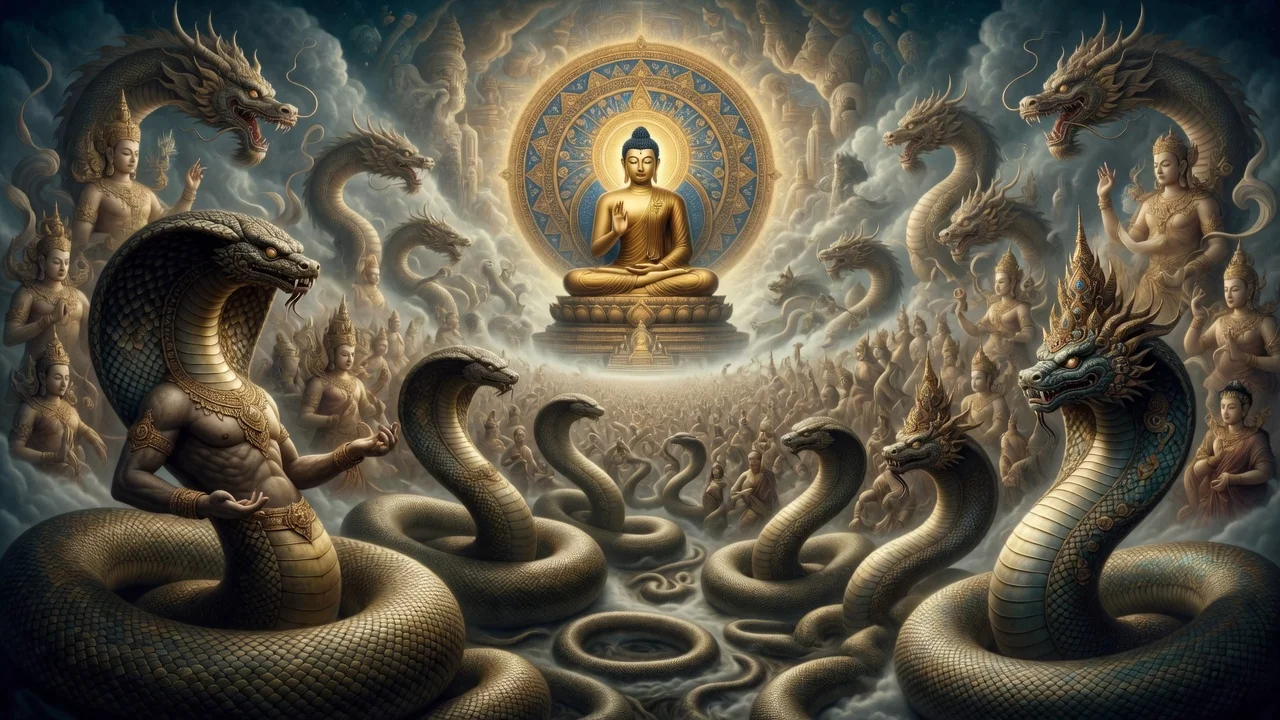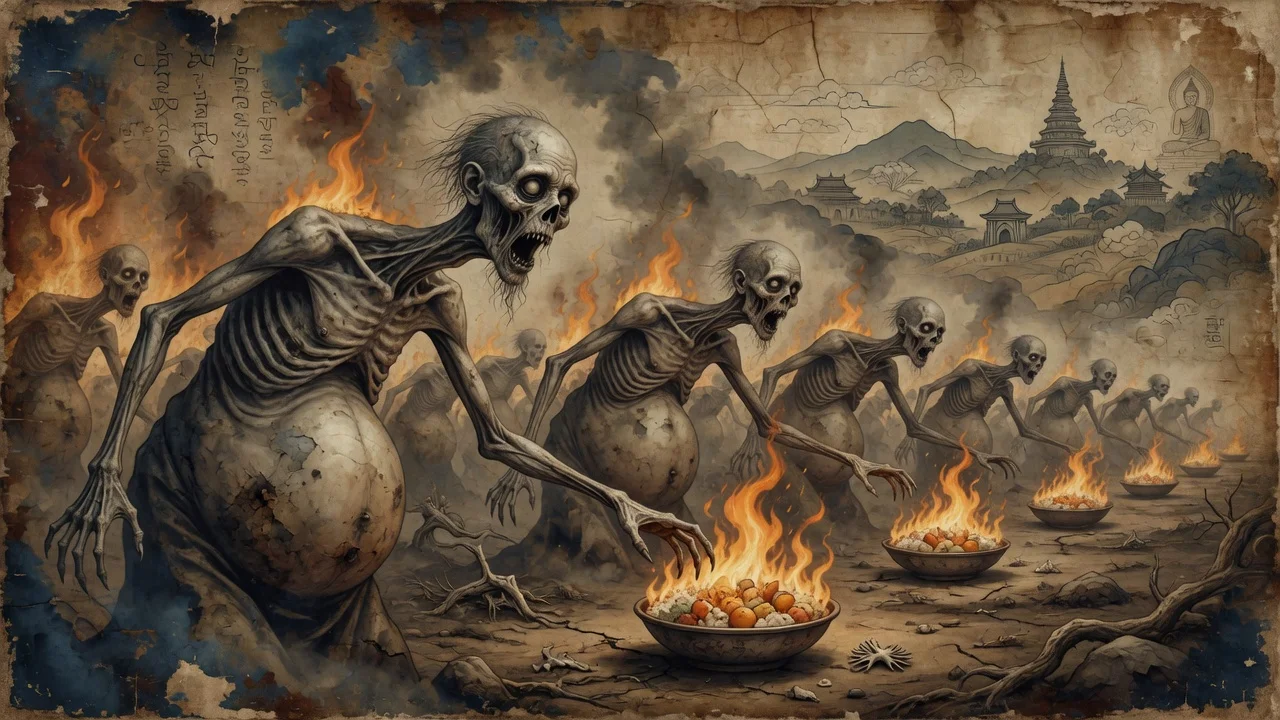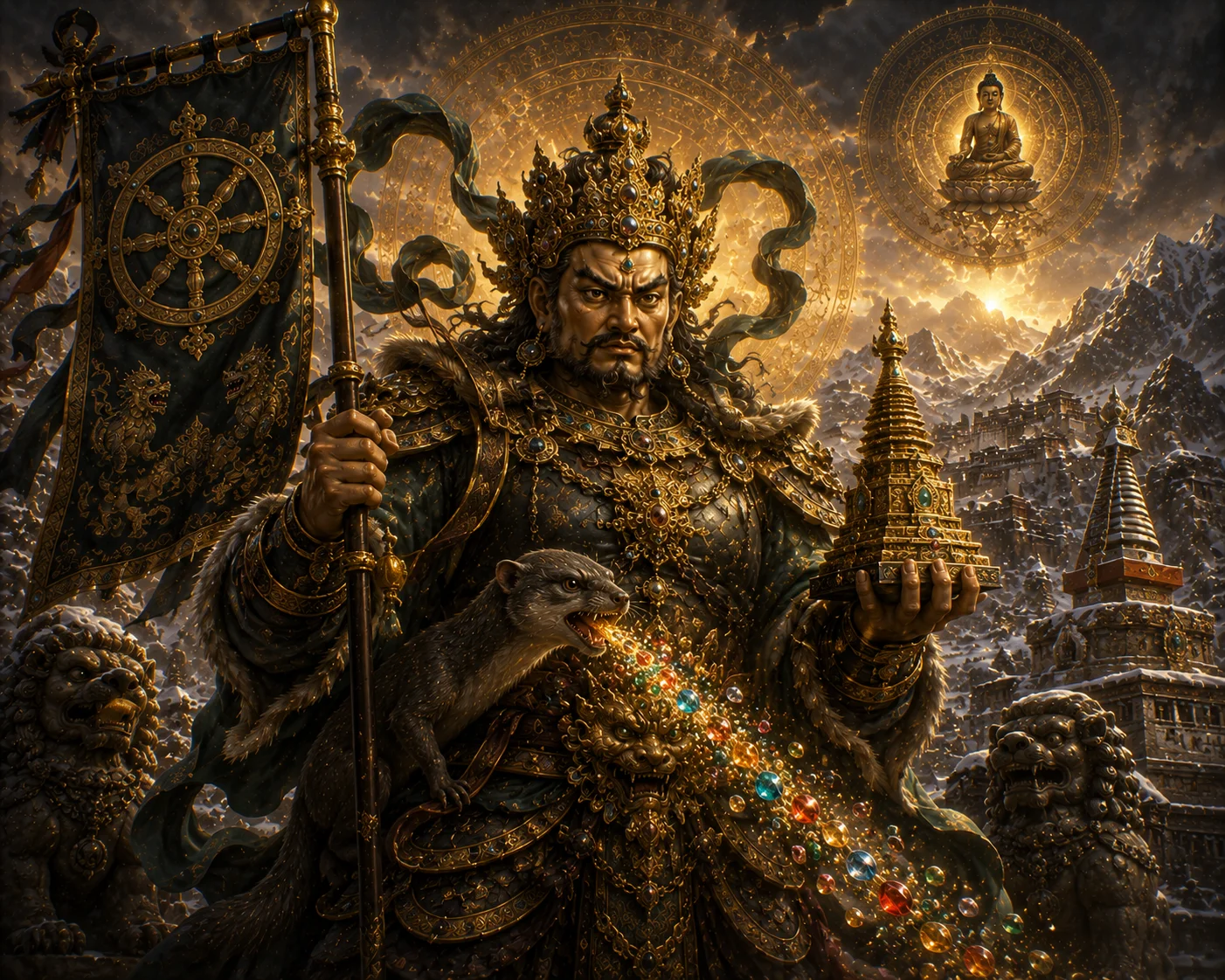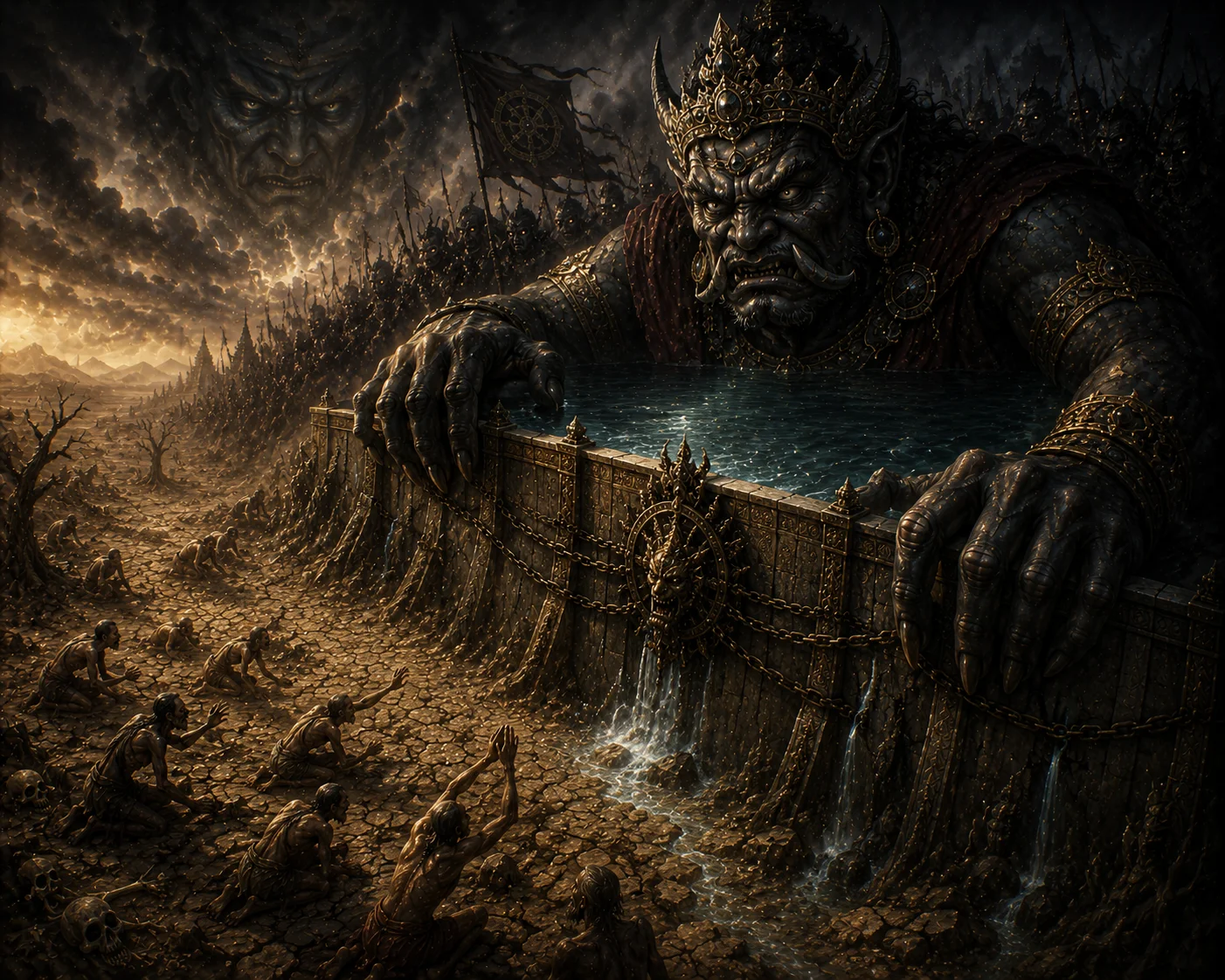
Namuci — the demon of drought, death, and obstruction — is an ancient adversary inherited by Buddhism from the older Indian tradition: a malign being who withholds the waters of life, and who came to be identified with, or numbered among, the forces of Mara, the great tempter, as an embodiment of the powers that bind beings and obstruct liberation. His very name is read as “he who does not let go.”
The One Who Does Not Let Go
Namuci’s name is traditionally interpreted as “na-muci” — “he who does not release” or “he who holds fast” — for in the ancient myth he was the demon who withheld and refused to release the waters, the life-giving rains and rivers, holding the world in the grip of drought. In the older Vedic tradition he was an asura, a demon-adversary slain by the storm-god Indra, who released the waters Namuci had imprisoned. This deep mythic association with the withholding of life and the binding-fast of what should flow free carried into Buddhism.
The Demon of Mara’s Host
In the Buddhist tradition, Namuci became closely associated with Mara, the lord of death and desire — sometimes named as another name or aspect of Mara himself, sometimes as one of his demon-generals or his host. As such, Namuci embodies the forces that obstruct the path to enlightenment: the binding power of craving and delusion, the “not letting go” of attachment that keeps beings chained to suffering and rebirth. He is the demon who holds fast to beings, refusing to release them from the cycle of samsara, just as in the old myth he held fast to the waters.
The Adversary of Liberation
Namuci thus stands among the personified obstacles to awakening — the “armies of Mara” that the Lord Buddha and every practitioner must overcome. As death, as drought, as the withholding and binding of life, and as the grip of attachment that will not let go, he embodies a profound spiritual truth in demonic form: that liberation requires the release of all clinging, the breaking of the demon’s grip. In Namuci, Buddhism inherited and transformed an ancient demon — the withholder of the waters, the one who does not let go, identified with the forces of Mara as the embodiment of death, drought, and the binding attachment that obstructs the path to liberation.
The Foam That Was Neither Wet Nor Dry
Long before Buddhism gave Namuci a place in Mara’s court, the Rigveda already knew how he died: with the foam of the waters, Indra struck the head from Namuci’s shoulders. The hymns say little more than that, and taken alone it sounds like an odd, almost incidental weapon. The later ritual literature explains why it had to be foam. In the telling preserved by the Shatapatha Brahmana, Indra had bound himself to Namuci by a compact — that he would kill him neither by day nor by night, neither with staff nor with bow, neither with the palm of the hand nor with the fist, neither with anything dry nor with anything moist. It looks like a guarantee of safety, and it was really a cage built out of language: no weapon that existed in the ordinary world could fit through so narrow a gap. Indra found the gap anyway. At the joint of day and night — neither one nor the other — he took up the foam of the waters, which is neither dry nor moist, and with it took off Namuci’s head. The episode survives less as a battle than as a riddle solved: the god does not overpower the demon so much as out-read the fine print of his own oath. It is a peculiarly legalistic ending for a peculiarly legalistic demon — the one who does not let go, undone by someone who read the terms of holding-on more carefully than he did.
One Drought-Demon Among Several
Namuci does not stand alone in the Rigveda’s gallery of water-withholders. The hymns that celebrate Indra tend to run through a roll of the enemies he has broken — Vritra, Shambara, Shushna, Pipru, Namuci — and the greatest of that company is Vritra, the coiled serpent-obstruction whose body Indra’s thunderbolt splits open so that the rivers can run again. Namuci belongs inside that list rather than outside it: another asura, in another hymn, performing the same essential work of damming what ought to flow freely to the world. This matters for understanding what Buddhism later inherited. The Namuci who walked into the Pali Canon was never a single fixed personality so much as a role — the obstructer of the waters — and it was a role Vedic recitation had already handed to more than one figure across centuries before it settled by name onto him.
Namuci at the Foot of the Bodhi Tree
The clearest evidence that Buddhism did not merely borrow a demon’s name but understood exactly whom it was borrowing survives in the Padhana Sutta, the discourse on striving, preserved in the Sutta Nipata of the Pali Canon. There, in the last hours before his awakening, the Lord Buddha does not address his tempter as Mara. He calls him Namuci, directly and by name, as the demon arrives with an army arrayed for a war that has nothing to do with swords: sensual desire; discontent; hunger and thirst; craving; sloth and torpor; fear; doubt; denigration and obstinacy; gain, praise and honour wrongly won; and the exalting of oneself while disparaging everyone else. Ten squadrons, which the sutta names as Namuci’s own host and calls the striking force of the Dark One — no coward overcomes them, it says, though whoever does overcome them wins happiness. Against that army the Lord Buddha draws no blade. He answers that faith is found in him, and energy, and wisdom, and asks why the demon troubles to question a man so resolved about the value of his life. The choice of name here is not decoration. Whoever composed the sutta wanted the old Vedic history heard inside the word itself: the god-defying withholder who once dammed the rivers now dams the mind, and the struggle for enlightenment is set out, quite deliberately, as the same order of contest Indra fought at the edge of the dawn.
Touching the Earth Against the Demon’s Claim
Among the most widely reproduced images in the whole history of Buddhist art is, in effect, a picture of that demon losing. When Mara came to claim the seat beneath the Bodhi tree as rightfully his, producing his own followers as witnesses to his merit while the Lord Buddha had nobody to call, the Lord Buddha did not argue the point. He extended his right hand, fingers reaching downward, and touched the ground, calling the earth to bear witness in his place. This is the bhumisparsha mudra, the earth-touching gesture, carved, cast and painted across the Buddhist world from Bodh Gaya outward: wherever a seated Lord Buddha’s right hand reaches toward the ground rather than resting in his lap, this is the moment being shown. In the living traditions of Thailand, Myanmar, Laos and Cambodia the scene is carried further still. The earth answers in person, as the goddess known in Thai as Phra Mae Thorani and by cognate names across the region, and wrings from her long hair the accumulated water of every gift the Lord Buddha had made in his past lives — a flood that sweeps the demon armies away. It is worth pausing on what that image claims. The demon of drought and withholding is beaten at last not by a greater force than his own, but by water: the very element he once dammed and denied, coming back in quantity to carry him off.
Why a Demon of Drought Became a Demon of the Mind
It is not obvious why an ancient anxiety about failed monsoons should still mean anything to a tradition concerned with the workings of the mind. But the logic that carried Namuci out of the Rigveda and into the Pali Canon was never really about weather. It is about a specific fear: that something necessary is being withheld by a will that could release it and refuses to. A drought is not simply an absence of rain — it is rain existing somewhere, held back, denied to those who need it, by something that will not let go. Craving has precisely that shape: not an absence of satisfaction but a grip that will not open, a mind holding fast to what it wants and mistaking the holding for the wanting. Namuci’s name survived the crossing between two religions because the shape of the problem survived it first. Long before either tradition had a doctrine to explain it, anyone who had ever watched a sky refuse to rain already understood the essential thing — and understood, too, that the withholding which costs most is not always the sky’s. Sometimes it is one’s own.
Sources & traditions
- TraditionBuddhist texts, oral tradition and village tellings (South/Southeast Asia)
Myths change from area to area and from time to time. This chronicle follows the most widely told versions; tellings in other villages, regions and eras may differ.