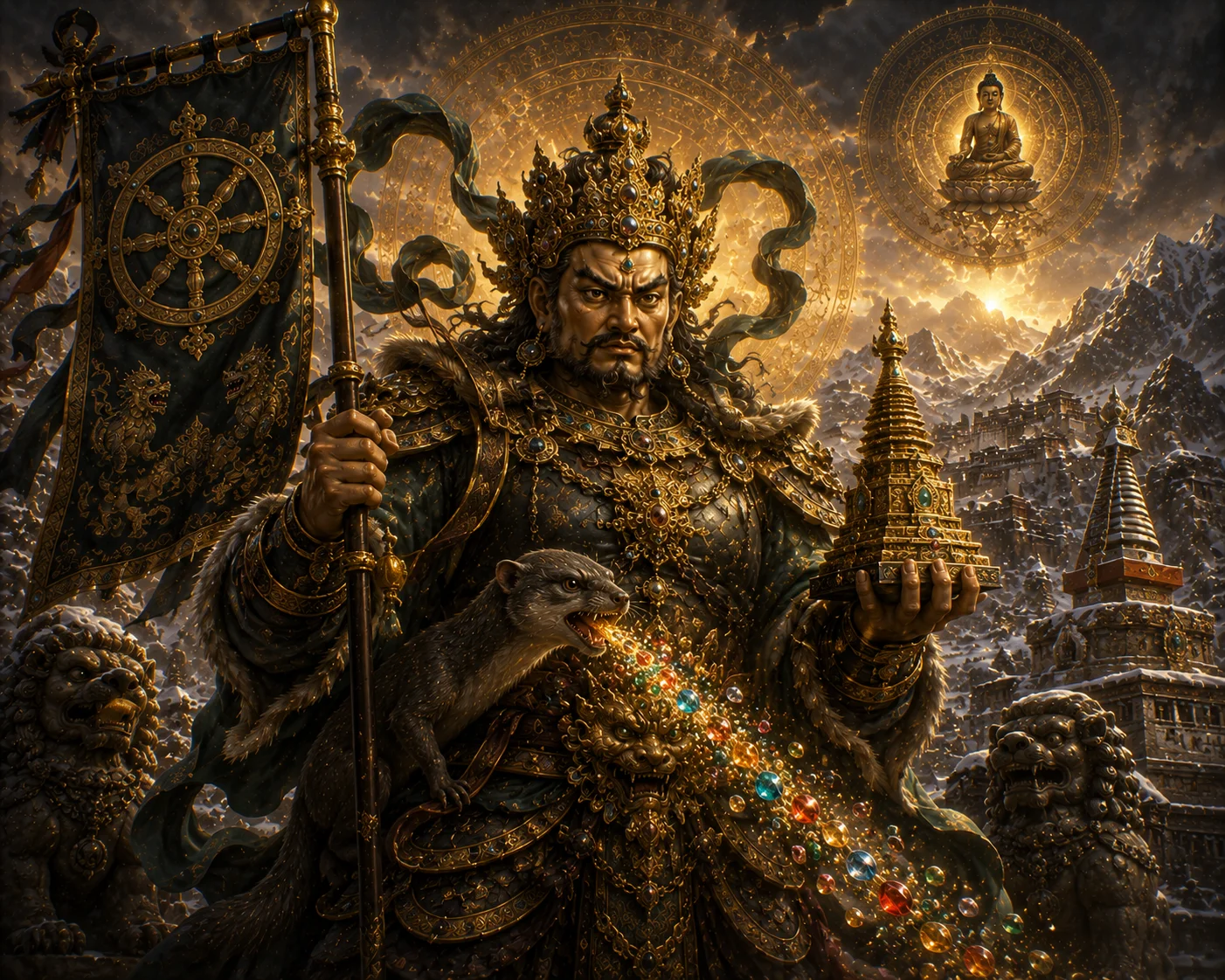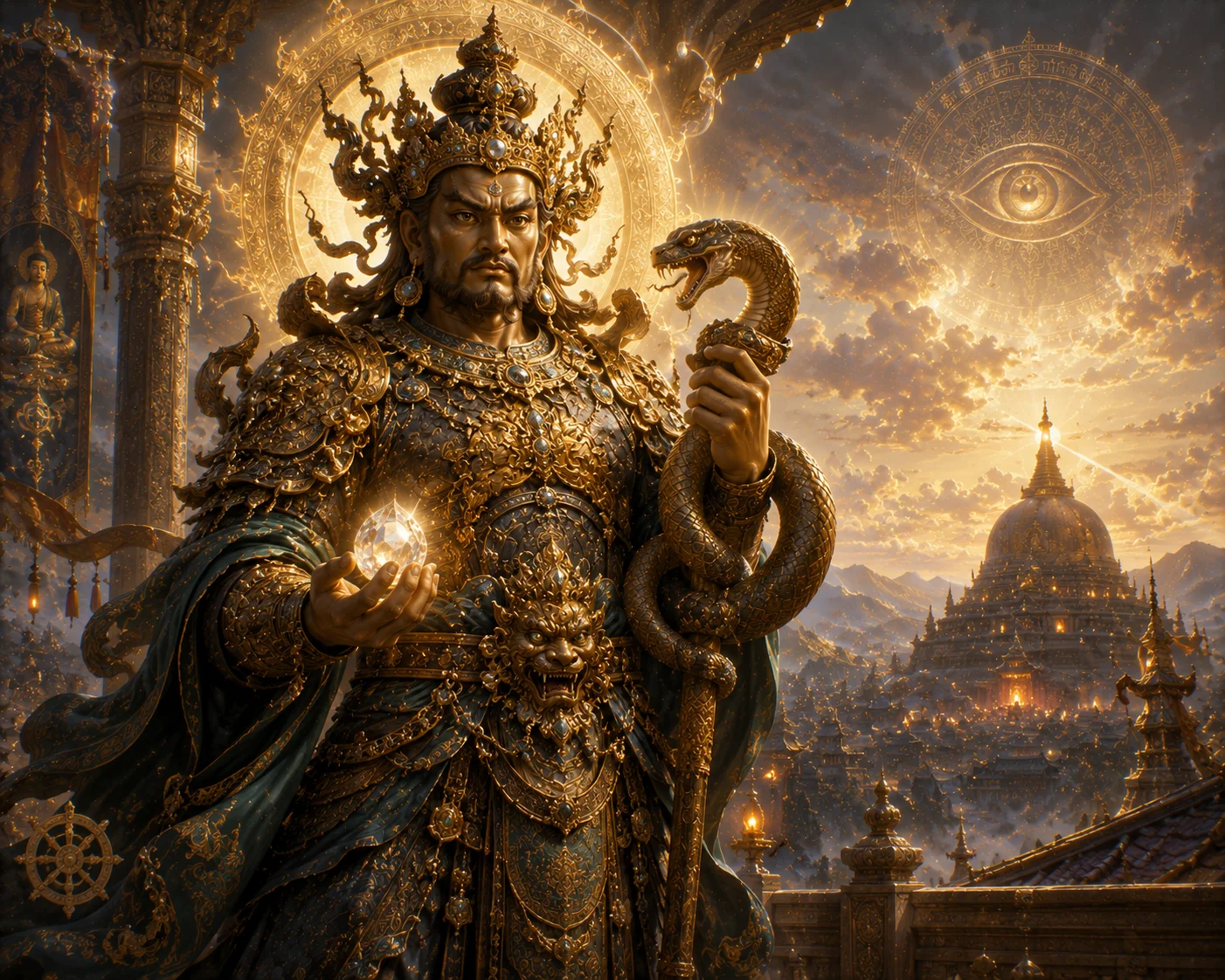
Virupaksa — the guardian king of the West — is one of the Four Heavenly Kings, the protectors of the world and the dharma: an armored deity who watches over the western quarter, commands the nagas, and sees all with his far-seeing eyes, holding a serpent and a jewel as he defends the teaching. His name means “he who sees all” or “of varied eyes.”
The All-Seeing King
Virupaksa is the guardian of the West among the Four Heavenly Kings (Lokapalas), the four deities who ward the cardinal directions from Mount Meru and protect the world and the Buddhist teaching. His name signifies his far-reaching, all-seeing sight — he is the king with the penetrating gaze who watches over the world, observes the deeds of beings, and perceives those who do evil. With his all-seeing eyes he keeps watch and reports, and he punishes the wicked and encourages the good.
The Lord of the Nagas
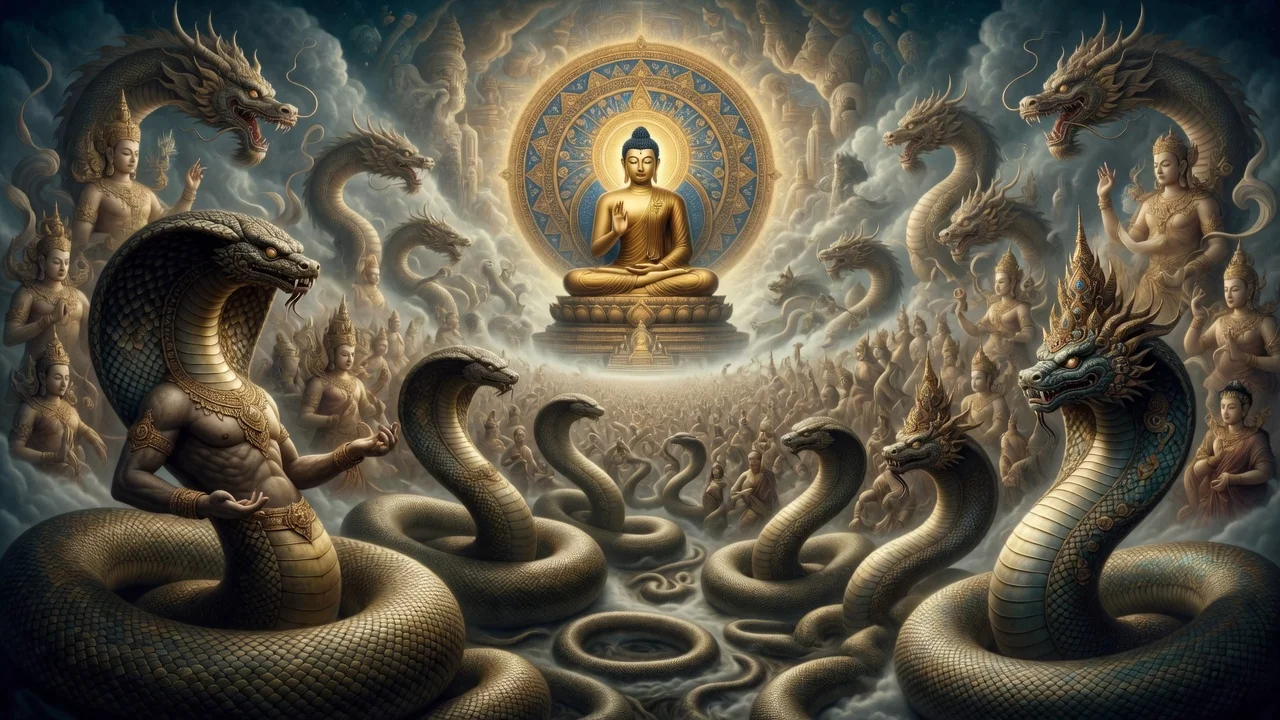
Virupaksa commands the nagas — the serpent-beings and dragon-spirits of the waters — as his hosts, and he is most often depicted holding a serpent or a small dragon (sometimes a noose or a rope of snake-form) in one hand and a jewel or pearl in the other — the serpent he masters and the jewel it guards. In China he is Guangmu Tianwang (“the Broad-Eyed Heavenly King”), and his armored image, holding the serpent, guards temple gates with his three royal brothers, each defending a quarter against the forces of evil.
The Guardian of the West
As one of the four protectors, Virupaksa is invoked for protection and for the all-seeing watchfulness that guards against evil and encourages virtue. The Four Heavenly Kings together — Vaisravana of the North, Dhrtarastra of the East, Virudhaka of the South, and Virupaksa of the West — form the complete fourfold guard of the Buddhist cosmos, their fierce armored figures standing at temple gates across Asia to ward off demonic forces from every direction. In Virupaksa, Buddhism gave form to all-seeing watchfulness and the mastery of the serpent-powers — the broad-eyed guardian king of the West who sees all the deeds of the world, commands the nagas, and defends the dharma from the western quarter.
Roots in an Older Sky
Indian cosmology parcels the horizon out among guardians — the dikpalas, one sovereign to each quarter: Indra in the east, Yama in the south, Kubera in the north, and in the west Varuna. Varuna is far older than any Buddhist text. In the Rigveda he is the keeper of rta, the order that holds the cosmos to its course, the god who binds oath-breakers with his noose; in later tradition he becomes lord of the waters outright, riding the crocodile-bodied makara through a court of serpent-nymphs. When Buddhist cosmographers drew their own world around Mount Meru, they kept the four-cornered watch and installed new tenants: the Four Great Kings, whose heaven — the realm belonging to the four great kings — sits lowest of all the heavens, on the mountain’s own slopes rather than above them. Virupaksa took the western post, and with it a quarter that Indian thought had already made watery and thick with serpents. No text records a handover. The west simply stayed a place of water and snakes no matter which religion was drawing the map.
His earliest appearances are canonical rather than legendary, and in Pali his name is Virupakkha. In the Mahasamaya Sutta of the Digha Nikaya the four kings arrive before the Lord Buddha at the head of enormous retinues, ranked by quarter — gandhabbas to the east, kumbhandas to the south, yakkhas to the north, and nagas following the king of the west. The Atanatiya Sutta of the same collection stages the scene more carefully still: the kings post their armies around all four directions, approach the Lord Buddha, and then Vessavana, the northern king, recites a ward for monks who meditate alone in forests where such beings are held to live. It is a revealing arrangement. The protection on offer is protection from the kings’ own unrulier subjects — which is to say that the western king’s authority over the nagas was never decorative. It was the entire point of giving him the job.
A Name Shared with Shiva
Walk into the Virupaksha Temple at Hampi in Karnataka and nobody will point you toward a Buddhist guardian. Virupaksha there is Shiva, worshipped as the consort of the local goddess Pampa; inscriptions record the god at that spot in the ninth and tenth centuries, long before the Vijayanagara kings made him the tutelary deity of an empire and grew their capital around his shrine. The place name is generally understood to be the goddess’s own, worn down by centuries of Kannada speech until Pampa became Hampi.
The overlap between the two gods lies in the word, and the word is oddly specific. Virupa means irregular, misshapen, of unlike or varied form; aksa means eye. Attached to Shiva it points at a face carrying a third eye set vertically where no eye belongs — sight that is the wrong shape. Attached to the guardian of the west, the identical compound is read in almost the opposite direction: not deformed sight but enlarged sight, which is why Chinese translators settled on “broad eyes.” Whether the two usages are related or merely converged is not something the sources settle. What they share is a description of an eye that refuses to behave like an ordinary eye.
The Sutra That Set Him Over Nations
A gate guardian turns back whatever tries to come through the gate. The Sutra of Golden Light handed Virupaksa and his brother-kings a far larger brief. In its chapter on the four kings protecting the nation, they vow before the Lord Buddha to defend any ruler who governs justly and honours the text — keeping invasion, disaster and famine away from an entire territory rather than a doorway. Rulers took the offer at its word. In 741 Emperor Shomu ordered a state temple raised in every province of Japan, and the official name given to that network was, in full, the Temple for the Protection of the State by the Four Heavenly Kings of the Golden Light Sutra. Virupaksa had become part of the administrative machinery of a country.
The oldest Japanese story about the kings is older than that programme by a century and a half. Following the Nihon Shoki, tradition holds that during the war between the Soga and Mononobe clans in 587 the teenage prince later known as Shotoku cut down a tree, carved images of the Four Heavenly Kings from it, and vowed to raise them a temple if his side won. It won. Shitennoji — literally “Temple of the Four Heavenly Kings” — is traditionally dated to 593 and stands in Osaka still, though its halls have burned and been rebuilt so often that nothing there now is original. A guardian of the western quarter had been enlisted to legitimise a dynasty, which is a considerably more ambitious assignment than frightening spirits off a threshold.
Komokuten, the Wide-Eyed King
In Japan he is Komokuten, the “wide-eyed” one, and the oldest surviving set of Shitenno figures in the country still has him at his post: four camphor-wood guardians in the Kondo of Horyuji, carved in the middle of the seventh century and designated National Treasures. Japanese images also hand him something quieter than a serpent — a writing brush in one hand and a sutra scroll in the other, traditionally read as the power of the teaching to cut through ignorance. The substitution is worth pausing over anyway. A god whose entire office is noticing what beings do has been handed, of all things, a pen and something to write in.
Wind, Rain and the Serpent in His Grip
In a Chinese temple the western king waits in the Hall of Heavenly Kings, the first hall past the mountain gate, two guardians to a side with a broad laughing Maitreya seated between them and the main sanctuary still ahead. What the four of them carry is a pun as much as a warning. Temple tradition reads their emblems together as a four-word blessing spoken over the fields — favourable winds, timely rain — the sword, the lute, the umbrella and the serpent each supplying one syllable, the western king’s writhing snake standing for the last of them: compliance, things running smoothly. The joke has teeth. Across East Asia it is dragons and nagas who withhold or release the rain, and a slighted dragon-king means a failed harvest. The creature struggling in his fist is precisely the one the farmers outside were bargaining with every spring, and he is holding it still.
A Cosmology Still Being Recited
In the Theravada south — Sri Lanka, Myanmar, Thailand — the western king never dwindled into statuary. The Abhidhamma’s map of the universe seats the Four Great Kings over Catumaharajika, the lowest of the six heavens of the sense-sphere gods, on the slopes of Mount Sineru: exactly where the suttas first placed them. Nor is the Atanatiya a museum piece there. It sits in the Catubhanavara, the Sri Lankan book of protective chants, and is recited at pirit ceremonies to this day — which means that in these countries Virupaksa is less remembered than addressed.
Why the Watcher Endures
Cultures that never met put figures at their doorways: lamassu at Assyrian gates, Janus over the Roman one, stone dvarapalas at temple entrances across South and Southeast Asia. A threshold is where a community is most nervous about what might come through it, and the answer is almost always a body — something large, armed and unsleeping. What the western king adds to that very old arrangement is an eye. His deterrent is not the blow he might land but the certainty that nothing gets past him unobserved, that a wrong done in an empty place does not simply vanish into the size of the world. Give a fear that ancient a shape and it will outlast every empire that carves it.
Sources & traditions
- EncyclopediaWikipedia — Virūpākṣa
- TraditionBuddhist texts, oral tradition and village tellings (South/Southeast Asia)
Myths change from area to area and from time to time. This chronicle follows the most widely told versions; tellings in other villages, regions and eras may differ.