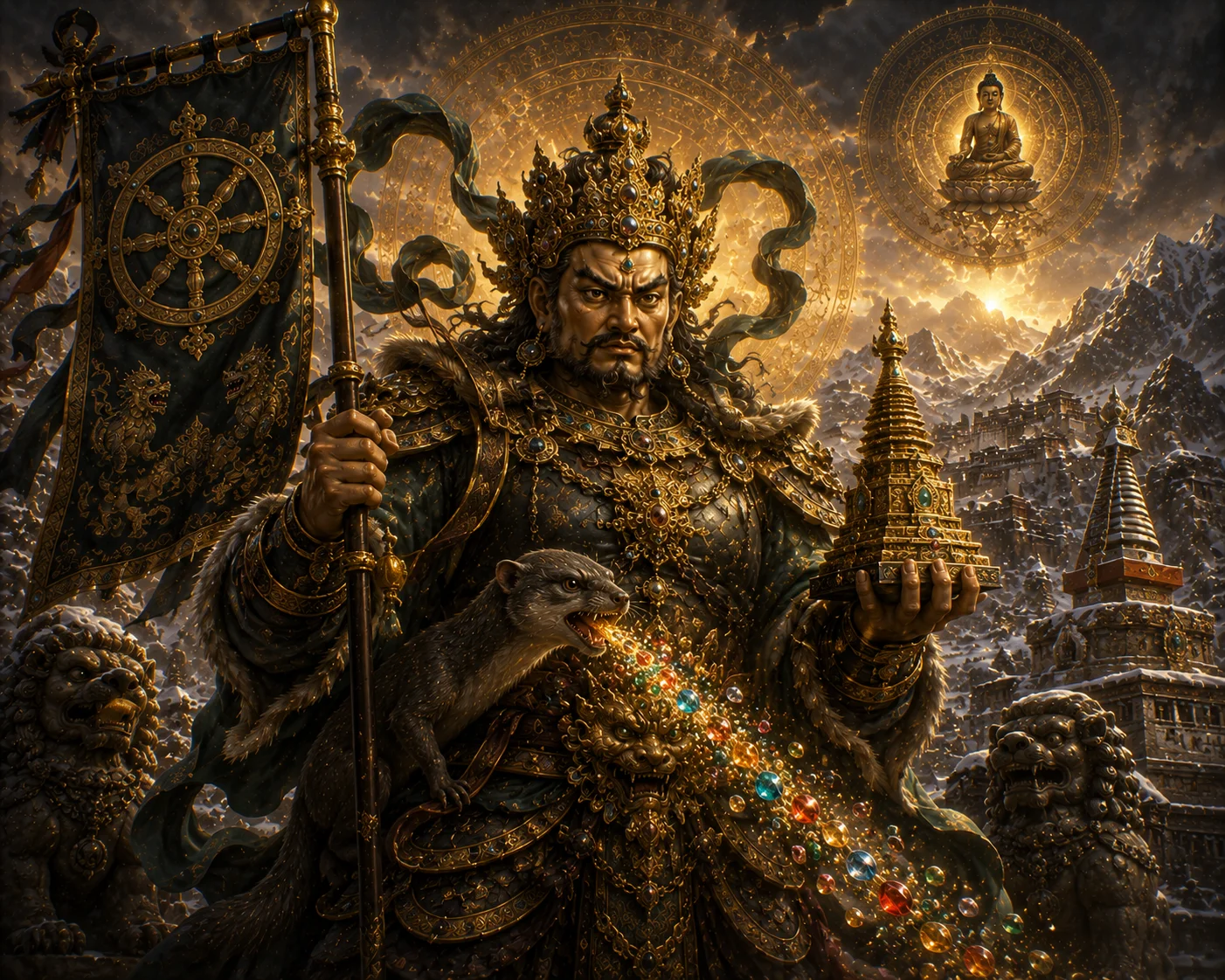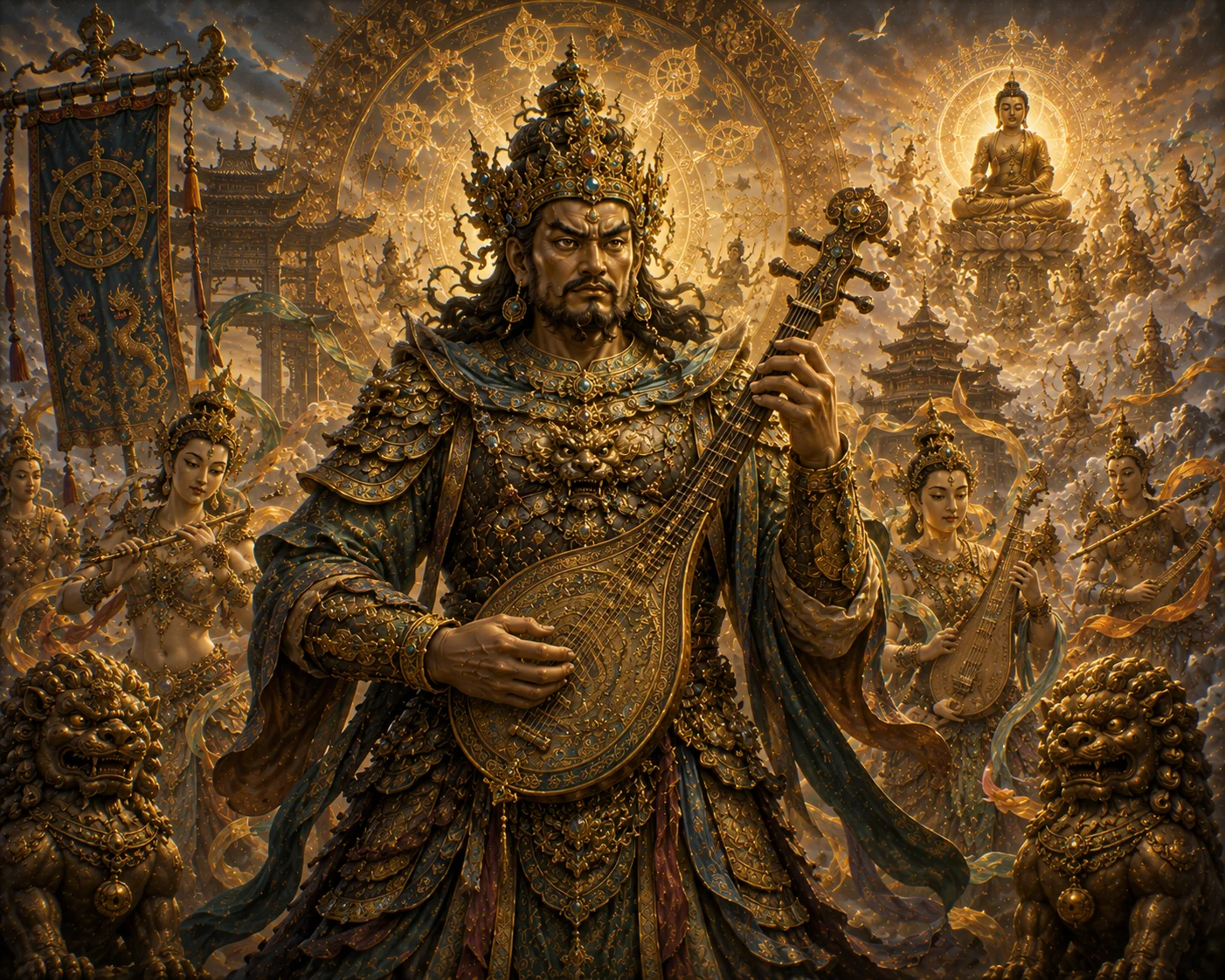
Dhṛtarāṣṭra, the guardian king of the East, is one of the Four Great Kings (Cāturmahārāja) of Buddhist cosmology: a noble, armored deity who watches over the eastern quarter of the world from the slopes of Mount Sumeru, commands the celestial musicians known as the gandharvas, and upholds the realm in harmony and order. Revered across the Pali, Mahayana, and Vajrayana traditions alike, he stands among the most widely recognized protector figures in the Buddhist world, his image greeting pilgrims and devotees at temple gates from China to Japan to Tibet.
He Who Upholds the Realm
The name Dhṛtarāṣṭra, rendered Dhataraṭṭha in Pali, means "upholder" or "sustainer of the realm" — the king who keeps the kingdom in order and concord. He should not be confused with the blind king Dhritarashtra of the Kuru dynasty found in Hindu epic literature; the two figures share a name and nothing else, one belonging to the epic tradition of the Mahabharata, the other to Buddhist cosmology entirely. The Dhṛtarāṣṭra venerated here is a lokapāla, a world-guardian, one of four such kings who watch over the cardinal directions and, by extension, the Buddhist teaching itself.
Dwelling on the Slopes of Sumeru
Dhṛtarāṣṭra dwells, together with his fellow guardian kings, on the lower slopes of Mount Sumeru (also called Meru), the axial mountain at the center of Buddhist cosmology. This dwelling place lies within the Cāturmahārājika heaven, the lowest of the six deva realms of the kama-loka, the realm of desire. It is a fitting station for the Four Great Kings: near enough to the human world to ward it directly, yet already part of the ordered, luminous hierarchy of the heavens that rises above it.
Warden of the Eastern Gate
Among the Four Great Kings, Dhṛtarāṣṭra holds the eastern quarter as his particular charge. His three royal companions divide the remaining directions between them: Virūḍhaka guards the South, Virūpākṣa the West, and Vaiśravaṇa — also known as Kubera — the North. This fourfold directional scheme is not a late invention or a regional embellishment; it is attested across both the Pali Nikāyas and the Mahayana sutras, appearing with remarkable consistency wherever Buddhist cosmology is set out, a sign of how deeply the four-quartered guardianship of the world was woven into the tradition from its early centuries.
Lord of the Gandharvas
Dhṛtarāṣṭra is traditionally described as the lord and king of the gandharvas, the celestial musician-spirits of Buddhist and Indic cosmology. It is this retinue that gives him his most distinctive iconographic signature: he is very often shown holding or playing a musical instrument, most commonly a lute or pipa in the East Asian artistic tradition. The association is not merely decorative. As commander of beings whose nature is musical and harmonious, Dhṛtarāṣṭra's guardianship of the East is itself figured as a kind of harmony — the maintenance of order through concord rather than through force alone.
The String That Is Neither Too Taut Nor Too Slack
The stringed instrument so often placed in his hands has, within the devotional and artistic tradition, been read as more than an emblem of his gandharva hosts. Some interpreters have seen in the tuning of the string itself a reflection of the middle way — a string pulled too tight will snap, one left too slack will produce no note at all, and only the balanced string sings true. Whether or not every depiction was created with this reading consciously in mind, it has become a natural association for a guardian whose very name speaks of upholding and sustaining, rather than crushing or overpowering, the realm entrusted to him.
The Protective Verse of the Āṭānāṭiya Sutta
The clearest canonical attestation of Dhṛtarāṣṭra's protective office comes from the Āṭānāṭiya Sutta, preserved in the Digha Nikaya as its thirty-second discourse. There, the Four Great Kings — Dhṛtarāṣṭra among them — approach the Lord Buddha directly and offer a protective verse, a paritta, on behalf of the monks and nuns who dwell in remote and solitary places, far from the safety of settled communities. The purpose of this verse is explicit: to ward off harm from non-human beings who might trouble those given over to meditation in the wilderness. It is one of the earliest and most direct Pali sources for understanding the Four Kings not as distant cosmological abstractions but as guardians actively invoked for the protection of the sangha.
Subordinate to the Lord of the Trāyastriṃśa
Within the ordered hierarchy of Buddhist cosmology, Dhṛtarāṣṭra and his fellow kings occupy a specific rank. The Cāturmahārājika heaven in which they dwell sits below the Trāyastriṃśa heaven, the realm governed by Śakra, also known as Indra. The Four Great Kings report to and serve Śakra according to the standard cosmological schema found in Abhidharma cosmology texts such as the Abhidharmakośa. This is not a diminishment of Dhṛtarāṣṭra's office so much as a placement within a coherent celestial order — the eastern gate is his to hold, but the holding of it takes place within a larger, harmonious structure of authority that culminates, ultimately, in the Lord Buddha's own teaching.
Chiguo Tianwang, Upholder of the Nation
In Chinese Buddhism, Dhṛtarāṣṭra is known as Chiguo Tianwang, 持國天王, a name that carries forward his Sanskrit meaning: the guardian who upholds and sustains the nation or realm. He is enshrined, together with the other three Heavenly Kings, in the Hall of the Four Heavenly Kings, the Tianwang Dian, found near the entrance of Chinese Buddhist monasteries across the country. Devotees encounter him, quite literally, as one of the first sacred images passed on entering consecrated ground — an armored figure standing watch at the threshold between the ordinary world and the space of the dharma.
Iconographic convention in China has often associated him with pale or white coloring and, depending on the tradition and the temple, either the sword or the stringed instrument as his attribute, though these assignments are not fixed and sources sometimes differ on which of the Four Kings carries which emblem.
Jikokuten of the Shitennō
In Japan, Dhṛtarāṣṭra is venerated as Jikokuten, 持国天, one of the four Shitennō, 四天王, the guardian kings who stand watch over the cardinal directions in Japanese Buddhist practice. Among the most celebrated surviving representations of Jikokuten and his three companions are the Shitennō statues of Hōryū-ji temple, dating to the seventh century — among the oldest surviving works of Buddhist sculpture in Japan, and a testament to how early and how firmly the veneration of the Four Great Kings took root once Buddhism reached the Japanese islands. Standing in armor at the temple threshold, Jikokuten embodies the same eastern guardianship and protective vigilance found in every regional tradition that has received him.
Yulkhorsung at the Threshold of the Vajrayana Temple
Tibetan Buddhism preserves Dhṛtarāṣṭra as Yulkhorsung, retained within Vajrayana protector iconography as one of the four directional guardian kings. As in the Chinese and Japanese traditions, he is typically depicted at temple entrances alongside the other three kings, a placement that recurs with striking consistency across very different artistic and linguistic traditions. That the same fourfold guardianship, the same eastern charge, and the same threshold placement persist from the Pali sources through Chinese, Japanese, and Tibetan reception is itself a mark of how central this protective office has remained across the full breadth of Buddhist civilization.
Colors and Attributes Without a Single Fixed Form
It is worth noting plainly that no single color or weapon is universally assigned to Dhṛtarāṣṭra across every tradition that venerates him. White or pale coloring is common in East Asian convention, and the sword appears alongside the lute or pipa as an alternative attribute in some regional schemes, but these assignments vary between Chinese, Japanese, and Tibetan systems, and sources sometimes swap attributes between the Four Kings entirely. This is not confusion so much as the natural variation of a living tradition carried across many centuries and many cultures, each rendering the same guardian office in its own visual language while preserving his essential identity as protector of the East.
Guardian of the Threshold, Protector of the Sangha
Across every tradition that receives him, Dhṛtarāṣṭra functions as a dharmapala-type protector, one whose office is to guard the eastern quarter and, through that guardianship, to protect the Buddhist teaching and its practitioners from harm approaching from that direction. The Four Great Kings collectively symbolize the protection of the cosmos and of the sangha; they are not vehicles of doctrinal or wisdom teaching in the way that a bodhisattva or a figure of the Lord Buddha is, but stand instead as the vigilant, armored presence that makes the practice of the dharma possible by warding off what would disturb it. The placement of his statue, and those of his three companions, at temple gates across Asia is therefore no mere architectural habit — it is the physical expression of a cosmological role: the guardian is met first, before the sanctuary, because it is the guardian who makes the sanctuary safe to enter.
The Harmony That Holds the Eastern Quarter
In Dhṛtarāṣṭra, the Buddhist tradition gives lasting form to a particular vision of protection — not one of raw force alone, but of upholding, sustaining, and harmonizing. Lord of the celestial musicians, keeper of the eastern gate, subordinate within a vast and ordered cosmology yet indispensable to it, he has been venerated under many names and in many forms: Dhataraṭṭha to the reciters of the Pali canon, Chiguo Tianwang to the monasteries of China, Jikokuten to the temples of Japan, Yulkhorsung to the protector shrines of Tibet. Across all of these, the same guardian endures — the upholder of the realm, standing watch at the threshold of the sacred, holding the East in concord and peace.
Sources & traditions
- EncyclopediaWikipedia — Dhṛtarāṣṭra
- TraditionBuddhist texts, oral tradition and village tellings (South/Southeast Asia)
Myths change from area to area and from time to time. This chronicle follows the most widely told versions; tellings in other villages, regions and eras may differ.