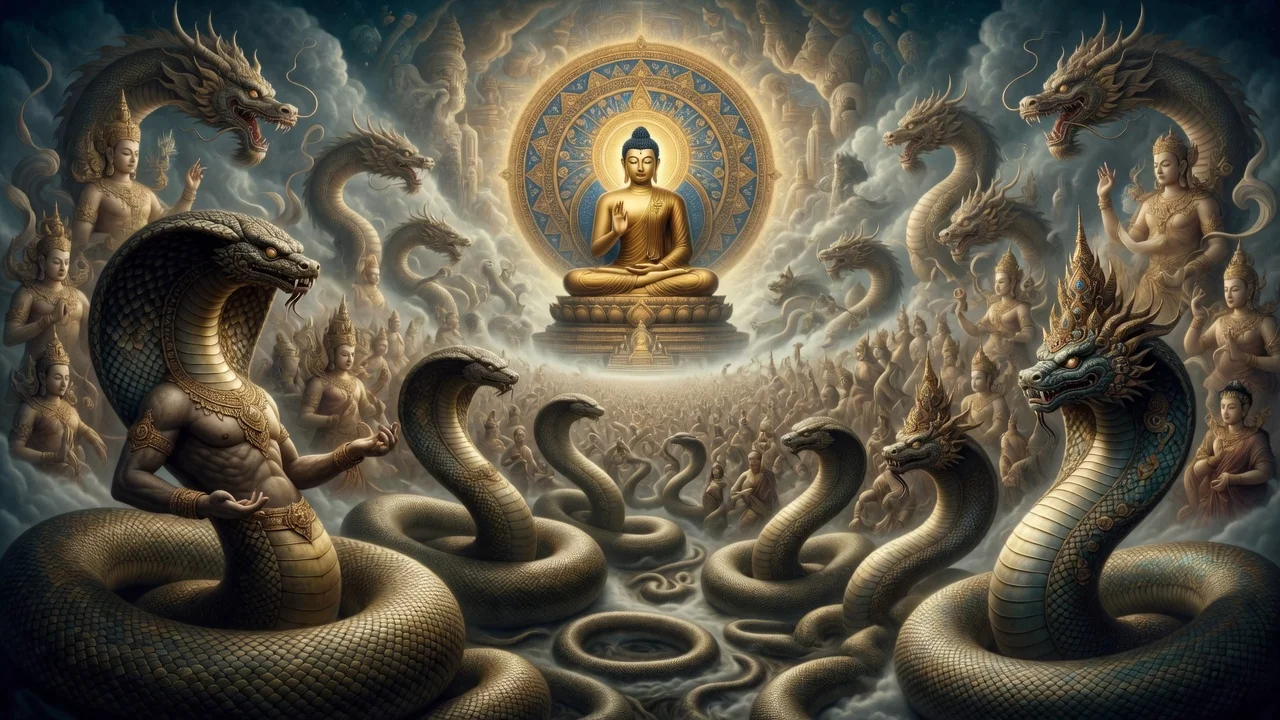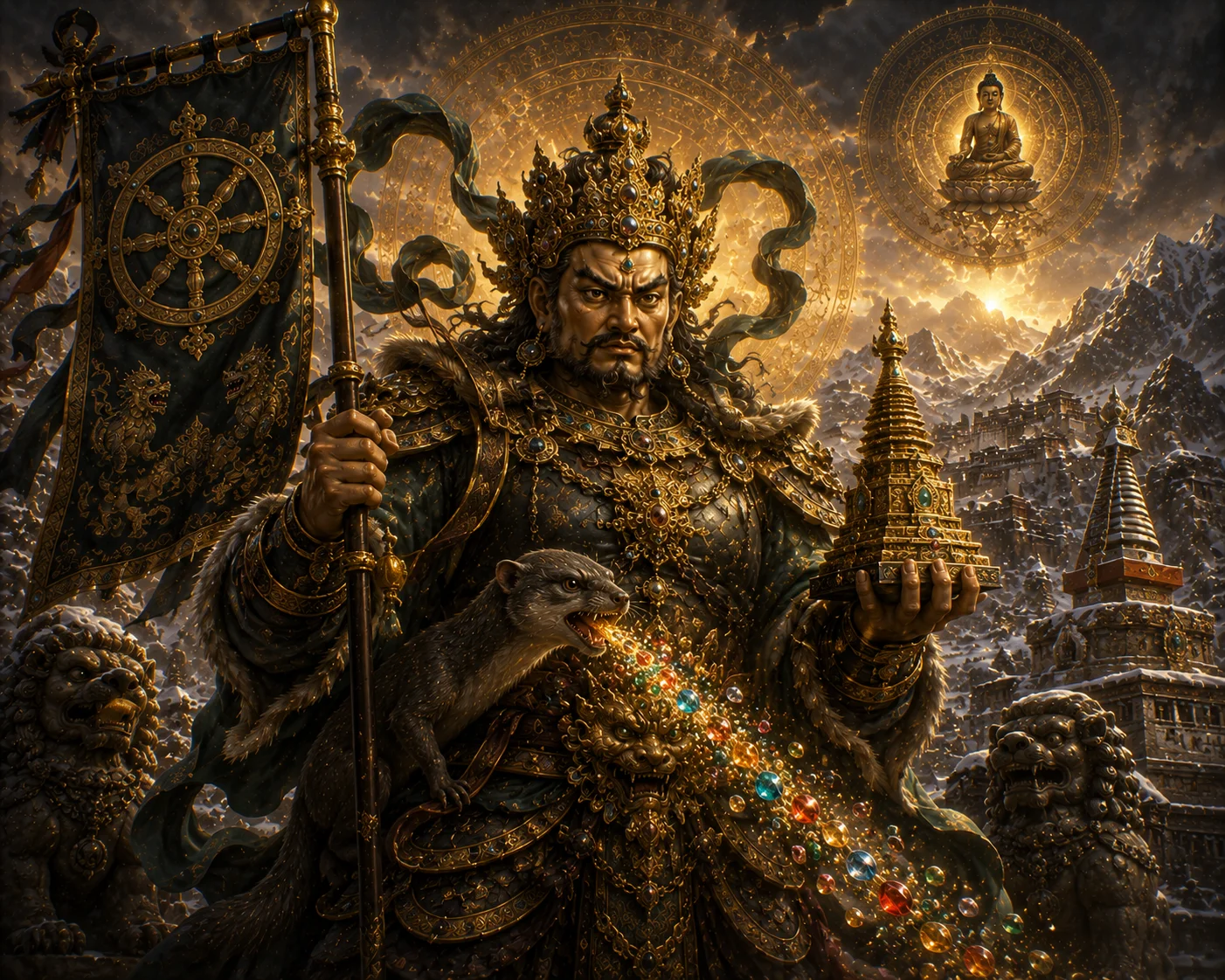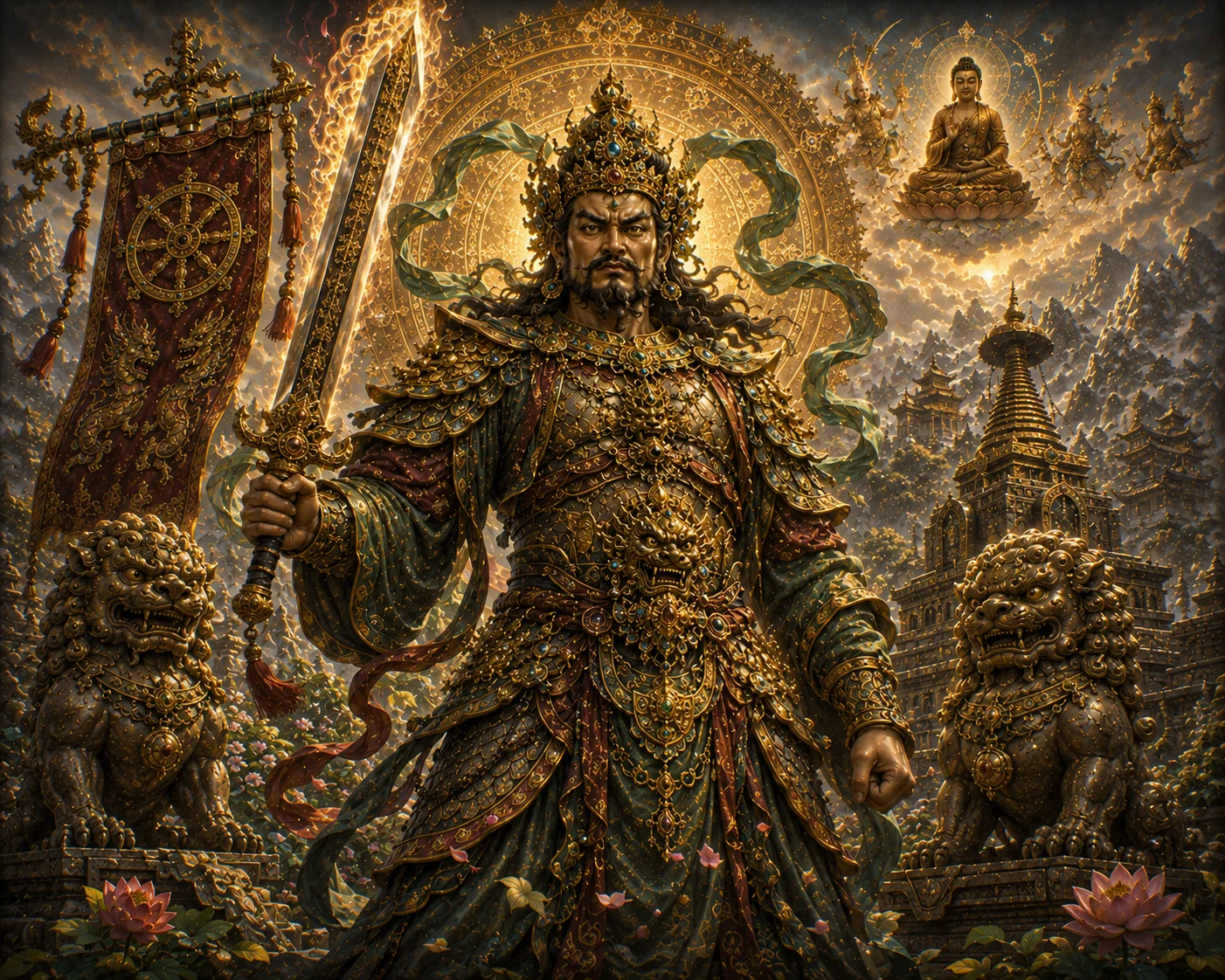
Virūḍhaka, the guardian king of the South, is one of the Cāturmahārājikā, the Four Great Heavenly Kings who ward the cardinal directions in Buddhist cosmology: a fierce armored deity who watches over the southern quarter from the slopes of Mount Sumeru, commands the kumbhāṇḍas, and wields a great sword to defend the teaching and to cause the roots of virtue to grow.
The One Who Causes Growth
The name Virūḍhaka, rendered in Pali as Virūḷhaka and elsewhere as Virulhaka, is drawn from the Sanskrit and Pali root vṛdh, to grow or increase. He is commonly known by the gloss He who Causes Growth, or the Enlarger, and the title is not decorative. Among the Four Great Heavenly Kings he is the one whose office is tied specifically to flourishing: the growth of the roots of goodness in beings, the growth of merit, the growth of the dharma itself in the quarter of the world entrusted to him. Where his eastern and western counterparts are bound up with other themes of kingship and vision, Virūḍhaka's name fixes him permanently to the image of something taking root and increasing under watchful guard.
Regent of the Southern Quarter
Virūḍhaka is one of the Cāturmahārājikā, the Four Great Heavenly Kings, who together form the lowest of the six deva realms of kāmadhātu, the Cāturmahārājika heaven. He is the regent of the southern quarter, dakkhiṇa disā, and his residence is placed on the southern face of Mount Sumeru, called Meru in the wider tradition, in a realm sometimes referred to as his own palace within that heaven. This placement is attested across the Pali Nikāyas, most notably the Āṭānāṭiya Sutta of the Dīgha Nikāya, and it recurs in Mahayana and Vajrayana canonical and iconographic sources as well. The four kings are not isolated figures ruling separate domains in competition with one another; they are co-equal guardians, each responsible for one direction, and together they attend upon Śakra, known also as Indra, lord of the Trāyastriṃśa heaven above them.
Lord of the Kumbhāṇḍas
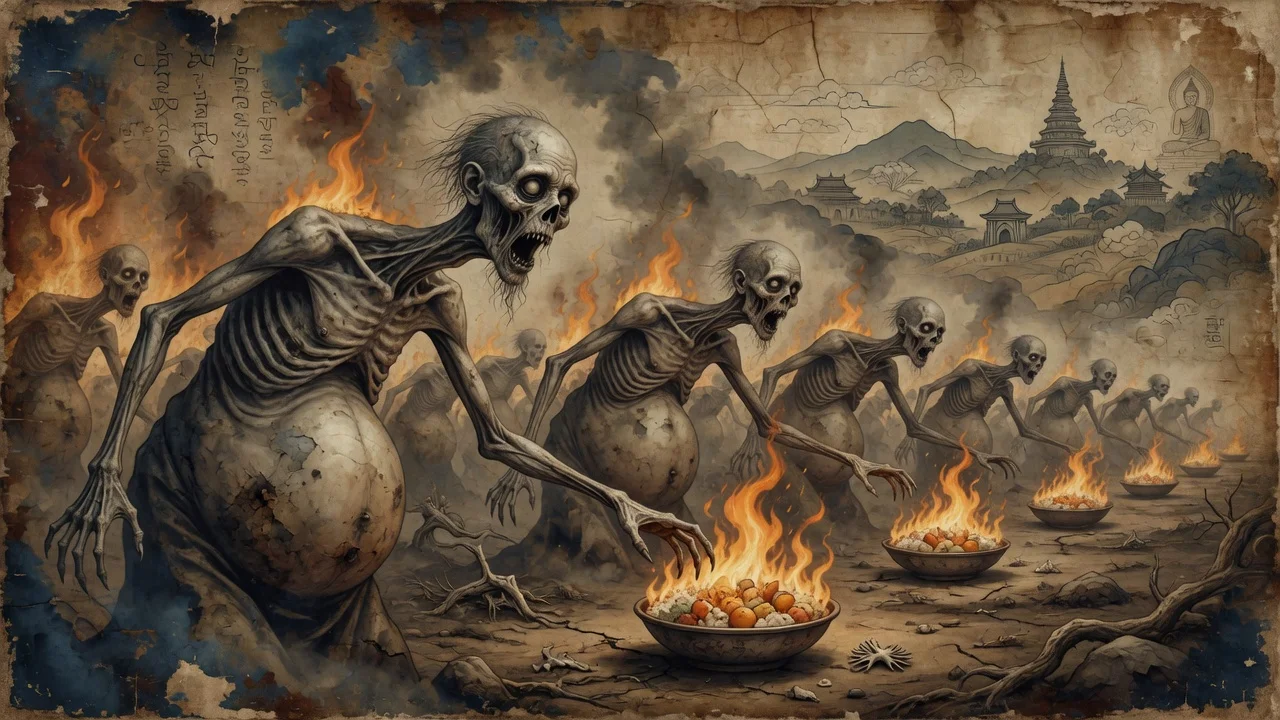
Virūḍhaka's dominion is defined above all by the beings he commands: the kumbhāṇḍas, a class of dwarfish, gnome-like earth-spirits associated with fertility and guardianship. Buddhist iconographic tradition sometimes describes them with pot-shaped bellies or forms, a detail bound up with their name, and they appear across canonical and commentarial literature as a host distinct from, though related to, the yakkhas who serve the other kings. In some later regional systems Virūḍhaka is also linked with the pretas, though this association carries far less canonical weight than his rule over the kumbhāṇḍas, which is the stable and consistently attested feature of his office. To command the kumbhāṇḍas is, in the logic of his name, a fitting charge: spirits of the fertile earth answering to the king whose very title means growth.
Bound by the Āṭānāṭiya Pledge
The Āṭānāṭiya Sutta preserves the pattern by which the Four Kings are bound to the Buddhadharma as its protectors, dharmapālas in the fullest sense. In that discourse the four pledge themselves to shield Buddhist monks and lay followers from harm at the hands of malevolent spirits, the yakkhas and their kin who might otherwise trouble the faithful. Virūḍhaka's portion of that pledge concerns the beings of the south: the kumbhāṇḍas and the related non-human hosts under his command are tasked with restraint, kept from harassing meditators and monastics who dwell in remote forest lodgings, far from the protection of towns. In this office Virūḍhaka is less a distant cosmological figure than a watchful presence over the actual, lived vulnerability of those who go forth into solitude to practice.
Witness at the Turning of the Month
Alongside his role as protector, Virūḍhaka shares in a second duty described in the Anguttara Nikāya's tradition of the Kings' periodic inspection of the human world. On the eighth, the fourteenth, and the fifteenth days, the Four Kings, or their emissaries, or the Kings themselves, move through the world of human beings to observe the conduct of the living: whether they honour their parents and elders, whether they keep the precepts, whether generosity and virtue are practised or neglected. What is seen is reported upward to the assembly of the gods, so that the moral state of the human realm is not hidden from the higher heavens but carried to them directly by its own appointed witnesses. Virūḍhaka's part in this rhythm ties his guardianship of the south to something larger than territory: a recurring accounting of how beings are actually living.
The Sword That Guards the South
In Mahayana and Vajrayana iconography Virūḍhaka is depicted as a warrior-king in full armor, his colouring given variously as blue or green depending on tradition and region, and he is most commonly shown holding a great sword. The blade is his defining emblem: it marks him at temple gates across East Asia and distinguishes him among his three royal brothers at a glance. In some East Asian traditions, attested with less canonical weight than the core Indic sources but well established in regional practice, the sword is read as an instrument for cutting through illusion, wisdom expressed in action rather than only in stillness, and it is also linked, through the resonance of his name, to the protection of the harvest and the growth of crops. This second reading is a later interpretive layer laid over the older office rather than a doctrine drawn directly from the earliest texts, but it sits naturally beside a guardian whose name already means increase.
Zōchōten at the Southern Gate
In Japanese Buddhism Virūḍhaka is known as Zōchōten, and he is enshrined facing south in the guardian halls of temples such as Tōdai-ji and Hōryū-ji, positioned according to the direction that is his charge. This is part of the well-documented East Asian reception of the Four Heavenly Kings, known in China as the Sìtiānwáng and in Japan as the Shitennō, rather than a detail carried directly from the Indian canonical sources. Across China, Japan, and Korea, his armored, sword-bearing image stands at temple gates beside his three brothers, each oriented to his own quarter, together forming a single guardian company that faces outward in every direction at once. Devotees passing beneath these figures pass, in effect, through the boundary the Four Kings were pledged in the Āṭānāṭiya Sutta to hold.
Brothers of the Four Directions
Virūḍhaka's office cannot be understood apart from his three co-equal counterparts: Dhṛtarāṣṭra in the east, Virūpākṣa in the west, and Vaiśravaṇa, also known as Kubera, in the north. The four are not ranked against one another in the canonical framework; they are a single fourfold guardianship, each holding one quarter and reporting, in their season, to the same assembly under Śakra. Of the four, Vaiśravaṇa alone developed a far greater independent cult status in later tradition, worshipped in his own right well beyond his role as one of the Kings. Virūḍhaka's devotion, by contrast, has remained closely bound to the collective image of the four together, encountered as a set at temple gates rather than sought out in isolation, which is itself a faithful reflection of how the earliest sources present him: never solitary, always one of four.
Please note that the Virūḍhaka described here, deva-guardian of the south and one of the Four Great Heavenly Kings, is a wholly distinct figure from the like-named King Virūḍhaka, also called Viḍūḍabha, of Kosala, who appears in Pali narrative literature such as the Dhammapada commentary as the human king who destroyed the Śākya clan. The two share a name and nothing else, and the Buddhist tradition itself treats the conflation of the two as an error to be avoided.
'Phags skyes po in the Vajrayana Mural
In the Tibetan Vajrayana tradition Virūḍhaka is known under lineage-specific renderings of the name 'Phags skyes po, and, as with the other Great Kings, invocation of the four appears within the liturgies addressed to protector deities and within the mural cycles that adorn temple walls. The detailed iconometric specifications given to Virūḍhaka individually within these Tibetan sources are less standardized and less thoroughly attested than those developed for Vaiśravaṇa, whose independent cult drew far more elaborate ritual and artistic attention. Even here, in a tradition capable of extraordinary iconographic precision, Virūḍhaka's presence remains most secure as one voice within the fourfold chorus of the Kings rather than as a figure elaborated wholly on his own.
A Guardian Who Grows What He Protects
What distinguishes Virūḍhaka among the Four Kings, when his attested features are gathered together, is the coherence between his name, his office, and his following. He is the Enlarger who rules the fertile, pot-bellied kumbhāṇḍas; the sword-bearing warrior whose blade is read, in later tradition, as both the cutting away of illusion and the safeguarding of the harvest; the southern witness who reports the moral conduct of the human world upward on the appointed days; and the pledged protector of monastics whose solitude might otherwise be preyed upon by the very spirits he commands. Each of these threads returns to the same root: growth held safe by force of arms. He is invoked, as all Four Kings are, for protection and for the increase of virtue and merit, and he is honoured less as a solitary object of devotion than as one indispensable face of a guardianship that only exists complete when all four directions are held at once.
The Southern Face of the Watch
In Virūḍhaka the tradition gives lasting form to growth guarded by valour: the armored king of the south who causes the roots of virtue to increase, commands the kumbhāṇḍa spirits of the fertile earth, stands bound by ancient pledge against those who would harm the meditator in solitude, and takes his place each month among the witnesses who carry the true state of the human world back to the assembly of the gods. Facing outward from the southern gate, sword raised, he remains what his name has always named him: the one who causes growth, and stands guard over it.
Sources & traditions
- EncyclopediaWikipedia — Virūḍhaka (Heavenly King)
- TraditionBuddhist texts, oral tradition and village tellings (South/Southeast Asia)
Myths change from area to area and from time to time. This chronicle follows the most widely told versions; tellings in other villages, regions and eras may differ.