The Mahoraga are great serpent-beings of Buddhist cosmology — immense, chthonic, dragon- or python-like creatures who are counted among the eight classes of supernatural beings that protect the dharma and attend the teaching of the Lord Buddha. Beings of the earth and the underground, they are the deep, slow, ancient powers brought into the great assembly of the dharma’s guardians.
The Great Serpents
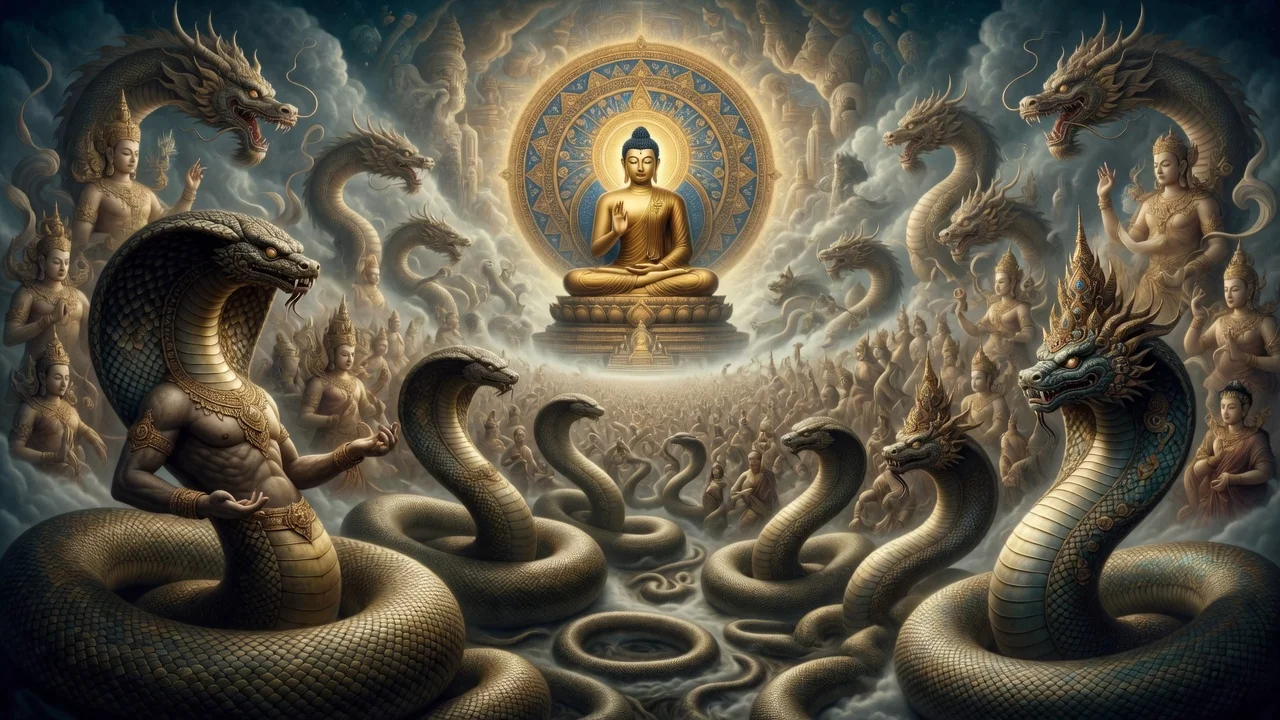
The Mahoraga (the name suggesting “great” maha + a serpent or crawling being) are described as enormous serpent-beings — great snakes, pythons, or dragon-like creatures, sometimes depicted with human upper bodies and serpentine lower bodies, or as humans with serpents upon their heads. They are chthonic beings, associated with the earth and the underground, the deep places of the world. Slow, ponderous, and ancient, they belong to the powers of the earth and the subterranean realms.
The Eightfold Guardian Host
The Mahoraga are one of the Eight Legions or eight classes of supernatural beings (the tianlong babu) who, in the Mahayana scriptures, gather to hear the Lord Buddha’s teaching and to protect the dharma: the devas (gods), the nagas (dragons), the yakshas, the gandharvas (celestial musicians), the asuras (titans), the garudas (great birds), the kinnaras (celestial half-bird musicians), and the mahoragas (great serpents). Together these eight classes represent the whole range of supernatural beings — from the highest gods to the chthonic serpents — brought into the assembly and the protection of the Buddhist teaching, a sign of the dharma’s universal scope.
The Earth-Powers in the Assembly
As members of this guardian host, the Mahoraga represent the inclusion of even the deep, ancient, earth-bound powers in the great congregation of the dharma. Often regarded as somewhat dull or torpid by nature (befitting their serpentine, earthbound character), they are nonetheless honoured beings who attend the Lord Buddha and protect the teaching. They appear in the great assembly scenes of the Mahayana sutras, among the countless beings gathered to hear the Lord Buddha preach. In the Mahoraga, Buddhism gave form to the great serpents of the earth brought into the dharma — the chthonic, ancient serpent-beings who, with the gods and dragons and all the supernatural classes, gather to hear and protect the teaching, the deep earth-powers numbered among the guardians of the Lord Buddha’s word.
What the Name Actually Says
Strip the honorific and the word does not describe a monster so much as a way of moving. Sanskrit uras means the breast, the flat plane of a chest pressed to the ground; ga means goer, from the root gam, to go. An uraga is therefore “the one that goes on its breast” — one of the standard Sanskrit words for a snake, chosen because a snake is the animal with no legs to lift it clear of the dust it travels through. Add mahā, “great,” and Mahoraga reads less as a proper name than as a grammatical verdict: the great belly-goer, the vast thing that must crawl rather than walk. The same root supplies the snake its other titles — uragarāja, king of snakes, for Vāsuki; uragāri, enemy of snakes, for Garuḍa. The word carries its cosmology in miniature: it tells you where this being sits before a single story is told about it.
The Roll Call That Skips a Name
Open the first chapter of the Saddharmapuṇḍarīka, the Lotus Sūtra, and before a single teaching is given the text pauses to count its audience on Vulture Peak above Rājagṛha. It is an exhaustive census, and it goes down to individuals: eight nāga kings by name — Nanda, Upananda, Sāgara, Vāsuki, Takṣaka, Anavatapta, Manasvin, Utpalaka; four gandharva kings; four kinnara kings; four asura kings, Rāhu among them; four garuda kings. Then the mahoragas, who receive a line and no names at all. The register that hands out crowns to every other class of serpent, musician and titan stops short of this one and enters it as a category.
The contrast sharpens when you see what a nāga can become in the same literature. Mucalinda, the serpent king who is said to have coiled about the newly enlightened Lord Buddha and spread his hood over him through seven days of storm, has a name, an episode, and an entire iconographic type of his own. Nothing in the mahoraga’s file answers to it. In the great assembly scenes they are a collective murmur at the edge of the crowd — present, counted, and given nothing to do.
Not the Nāga: Two Grades of Serpent Power
It is tempting to fold the mahoragas into the far more famous nāgas, since both are serpentine and both crowd the same scenes. Buddhist tradition keeps them apart, and the difference is one of rank rather than of species. Nāgas are aristocrats: hooded cobra-kings who hold court in jewelled palaces beneath lakes and rivers, who take on flawless human form, marry into royal lines, withhold or release the rain, and guard treasure. They are serpents with a court, a currency and a diplomatic history. The mahoraga has none of that; in the assembly lists it is given no throne, no name and no episode, only its class. What Buddhist cosmology did here is worth noticing. Offered a whole subcontinent’s worth of serpent power, it did not compress that power into a single figure but graded it — crown to the nāga, and to the mahoraga the unpromoted remainder: the serpent as sheer mass rather than as sovereign.
Crossing into China and Japan
When translators in China reached for a word to render mahoraga, most declined to translate it at all. It survives in the Chinese canon as a straight phonetic transcription, móhóuluójiā (摩睺羅伽), sitting beside yèchā (夜叉) for yaksha and qiántàpó (乾闥婆) for gandharva — categories so particular to Indian cosmology that Chinese had no ready equivalent and simply borrowed the sound. The whole company travelled on to Japan as the Hachibushū, and there produced one of the most admired ensembles in East Asian religious art: eight guardian figures built in hollow dry lacquer in 734 for the Saikondō, the Western Golden Hall that Empress Kōmyō raised at Kōfuku-ji in Nara in memory of her mother. Lacquer-soaked cloth was layered over a clay core that was afterwards removed, leaving statues of ten to fifteen kilograms apiece; the Ashura of that set is among the most famous sculptures in Japan.
What the set does not contain is a Mahoraga. Its eight are recorded as Ashura, Karura, Kinnara, Kendatsuba, Gobujō, Sakara, Kubanda and Hibakara — a roster that departs from the canonical one, three of its names belonging to no member of the sutras’ eight. Even in the most celebrated sculptural rendering of its own company, the great belly-goer does not appear under its own name.
Where the Devotion Actually Went
Serpent veneration never needed Buddhism’s permission to exist. Across South and Southeast Asia, snake powers were honoured at wells, river bends and rice bunds long before any sutra arrived, and Buddhism largely absorbed that reverence rather than abolishing it. But the name the absorption reached for was nāga, not mahoraga. It is the nāga whose coiled balustrades run the length of temple stairways in Thailand and Laos, and the nāga who is petitioned for rain. The mahoraga stayed where the texts had put it — inside the list, unvisited.
The Empty Slot That Modern Fiction Filled
A figure with no story of its own is an invitation. In the manga and anime Jujutsu Kaisen, Mahoraga is the strongest of the ten shikigami of the Ten Shadows Technique, a divine general that no inheritor of the technique had ever managed to tame until Sukuna did, and whose defining power is adaptation: strike it with the same phenomenon often enough and it becomes immune to it. Nothing in the sutras grants the mahoraga such an ability, or any ability at all. What the story borrowed was the name and the rank — a guardian out of the eightfold host — and then supplied the myth the canon had left blank. Which is a fair description of what the mahoraga has always been: a slot in a list that mythology never got round to filling, and that almost everyone who meets the name afterwards feels obliged to fill for themselves.
Sources & traditions
- EncyclopediaWikipedia — Mahoraga
- TraditionBuddhist texts, oral tradition and village tellings (South/Southeast Asia)
Myths change from area to area and from time to time. This chronicle follows the most widely told versions; tellings in other villages, regions and eras may differ.