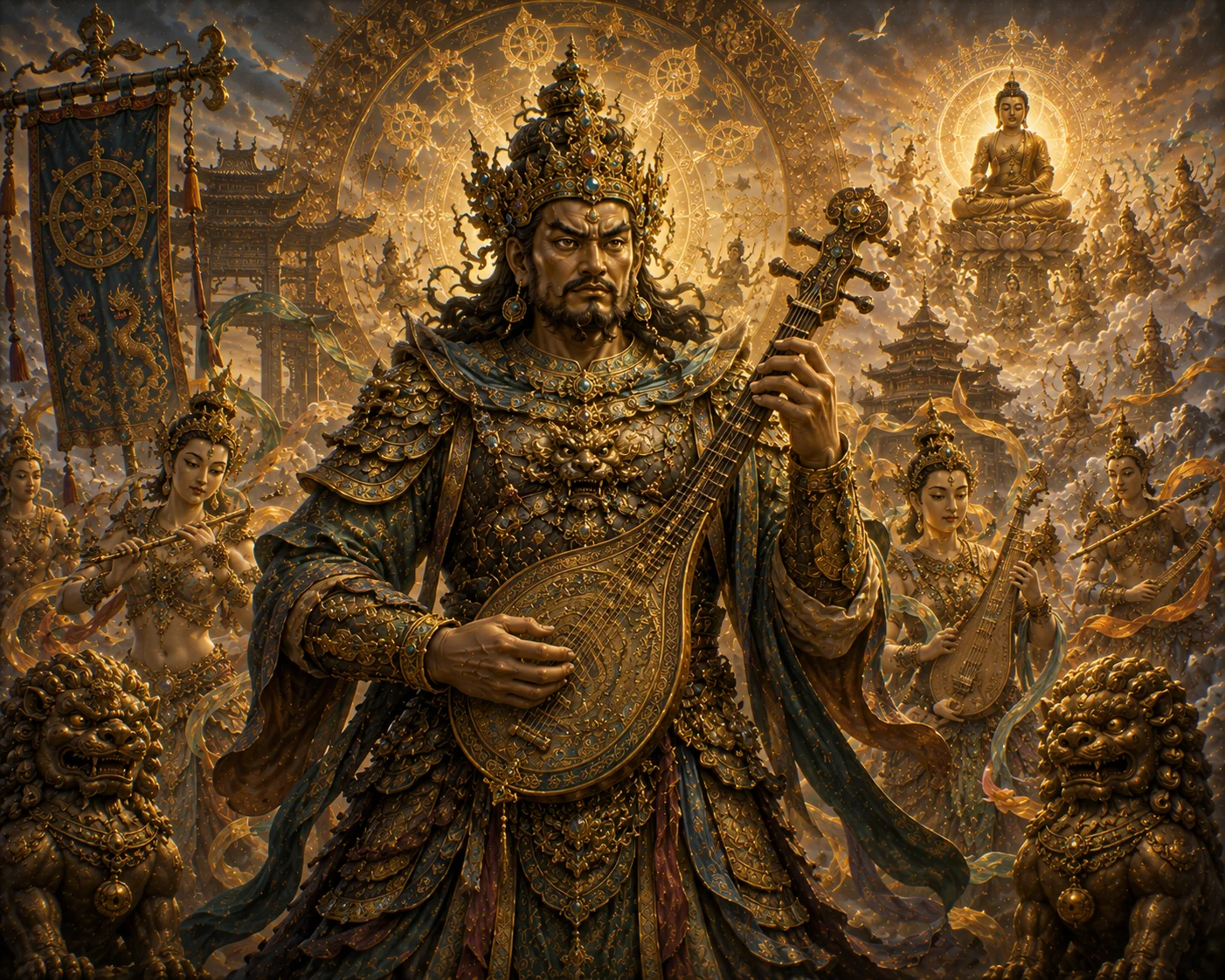
Vaiśravaṇa, honored also as Vessavaṇa in the Pali tradition, is the foremost of the Four Heavenly Kings — the Cāturmahārāja — who guard the world and the dharma from the slopes of Mount Sumeru. He rules the northern quarter, commands the yakṣa hosts as their sovereign, and presides over Cāturmahārājika, the lowest of the six deva realms of the kāmadhātu. He is at once a warrior-king who defends the Buddhist teaching and a bestower of wealth whose generosity has made him one of the most widely venerated figures across the Buddhist world.
The Renowned One Who Hears All
The name Vaiśravaṇa derives from the Sanskrit root śravaṇa, meaning "hearing" or "fame," and is commonly glossed as "Son of Śravaṇa," "the Renowned One," or "He Who Hears Everything." This epithet reflects his ancient character as a deity of wide report, whose vigilance and reputation extend across the far corners of his domain. He is attested by this role in the Pali Canon, most notably in the Āṭānāṭiya Sutta of the Dīgha Nikāya, where he appears not as a distant cosmological figure but as an active participant in the affairs of the Lord Buddha and the monastic community.
A Patronymic from the Sage Viśravas
In the lineage recorded by Vedic and Puranic tradition, Vaiśravaṇa is said to be the son of the sage Viśravas, and it is from this parentage that his name — "descendant of Viśravas" — is drawn. This ancestry situates him within a broader Brahmanical genealogy even as Buddhist cosmology reframes his role entirely around the protection of the dharma, illustrating how a figure can carry a name rooted in one tradition while serving a distinct function within another.
The Verse Offered at Rajgir
The Āṭānāṭiya Sutta preserves one of the most significant episodes in Vaiśravaṇa's canonical history: his recitation of a protective verse, a paritta, to the Lord Buddha at Rajgir. He offers this verse so that Buddhist monastics might be shielded from harassment by yakṣas who had not yet given their devotion to the teaching. In this act, Vaiśravaṇa's authority over the spirit-hosts is turned wholly toward guardianship — he does not merely rule the yakṣas, he answers for their conduct toward the Sangha, and this scene establishes him permanently as a protector of Buddhist practitioners.
Sovereign of the Yakṣa Hosts
As king of the yakṣas, Vaiśravaṇa commands a retinue that includes named yakṣa generals, and his rule over these spirit-beings is inseparable from his identity as a guardian king. This dominion is closely bound to his association with Kubera's traditional attendants and with treasure-related beings more broadly, reflecting the layered inheritance of wealth-guardianship and spirit-sovereignty that converge in his figure.
The Long Reach of an Identity Shared with Kubera
Buddhist tradition widely identifies Vaiśravaṇa with Kubera, also called Kuvera, the Hindu and Vedic god of wealth. This equation of the two names is pervasive across Buddhist literature and iconography, yet scholars treat it with appropriate caution: the identity between the two figures may reflect a later syncretic assimilation rather than a single original deity split across traditions. What is certain is that the association enriched Vaiśravaṇa's character considerably, layering the role of wealth-bestower onto his original function as a directional guardian, and it is this composite identity — warrior-protector and treasure-lord together — that devotees across Asia came to venerate.
Emblems of Armor and Abundance
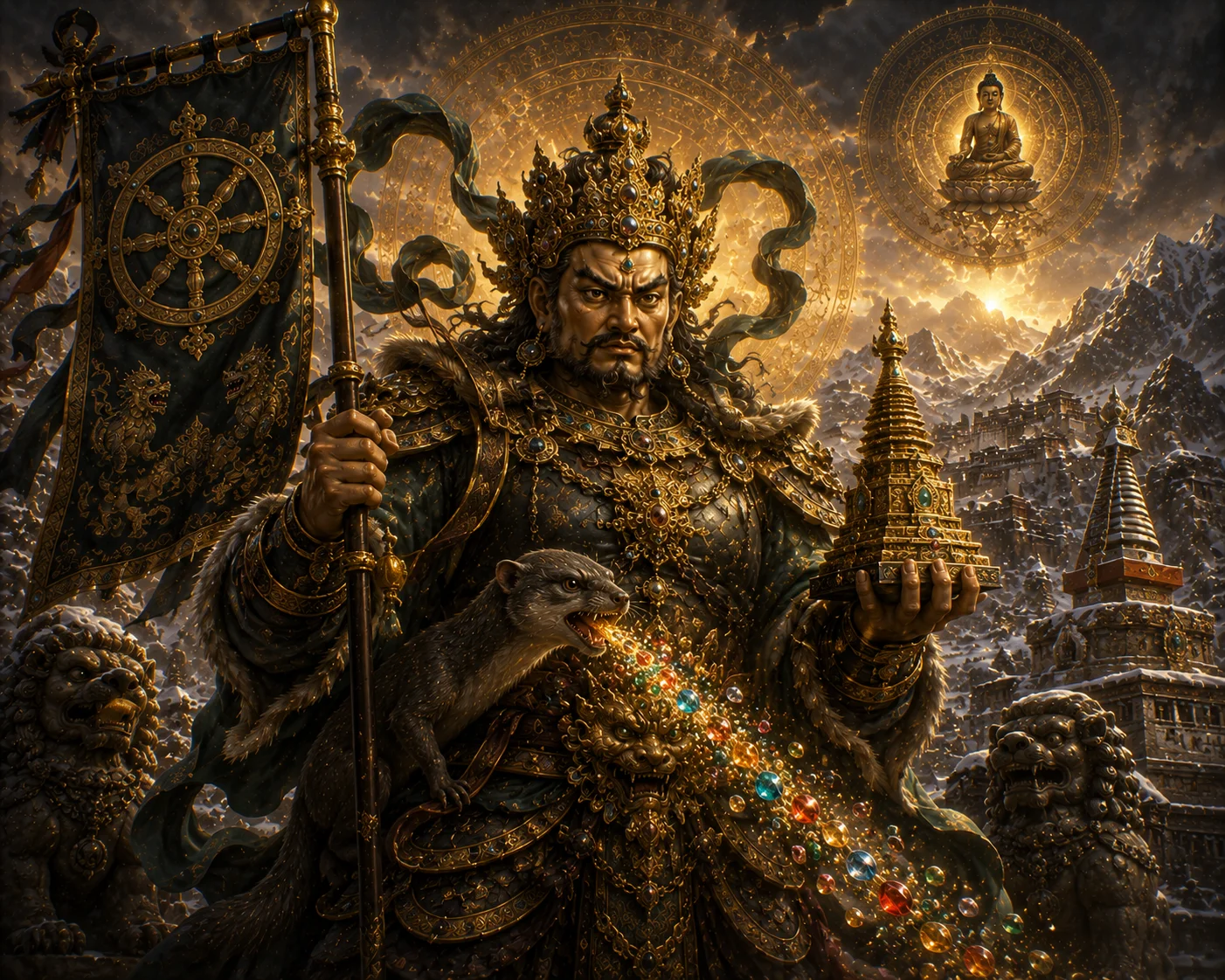
Vaiśravaṇa is portrayed in full armor, the image of a martial guardian ready to defend the teaching. In one hand he typically holds a pagoda or stupa, representing the treasury of the Dharma he offers to the Lord Buddha; in the other, a spear or trident, or else a mongoose — the nakula — that spits forth jewels. This mongoose motif is shared directly with Kubera in Hindu iconography, a visual thread connecting the two traditions of wealth-bestowal. Together these emblems hold his dual nature in balance: the pagoda speaks to his guardianship of the dharma itself, while the jewel-spitting mongoose speaks to the material abundance he grants those who honor him.
Names Carried Across Borders
As Buddhism spread through East Asia, Vaiśravaṇa's name and image were carried and translated anew in each land. In Japan he became Bishamonten; in China, Duōwén Tiānwáng, "the Multi-Hearing Heavenly King"; in Korea, Damun Cheonwang. In each of these forms he remains one of the Four Heavenly Kings, standing guard over his cardinal direction in the great gate halls of temples — the Niō-mon in Japan, the Tianwang Hall in China — where his armored figure has watched over pilgrims and worshippers for centuries.
Among the Twelve Generals and the Guardians of the Teaching
Beyond his place among the Four Heavenly Kings, Vaiśravaṇa is counted in some East Asian schemes among the Twelve Heavenly Generals, the Jūni Shinshō, and independently he is numbered among the Twenty-Four, or in some reckonings Twenty, Protective Deities of Mahayana Buddhism who stand guard over the teaching. These overlapping enumerations, drawn from different regional and sectarian schemes, speak to how central his protective function became across the breadth of the Buddhist world, each tradition finding its own place for him within its guardianship structures.
Bishamonten Among the Seven Lucky Gods
In Japan, Bishamonten's story extends beyond his canonical Buddhist role. He was adopted independently into the Shichifukujin, the Seven Lucky Gods of Japanese folk religion, where he became associated with fortune in battle and material wealth, particularly beloved by warriors who invoked him for victory and protection. This is a distinct cultural accretion, layered onto his Buddhist identity by centuries of Japanese devotional practice rather than inherited directly from the continental tradition.
Consort and Companion: Hārītī's Presence
In narrative and cult practice, Vaiśravaṇa is closely linked to Hārītī, known in Japan as Kishimojin — the once child-devouring yakṣiṇī who was converted by the Lord Buddha and transformed into a protector of children. In certain East Asian traditions she is depicted as his consort or as a closely associated protective figure standing beside him. This pairing is understood as a later regional development rather than a feature found uniformly across all Buddhist canons, and it reflects the way protective deities were drawn into relationship with one another as devotional practice matured in particular locales.
Epithets of the Wealth-Bestower
Vaiśravaṇa carries several epithets beyond his principal name. He is called Dhanada, "bestower of wealth," and Nara-vahana, "he whose vehicle is a man" or "a horse," an epithet he shares with Kubera. He is also linked, though with real scholarly nuance, to Jambhala, a wealth-bestowing deity of the Vajrayana pantheon. In certain Vajrayana contexts Jambhala is treated as overlapping with or related to Vaiśravaṇa, yet Jambhala is more properly classed as a distinct, if affiliated, deity in his own right. The degree of identity between the two remains debated among scholars and is best understood as an area of tradition-dependent overlap rather than settled doctrine — a reminder that devotional traditions often hold layered, regionally varied understandings of a single sacred figure rather than one fixed genealogy.
Namtöse, Rider of the Snow Lion
In Tibetan Buddhism, Vaiśravaṇa is known as Namtöse, rNam-thos-sras, and stands among the principal wealth deities and dharmapālas, the Dharma-protectors, of the Tibetan tradition. He is frequently depicted riding a snow lion, and he occupies a central place in wealth-invocation sādhana practices within the Gelug and other schools. This Tibetan form demonstrates the same enduring pattern found across the whole of his cult: a guardian of the teaching whose protection extends naturally into the material welfare of those who venerate him.
Guardian Along the Silk Road
Vaiśravaṇa's cult carried particular historical weight in Central Asia and along the Silk Road. In Khotanese Buddhist tradition, he was held as the legendary founder and protector deity of the kingdom of Khotan, a role attested in local legend recorded by Chinese pilgrim accounts — including those of Xuanzang — as well as in Khotanese manuscripts themselves. This civic-guardian role marks a significant expansion of his function: from protector of the Sangha in the earliest canonical accounts, to protector of an entire kingdom and its people, a testament to how thoroughly his guardianship was trusted to extend over whatever community called upon him, whether a handful of wandering monastics or a Silk Road kingdom at the crossroads of civilizations.
Sources & traditions
- EncyclopediaWikipedia — Vaiśravaṇa
- TraditionBuddhist texts, oral tradition and village tellings (South/Southeast Asia)
Myths change from area to area and from time to time. This chronicle follows the most widely told versions; tellings in other villages, regions and eras may differ.