White Tara — the gentle goddess of compassion, healing, and long life — is one of the most beloved female deities of Mahayana and Vajrayana Buddhism: a serene, maternal bodhisattva who looks upon all beings with seven eyes of compassion and grants health, longevity, and protection. She is one of the principal forms of Tara, the great female bodhisattva born from the tears of Avalokiteshvara.
Born from a Tear of Compassion
Tara was born, the tradition tells, from the tears of the bodhisattva of compassion, Avalokiteshvara: gazing upon the endless suffering of beings, he wept, and from his tears arose Tara, the female embodiment of compassion in action, the swift saviouress who comes to the aid of all in distress. Tara appears in many forms and colours; White Tara is her aspect of compassion, healing, serenity, and especially long life and the overcoming of obstacles to a long and fruitful spiritual practice.
The Goddess of Seven Eyes
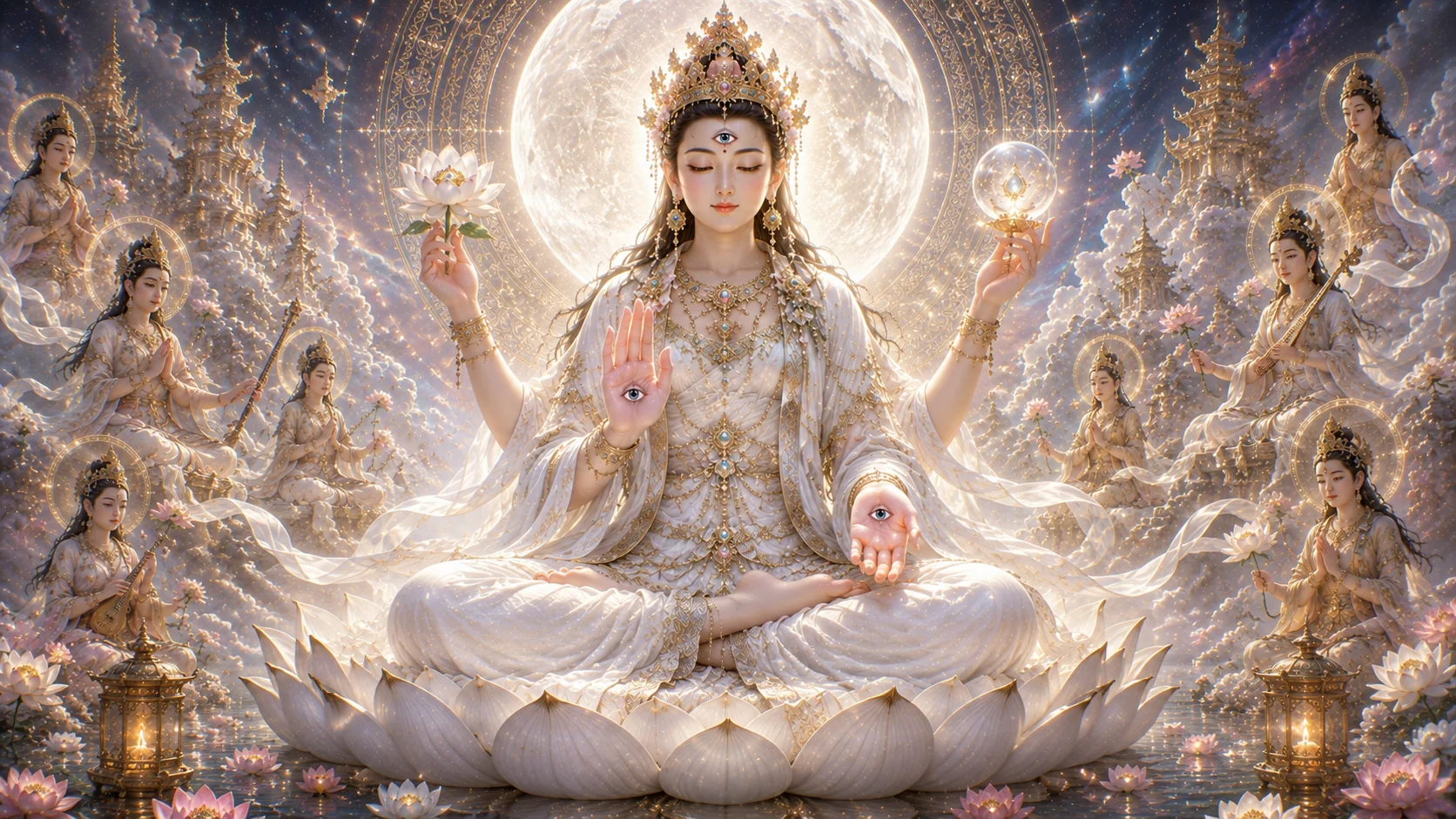
White Tara is depicted as a beautiful, serene goddess, white as the autumn moon, seated in meditation with one hand in the gesture of giving and the other in the gesture of protection or teaching. Her most distinctive feature is her seven eyes: the usual two, plus an eye in her forehead, and eyes in the palms of both hands and the soles of both feet — the seven eyes of compassion with which she watches over all beings in all directions, seeing every form of suffering and need. She is the very image of maternal, all-seeing care.
The Healer and Giver of Life
White Tara is invoked above all for healing, for long life, and for the removal of the obstacles — illness, accident, untimely death — that cut short life and practice. Her practice is one of the most popular in Tibetan Buddhism, performed for the long life of teachers and loved ones and for one’s own health and longevity. Gentle, compassionate, and accessible, she is a goddess to whom the devoted turn in times of sickness, danger, and need. In White Tara, Buddhism gave form to compassionate healing and the gift of life — the serene seven-eyed goddess born of compassion’s tears, who watches over all beings with maternal care and grants health, long life, and protection to all who call upon her.
The Princess Who Refused to Become a Man
Alongside the tears of Avalokiteshvara, Tibetan tradition preserves a second account of Tara’s origin, and a stranger one. In a world-age long past, it runs, a princess named Wisdom Moon — Jnanachandra in Sanskrit, Yeshe Dawa in Tibetan — made offerings for aeons before a buddha called Drum Sound, and generated the resolve to attain full enlightenment herself. The monks around her, moved by her devotion, offered the customary counsel: pray, they said, to be reborn in a man’s body, since it was a man’s body that carried a practitioner to buddhahood. Wisdom Moon refused. Here, she told them, there is no man and no woman, no self and no person; those who see a male form as a prerequisite for awakening are the ones who are confused. She vowed instead to work for the liberation of beings in a woman’s form, birth after birth, until samsara itself was emptied. The Tibetan historian Taranatha set the episode down in his account of the origins of the Tara tantra, and it is the reason Tara is never explained away in her own tradition as the diminished consort of some male buddha. Her femaleness is not incidental to the story. It is the vow.
The Three Deities of Long Life
White Tara rarely stands alone in the Tibetan practices devoted to longevity. She is one-third of a trio Tibetans call the tshe lha rnam gsum, the “three deities of long life,” alongside Amitayus — the red buddha of Boundless Life, who cradles a vase of the nectar of immortality — and Ushnishavijaya, whose name means “Victorious Crown Protuberance” and who is invoked to purify the karma that brings an untimely death. The three are painted together, requested together, and invoked together in the long-life ceremonies commissioned for teachers, for parents, and for the seriously ill. Between them they divide the work: Amitayus is life held as an inexhaustible reservoir, Ushnishavijaya clears away the causes that would cut a life short, and White Tara supplies the thing that makes the extra years worth having — the wish, held toward another person, that they simply not suffer and not yet die.
Reading Her Posture: White Tara Against Green
Put a painting of White Tara beside one of Green Tara and the difference registers before any iconographic detail does. Green Tara sits in the posture of royal ease, her left leg folded and her right leg extended, the foot resting on a small lotus, as though she has been caught mid-movement and might rise at any moment toward whoever has called her. White Tara sits in full vajra posture, both legs locked in meditation, immovable. The contrast is doctrinal rather than decorative. Green Tara is Tara as swift rescuer — the name Tara itself is read as “she who ferries across” — the deity called on against the great fears catalogued in Buddhist liturgy: fire, flood, thieves, snakes, wild beasts, imprisonment. White Tara is Tara as unshakeable presence, a goddess one sits with rather than one shouted for. Both cradle the stem of an utpala, the blue lotus that opens beside the shoulder, its stem held at the heart; and in the paintings the two are often placed as a pair, so that a devotee can see, in a single glance across a temple wall, the difference between being rescued and being accompanied.
Atisha, and the Empowerment That Travelled
The Bengali master Atisha Dipankara, who reached western Tibet in 1042 and became one of the architects of its monastic Buddhism, took Tara as his personal deity and is remembered as consulting her before every consequential decision. Tibetan hagiography has her answer him plainly when he asked whether he should make the journey north: it would shorten his own life, and it would be of enormous benefit to beings. He went. Through Atisha and the Kadam school that grew out of his teaching, Tara practice took root in Tibet with unusual speed for an imported cult, and the White Tara long-life empowerment — the tshe dbang, in which a lama confers the practice together with consecrated long-life pills and nectar — became one of the initiations most freely given in the Tibetan world, offered not only to monastics but to entire lay congregations gathered for a single afternoon. Her long-life mantra extends the basic Tara formula with a plea for exactly what the practice promises: Om Tare Tuttare Ture Mama Ayur Punye Jnana Pushtim Kuru Svaha — ayus, lifespan; punya and jnana, the merit and the wisdom that make a longer life worth extending.
Two Foreign Queens, One Goddess
Tibetan historical tradition folds Tara into the founding legend of Tibetan Buddhism itself. King Songtsen Gampo, the seventh-century ruler credited with opening Tibet to the dharma, married two foreign princesses to seal alliances: Bhrikuti of Nepal and Wencheng of Tang China. Later Tibetan chronicles remember both brides as emanations of Tara sent to turn the king toward Buddhism, Bhrikuti identified with the green form and Wencheng with the white. It is Wencheng who is credited with bringing the Jowo Shakyamuni to Lhasa, the image now enshrined in the Jokhang and the most venerated statue in Tibet, and with the geomantic divination that read the Tibetan land itself as a vast supine demoness who had to be pinned down with temples before the dharma could stand on her. Whatever the history behind the two marriages, the legend does real work. It makes the goddess a participant in Tibet’s own national story rather than a purely celestial abstraction, and it lets an ordinary devotee understand Tara as someone who has, in a sense, already walked among them.
Why the Goddess of Long Life Endures
Every religious tradition eventually has to answer the plainest fear anyone carries into a temple: that they, or someone they love, will die before their time. White Tara is Vajrayana’s most direct answer to it, and the shape of her practice shows it. The rites built around her are typically said for one person, named aloud — an ageing parent, an ailing teacher, a patient in recovery — rather than for beings in general. The fourteenth Dalai Lama, who has spoken publicly of his devotion to Tara, is himself the object of such ceremonies: the long-life offerings that monasteries and lay communities make for him, year after year, draw on exactly this practice. She endures not because her theology is unusually elaborate but because the wish she carries is unusually plain. Not victory over death, which Buddhism does not promise. A little more time, and the merit to spend it well.
Sources & traditions
- EncyclopediaWikipedia — Tara (Buddhism)
- TraditionBuddhist texts, oral tradition and village tellings (South/Southeast Asia)
Myths change from area to area and from time to time. This chronicle follows the most widely told versions; tellings in other villages, regions and eras may differ.