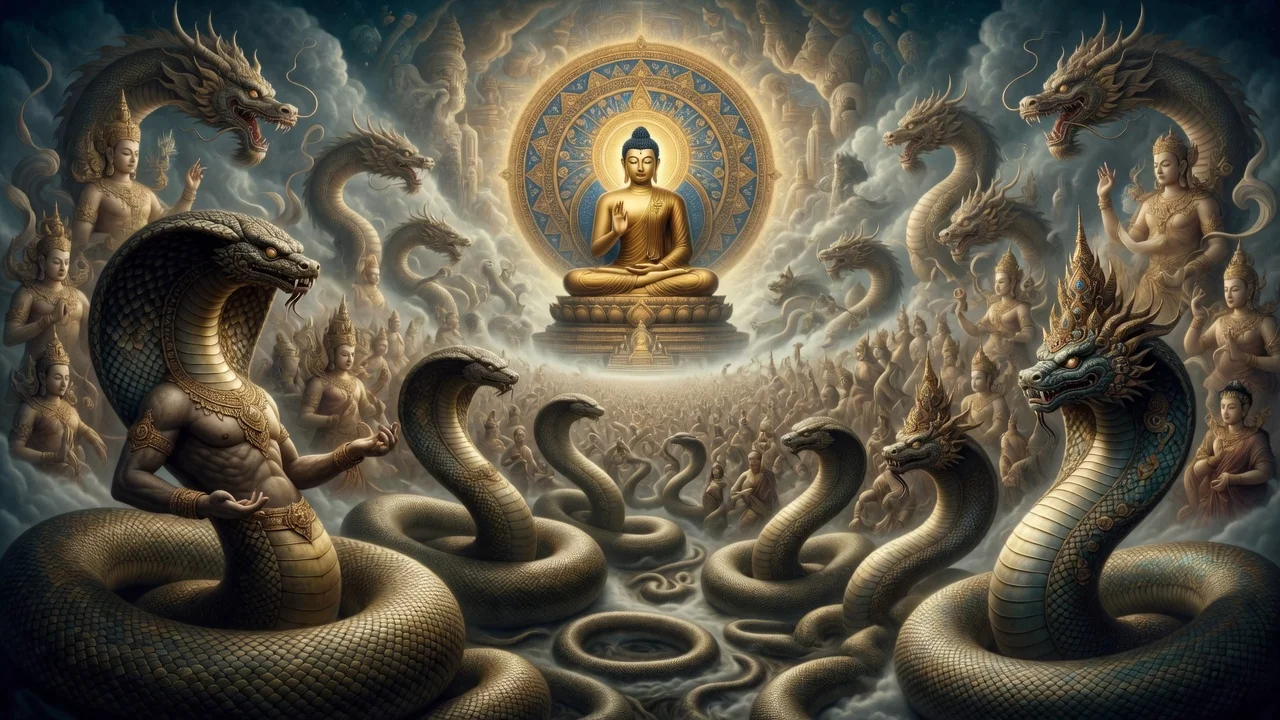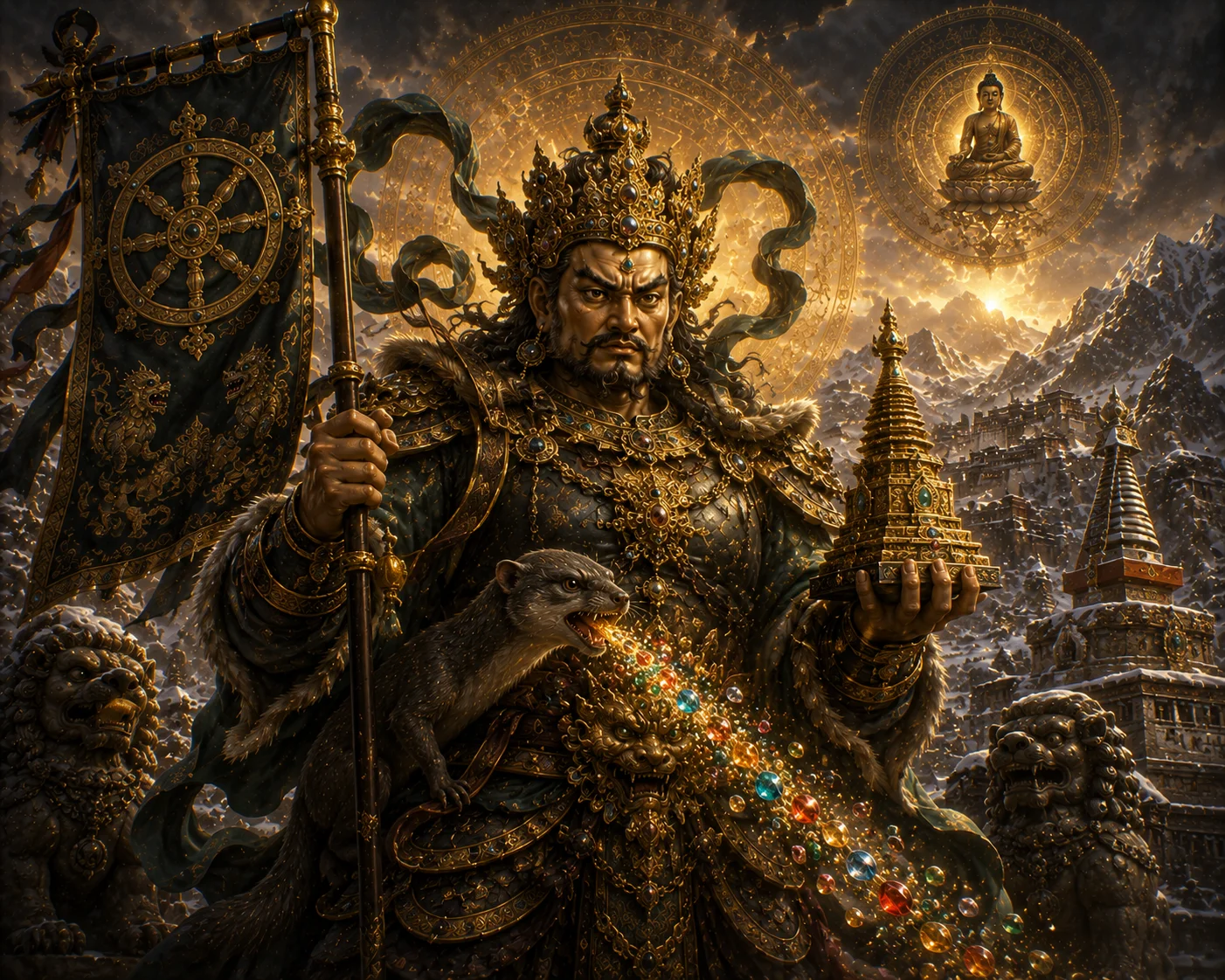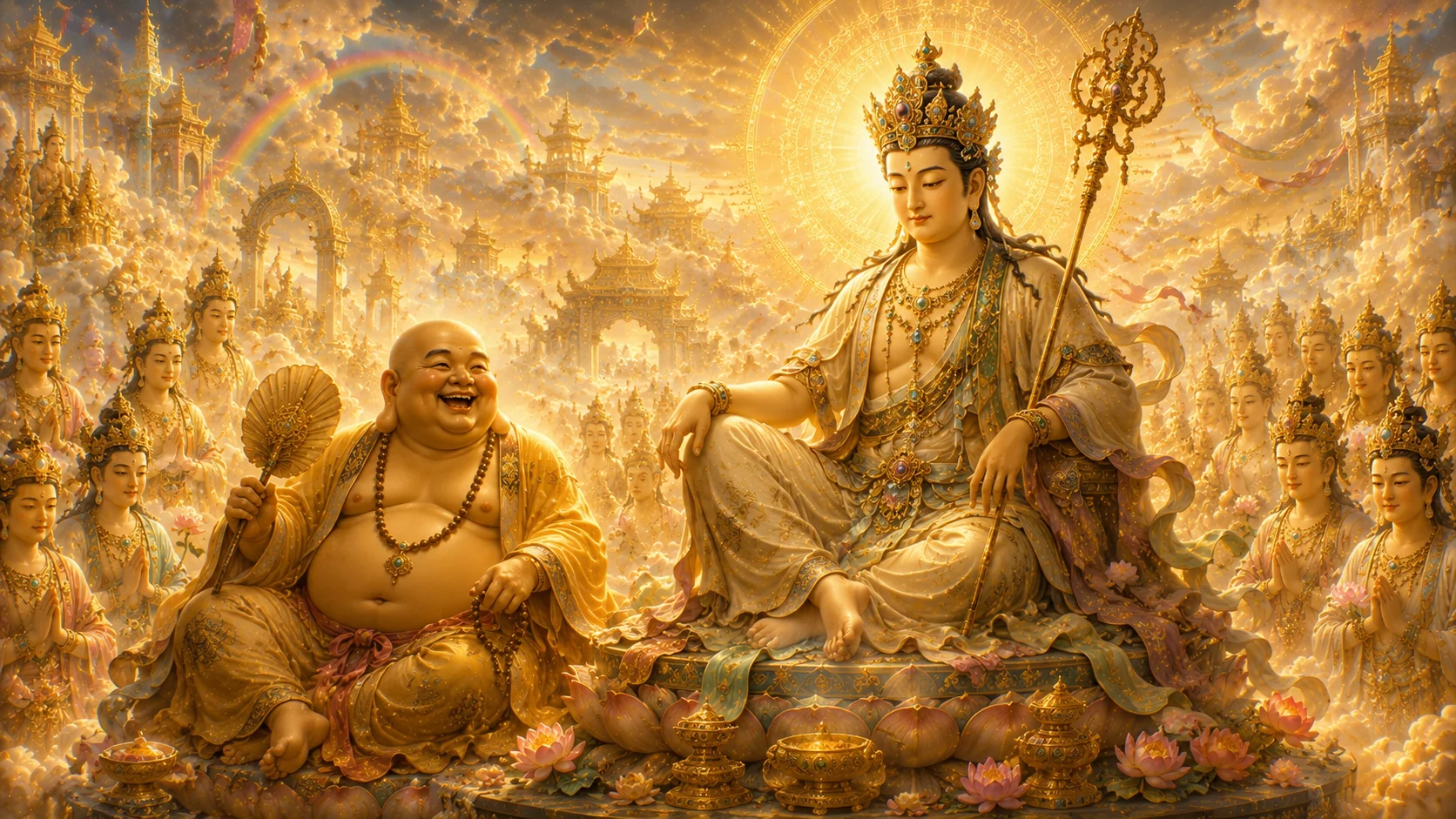
Maitreya, the Loving One, the Benevolent, is the Lord Buddha who is yet to come: the future Lord Buddha who waits in the Tushita heaven and who will descend, in a far age when the teachings of the present Lord Buddha have been forgotten, to become the next Lord Buddha of this world and turn the wheel of the dharma anew.
A Name Woven from Loving-Kindness
The name Maitreya, Metteyya in Pali, is drawn from maitri, metta, the boundless loving-kindness that stands among the supreme virtues of the dharma. Some early sources also preserve a second, personal epithet for him: Ajita, the Invincible, a name attested alongside Maitreya in the oldest strata of the tradition. Together the two names capture the whole of who he is understood to be, gentleness paired with an unshakeable, unconquerable resolve to bring the dharma back into the world when it has vanished from it.
The Bodhisattva Who Waits in Tushita
Maitreya now dwells as a bodhisattva in the Tushita heaven, the heaven of the contented, the realm reserved for a bodhisattva in his final existence before Buddhahood, where he teaches the gods who dwell there and where he waits, patient beyond ordinary reckoning, for the conditions of the world to become right for his descent. He is not yet the Lord Buddha; he is the one who is to become the Lord Buddha, and the waiting itself is understood as part of his path, a vigil kept across an unimaginable span of time.
The Sutta of the Wheel-Turning Kings
Among the oldest and most striking accounts of Maitreya's coming is found in the Cakkavatti-Sihanada Sutta, the twenty-sixth discourse of the Digha Nikaya, where the Lord Buddha Gautama himself is recorded speaking of the future Lord Buddha who will arise long after him. This sutta is counted among the earliest attested prophecies of a future Lord Buddha anywhere in the Pali canon, and it is here that the shape of Maitreya's coming is first laid down: not as legend accumulated later, but as a teaching placed directly within the recorded words of the present Lord Buddha.
An Age of Eighty Thousand Years
The sutta describes the world into which Maitreya will be born as one utterly unlike our own. He will not come amid decline but at a summit of human flourishing, in a distant future age when the span of a human life has lengthened to eighty thousand years, the fruit, in the telling of the sutta, of a world that has returned to righteousness. And yet it is precisely into that flourishing world that Maitreya comes, because by then the dharma taught by Shakyamuni, the Lord Buddha of our own age, will have been wholly forgotten, its liberating knowledge lost even amid great worldly prosperity. It is this loss, not any worldly lack, that calls the future Lord Buddha into being.
Ketumati and the City of the Righteous King
The Mahayana tradition, in the sutra known as the Maitreyavyakarana, the Prophecy of Maitreya, adds further detail to this future age. Maitreya, it says, will be reborn into the city of Ketumati, a city ruled by the righteous king Sankha, whose just governance forms the worldly counterpart to the spiritual renewal that Maitreya will bring. There, beneath a nagapushpa, a dragon-flower tree, Maitreya will attain enlightenment, exactly as Shakyamuni attained his beneath the bodhi-tree, and there he will begin to teach, gathering to himself a following as vast as the age is long.
The Thousand Buddhas of This Aeon
Maitreya's place is understood within a still larger frame, the lineage of the thousand Buddhas said to appear across this present kalpa, this world-age, of whom Shakyamuni is one and Maitreya the next in succession. He is, in this sense, not an isolated wonder but a link in a chain that stretches far beyond any single teaching or any single teacher, the dharma renewing itself, Lord Buddha after Lord Buddha, across a span of time that dwarfs ordinary history.
The Robe Kept in the Mountain
Later tradition binds Maitreya's coming to a particular, poignant image: the arhat Mahakashyapa, who according to this legend has entered a deep mountain trance to keep watch over the robe of Shakyamuni, guarding it faithfully across the whole of the intervening age until Maitreya at last arrives to receive it from his hands. In this image the whole distance between the present Lord Buddha and the future one is folded into a single act of patient guardianship, one robe carried across an ocean of years to be handed, in due time, to the one for whom it was always kept.
A Celestial Teacher, Disputed by Scholars
Within certain Mahayana currents, particularly those associated with the Yogacara school, Maitreya is credited as the source of a body of teaching known as the Five Treatises of Maitreya, said to have been transmitted to the philosopher Asanga. Whether this Maitreya was a historical human teacher who instructed Asanga directly, or a celestial, visionary presence encountered in meditation, remains a matter of genuine and unresolved scholarly debate, one this account does not attempt to settle, only to note as it stands: disputed, and honestly so.
The Stupa in the Crown
In the art of Gandhara, and in the Chinese and Central Asian traditions that carried that art eastward, Maitreya is given a distinctive mark that sets him apart from every other figure in the Buddhist pantheon: a small stupa or shrine set into his headdress or crown, a sign carried on his very person of the enlightenment that is still to come. He is shown, too, seated not in the cross-legged posture of the Buddhas who have already attained awakening, but in bhadrasana, pralambapadasana, the pendant-legged, so-called seated European style, legs resting downward as one who is poised, ready, still in the posture of waiting rather than arrival.
The Laughing Monk of the Ten Thousand Things
In East Asia a very different image of Maitreya took hold in popular devotion: Budai, Hotei in Japan, the rotund, laughing monk of Chinese folk legend who emerged from tenth-century Chan tradition carrying his cloth sack and his wide, unguarded grin. This identification of the jovial wandering monk with the bodhisattva of the future is a later act of cultural and folk syncretism, grafted onto the canonical Maitreya rather than present in the earliest Indian descriptions of him, yet it became, in time, the face by which countless people came to know him, abundance and contentment made visible.
A Name Invoked for Renewal
The expectation of Maitreya's coming carried real weight in the history of Chinese Buddhism, where devotion to him fed messianic currents, including White Lotus-type millenarian movements that arose across the late Sui and Tang eras. These movements invoked his coming not as distant theology but as an urgent call, a promise that the present order, however troubled, would give way to renewal, and Chinese historical records preserve their memory as a documented current within the wider religious and political life of those centuries.
Jampa Among the Eight Great Bodhisattvas
In Tibetan Vajrayana, Maitreya is honoured as Jampa, one of the Eight Great Bodhisattvas, and it is in this tradition that devotion to him has taken its most monumental physical form: the colossal statues raised in his honour at monasteries such as Tashilhunpo and Thiksey, towering images meant to hold, in bronze and gilt and paint, something of the scale of what is awaited. That same impulse continues into the present, in modern efforts such as the Maitreya Project, which has sought to raise still greater statues to him in this age, a continuity of devotion reaching from ancient monastery walls to contemporary undertakings.
The Present Lord Buddha and the One to Come
Maitreya is, in the end, held apart from other great figures with whom he might be confused: he is not Amitabha, and he is not a Pure Land buddha of any kind; he is specifically the bodhisattva destined for Buddhahood within this world-system, this earth, this age. He is distinct, too, from Avalokiteshvara, and any resemblance drawn between him and other future-saviour figures across the world's religions belongs to the comparative study of religion, an observation about shared human hope, not a claim of shared identity. What endures, undiluted by any of these comparisons, is the pairing at the heart of the tradition itself: Shakyamuni as the present Lord Buddha, Maitreya as the Lord Buddha of the future, hope and loving-kindness held in trust for an age not yet arrived.
Sources & traditions
- EncyclopediaWikipedia — Maitreya
- TraditionBuddhist texts, oral tradition and village tellings (South/Southeast Asia)
Myths change from area to area and from time to time. This chronicle follows the most widely told versions; tellings in other villages, regions and eras may differ.