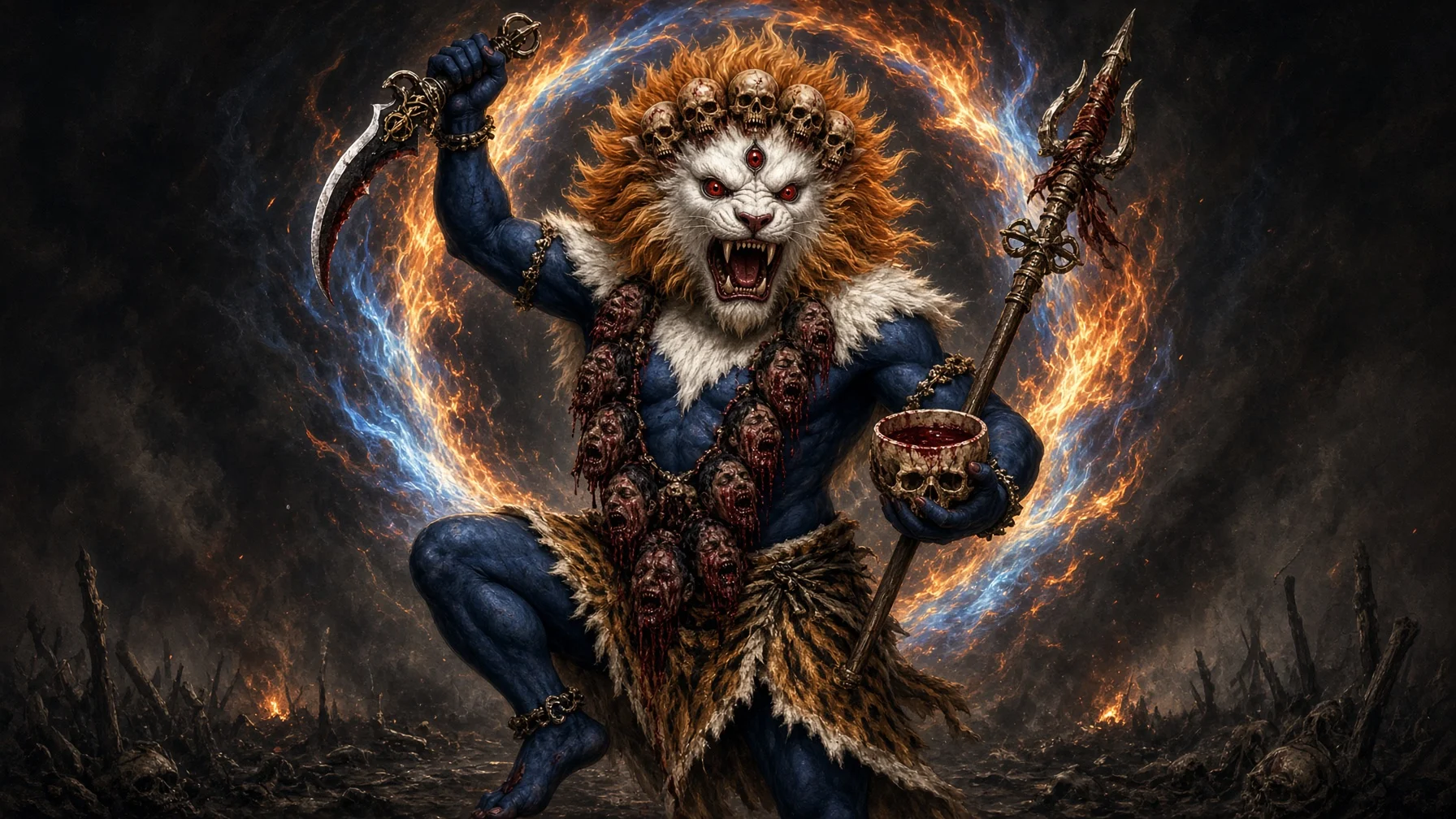
Senge Dongma, the Lion-Faced Ḍākinī — known in Sanskrit as Siṃhamukhā — is a wrathful enlightened ḍākinī of the Tibetan Buddhist Vajrayana tradition, her body blue or blue-black, her face that of a snarling lion, invoked above all others for the turning-back of curses, black magic, and malevolent forces directed against the practitioner. She is not a worldly spirit to be bargained with or placated, but a fully realized being, an expression of enlightened wisdom itself wearing a wrathful and terrifying form for the sake of those she protects.
The Face of the Lion
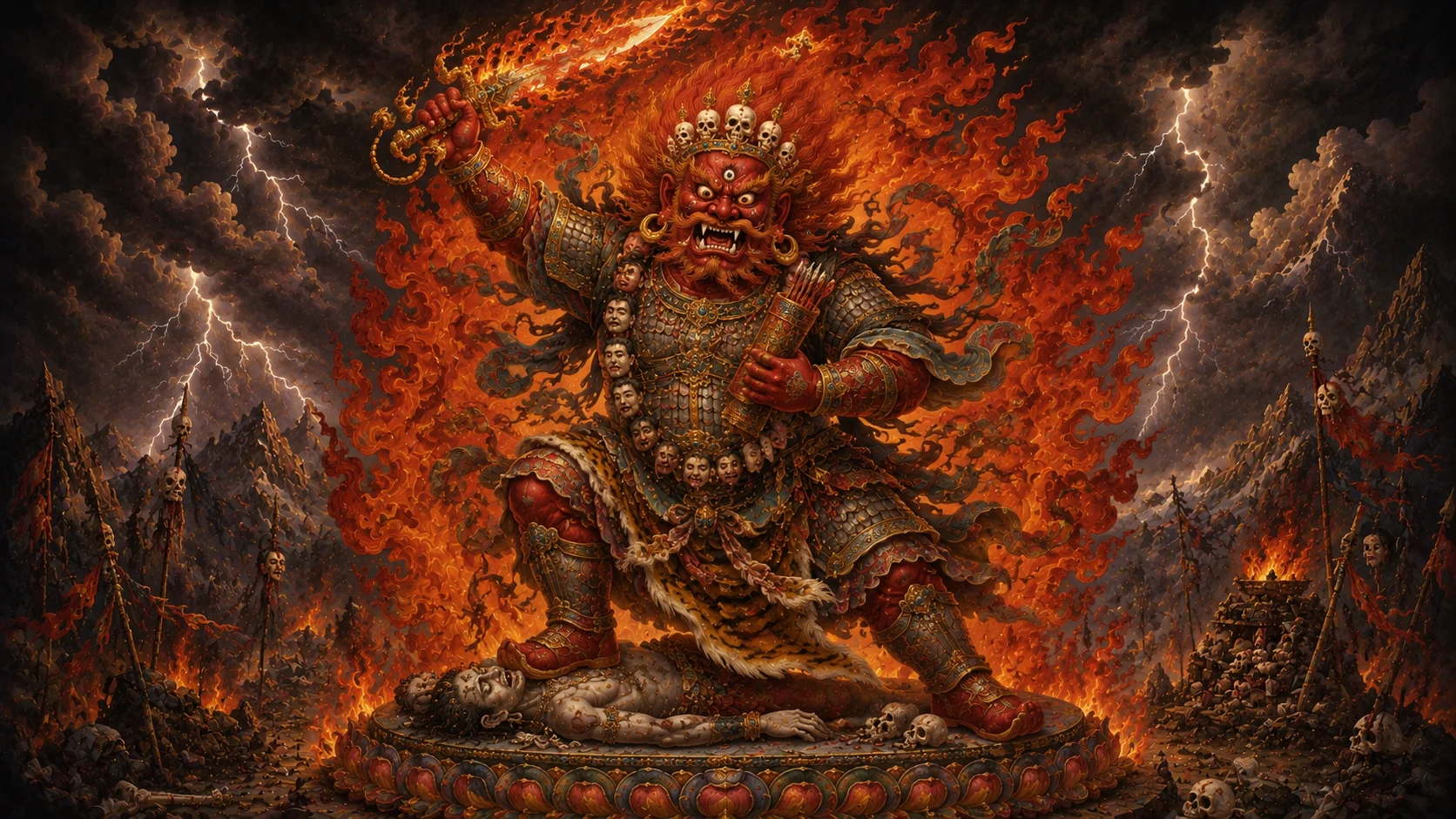
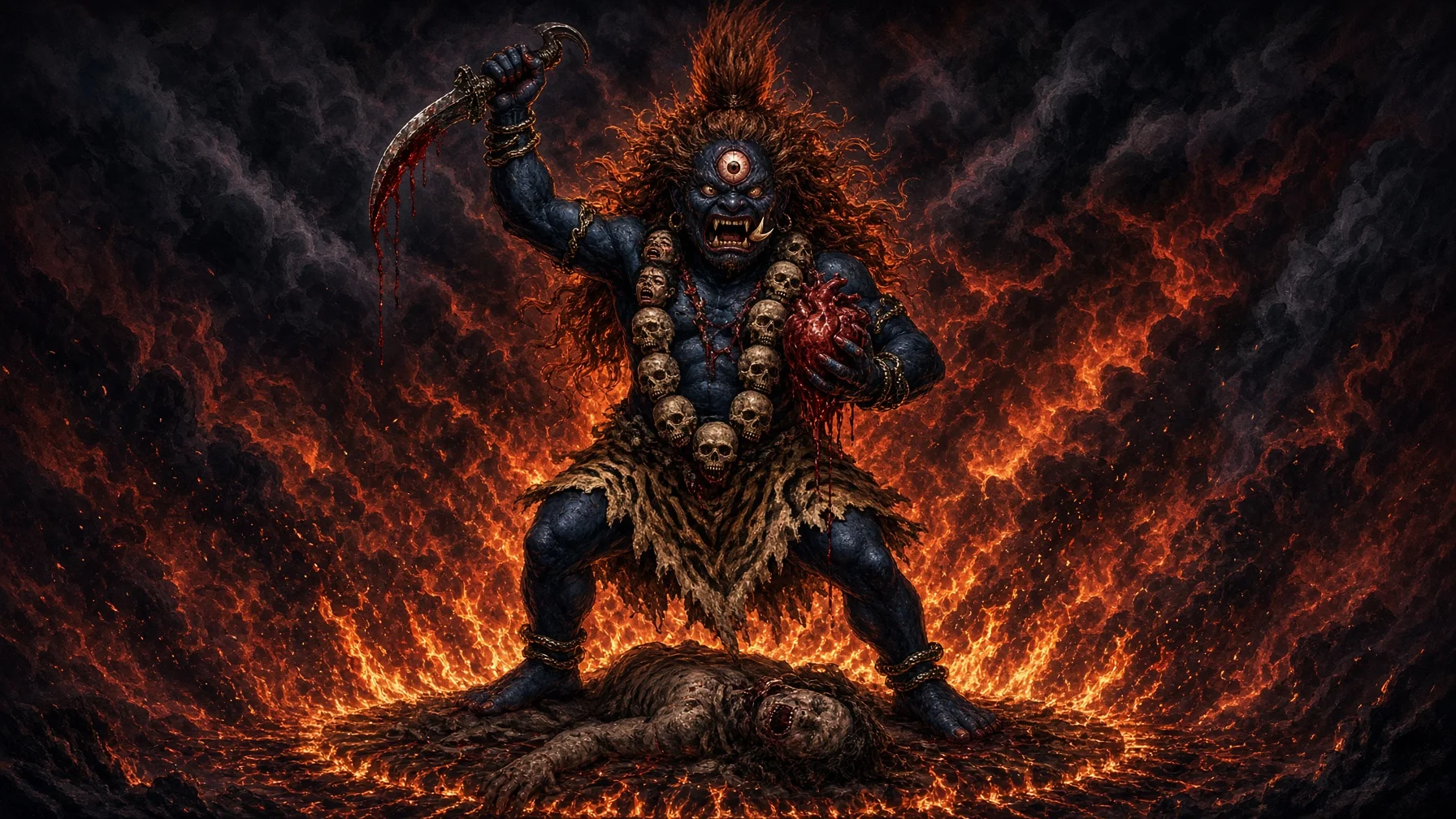
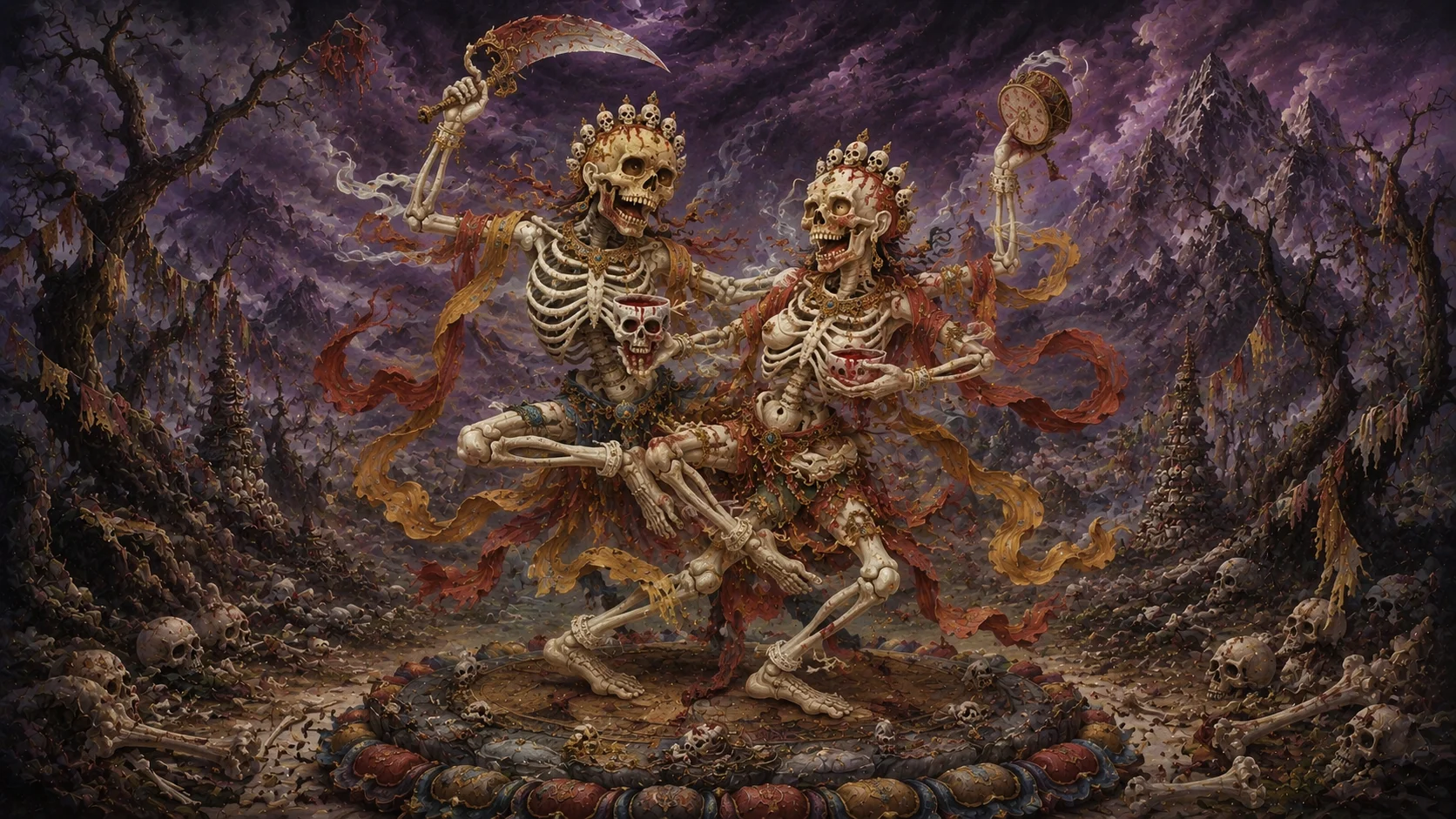
To meet Senge Dongma in visualization or in painted form is to meet a being built entirely from fearlessness made visible. Her body is dark, blue or blue-black, the color Tibetan iconography reserves for the deepest and most unshakeable states of wrathful compassion. Her head is that of a lion, mouth open in a roar, and it is this single detail — the lion's face set upon a dancing female body — that gives her her name in both languages: Senge Dongma in Tibetan, Siṃhamukhā in Sanskrit, both meaning simply the Lion-Faced One. She dances upon a seat of a sun-disc, itself resting upon a corpse, the traditional throne of the wrathful ḍākinīs, and she is adorned with a garland of skulls and ornaments of bone, the traditional regalia that marks her as a being who has moved entirely beyond ordinary attachment and ordinary fear. Around her hips is tied a skirt of tiger skin. In her right hand she holds a curved knife, the kartika, the blade that cuts through delusion and severs the threads of harmful magic at their root; in her left hand a skull-cup, the kapala, and in some lineages a khatvanga staff besides. Every element of her appearance is deliberate. Nothing about her is decorative. She is armed, precisely, for the work she does.
Not to Be Mistaken for the Tiger-Faced One
Tibetan Buddhist iconography includes a wider retinue of animal-headed ḍākinīs, among them Tak Dongma, the tiger-faced ḍākinī, and it is worth being precise about the distinction, because the two are sometimes confused by those encountering these forms for the first time. Senge Dongma's lion face carries a specific symbolic weight that is not interchangeable with the tiger's: the lion, in the Buddhist world, is the animal of the fearless roar, the sound said to travel across all directions and be feared by every other creature the instant it is heard. Senge Dongma's lion face carries this same symbolism into wrathful female form: she is the fearless proclamation of Dharma made active and protective, her roar the sound that instantaneously overpowers negative forces the moment it is loosed. The tiger-faced and other animal-headed ḍākinīs carry their own distinct symbolic charges and belong to their own lineages of practice; conflating them flattens what each was built, with great care, to mean.
An Enlightened Being, Not a Worldly Spirit
It matters, in approaching Senge Dongma correctly, to understand what kind of being she is understood to be. She is classed within the Vajrayana tradition as an enlightened wrathful ḍākinī and yidam — a meditational deity, a being who has already attained full realization and who manifests in wrathful form purely as an expression of active compassion, not out of anger in any ordinary sense and not as a spirit bound to any particular place or worldly bargain. This distinguishes her, doctrinally, from the classes of worldly protectors and local spirits who populate other corners of Tibetan cosmology and whose power is real but whose realization is not yet complete. That said, in the wider devotional life of the tradition she is sometimes spoken of loosely alongside the protector deities, given how central her protective function is to daily and ritual life. Both things are true at once: she is invoked as a protector, and she is regarded, at the level of doctrine, as fully enlightened.
Anger Turned Inside Out
Senge Dongma's wrathful form carries a teaching that sits at the very center of Vajrayana practice: that the raw energy underlying destructive states such as anger is not, in itself, something to be suppressed or discarded, but something that can be recognized and transformed into its enlightened counterpart. A wrathful deity is never simply anger given a body. She is what anger becomes when it is fully purified and turned toward protection rather than harm — ferocity in the service of compassion, ferocity with nothing personal left in it. Senge Dongma stands as one of the clearest embodiments of this principle: her wrath exists for exactly one purpose, the shielding of practitioners from harm, and it moves in no other direction.
Terma From the Time of Padmasambhava
The practice of Senge Dongma is preserved within the Nyingma tradition as terma — teachings said to have been hidden away in earlier ages to be revealed at the right future moment by a qualified tertön, a treasure-revealer. Her terma are associated with Padmasambhava, and notably her lineage was not revealed once but multiple times: several different tertöns across Tibetan history each brought forth their own parallel Simhamukha transmission, independently of one another. This is part of why her practice today exists not as one single fixed liturgy but as a family of related lineages, each tracing back through its own tertön to the same source.
Bound Into Padmasambhava's Circle of Tamed Forces
Within Nyingma hagiography, Senge Dongma occupies a place close to Padmasambhava himself, appearing as a wrathful manifestation and protector within the network of forces he is said to have subdued and turned toward the Dharma. This connection is part of why her practice carries such particular weight among those who follow the Nyingma lineage: she is not a peripheral figure borrowed in from elsewhere, but one bound directly into that founding network, standing among the forces Padmasambhava brought to bear against obstruction and harm.
Kin Among the Wrathful Ḍākinīs
Senge Dongma belongs to the broader class of wrathful ḍākinīs, standing alongside figures such as Vajrayoginī and Ekajaṭī as expressions of the same fierce enlightened feminine principle taking different forms for different purposes. The exact relationships between these figures — where one lineage identifies two wrathful ḍākinīs as ultimately the same being viewed through different practices, and another lineage holds them distinct — is a matter that varies by transmission and is genuinely disputed across schools. No single, universal cross-identification holds true everywhere she is practiced, and that plurality is not a flaw in the tradition but a faithful record of how many independent lineages carried her forward, each shaped by its own tertön and its own line of teachers.
Where Her Power Is Called Upon
The center of Senge Dongma's ritual role, across every lineage that holds her practice, is protection from black magic and the pacification of obstacles — bar chad — that arise to obstruct a practitioner's path. Where curses, hostile spells, or ill-intentioned magic are believed to be at work against someone, her practice is the one most specifically suited to the danger: she does not merely shield against such attacks but is understood to turn them back toward wherever they originated, her roar scattering what was sent to do harm before it can land. Practitioners who feel themselves under this kind of pressure, or who wish to clear the more subtle obstacles that can gather around any committed spiritual practice, turn to her specifically for this reason.
A Roar That Needs No Translation
What makes the lion's roar such an apt central image for her is its immediacy. It is not a slow unraveling of a curse through patient counter-ritual; it is instantaneous, total, and requires no negotiation with whatever force it is turned against. The roar simply overpowers. This quality of instantaneous, complete reversal is what practitioners across her various lineages describe as her defining strength — not a gradual protection but a decisive one, matched to the urgency of the dangers she is invoked against.
Variation Across Lineages
Because her practice descends through multiple, independently revealed terma lineages rather than a single unbroken transmission, the specifics of her sadhana are not identical from school to school. Her mantra, the retinue of figures that may surround her in a given visualization, and even her number of arms are all attested to vary by lineage and by the particular tertön through whom a given transmission passes. A practitioner encountering two different textual descriptions of Senge Dongma is not necessarily encountering an error in one of them; more often they are encountering two authentic, separately preserved lines of the same treasure, each faithful to its own source.
Approaching Her Rightly
Senge Dongma belongs to a living religious tradition still practiced today, and the wrathful appearance that marks her — the blue-black body, the bared teeth, the ornaments of bone — is not meant to frighten the practitioner who approaches her correctly, but to embody exactly the fearlessness and protective ferocity that her practice calls upon. She is held, within the traditions that carry her, in the same register of reverence as any other fully realized being of the Vajrayana pantheon: her wrath is not chaos but the most disciplined kind of compassion, aimed with total precision at the harm it exists to undo.
Sources & traditions
- EncyclopediaWikipedia — Simhamukha
- TraditionTibetan Buddhist texts, oral tradition and village tellings
Myths change from area to area and from time to time. This chronicle follows the most widely told versions; tellings in other villages, regions and eras may differ.