Padmasambhava, the Lotus-Born, is venerated across the Himalayan world as Guru Rinpoche, the Precious Master — the tantric adept credited with establishing Buddhism in Tibet and binding the land's own fierce powers into its service. Tradition holds that a being of his realization does not enter the world as other beings do, and that the whole of the Vajrayana transmission in Tibet flows from what he did, taught, and hid across a single extraordinary lifetime.
A Child Upon the Lotus
The hagiographical account, recorded in the Padma bka'i thang yig, tells that Padmasambhava was not born of a mother's womb but appeared spontaneously upon a blossoming lotus in the middle of Lake Dhanakosha, in the land of Oddiyana — the region of the Swat Valley. He is described as arriving already an eight-year-old child, already realized, requiring no gradual path to attainment because his very appearing in the world was itself the sign of a being beyond ordinary birth and death. From this account comes his name: Padmasambhava, the Lotus-Born. Devotees hold this narrative as revealed truth about the nature of an enlightened emanation, not as embellishment upon an ordinary life.
Last updated .
The Master from Oddiyana
Alongside the lotus-birth account stands another, quieter fact, one on which the devotional tradition and academic history do not fully agree: scholars broadly accept that a real tantric master did live and teach in eighth-century Oddiyana, and that this historical figure is the same person Tibet remembers as Padmasambhava. What divides tradition from historical inquiry is not whether he existed, but how his life is told — the miraculous birth, in this reading, belongs to the genre of hagiography that grew up around him in the centuries after his time in Tibet, layered onto the record of a genuine master's genuine journey. Held together, the two accounts are not simply in conflict; they are two different ways of answering what kind of being he was.
Called to the Roof of the World
Padmasambhava's crossing into Tibet was not his own initiative alone. King Trisong Detsen, seeking to establish Buddhism as the faith of his kingdom, and the abbot Śāntarakṣita, who had already attempted to build a monastery and found the effort thwarted at every turn, together invited the tantric master from Oddiyana to come and clear the way. Śāntarakṣita could teach the dharma, but something more was needed to open the land itself to it — a master whose power matched or exceeded the forces already rooted there. Padmasambhava's summons to Tibet is remembered as the turning point at which the dharma's arrival became possible rather than merely intended.
The Wrathful Turning of the Land's Old Powers
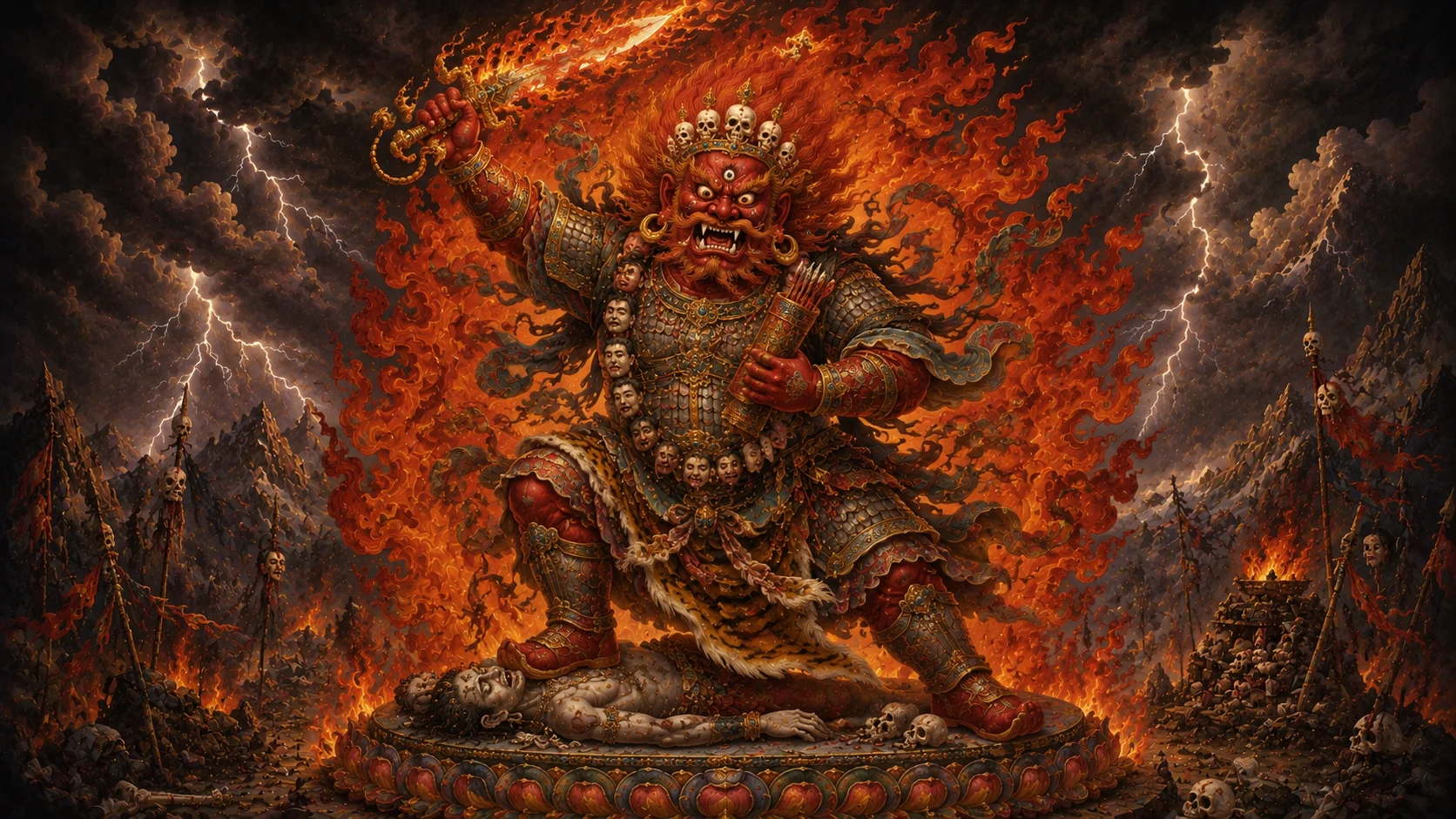
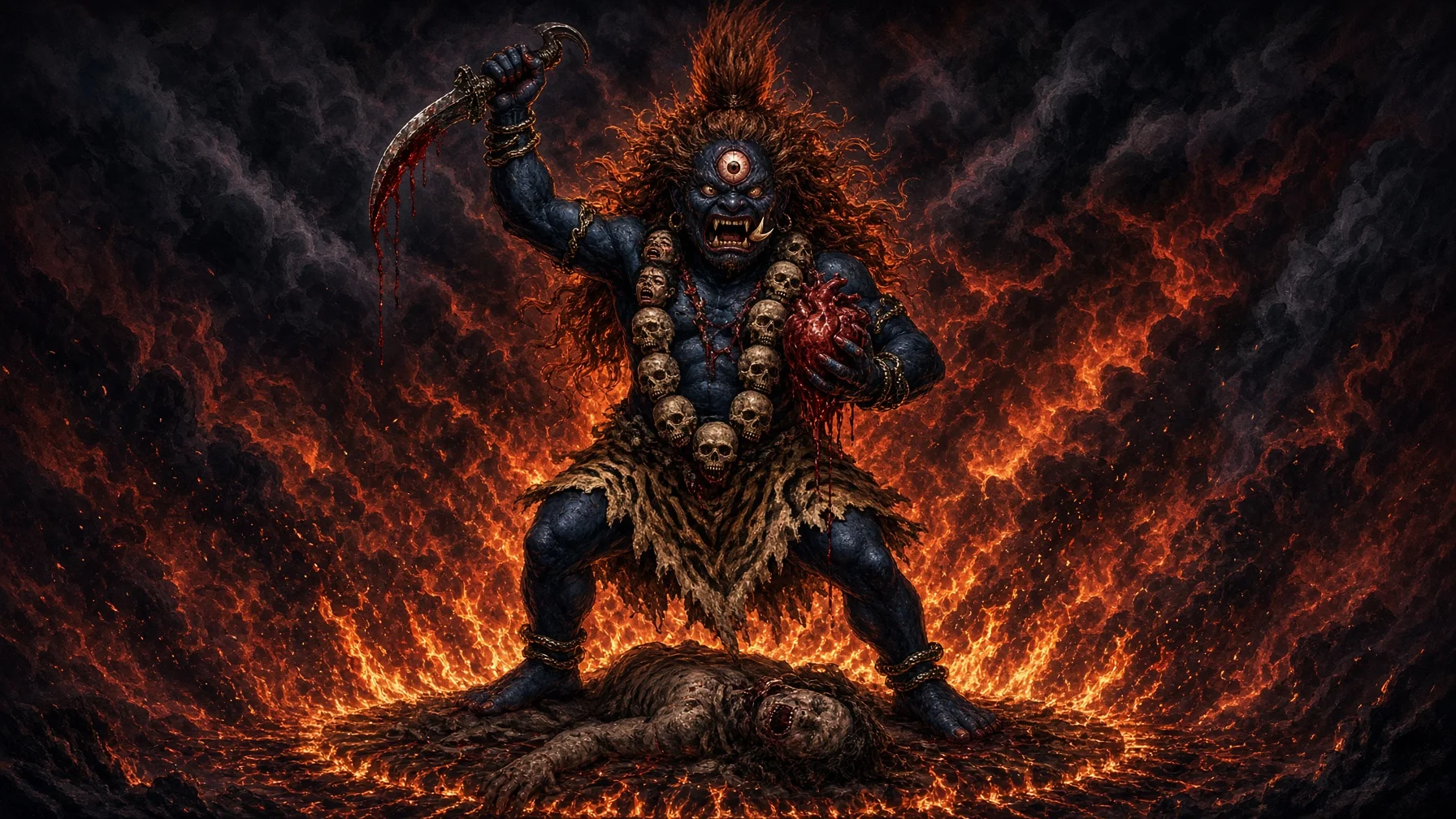
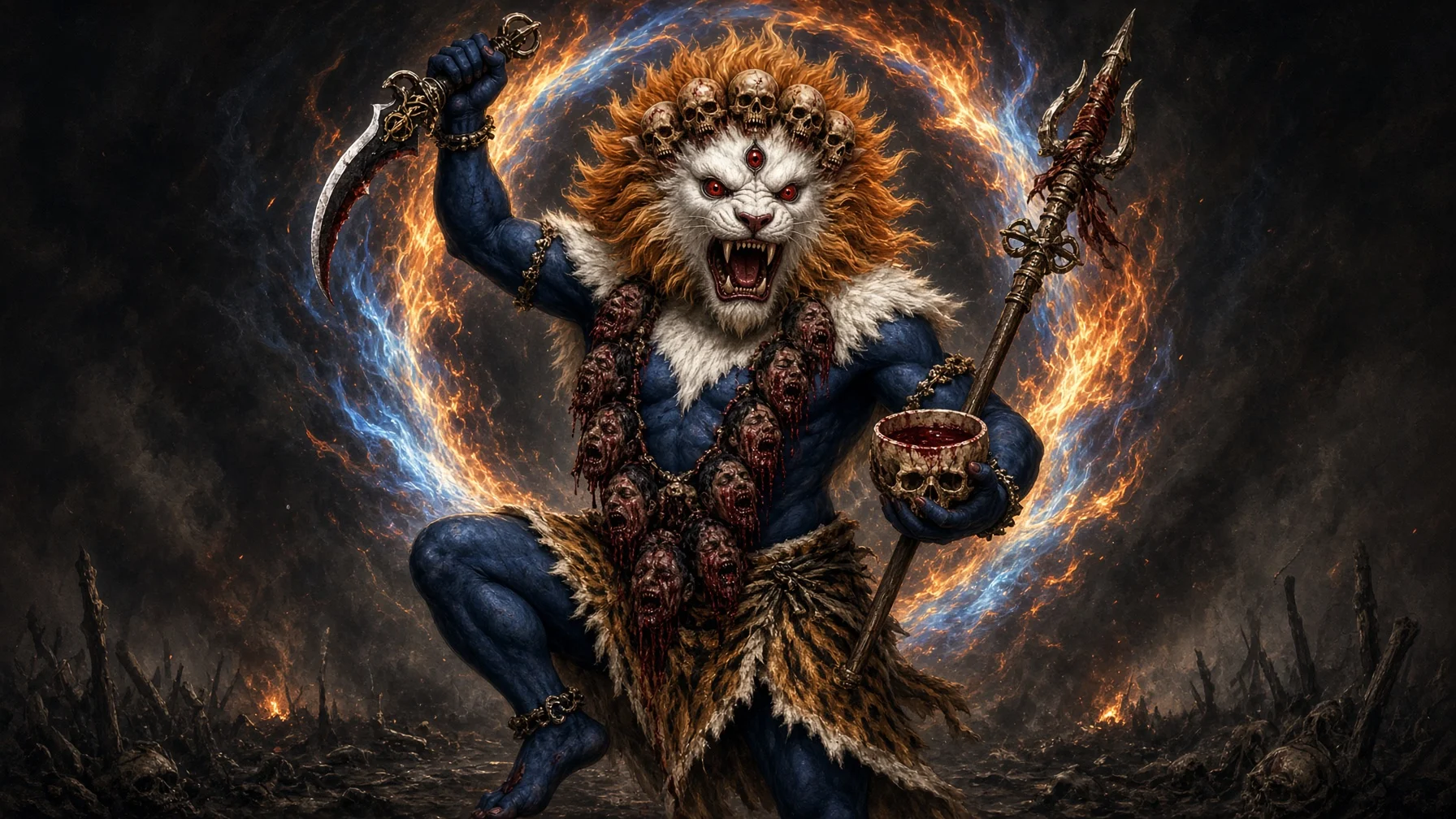
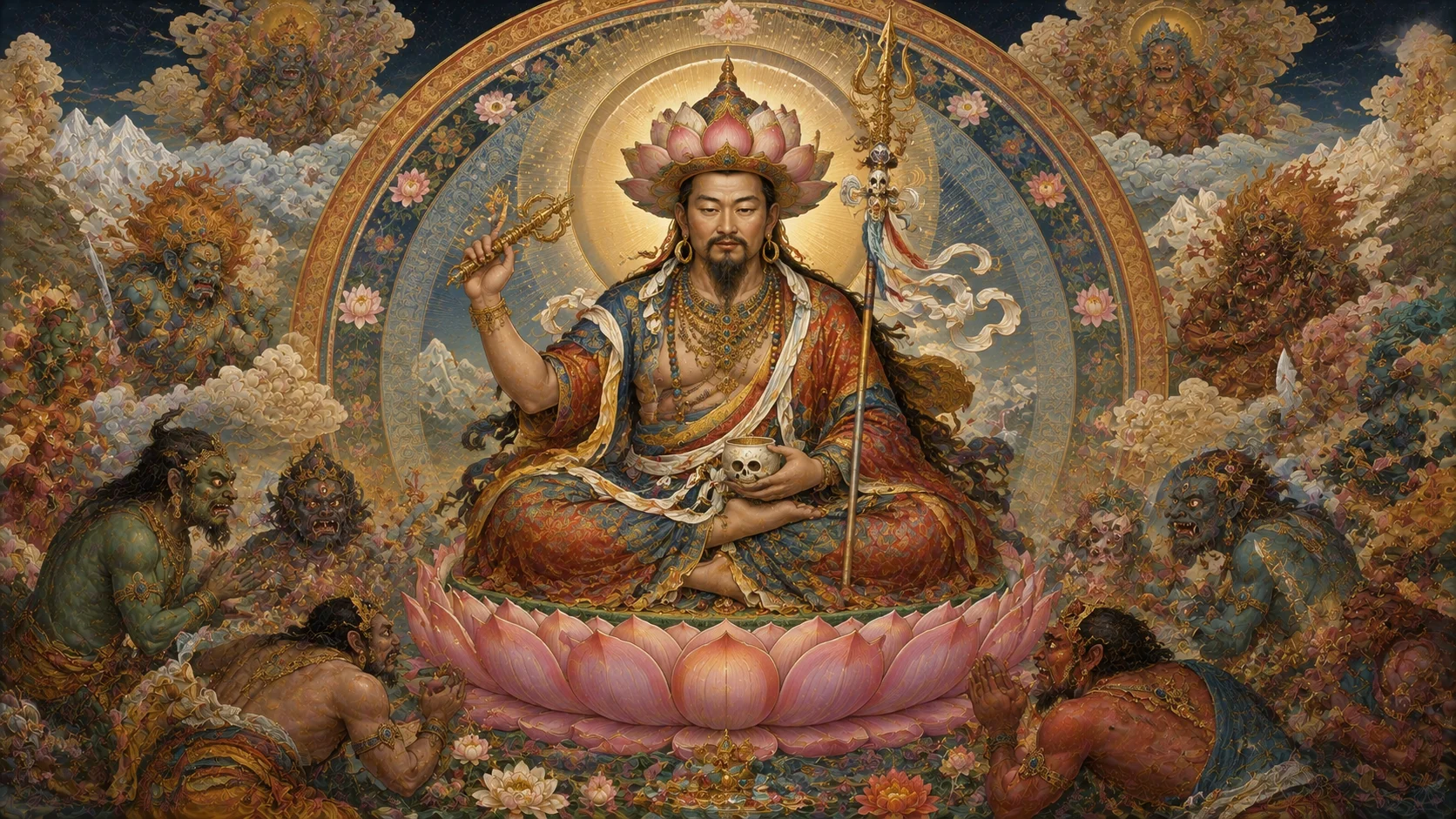
Tibet before Buddhism's establishment was, in this telling, a country alive with its own gods and spirits — mountain deities, earth-lords, and the deities associated with the older Bon tradition — and these powers resisted the new faith's arrival with real hostility, obstructing the work that Śāntarakṣita had begun. Padmasambhava's response was neither destruction nor negotiation in the ordinary sense: he engaged these hostile deities in a contest of tantric power, subdued them, and then bound them by solemn oath. Rather than annihilating the old powers of the land, he converted them — transforming hostile spirits into oath-bound protectors of the Buddhist teaching. This recurring pattern, of a pre-Buddhist deity tamed and repurposed as a guardian rather than erased, became one of the defining mythic structures of Tibetan Buddhism, repeated in countless local accounts across the plateau and its borderlands.
Raising Samye Among the Tamed
With the land's obstructing forces subdued and bound to their new role as protectors, the way was finally clear for the project Śāntarakṣita had begun and could not complete alone: the construction of Samye, Tibet's first monastery, completed around 779 CE. Samye stood as the visible proof that the invisible contest had been won — a seat of the dharma raised upon ground that had, in living memory, actively resisted it. Its completion marks the moment Buddhism in Tibet passed from attempt to institution.
Yeshe Tsogyal and Mandarava
Two women stand beside Padmasambhava as his principal consorts in the tradition: Yeshe Tsogyal, a Tibetan practitioner central to the transmission and recording of his teachings, and Mandarava, a princess of Zahor in India. Both are remembered not as peripheral figures but as accomplished practitioners in their own right, whose participation in Padmasambhava's activity was integral to the teachings he transmitted and, in Yeshe Tsogyal's case, to their preservation for later generations.
Guru, Abbot, and Dharma King
Tibetan tradition remembers the founding of its Buddhism not as one man's achievement but as the joint work of three: Padmasambhava as the tantric Guru, Śāntarakṣita as the Abbot who carried the monastic and philosophical transmission, and Trisong Detsen as the Dharma King whose royal authority made the whole undertaking possible. This trio — Guru, Abbot, Dharma King — is invoked together as the triad responsible for planting Buddhism in Tibetan soil, each supplying what the others could not: royal sanction, scholastic lineage, and the tantric power to clear the ground itself.
Treasures Sealed for an Age Not Yet Born
Padmasambhava is remembered as having foreseen ages to come in which the dharma would face persecution, decline, or simple forgetting, and having acted against that future before it arrived. Across Tibet and the wider Himalayan region, he is said to have concealed termas — hidden treasures taking the form of texts, sacred objects, and teachings — secreted in rock, earth, water, and even in the minds of disciples not yet born, each intended for discovery only when the right tertön, the destined revealer, would appear in a later era ready to receive it. This terma tradition is not regarded as a closed chapter of history but as an ongoing feature of Tibetan Buddhist life, with revelations continuing to be recognized long after Padmasambhava's own time in Tibet.
The Eight-Fold Face of the Guru
Devotion to Padmasambhava does not picture him as a single fixed form. He is venerated through the Eight Manifestations of Guru Rinpoche, a set of distinct forms in which his activity and qualities are separately depicted and invoked, each emphasizing a different aspect of his realization and his deeds. This multiplicity is not treated as contradiction but as the natural expression of a being whose activity in the world took many shapes according to what each moment required.
Vessel of Amitābha
Padmasambhava is regarded as an emanation of the Buddha Amitābha, the identification most consistently affirmed across the tradition, though certain texts also associate him with Avalokiteśvara or with Shakyamuni himself. These varying identifications are not treated as competing claims to be resolved but as different lenses through which his enlightened nature has been described by different lineages and different texts over time.
Departure Without Death
Where an ordinary life ends in death, tradition holds that Padmasambhava's did not. Rather than dying, he is said to have departed Tibet for the Copper-Colored Mountain, Zangdok Palri, a pure land where he is understood to continue to abide and to remain accessible to those who call upon him with devotion. This departure rather than death is central to how he is regarded: not as a historical teacher who has passed on, but as a living presence still reachable through practice and prayer.
The Prayer That Never Ceases
Devotion to Guru Rinpoche is carried, above all, in the Seven-Line Prayer, recited by practitioners across the Himalayan Buddhist world as a direct invocation of his presence, and in the Tsechu, the festival held on the tenth day of the lunar month in his honor. His iconography is unmistakable and consistent: a vajra held in the right hand, a skull-cup bearing the nectar of long life in the left, a khatvanga staff resting in the crook of his arm, and a lotus hat crowning robes layered to suggest king, monk, and yogin at once — a figure who holds within a single form the authority of royalty, the discipline of monastic ordination, and the freedom of the tantric adept, and who is invoked by names as varied as his forms: Guru Rinpoche, Padmakara, Urgyen Rinpoche.
The Living Inheritance of the Nyingma
The Nyingma school, the oldest of Tibetan Buddhism's major traditions, looks to Padmasambhava as its founding figure, and credits him directly with introducing Vajrayana practice and the teachings of Dzogchen to Tibet. What he began at Samye, in the taming of hostile powers and the concealment of treasures for later revelation, did not close with his departure for the Copper-Colored Mountain — it continues in the terma revelations, in the recitation of the Seven-Line Prayer, and in the Tsechu celebrations still held in his honor, so that the Lotus-Born master remains, for those who venerate him, not a distant founder but a guide still actively present in the unfolding of the teaching he first brought to the roof of the world.