Mandarava, also rendered Mandāravā, is honored in Nyingma hagiography as a princess of Zahor who set aside a royal marriage for the dharma, became a principal tantric consort and disciple of Guru Padmasambhava, and is held to have attained, together with him, the deathless realization of a vidyadhara at Maratika Cave. Alongside Yeshe Tsogyal, she is remembered as one of the two most prominent among Padmasambhava's consorts, and she carries in Tibetan sources the honorific title of Great Dakini, Khandroma.
A Name Carried Down from the Heavens
Her name is drawn from the mandarava, a celestial flower of Buddhist cosmology said to fall like rain from the heavens at moments of great auspiciousness — coral-red or radiant white blossoms marking the presence of the sacred in the world. That a woman destined to embody enlightened feminine wisdom should carry the name of a flower said to descend from the heavens is, in the tradition's own telling, no accident: the name itself is read as an announcement of what her life would become. She is described in iconographic sources as youthful and radiant, often depicted as light-colored or moon-like in complexion, a visual echo of the celestial flower whose name she bears.
A Princess of Zahor
Tradition holds that Mandarava was born a princess of Zahor, a kingdom whose precise historical location remains genuinely uncertain among scholars — traditional accounts place it variously within the wider region of present-day North India, with Himachal Pradesh commonly cited, though the underlying geography of "Zahor" has never been settled with confidence. What the hagiography states plainly is her lineage: she was the daughter of a king remembered in the sources as Vihardhara, though his name varies across tellings, and she was raised amid the wealth and expectation proper to a royal house destined for a dynastic marriage.
The Refusal That Shaped a Life
It is a foundational episode of her hagiography that Mandarava, as a young woman, refused the marriage her family intended for her. She turned instead toward the life of a Buddhist renunciate, choosing ordination and practice over the throne and household that awaited a princess of her station. This was not a minor domestic disagreement but a defiance of her family's explicit wishes, and the tradition preserves it as the founding act of her spiritual biography — the moment a woman born to rule chose instead to renounce, and in renouncing, opened the path that would lead her to Padmasambhava.
Meeting the Wandering Yogin
It was in Zahor that Mandarava's path crossed that of Padmasambhava, then a wandering tantric yogin rather than the settled master later generations would revere. Their meeting became the axis of her hagiography: she became his consort and his disciple at once, entering with him into the practices of the Vajrayana that would define the rest of her life. Their union in Zahor is remembered as the seed of everything that followed — the persecution that nearly destroyed them both, and the realization that ultimately vindicated their bond.
Discovery and the King's Wrath
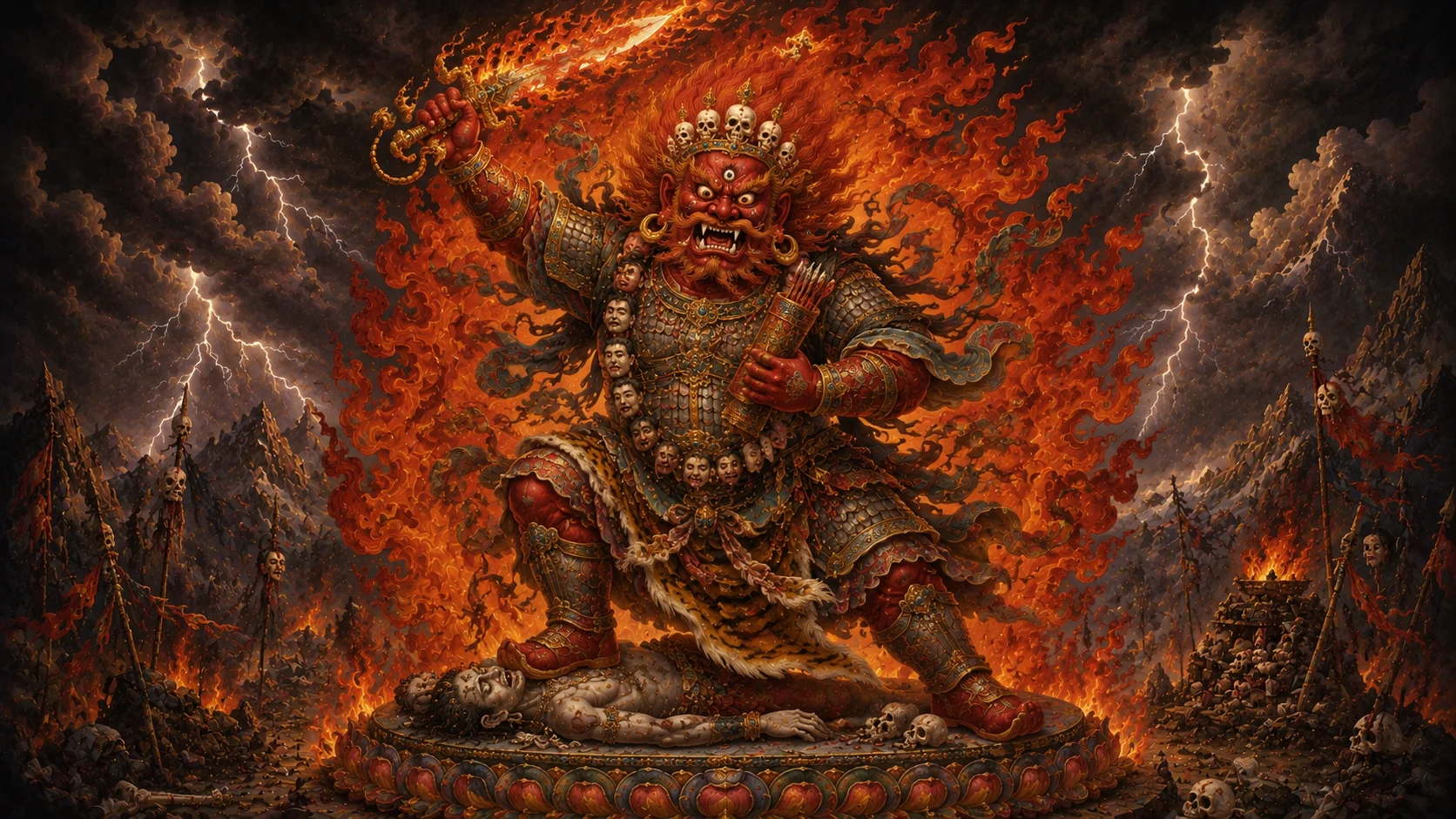
When the relationship between the princess and the wandering yogin came to light, it provoked a crisis remembered as the Zahor persecution. Her father — named in the sources as Vihardhara, or in some versions Arshadhara — is held to have judged his daughter dishonored by the union. His response was severe: Padmasambhava was condemned to be burned alive at the stake, while Mandarava herself was imprisoned, or by some accounts threatened with punishment, for the choice she had made. What had begun as a private bond between a princess and a yogin had become, in the space of a single royal judgment, a matter of fire and imprisonment.
The Pyre Transformed into a Lake
Tradition holds that Padmasambhava's tantric power turned the flames of his own execution into water: the blazing pyre became a cool lake, and where the fire had been meant to consume him, he was found instead unharmed, seated upon a lotus at the water's center. This event is traditionally associated with the site later known as Rewalsar, or Tso Pema — the Lotus Lake — in present-day Himachal Pradesh, India, a place that remains a pilgrimage destination bound to this very story. Confronted with what he could not explain away, the king relented; rather than persisting in his judgment, he came to honor the two he had condemned. The persecution that had sought to end their bond became instead the occasion of its vindication.
Caves of Long Retreat
In the aftermath of the Zahor persecution, Mandarava and Padmasambhava are held to have entered extended retreat together, practicing in caves as teacher and consort bound now not by scandal but by shared realization. These retreats were not a single episode but a sustained period of practice, the tradition's way of showing that what had begun in crisis matured, over time, into the deepest kind of spiritual partnership — one carried out far from the court that had once condemned them.
Maratika and the Deathless Attainment
The culmination of that shared practice is held to have taken place at Maratika Cave, near Halesi in present-day Nepal. There, Mandarava and Padmasambhava are said to have jointly accomplished the practices associated with Amitayus — the long-life aspect of the buddha Amitabha — and through this practice to have attained the vidyadhara level of immortality, a deathless realization transcending ordinary mortality. This is remembered as no minor accomplishment but as the central attainment of Mandarava's spiritual life, the point at which her practice reached its fullest expression. It is this episode above all that anchors her later role as a source of blessing for long-life practice throughout the tradition.
Consort of the Guru, Companion of Amitayus
Mandarava's place in the tradition rests on two bonds held inseparably together: her connection to Padmasambhava as her root guru and consort, and her connection to Amitayus and Amitabha through the Maratika attainment. Hagiographic tradition sometimes speaks of five principal consorts of Padmasambhava in total, yet it is Mandarava and Yeshe Tsogyal who remain, consistently, the two most prominent in the literature that has come down to the present — the Indian princess of Zahor and Maratika standing alongside the Tibetan dakini of Kharchen, Samye, and the Tibetan royal court, each anchored to her own distinct land and narrative, neither one to be folded into the other's story.
An Emanation of Enlightened Wisdom
As with Yeshe Tsogyal, Mandarava is regarded not merely as an accomplished practitioner but as a dakini in her own right — an emanation of enlightened feminine wisdom made manifest in human form. She is honored with the title of Great Dakini, Khandroma, a recognition that places her among the very few women in the tradition granted that particular status, and that marks her as a realized being whose attainment stands independent of, even as it is bound up with, her role as consort.
The Vase of Long Life
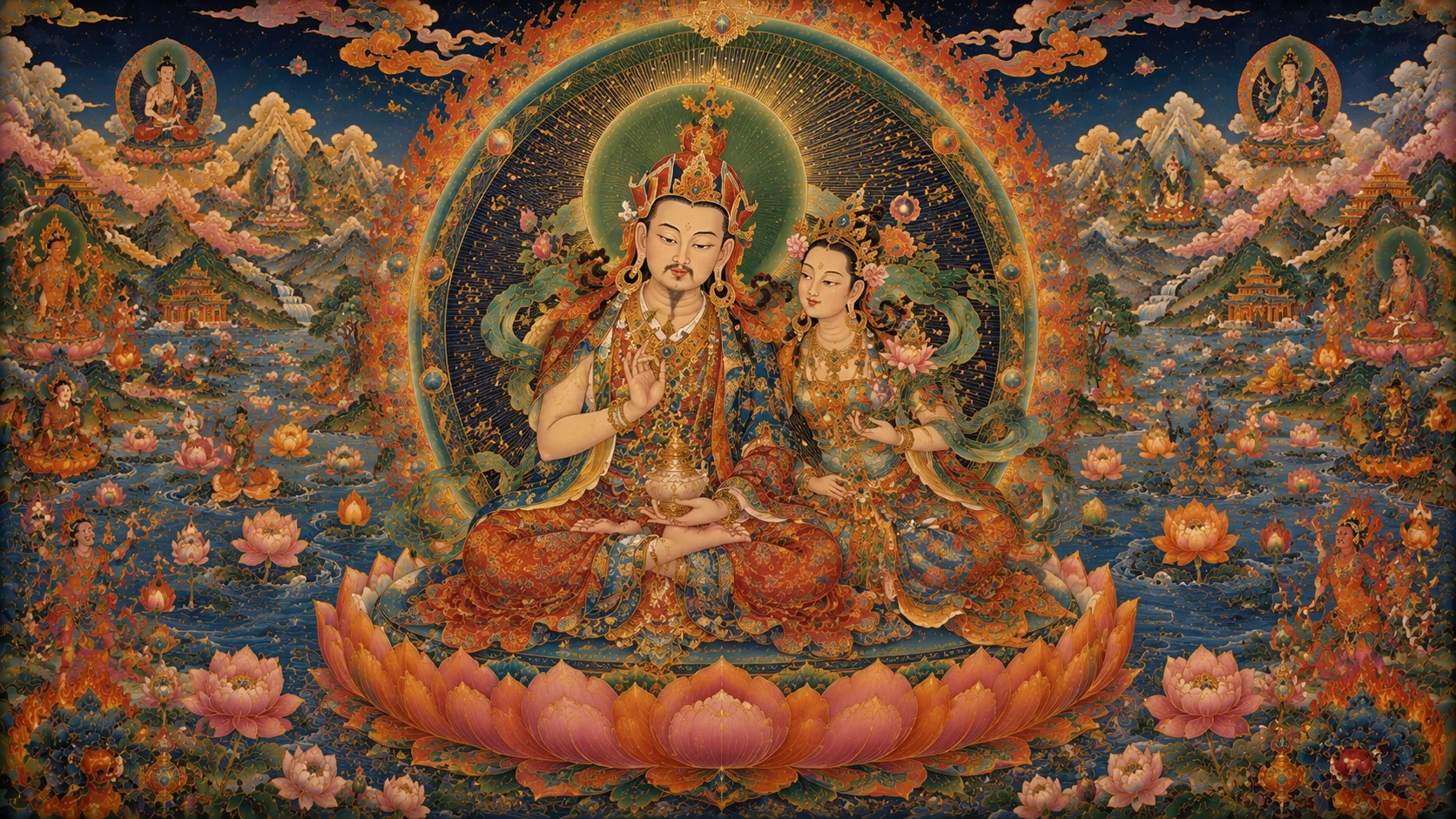
In iconography, Mandarava is typically shown as a youthful dakini, radiant and often described as white or moon-pale, holding a long-life vase — the emblem of her Amitayus attainment at Maratika — and at times a skull-cup. She may also be depicted in yab-yum union with Padmasambhava. Where Yeshe Tsogyal's iconography leans toward the attributes of wisdom-dakini, Mandarava's is distinguished chiefly by this connection to longevity: the vase in her hands is a visual record of the cave at Maratika and the deathless realization accomplished there, distinguishing her at a glance from the consort whose own narrative belongs to Tibet rather than to Zahor.
Invoked Where Long Life Is Sought
Because of her association with the Maratika immortality attainment, Mandarava is particularly invoked in longevity practices, known as tse-drub, within the Nyingma tradition and more broadly across Tibetan Buddhism. Her story functions as a canonical reference point whenever practitioners turn to these practices: to invoke long life is, in a real sense, to invoke the cave where she and her guru first accomplished it. Her hagiography also carries a distinct doctrinal weight in Vajrayana teaching more generally, standing as an exemplar of renunciation — a princess who set aside worldly status and a royal marriage for the sake of the dharma, and whose story is told to illustrate that such renunciation, however costly, opens onto realization rather than loss.
A Story Preserved through Revelation
Mandarava's hagiography survives chiefly through terma literature connected to the broader biographical corpus of Padmasambhava — treasure texts revealed within the life-story cycles of Guru Rinpoche rather than transmitted as continuous historical record. As with the life of Yeshe Tsogyal, scholars note that the terma genre's mode of revelation-based transmission leaves open a real question: how much of the narrative core reflects an early layer of memory, and how much reflects later redaction as the texts were revealed and re-transmitted across centuries. This is not a flaw to be smoothed over but an honest feature of how the story has reached the present, and it is offered here as such rather than as settled history — a caution that sits alongside, not against, the reverence in which the tradition holds her.
Sources & traditions
- EncyclopediaWikipedia — Mandāravā
- TraditionTibetan Buddhist texts, oral tradition and village tellings
Myths change from area to area and from time to time. This chronicle follows the most widely told versions; tellings in other villages, regions and eras may differ.