Green Tara, the swift saviouress, the Mother of all the Lord Buddhas, is the most beloved and active form of the great goddess Tara in Tibetan Buddhism: the embodiment of enlightened compassion in action, who springs to the aid of all who call upon her, the protectress against fear and danger and the bestower of swift help. Her Tibetan name, Sgrol ljang, and her fuller devotional title, Jetsun Dolma Jangku, both carry the same root meaning as the Sanskrit Tara itself, from tṛ, "to cross" or "to save" — she is literally the one who ferries beings across suffering to safety. Where White Tara is serene and healing, Green Tara is dynamic and immediate, one of the principal forms among the Twenty-One Taras and, in the devotion of millions, the first face compassion wears when danger is close.
Born of a Tear Upon a Suffering World
Widespread tradition holds that Tara was born from a single tear of Avalokiteshvara, the bodhisattva of compassion, shed as he looked upon the boundless suffering of beings and grieved that he could not relieve it all, however tirelessly he laboured. That tear fell and formed a lake, and from the lake rose a lotus, and from the lotus Tara herself emerged — compassion given form because compassion alone, even infinite compassion, needed a further vessel through which to act without ceasing. In this account she is inseparable from Avalokiteshvara from the very moment of her arising: not a separate mercy but the continuation of his, compassion doubling itself so that no cry for help would ever go unanswered.
The Princess Who Vowed to Return as a Woman
A second, equally well-attested account gives Tara a different beginning: as the princess Yeshe Dawa, "Wisdom Moon," who generated bodhicitta, the mind set wholly on enlightenment for the sake of all beings. When monks advised her to pray that her merit ripen into a male rebirth, so that she might progress more easily toward buddhahood, she refused. She vowed instead to attain enlightenment specifically in female form, and to continue working for the liberation of beings as a woman for as long as beings remained in suffering. It is a vow remembered as much for what it rejects as for what it promises: the assumption, offered to her as ordinary wisdom, that the path to awakening runs more smoothly through a male body. Yeshe Dawa's answer became one of the founding declarations of Tara's identity.
Two Births, One Saviouress
The tradition does not resolve the tear-narrative and the vow-narrative into a single tidy story, and it does not need to. Both are carried forward together in Tara's devotional life, each illuminating a different facet of who she is: the tear names her origin in another's boundless compassion, the vow names her own resolve, freely made, to be enlightened precisely as a woman and to remain so. Together they give Green Tara a double foundation — she is both the overflow of Avalokiteshvara's mercy into the world and a being who chose, deliberately and irrevocably, the form in which she would save it.
The Swift One Who Saves
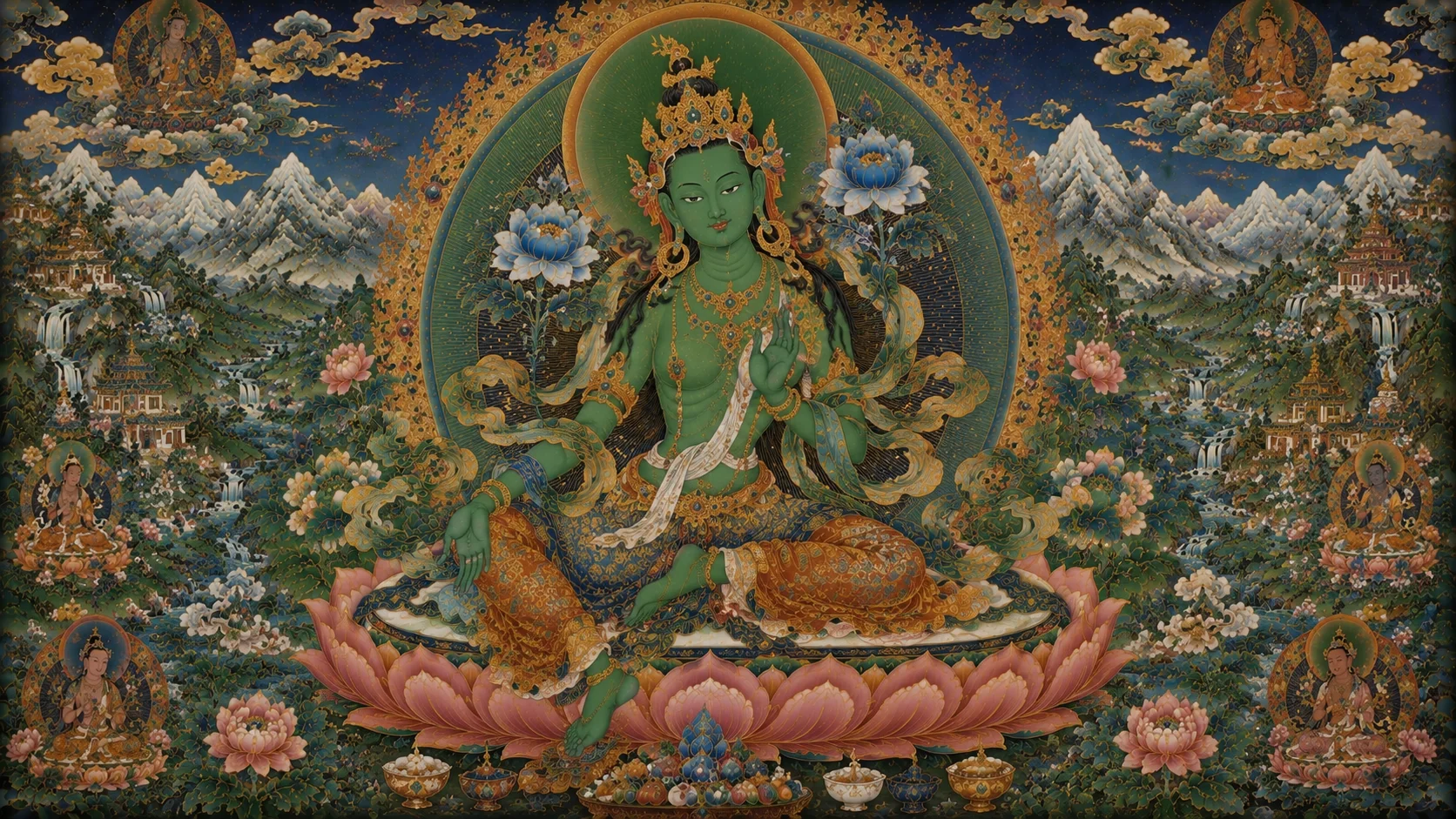
Green Tara is depicted as a beautiful young goddess, green of colour, the green of activity and accomplishment, seated with her right leg extended rather than folded fully into meditation posture. This posture of readiness is her essence: she is compassion that does not wait. Where a fully seated deity conveys settled, timeless stillness, Tara's extended leg says she could rise in an instant, and that she will, the moment a being in distress calls her name. Her right hand rests in varada mudra, the gesture of boon-granting, open and giving; her left hand is held near her heart, the stem of a blue or white utpala lotus rising from her fingers. Every element of her iconography points the same direction — toward action, toward the immediate crossing from danger into safety that her name itself promises.
Kinship with the Bodhisattva of Mercy
Green Tara's bond with Avalokiteshvara runs through both of her origin accounts and through the whole of her practice: she is honoured as his spiritual consort, his emanation, and the active extension of his enlightened compassion into the world. He is often described as compassion in its vast, all-encompassing aspect; she is that same compassion made swift, particular, and immediately responsive to the single being who calls out in a single moment of danger. Practitioners who invoke Avalokiteshvara for the ocean of suffering and Tara for the wave breaking over them now are not invoking two different mercies but one mercy working at two registers.
Deliverer from the Eight Great Fears
Green Tara is invoked above all as the protectress who delivers her devotees from danger and fear, classically enumerated as eight great fears: lions, wild elephants, fire, snakes, thieves, imprisonment, floods, and demons. Tradition also reads these symbolically, as corresponding inner afflictions that threaten the mind as surely as their outer counterparts threaten the body — pride that roars like a lion, delusion that tramples like an elephant, the fire of anger, the poison of envy, wrong views that strike unseen like a snake, avarice that steals one's own peace, attachment that imprisons, the flood of overwhelming emotion, and doubt that haunts like a demon. To call upon Green Tara is to summon her protection against both kinds of peril at once, the outer world's dangers and the mind's own.
The Mantra Carried on Every Breath
Om Tare Tuttare Ture Svaha is recited more widely across Tibetan Buddhist practice than perhaps any other mantra, murmured by travellers setting out on dangerous roads, by the sick, by the dying, and by ordinary practitioners simply moving through an ordinary day. Its repetition is understood as a direct line to Tara's swift protection: not a request that must wait to be considered, but a summons she is vowed to answer without delay. The mantra's presence in daily life — on the lips of pilgrims, painted on prayer flags, spun into prayer wheels — is itself a testament to how thoroughly Green Tara's promise of swiftness has been taken at its word.
Green and White, Two Faces of One Mercy
Green Tara and White Tara stand as the two most prominent of Tara's twenty-one forms, and Tibetan devotion has long understood them as complementary rather than competing. Green Tara answers danger: she is invoked for active, urgent, swift protection when harm is immediate. White Tara answers frailty: she is sought for healing, for longevity, for the serenity that follows once the danger has passed. A practitioner may call on Green Tara to survive the crisis and White Tara to recover fully from it — two aspects of a single compassionate intention, meeting the same being at two different moments of need.
Root of the Twenty-One Emanations
Within the Twenty-One Praises to Tara, the liturgy that names and describes twenty-one differentiated forms of the goddess, each with its own colour, activity, and protective function, Green Tara is typically regarded as the principal or root form from which the others are understood to arise. The twenty-one are not twenty-one separate goddesses so much as twenty-one facets of the compassionate activity that Green Tara embodies in its most complete and immediate expression, each addressing a particular danger or a particular kind of aid.
The Foreign Queen Remembered as Her Emanation
Tibetan hagiography identifies Green Tara with Bhrikuti, the Nepalese wife of the seventh-century Tibetan emperor Songtsen Gampo, within the devotional narrative that credits his two foreign wives with bringing Buddhism into Tibet — his Chinese wife Wencheng being linked in the same tradition with White Tara. This association belongs to devotional memory rather than documented history, a way of reading the arrival of the dharma in Tibet as itself an act of Tara's compassion working through royal marriage and statecraft. It should be understood as sacred narrative, cherished for what it reveals about how deeply Tara's presence was felt to run beneath Tibet's own founding, not as a claim of verified biography.
A Lord Buddha Who Chose to Remain a Woman
In Vajrayana understanding, Green Tara is not merely a protector spirit but a fully enlightened Lord Buddha, manifesting in female form to demonstrate, unambiguously, that buddhahood is not restricted to any one gender. She stands among the most widely venerated female yidams across the Nyingma, Kagyu, Sakya, and Gelug schools alike, her practice crossing lines that divide Tibetan Buddhism in almost every other respect. Her presence in the tantric corpus — in the sadhana texts and the Tara Tantra literature transmitted from Indian Vajrayana sources into the Kangyur and Tengyur traditions — establishes her origin as pan-Vajrayana even as her devotional life became something distinctly, deeply Tibetan.
Called Upon at the Threshold
Tara's mantra and her praises are woven into the most consequential passages of a practitioner's life: recited daily as part of ordinary liturgical practice, invoked for protection before setting out on a journey, and called upon at the bedside of the dying, when the crossing she was named for becomes literal. Few deities in Tibetan Buddhism are asked to be present at so many different thresholds — the start of a road, the edge of danger, the final passage out of this life — and fewer still are trusted to arrive, each time, as swiftly as she promises.
The Mother Who Comes the Instant She Is Called
Green Tara is among the most universally beloved deities of Tibetan Buddhism, prayed to daily by countless practitioners across every school, her mantra one of the most recited in the Himalayan world. She is honoured as the Mother of all the Lord Buddhas, the feminine wisdom from which enlightenment itself is said to be born, and as proof, embodied and enthroned, that the female form is no obstacle whatsoever to full awakening. In Green Tara, Tibetan Buddhism gave form to compassion in swift action: the green saviouress ever poised to spring to the aid of all who suffer, the deliverer from every fear, outer and inner alike, the beloved Mother of the Lord Buddhas who comes the instant she is called.
Sources & traditions
- EncyclopediaWikipedia — Tara (Buddhism)
- TraditionTibetan Buddhist texts, oral tradition and village tellings
Myths change from area to area and from time to time. This chronicle follows the most widely told versions; tellings in other villages, regions and eras may differ.