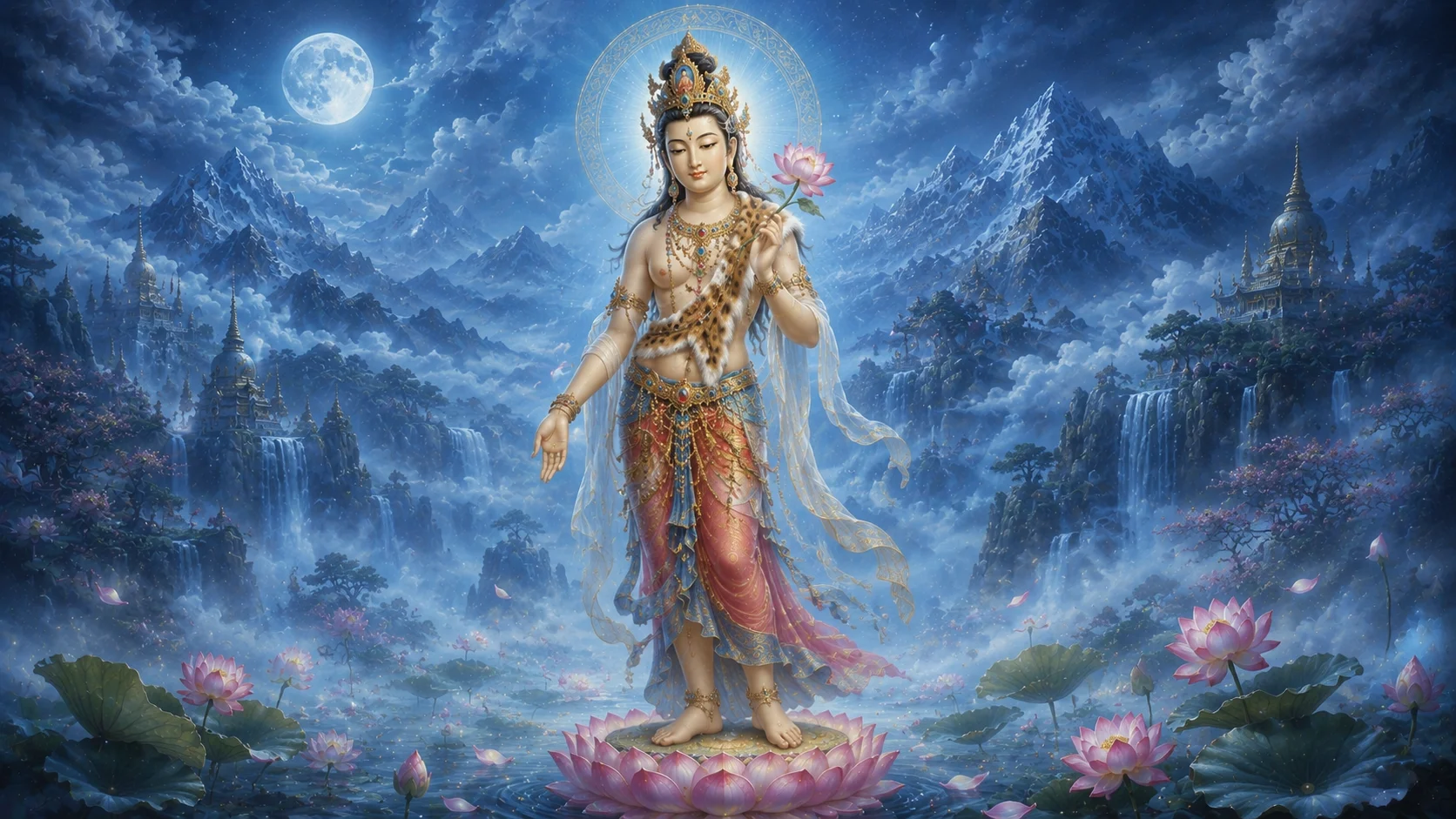
Avalokiteshvara — “the Lord Who Looks Down” in compassion upon the suffering of the world — is the great bodhisattva of compassion, the most beloved and widely venerated of all the bodhisattvas: the embodiment of the boundless mercy of all the Lord Buddhas, who hears the cries of every suffering being and comes to their aid. Across Asia, in many forms and many names, this is the divine compassion to which countless millions turn.
The One Who Hears the Cries of the World
Avalokiteshvara’s name is understood as “the lord who looks down” or “the lord who perceives the sounds of the world” — for he hears the cry of every being in distress and turns his compassionate regard upon them. He is the bodhisattva who has vowed to delay his own final Buddhahood until all sentient beings are freed from suffering, the very personification of karuna, compassion, the cardinal virtue of the Mahayana. He is closely associated with the Lord Buddha Amitabha, in whose western Pure Land he serves and whose compassion he extends into the world.
The Thousand Arms
The most famous image of Avalokiteshvara expresses the boundlessness of his compassion: the thousand-armed, thousand-eyed form. The legend tells that, beholding the immensity of the world’s suffering, the bodhisattva strove so hard to help all beings that his head shattered into pieces — and Amitabha restored him with eleven heads to hear all cries, and a thousand arms, an eye in the palm of each hand, to see and reach every suffering being. He holds in his many hands the implements of salvation, and he manifests in whatever form a being needs to be saved.
Guanyin, Kannon, and the Many Forms
Avalokiteshvara’s compassion took on countless forms across Asia. In China, the bodhisattva came to be venerated as the beloved Guanyin (Kannon in Japan), the “Goddess of Mercy,” most often in female form — the gentle, all-merciful mother to whom the suffering, the desperate, and women seeking children turn, one of the most worshipped deities in all of East Asia. In Tibet, Avalokiteshvara (Chenrezig) is the patron of the land, and the Dalai Lamas are held to be his emanations; his mantra, Om mani padme hum, is the most recited in the world. In Avalokiteshvara, Buddhism gave form to compassion itself — the bodhisattva who hears every cry, who shattered and was remade to help all beings, who appears as Guanyin and Kannon and Chenrezig, the boundless mercy of the enlightened mind reaching out to a suffering world.
A Name in Two Sanskrit Forms
Long before Chinese translators agreed on how to write his name, they could not agree on what it even meant. Kumarajiva, rendering the Lotus Sutra into Chinese in the early fifth century, gave the bodhisattva’s name as Guanshiyin — “the one who perceives the sounds of the world.” That reading points to a Sanskrit original, Avalokitasvara, built on svara, “sound” — and it matches the promise at the heart of his cult: cry out his name in danger, and he hears you. Centuries later the pilgrim-monk Xuanzang, who had spent years studying Sanskrit at Nalanda in India, insisted the correct form was Avalokiteshvara, from ishvara, “lord” — and translated it instead as Guanzizai, “the one who observes with sovereign ease,” the form that opens his version of the Heart Sutra. Both names are still chanted today, a fossil record of a bodhisattva whose defining faculty — whether hearing or seeing — was always his attention to suffering he had not caused and was not obliged to notice.
The Mountain That May Not Exist
Ask a seventh-century pilgrim where Avalokiteshvara actually lived and the answer was specific: a mountain called Potalaka, somewhere in the far south of India, reachable in principle by anyone willing to attempt the climb. Xuanzang recorded the local tradition — a peak of dangerous paths and sheer rock, where the few who reached the summit were said to behold the bodhisattva, sometimes in the form of the god Ishvara, sometimes as an ash-smeared ascetic, while most who tried were turned back by the terrain itself. No identification of the mountain has ever won general acceptance, and that may be the point: Potalaka functioned less as a place on a map than as a promise that compassion had an address, however far. The name outlived the search for the mountain. It travelled to Tibet, where the Dalai Lamas’ residence in Lhasa was named Potala after it, and to China, where an actual island would eventually claim the title in the mountain’s stead.
The Lotus in His Hand
Strip away the thousand arms for a moment and look at one of the most celebrated early images of this bodhisattva: a single figure, one head, a lotus stem held lightly between two fingers, painted on the wall of Cave 1 at Ajanta in western India in the fifth century. This form, Padmapani — “the lotus-bearer” — is how Avalokiteshvara was pictured long before the multiplied heads and hands of the esoteric traditions became standard. The lotus is not decoration: it grows rooted in mud yet opens unstained above the waterline, the standard Buddhist figure for a being who moves through a suffering world without being fouled by it. Later East Asian art gave him two companions who flank a great many Guanyin altars: a barefoot boy called Sudhana, drawn from a separate sutra in which he travels to fifty-three teachers in search of enlightenment and finds Avalokiteshvara among them, and a young woman known as the Dragon Girl, whose own story of sudden and complete awakening became attached to the bodhisattva’s retinue. Look for the willow branch and the vase of pure water in the other hand, too — instruments for sprinkling relief onto the afflicted, as literal as a physician’s kit.
Tears That Became a Goddess
Tibetan tradition tells of the moment the compassion became almost too much to bear. Looking out across the world and seeing that for every being he saved countless more remained trapped in suffering, Avalokiteshvara wept. From his tears a lake formed, and from the lake grew a lotus, and from the lotus stepped a goddess who vowed to share his labour: Tara, whose name is read both as “star” and, from the root meaning to cross over, as “she who ferries beings across.” In some tellings she emerges twice over, green from one eye and white from the other, so that the bodhisattva of compassion does not merely act alone but generates, out of his own grief, an entire lineage of saviours. Tara went on to become one of the most widely invoked figures in Tibetan and Newar Buddhism in her own right — compassion in this tradition is generative rather than static, spilling into new forms whenever the old ones prove insufficient.
The Blue Throat and the Great Compassion Spell
Walk into a Chinese, Korean, or Vietnamese monastery at the morning or evening chant and you will hear, recited from memory by monks who may never have studied Sanskrit, a long incantation known as the Nilakantha Dharani — the “blue throat” spell, among the most frequently recited texts in East Asian Buddhism and known there simply as the Great Compassion Mantra. The epithet “blue throat” is borrowed directly from Shiva, who in Hindu myth swallowed the poison churned from the ocean and held it in his throat, where it left a permanent blue stain, rather than let it loose on the world. Buddhist tradition carried the image over to Avalokiteshvara, and the dharani itself still names Shaiva epithets outright. Compassion, in this register, is not gentle sentiment but the willingness to absorb something lethal on behalf of everyone else and to carry the mark of it visibly, permanently, in your own body.
An Island, a Cave, and a Pilgrim Road
Devotion to this bodhisattva did not stay in texts; it built pilgrimage routes. Off the coast of Zhejiang province in China sits Mount Putuo, an island whose name comes directly from Potalaka, and whose founding legend tells of a Japanese monk unable to sail a Guanyin image home across a suddenly impassable sea, who concluded that the bodhisattva did not wish to leave and built her a shrine where his ship had stalled — a temple still called “the Guanyin Who Would Not Leave.” In Korea, the monk Uisang is recorded seeking a vision of the bodhisattva in a seaside cave on the east coast and founding Naksansa temple there, the name itself an echo of Potalaka carried into Korean. In Japan, thirty-three temples across the Kansai region form the Saigoku Kannon pilgrimage, held to be the oldest pilgrimage circuit in the country and still walked today, each stop housing its own image of Kannon — thirty-three for the number of forms the Lotus Sutra says the bodhisattva can assume. And in Vietnam, the bodhisattva is beloved as Quan Âm through the tale of Quan Âm Thị Kính, a woman falsely accused and driven from her home twice over, who endures every injustice without retaliation and is recognised only after death as mercy itself — a story still staged in traditional Vietnamese theatre.
The Guide Behind the Journey to the West
A Chinese reader today is as likely to have met Guanyin first in a sixteenth-century novel as in a temple. In Journey to the West, it is Guanyin who selects the pilgrim Tang Sanzang for his mission, who supplies the golden headband that keeps the unruly Sun Wukong’s violence in check, and who reappears at crisis after crisis to intervene when the pilgrims’ own strength runs out. The novel did not invent that role so much as dramatise the one she already held in devotional life — and it fixed her, for readers who might never enter a temple, as literature’s designated rescuer. That afterlife has not ended: a 108-metre statue of Guanyin, completed in 2005, now stands over the sea at Nanshan on Hainan Island, among the tallest statues on earth, raised by a tradition that has been building monuments to her compassion for well over a thousand years.
Why the World Wanted Someone Who Listens
Buddhist doctrine, at its most rigorous, offers no one to pray to: impermanence, emptiness, and the slow discipline of one’s own mind are not much comfort in a crisis. Avalokiteshvara is what the tradition built instead — not a contradiction of that philosophy but its overflow, the compassion the doctrine insists is real, given a face, a voice, a thousand hands and, crucially, ears. It is no accident that the cult grew largest in its most tender and human forms, nor that the chapter of the Lotus Sutra devoted to him reads like a list of ordinary terrors: fire, flood, shipwreck, bandits on the road, the executioner’s raised sword. Every religion that lasts must answer the same complaint — that suffering falls on people who did nothing to deserve it, and that no one is listening. Avalokiteshvara is Buddhism’s answer: someone is. That, more than any single myth attached to him, is why he is invoked by more people, in more languages, than almost any other figure in the Buddhist world.
Sources & traditions
- EncyclopediaWikipedia — Avalokiteśvara
- TraditionBuddhist texts, oral tradition and village tellings (South/Southeast Asia)
Myths change from area to area and from time to time. This chronicle follows the most widely told versions; tellings in other villages, regions and eras may differ.