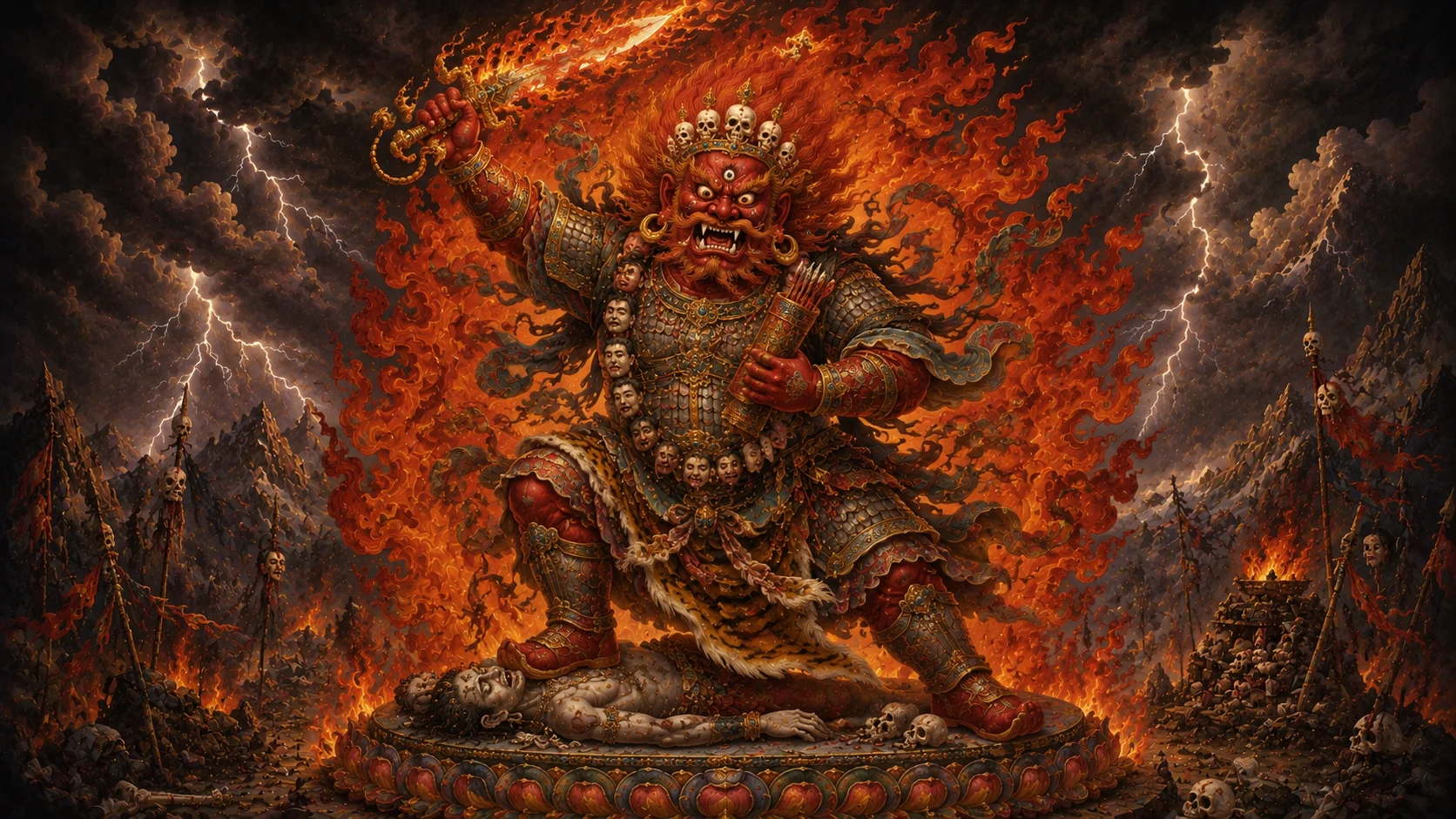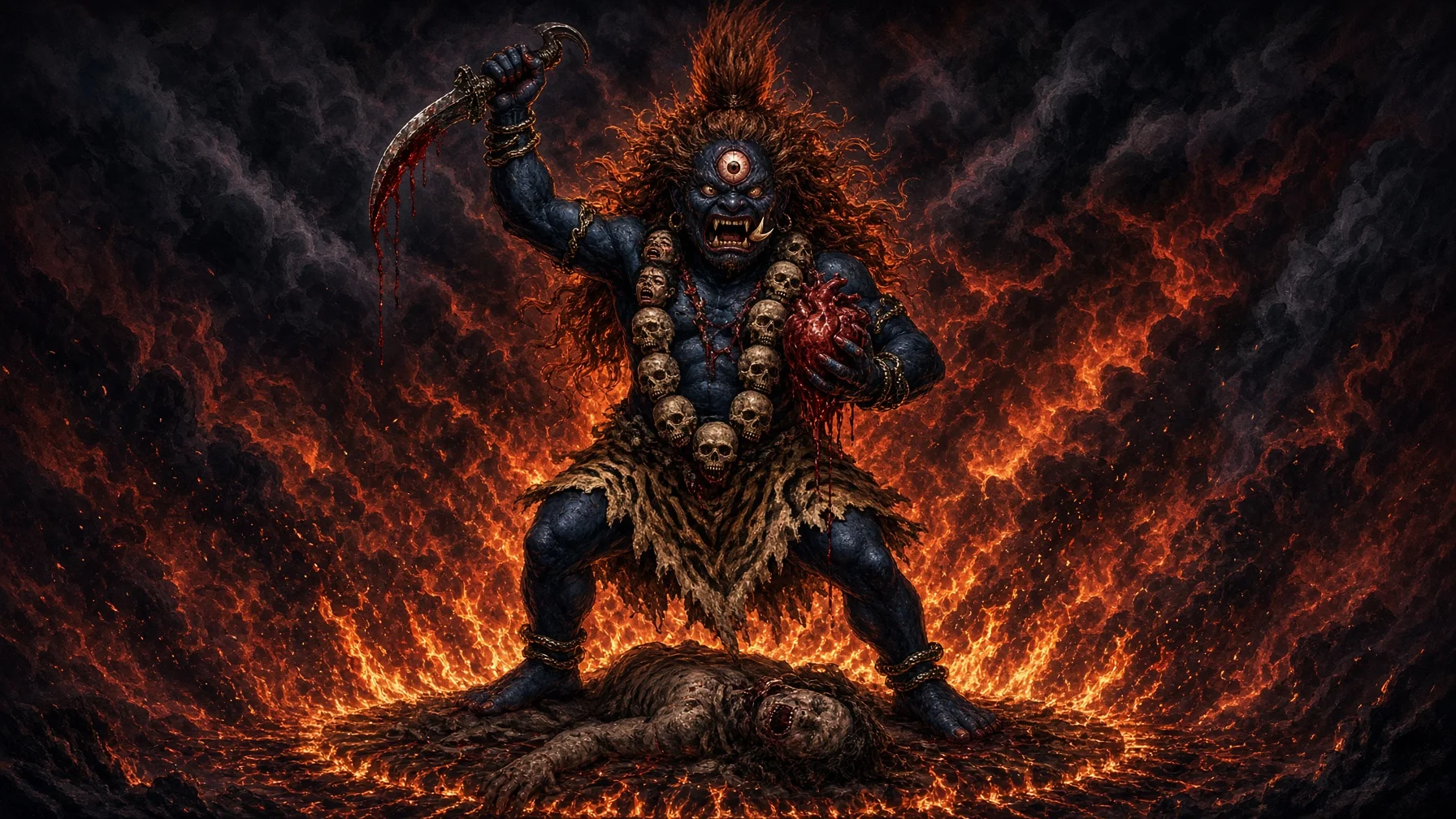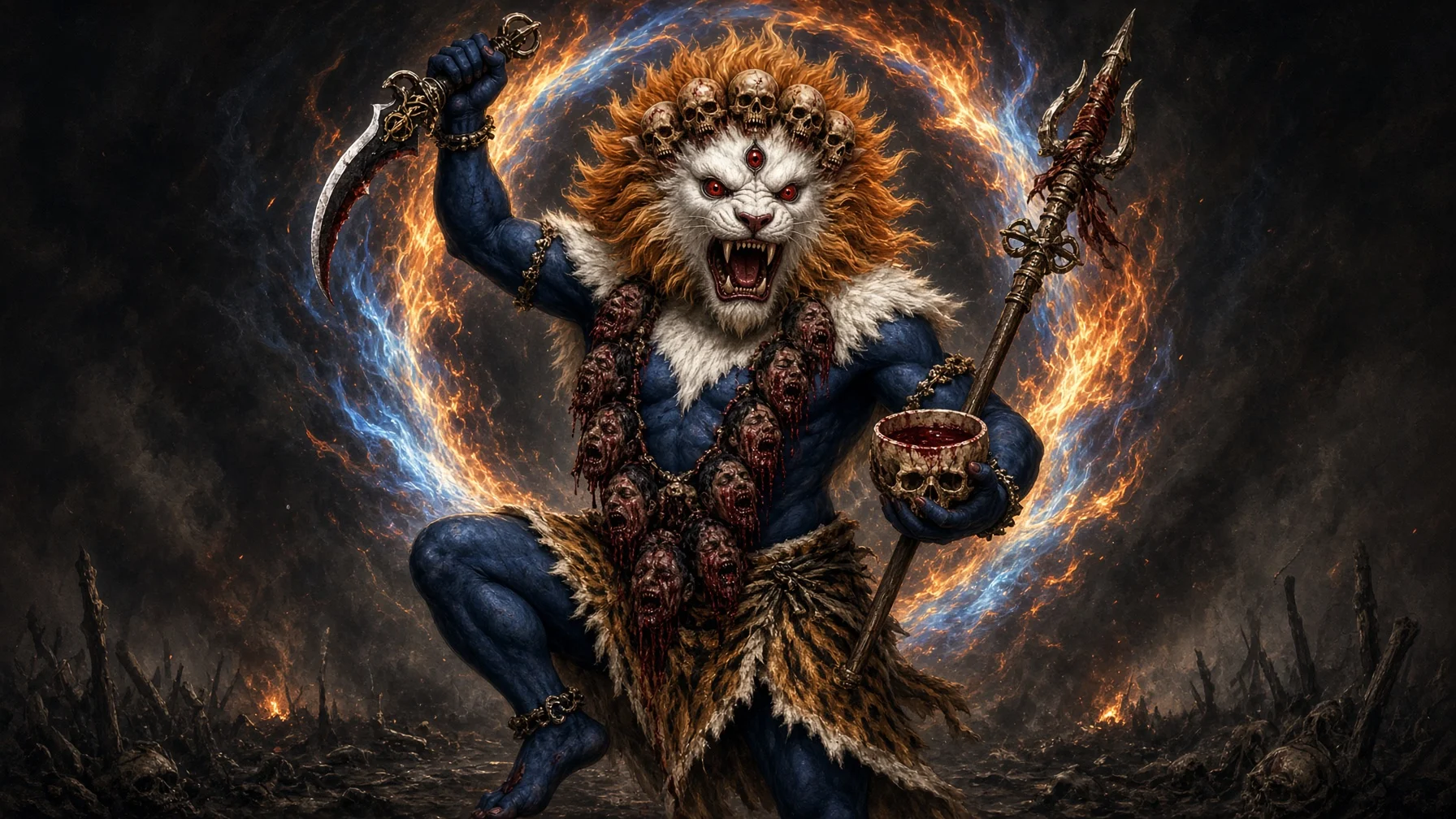
Mahakala — “the Great Black One” — is the foremost wrathful protector (dharmapala) of Tibetan Buddhism: a fierce, black, blazing deity who guards the dharma and its practitioners, destroying the obstacles and demonic forces that obstruct enlightenment. Though terrifying in form, he is an emanation of compassion itself — the wrathful aspect of a bodhisattva, his ferocity wholly in the service of the good.
The Great Black Protector
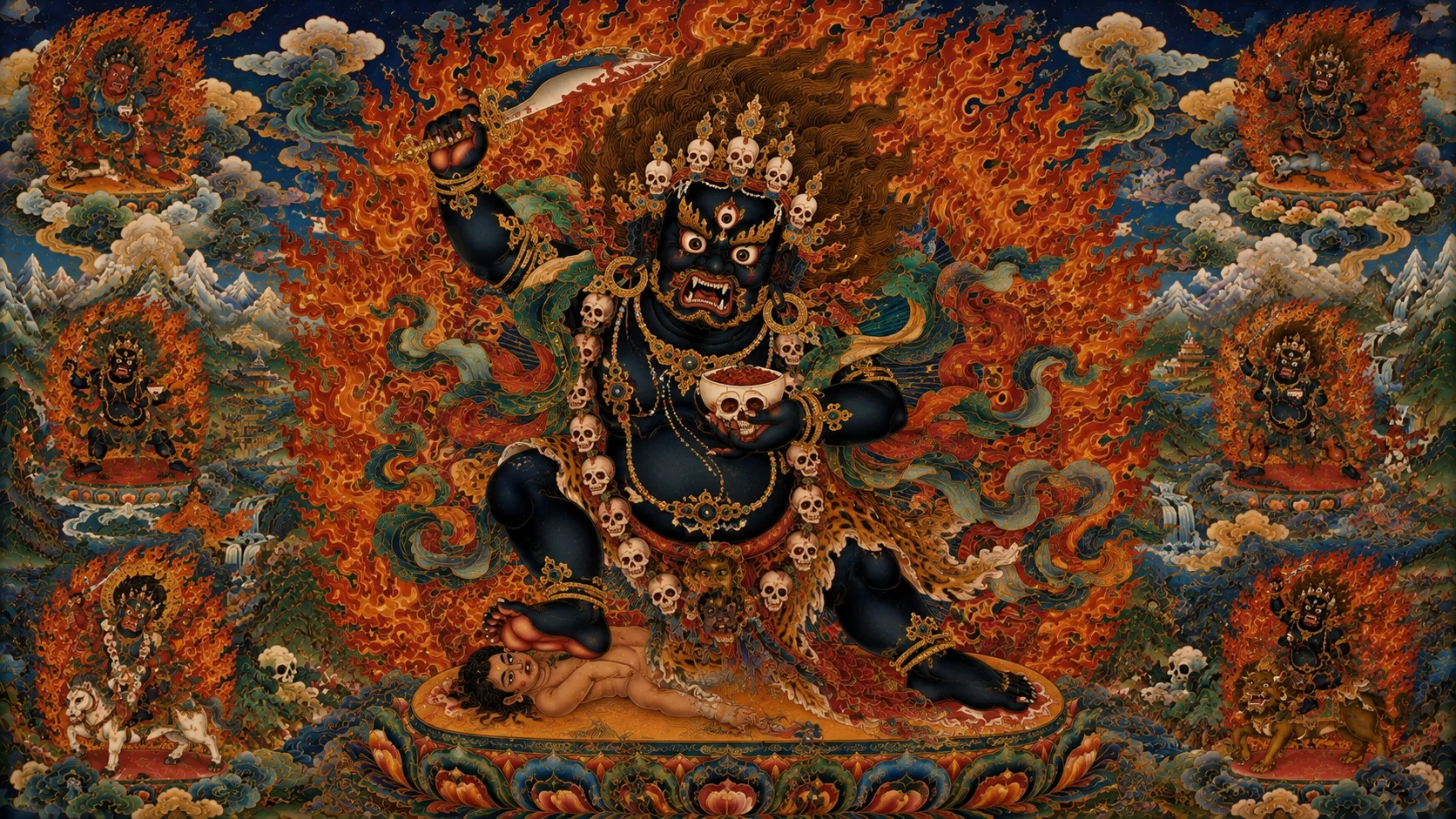
Mahakala is depicted as a fearsome, usually black or dark-blue deity of squat, powerful form, wreathed in flames, with a crown of skulls, a garland of severed heads, bared fangs, and a third eye blazing on his brow, wielding a curved knife and a skull-cup and trampling upon the forms of ignorance and evil. He appears in many forms — with two arms, four arms, six arms — each a different aspect of his protective power. His blackness signifies the changeless, all-encompassing nature of ultimate reality, into which all is absorbed, and his wrath is the dynamic, ferocious energy of compassion turned against everything that harms beings and obstructs the dharma.
The Wrath of Compassion
Crucially, Mahakala is not a demon or an evil being but an emanation of enlightened compassion — most often regarded as the wrathful form of Avalokiteshvara, the bodhisattva of compassion himself. His terrifying appearance is “skillful means”: there are obstacles, demons, and inner defilements that gentle compassion cannot overcome, and against these the bodhisattva manifests as the ferocious Mahakala, whose overwhelming wrath subdues and destroys what would harm beings. His ferocity is compassion in its most powerful and dynamic form, love that will not let evil prevail.
The Guardian of the Dharma
Mahakala is the principal protector of Tibetan Buddhism, guardian of monasteries, lineages, and practitioners, invoked to remove obstacles, destroy the forces of evil, and safeguard the teaching and those who follow it. He is honoured across all the schools of Tibetan Buddhism, his fierce image found in the protector-chapels (gonkhang) of the monasteries, his practice undertaken to clear the way for enlightenment. (He shares his deep origins with the Hindu Mahakala, a form of Shiva, transformed in the Buddhist context into the great dharma-protector.) In Mahakala, Tibetan Buddhism gave form to the wrath of compassion — the Great Black protector blazing with ferocious energy, the wrathful emanation of the bodhisattva of mercy, who destroys the obstacles and demons that obstruct the dharma and guards the teaching and its followers with overwhelming, compassionate power.
Kala Means Both Black and Time
The name hides a pun that is also a theology. In Sanskrit, kāla means black. It also means time — the same syllables, the same appetite. Mahakala is therefore the Great Black One and the Great Time at once: the darkness that swallows every colour and the duration that swallows every living thing. Nothing survives him because nothing survives time. To call a deity Mahakala is to say that the destroyer and the clock are the same being.
That double meaning belongs first to Shiva, in whose Hindu iconography Mahakala is a name for the god in his aspect as annihilator of the universe — the ash-smeared lord of the cremation ground, dancing where time ends. His consort in that register is Mahakali, the feminine of the same word, black time in a woman’s form. Buddhist tantra took up the name, the blackness and the cremation-ground furniture, and then did something startling with them: it kept the terror and changed the owner.
Ujjain, Where the Great Black One Is Still Woken With Ash
The Hindu Mahakala is not a historical curiosity. He is worshipped every morning at Mahakaleshwar in Ujjain, on the banks of the Shipra in Madhya Pradesh, one of the twelve jyotirlingas — the shrines where Shiva is held to be present as a shaft of light rather than as an image. Ujjain is a fitting address for a god whose name means time: the city served classical Indian astronomy as its prime meridian, the reference line from which longitudes, and so local times, were reckoned across the subcontinent. The lord of time keeps his temple on the meridian of time.
Before dawn the shrine performs the bhasma aarti, the ash offering, in which the lingam is bathed in sacred ash while drums and conches sound and the doors open to worshippers who have waited through the night. Tradition holds that Mahakaleshwar is the one jyotirlinga that faces south — the direction of Yama and of death — and pilgrims come precisely because this is the god who is not frightened of the thing everyone else is frightened of. It is a living rite, performed daily, and the deity encountered there is a protector of the city itself, not a demon.
The Protector Who Started in the Monastery Kitchen
One of the earliest eyewitness descriptions of a Buddhist Mahakala is disarmingly domestic. When the Chinese pilgrim Yijing travelled through India and Southeast Asia in the late seventh century, he described small dark images of the deity kept in the kitchens and dining-hall porches of Indian monasteries, seated, blackened and glossy from generations of being rubbed with oil, with food set before them at mealtimes. The monks understood him as the guarantor that the community would be fed — a protector of stores and of the daily meal, invoked by the cook rather than by the abbot.
Two things follow from that. First, Mahakala entered Buddhism from below as much as from the tantras: he was practical before he was doctrinal, a deity you dealt with because a monastery of hungry monks is a fragile institution. Second, the kitchen never left him. It travelled all the way to Japan and eventually turned him into a god of prosperity holding a sack. The blazing dharmapala of the Tibetan protector chapel and the smiling householder’s deity on a Japanese kitchen shelf are the same being, carried east along two different halves of one original job description.
Wisdom Protector, Not Bound Spirit
Tibetan Buddhism draws a distinction that outsiders routinely miss, and it is the most important thing to understand about Mahakala’s status. Protectors come in two grades. Worldly protectors are local gods, mountain spirits and pre-Buddhist powers who were subdued and made to swear oaths — they are still inside samsara, still capable of pettiness, still bargained with. Wisdom protectors, by contrast, are enlightened beings who have taken a wrathful shape deliberately; they stand outside samsara entirely and cannot be flattered, bribed or turned.
Mahakala is unambiguously of the second kind. Tibetan renders his name literally as Nagpo Chenpo, the Great Black One, though in everyday speech he is more often simply Gönpo, “the Protector” — the definite article doing the work, because there is no need to say which one. This is why his practice is not a transaction. You are not paying off a dangerous spirit to leave you alone. You are invoking the ferocity of an awakened mind against the parts of your own mind that will not yield to patience, and the fact that the deity cannot be corrupted is the entire point of the arrangement.
The Many Bodies of the Protector
Mahakala is not one figure but a family of them, and Tibetan schools are identified by which body of him they keep. The differences are not decorative; each form carries its own tantric cycle, its own lineage of transmission and its own history.
- Six-armed Mahakala (Shadbhuja) — the most widely practised form, black, squat and immensely powerful. He came into Tibet through the Shangpa Kagyu transmission and was taken up enthusiastically by the Gelug, and it is his image that most people picture when they hear the name.
- Four-armed Mahakala (Chaturbhuja) — associated with the Chakrasamvara cycle and prominent in Kagyu practice, carrying its own distinct sadhanas rather than being a mere variant of the six-armed form.
- Bernagchen, “the Black-Cloaked One” — two-armed, wrapped in a black cape, the special protector of the Karmapas and the Karma Kagyu line. His relationship to that lineage is personal rather than institutional: he guards particular successors of a particular seat.
- Panjaranatha, “Lord of the Pavilion” — the protector of the Sakya school, arising from the explanatory tantra attached to the Hevajra cycle. He is instantly recognisable because he holds a gandi, the long wooden beam whose striking summons monks to assembly, laid horizontally across his forearms. A protector who carries the monastery’s call to prayer as his weapon is a remarkably precise piece of theology.
How to Read Him in a Painting
Wrathful iconography is a written language, not a mood, and the attributes an onlooker reads as gruesome are each a specific statement. The crown of five skulls is not a body count: it stands for the five poisons — ignorance, attachment, aversion, pride, envy — transmuted into the five wisdoms, which is to say the crown is a diagram of what enlightenment does with your worst qualities. The curved flaying knife (kartrika) severs attachment at the root; the skull-cup (kapala) holds what has been transformed by that severing. Snakes coil at his limbs as ornaments, a reading of poison as jewellery once fear has been digested. The elephant hide stretched behind some forms is the skin of arrogance, worn as a cloak.
Beneath his feet, in the six-armed form, lies a small elephant-headed figure, often painted white. This is not the beloved remover of obstacles from Hindu worship but Vinayaka in his aspect as obstruction itself given a body — the personified impediment being pinned down. And the whole scene sits in a ring of wisdom-fire against a cremation ground, because the tantric imagination locates awakening in exactly the place ordinary people refuse to go. Many such images are painted in the nagthang or black-ground style, gold and vermilion lines drawn out of darkness rather than onto a bright field, so that the figure appears to be emerging from the void rather than standing in front of it.
The Protector Who Went to the Mongol Court
Mahakala’s fortunes have twice been tied to empire. In the thirteenth century the hierarchs of the Sakya school became religious preceptors to the Mongol rulers of China under Kublai Khan, in the arrangement Tibetans call yön-chö, patron and priest. When a lineage rises, its protector rises with it: the Sakya Mahakala moved from a Tibetan monastic chapel into the ritual apparatus of the Yuan dynasty, and images of him were made under imperial sponsorship. Later the Manchu rulers of the Qing, who cultivated Tibetan Buddhism as a matter of statecraft as much as of faith, maintained his cult in their own foundations.
This is worth stating plainly because it explains something about the deity’s reputation. A protector adopted by conquerors acquires an atmosphere of martial power, and Mahakala has often been read from outside as a war god. Within the tradition he is nothing of the kind. The obstacles he destroys are named, and they are internal before they are external: the defilements, the interruptions to practice, the forces that break a lineage. Empires have always liked borrowing gods whose ferocity they can point in a convenient direction. The tradition’s own definition never moved.
The Gonkhang and the Twenty-Ninth Day
How ordinary practitioners actually meet Mahakala is nothing like reading about him. He lives in the gonkhang, the protector chapel, which in most monasteries is deliberately dark, hung with old weapons and armour, its principal images often kept veiled and uncovered only at certain times. Access is restricted in many places and photography is generally unwelcome. The room is not designed to be pleasant; it is designed to make clear that what is kept there is serious.
Offerings are torma, sculpted barley-flour cakes, sometimes coloured red, made and destroyed on a schedule. The twenty-ninth day of each lunar month belongs to the protectors, and the twenty-ninth day of the final month of the year carries the great year-end rites — gutor — in which the accumulated obstacles, illnesses and hostilities of the past twelve months are gathered into an effigy and expelled before the new year begins. In monasteries of the Kagyu and other schools, extended Mahakala pujas run for days ahead of Losar, and masked cham dances bring the protectors bodily into the courtyard where lay people can see them. It is one of the few moments when a deity kept behind a curtain all year comes out and dances.
Daikokuten: How the Great Black One Learned to Smile
Follow Mahakala east instead of north and the transformation is almost unrecognisable. In China he became Dahei Tian; carried on to Japan with the esoteric schools, he became Daikokuten — and the kitchen tradition Yijing had noticed in India came with him. Japanese monasteries installed him as guardian of the kitchen and the food stores, the same job he had held in Indian monasteries centuries earlier and several thousand miles away.
Then the name did the rest of the work. Daikoku, “great black”, sounds identical to the reading of the characters for “great land” that open the name of Ōkuninushi, a great deity of Japanese myth — and the coincidence of sound invited an identification. Fused with him, the Great Black One shed his fangs entirely. Daikokuten today is a plump, beaming figure in a flat cap, standing on two bales of rice, a treasure sack over his shoulder and a magic mallet in his hand, one of the Seven Lucky Gods — a household deity of wealth, harvest and the hearth, with mice nibbling happily at his rice. The stoutest central pillar of a traditional Japanese house is still called the daikoku-bashira, the pillar that holds up the household, named for him.
The same deity, at the two ends of his journey, is a blazing black destroyer wreathed in flame and a smiling man with a sack of money. The thread connecting the two ends is simply this: both of them are what stands between a community and the disasters it fears. In thirteenth-century Tibet that meant demons and broken lineages. In an Edo merchant’s house it meant an empty rice bale.
Why the Wrathful Protector Endures
Most religions ask the question quietly and then avoid the answer: what is compassion supposed to do when kindness does not work? A tradition that answers “be kinder” has not really answered. Tibetan Buddhism gave the problem a body, painted it black, set it on fire and hung its portrait in a locked room at the back of the monastery.
That is why he travels so well into contexts with nothing to do with Buddhism, and why he is, more uncomfortably, a mirror. Everything about him is made of what we usually disown: rage, appetite, the corpse, the cremation ground, the fear of time. The tradition’s claim is that none of it needs to be discarded, only turned around and aimed correctly.
He asks a question the modern reader is unlikely to have settled either. If you had a ferocity in you that nothing could corrupt, what would you point it at? Mahakala already knows his answer, and it is the reason he is depicted mid-roar rather than at rest.
Sources & traditions
- EncyclopediaWikipedia — Mahakala
- TraditionTibetan Buddhist texts, oral tradition and village tellings
Myths change from area to area and from time to time. This chronicle follows the most widely told versions; tellings in other villages, regions and eras may differ.