Milarepa is the greatest of Tibet’s yogi-saints: a man who began as a murderer steeped in black magic and, through fierce repentance, brutal trials, and supreme devotion, attained complete enlightenment in a single lifetime, becoming the beloved cotton-clad poet-sage whose songs of realization are treasured throughout the Himalayas. His life is the supreme Tibetan story of redemption.
The Sorcerer of Vengeance
Milarepa’s early life was steeped in tragedy and sin. When his father died, his family was cheated and cruelly mistreated by a greedy aunt and uncle, and his embittered mother sent the young Milarepa to learn black magic and take revenge. He became a powerful sorcerer, and with his dark arts he caused a roof to collapse upon a wedding feast, killing many of his enemies, and then destroyed their crops with a hailstorm. But the weight of these terrible crimes — the many deaths he had caused — filled him with profound remorse and dread of the karmic consequences, and he resolved to seek the dharma to purify himself.
The Trials of Marpa
Milarepa sought out the great translator and master Marpa, begging to be taught. But Marpa, perceiving the heavy karma Milarepa needed to purify, subjected him to years of brutal trials before granting any teaching: most famously, Marpa repeatedly ordered him to build great stone towers single-handedly, only to command him to tear each one down and rebuild it elsewhere, again and again, until Milarepa’s back was a mass of festering sores and he despaired. These ordeals, harsh as they were, purified Milarepa’s terrible karma; and at last Marpa, satisfied, gave him the full teachings.
The Cotton-Clad Yogi
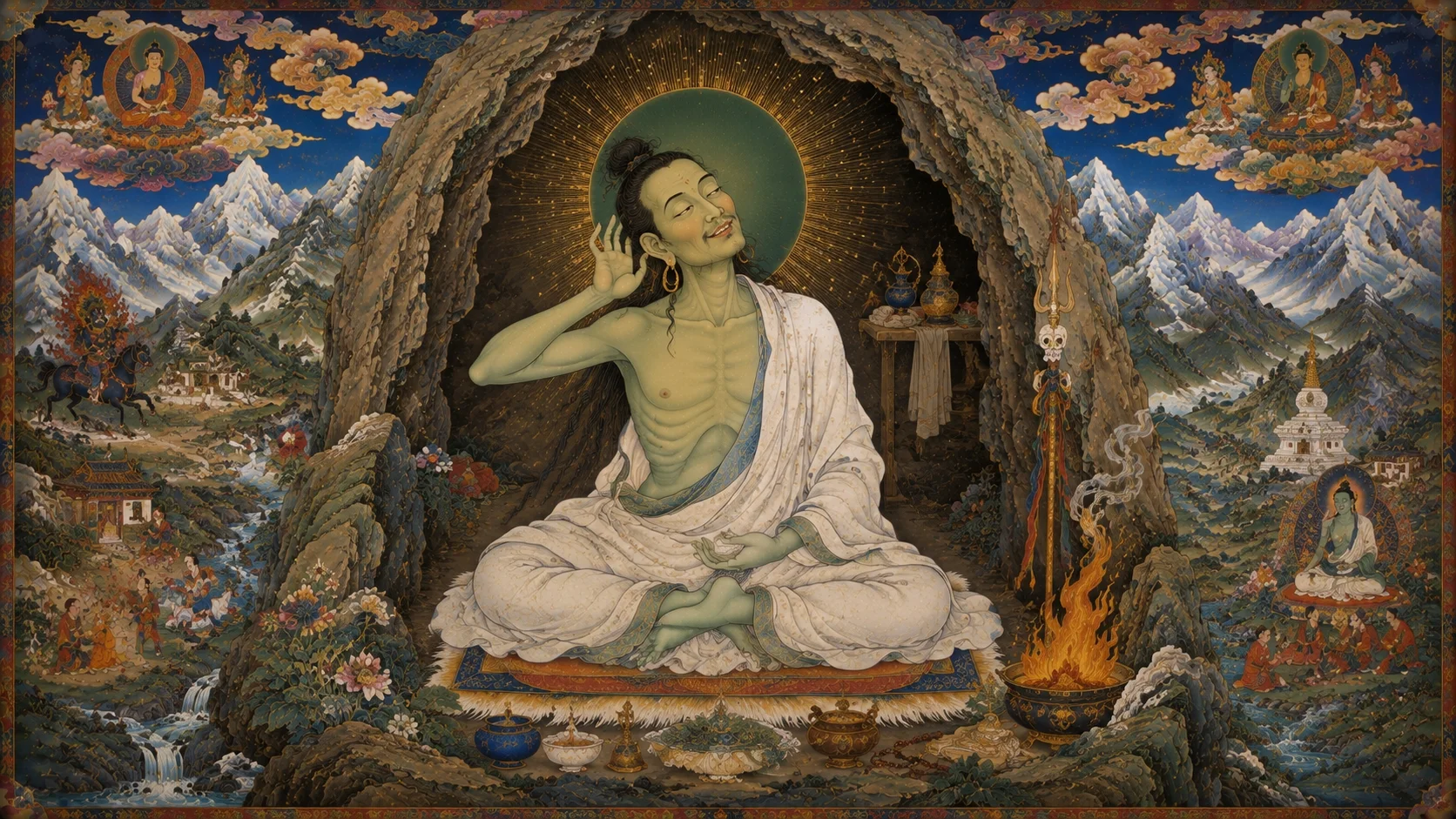
Milarepa then withdrew to solitary retreat in the high caves of the Himalayas, where for years he practiced with superhuman austerity — clad only in a thin cotton robe (hence “Mila the cotton-clad,” repa), surviving on nettles until his body turned green, mastering the inner heat (tummo) that let him endure the mountain cold. Through this fierce practice he attained complete enlightenment in that single lifetime — the supreme accomplishment, all the more remarkable for one who had begun as a murderer. He became a wandering teacher, expressing his realization in spontaneous songs of profound beauty and wisdom — the “Hundred Thousand Songs of Milarepa” — that are among the most beloved spiritual poetry of Tibet. In Milarepa, Tibetan Buddhism gave its supreme example of redemption and realization — the sorcerer-murderer who, through repentance, brutal purification, and superhuman devotion, attained Buddhahood in one lifetime and sang the dharma in immortal songs, the beloved cotton-clad yogi of the snows.
A Biography Written Centuries Later
Milarepa never wrote his own life story. The vivid, moment-by-moment account most readers meet today — the weeping, the terror at his own crimes, the exact words Marpa is said to have shouted at him — reached its now-standard form roughly three and a half centuries after his death, when the wandering yogi and hagiographer Tsangnyön Heruka, known as “the Madman of Tsang” after the deliberately unconventional “crazy yogin” style he practised, gathered older oral and written material into the two texts now inseparable from Milarepa’s name: his rnam thar, or liberation-story, and the collected songs. The distance between the life and its telling does not make the tradition less serious; a rnam thar was never composed as court testimony. It is built as a teaching instrument, shaped so that a listener might be moved along the same road — crime to cave to song — purely by hearing it recited. That a portrait this intimate survives at all, carried through memorisation and hand-copied manuscript before Tsangnyön Heruka fixed it in the late fifteenth century, is part of why Milarepa still reads like someone speaking directly to the listener rather than a distant historical file.
The Chain Behind Marpa’s Cruelty
Marpa’s brutality toward Milarepa was not personal caprice; in the tradition’s own account it was the price of admission to a specific, traceable lineage. Marpa is said to have crossed the Himalayas into India at grave physical risk to receive tantric instruction from the mahasiddha Naropa, who had received it in turn from the elusive Indian adept Tilopa. By that logic, Milarepa’s suffering under Marpa’s roof was the last purification needed before the Indian lineage could pass, unbroken, into a Tibetan vessel. Milarepa in turn passed it to two disciples whose paths diverged sharply. Rechungpa, a fellow wandering ascetic, travelled to India himself and appears throughout Milarepa’s songs as companion and sometimes rival. Gampopa, a widowed former physician who arrived already trained as a monk in the gentler Kadam tradition, fused Milarepa’s cave-yoga with monastic structure. From that fusion came the schools collectively known as the Kagyu, the “Oral Lineage” — among them the Karma Kagyu, headed across the centuries by successive Karmapas — all tracing their authority back through Gampopa to a repentant murderer meditating alone in a cave.
The Race to the Summit of Kailash
Tibetan tradition tells how Mount Kailash — holy to Hindus, Jains and Bonpos as well as to Buddhists — came into Buddhist hands: Milarepa won it in a contest. A Bon priest named Naro Bönchöng already claimed the mountain and disputed Milarepa’s right to meditate there, so the two agreed to settle the matter by racing to the summit at first light. Naro Bönchöng set off astride his ritual drum, using it to fly. Milarepa simply remained seated in meditation until the sun’s first rays touched the peak, then rode the sunbeam to the top, arriving before his rival had climbed halfway, without appearing to have moved at all. The point, as the tradition tells it, is not that magic settled a property dispute; it is that Milarepa’s realisation had become so complete that visible effort was no longer necessary, while his rival’s very public flying was still straining for effect. Pilgrims still walk the circuit around the mountain, and the episode remains among the most frequently retold in Milarepa’s legend precisely because it compresses his whole attainment into a single sunrise.
The Cup He Drank Knowingly
According to the traditional life, Milarepa did not die of illness or age but of poison — and he saw it coming. A local scholar-monk, humiliated when Milarepa’s teaching drew a larger following than his own, sent him a bowl of curd laced with poison. Milarepa, the story says, knew exactly what it contained and drank it anyway, at the settlement of Chuwar, judging that his work was finished and choosing to let an old karmic account close on his own terms. He is said to have spent his final days teaching undisturbed, refusing to let his disciples take revenge on the man who had poisoned him, and dying the way he had lived — without complaint, still instructing everyone in the room. The story closes his life where it opened, on poison and betrayal, except that this time they were received rather than dealt, and answered with compassion instead of a hailstorm.
How to Recognise Him: Green Skin and a Hand at the Ear
Walk into a Kagyu shrine room and Milarepa is easy to pick out among a wall of otherwise similar seated masters. He is shown slight and bare-chested, or wrapped in a single thin pale cloth, never in the heavy robes and ornaments of a monastic teacher, and his skin carries a distinct greenish tinge. His most distinctive feature is his right hand, raised and cupped behind or beside his ear, mouth slightly open, as though caught mid-verse: a portrait not of a silent meditator but of a singer, fixing in paint and bronze the fact that his teaching came out as spontaneous song rather than as formal doctrine. The left hand commonly rests open in his lap, and he is often placed within or before the mouth of a rock cave with snow peaks beyond — the solitude kept in frame with the man.
The Caves Are Not Museums
The caves where Milarepa meditated were never sealed off as monuments to a closed chapter of history; people still climb to them to practise. Sites such as Drakar Taso in Tibet and Lapchi, on the Tibet–Nepal border and counted among the great sacred retreat places of the Kagyu tradition, continue to draw pilgrims and retreatants, some of whom undertake the three-year, three-month retreat that remains a fixture of Kagyu training. Devotees across Tibet, Nepal, Bhutan and the Himalayan borderlands of India recite his songs as part of ordinary devotional life rather than as historical curiosities, and Kagyu centres that have since spread far beyond the Himalayas hand his verses to new students in the same spirit in which Rechungpa and Gampopa received them: not as literature to admire, but as instruction meant to be lived.
Why a Murderer Became Tibet’s Favourite Saint
Few major figures in Tibetan Buddhism begin where Milarepa begins. Bodhisattvas are compassionate from the outset; deities are compassionate by nature. Milarepa arrives at the dharma already carrying the dead, out of a grief and rage that anyone alive might recognise in themselves. That is precisely the source of his enduring pull: he stands as proof, retold across generations, that the worst a person has done need not be the end of the story, provided the remorse that follows is total and the discipline that follows the remorse is unflinching. A tradition that can produce a saint out of a murderer is making an argument about every lesser failure its listeners carry — and it is an argument people keep needing to hear, translated and resung, in every generation since.
Sources & traditions
- EncyclopediaWikipedia — Milarepa
- TraditionTibetan Buddhist texts, oral tradition and village tellings
Myths change from area to area and from time to time. This chronicle follows the most widely told versions; tellings in other villages, regions and eras may differ.