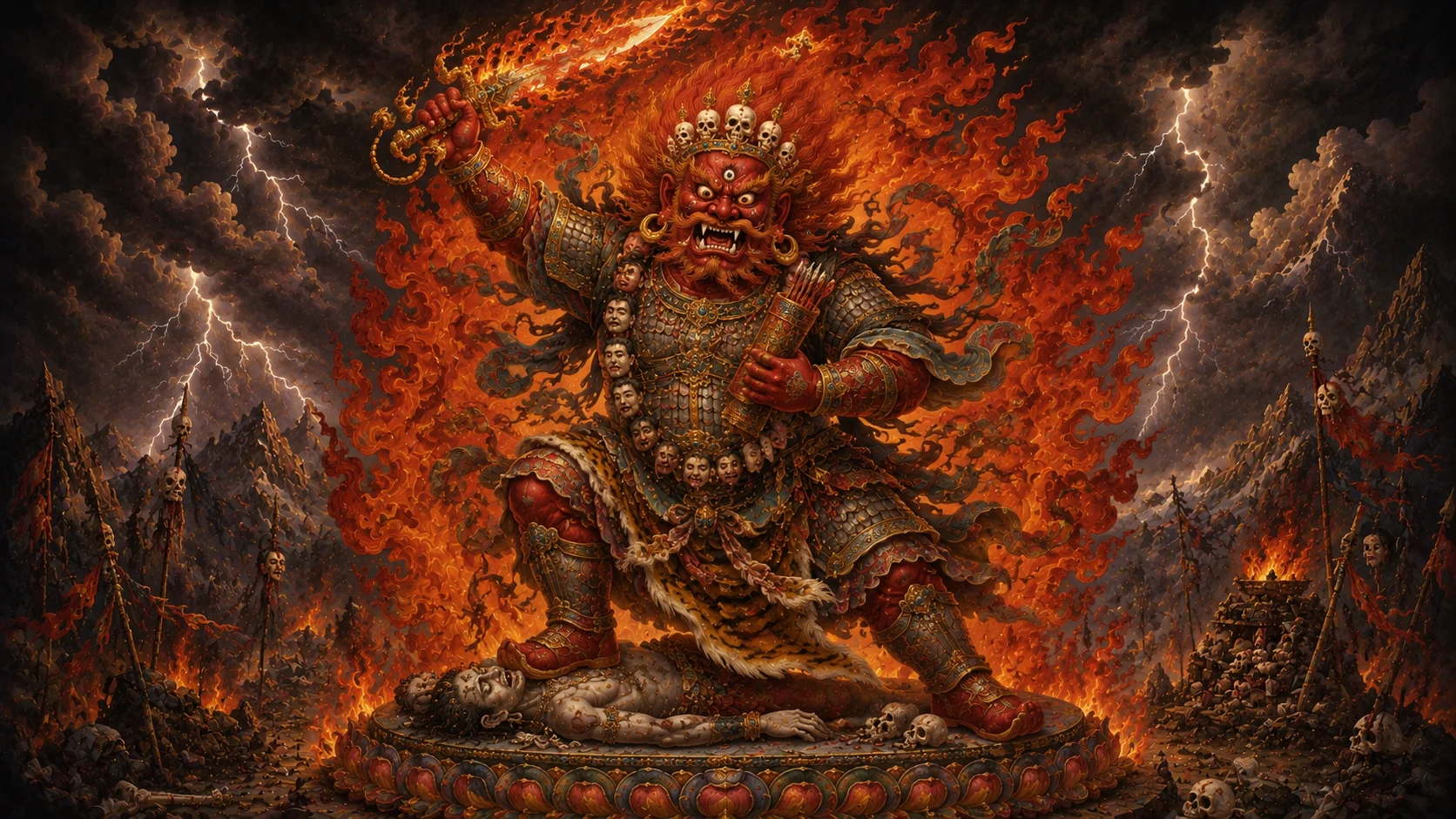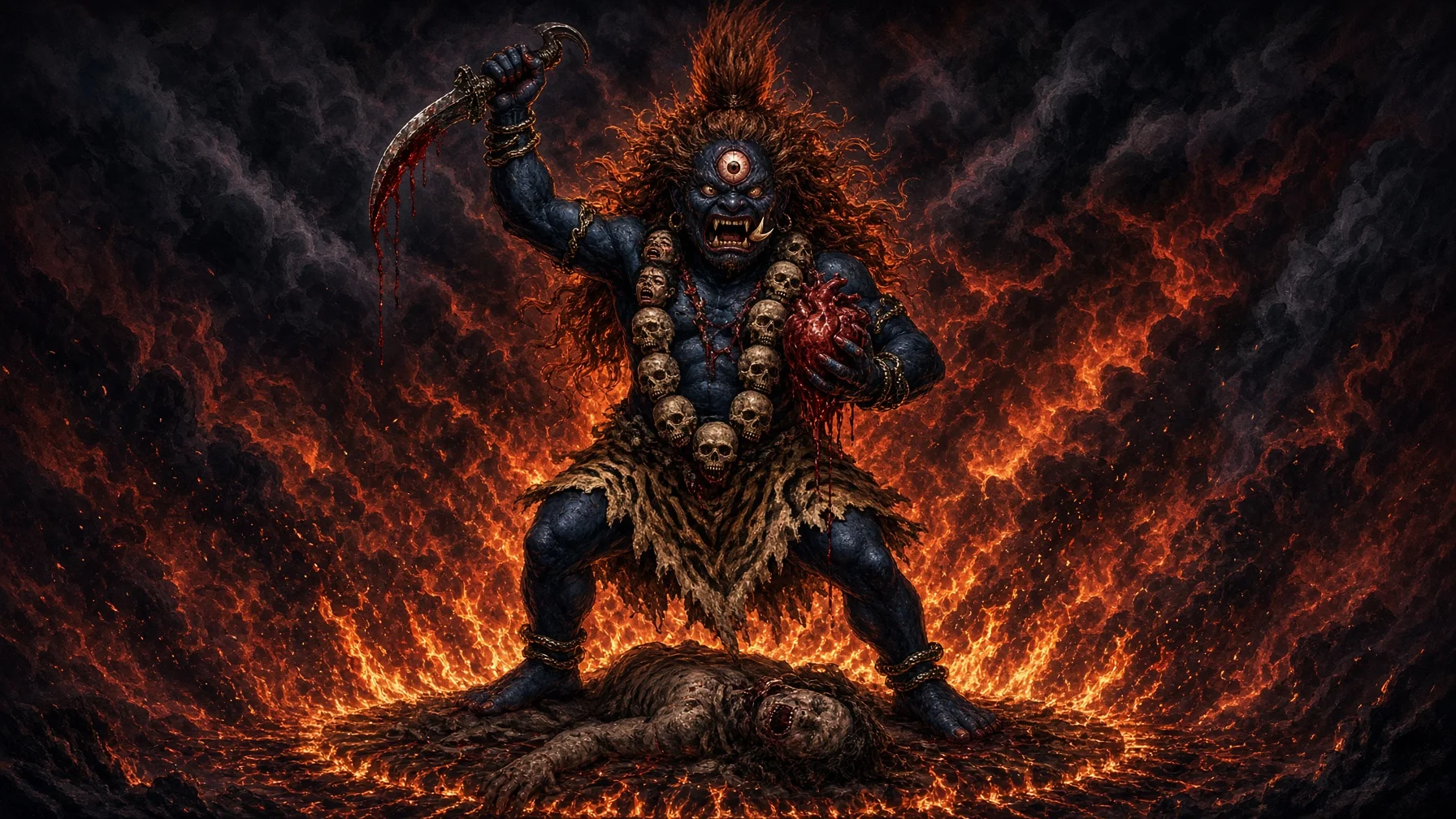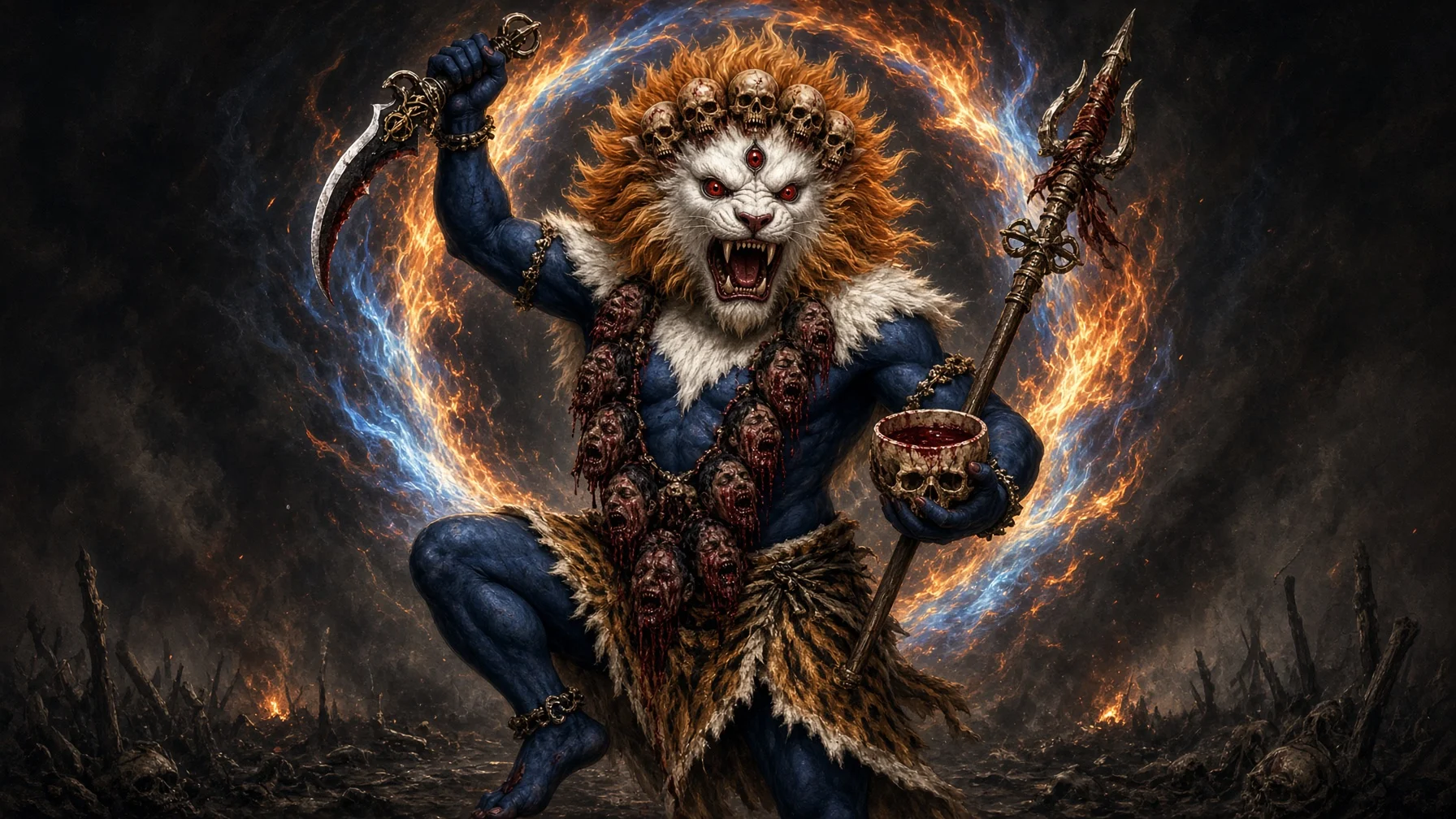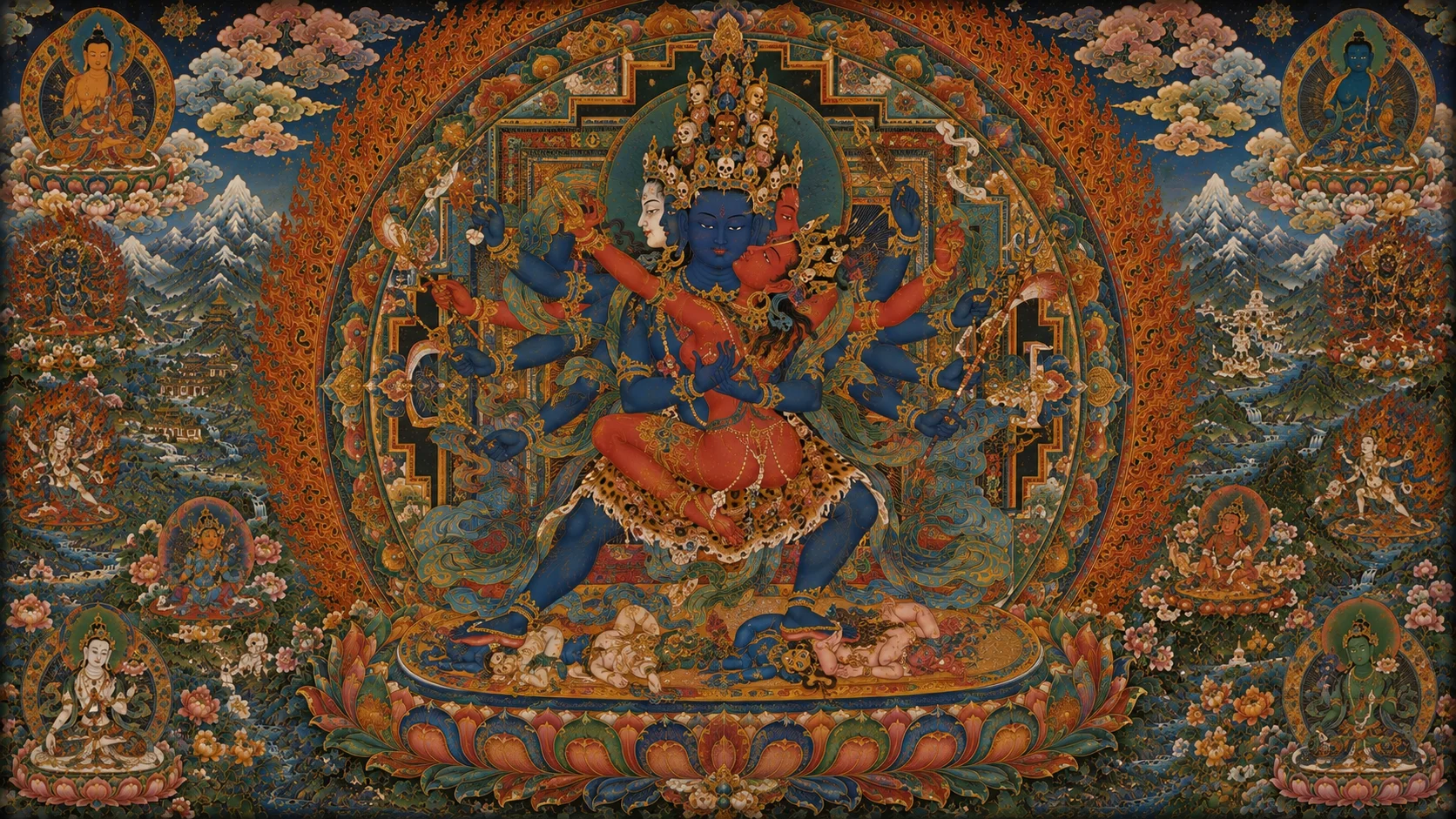
Chakrasamvara — Śrī Cakrasaṃvara in Sanskrit, Khorlo Demchok ('khor lo bde mchog) in Tibetan, the Wheel of Supreme Bliss — is the principal yidam of the Chakrasamvara Tantra, one of the foundational scriptures of the Anuttarayoga, or Highest Yoga, class of tantra, and specifically of the Mother, or Yogini, tantras within that class. He stands in eternal union with his consort Vajravarahi, Dorje Phagmo, and that union is not ornament but doctrine: the inseparability of great bliss and emptiness, method and wisdom, is the entire teaching compressed into a single embracing form.
Khorlo Demchok, the Wheel Turned Inward
The name itself carries the doctrine. Khorlo is the wheel, chakra; Demchok is supreme bliss. Read together they do not describe an external object so much as a completed process — energies gathered, bound, and turned into bliss rather than dispersed. In the Tibetan rendering of the Sanskrit Cakrasaṃvara, this binding, saṃvara, is what the deity accomplishes: the drawing-together of the subtle winds, channels, and elements of the practitioner's own body into the single centre from which realization is said to arise. He is not merely a deity to be visualized at a distance but a template for what the practitioner's own psycho-physical system is, in the completion-stage view, capable of becoming.
A Body Built to Be Read
Chakrasamvara's iconography is dense with meaning, each feature legible to those trained in the tradition. His body is dark blue-black, the colour associated among the herukas with the transformation of ignorance and aggression at their root. He bears four faces — blue, green, red, and yellow — each with three eyes, and twelve arms radiating from a torso locked in the mahasukha, great-bliss, posture. The two principal hands, crossed at the chest in the vajrahumkara mudra, hold a vajra and a bell, the paired implements of method and wisdom that every other gesture and object in the mandala elaborates. The remaining ten hands carry a wide array of implements — an elephant hide stretched behind him, a khatvanga staff, a hand-drum, an axe, a chopper-knife, a trident, a skull-cup, a noose — each a fragment of the wrathful heruka vocabulary, subjugating obstacles that both the outer and inner life present.
The Six Bone Ornaments
Around this arsenal of implements, Chakrasamvara wears the six bone ornaments that mark him, and herukas generally, as embodiments of the six perfections carried in their most severe and uncompromising form: generosity, discipline, patience, effort, concentration, and wisdom rendered not as abstractions but as things worn on the body — a crown, earrings, a necklace, bracelets and anklets, a girdle, and the sacred thread, all fashioned of bone. A garland of freshly severed heads circles his neck, and a tiger-skin skirt is knotted at his waist. Nothing in this assembly is decorative; each element is a mnemonic, a piece of doctrine made visible so that the meditator, calling the form to mind in detail, is in the same act rehearsing what the form contains.
What Lies Beneath His Feet
Chakrasamvara and Vajravarahi stand together upon two prostrate figures, Bhairava and his consort Kalaratri — forms of the worldly deity Mahesvara, an aspect of Shiva, and his consort. This is a recurring trope in the tantric literature of India: a Buddhist heruka mandala arising by subjugating and transforming a Shaivite deity and his retinue, converting rather than destroying what came before. The two figures underfoot are not depicted as annihilated but as pinned beneath and encompassed by a wider realization — worldly power brought within, rather than simply defeated by, the enlightened form standing above it. Understood this way, the imagery is a claim about the tantric path itself: nothing in ordinary existence, however forceful, sits outside what the practice can take up and transmute.
Sixty-Two Deities in Five Circles
The Chakrasamvara mandala that unfolds from this central pair is vast: sixty-two deities arranged in five concentric circles corresponding to body, speech, mind, and two circles of offering goddesses arrayed at the outer and inner rings. In the physiological reading that Vajrayana completion-stage practice applies to this structure, each circle and each resident deity is correlated with specific channels, chakras, and elements of the practitioner's own subtle body. The mandala, in other words, is read simultaneously as an external cosmological map and as an internal one — the practitioner's own energetic architecture rendered as a palace of deities, so that generation-stage visualization and completion-stage inner practice are two readings of a single structure rather than two separate systems.
Luipa, Ghantapa, Kanha, Naropa
The transmission of Chakrasamvara practice in India runs through a lineage of mahasiddhas whose names remain attached to distinct living sadhana traditions today: Luipa, Ghantapa — also called Vajraghanta — Kanha, known as Krishnacharya, and Naropa. Each articulated the deity's mandala and sadhana somewhat differently, and these differences were not smoothed away in transmission; the Luipa tradition, among others, persists as a recognizably distinct system of practice within the broader Chakrasamvara corpus, carried forward with its particular emphases intact rather than folded into a single generic form.
From Naropa's Hand to Marpa's
It was Naropa who transmitted the Chakrasamvara cycle to Marpa Lotsawa, the Tibetan translator whose journeys to India carried this and other tantric systems into Tibet and whose own students founded what became the Kagyu school. Through that transmission Chakrasamvara became one of the central yidam practices of the Kagyu tradition, held there alongside Hevajra and the closely related practice of Vajrayogini, who is herself understood as inseparable from Vajravarahi. The Sakya school likewise holds Chakrasamvara as a principal practice, so that across more than one Tibetan lineage this single tantric system has remained, for centuries, near the core of formal meditative training rather than at its periphery.
One of Three, Not One Alone
Within the broader architecture of Anuttarayoga tantra as it reached Tibet, Chakrasamvara is regularly named alongside Hevajra and Guhyasamaja as one of three principal deity systems, each transmitted through its own lineage and each treated as a complete path in itself. Chakrasamvara belongs, more specifically, to the heruka typology — the class of wrathful, blue-black tantric buddhas of which Hevajra and the Guhyasamaja-associated herukas are likewise members — sharing a family resemblance of form and function while remaining doctrinally and ritually distinct systems, each with its own mandala, its own lineage, and its own body of exegesis.
Twenty-Four Places on the Earth
The Chakrasamvara Tantra enumerates twenty-four sacred sites, pitha, and Tibetan tradition has mapped these onto real geography, both within India and beyond it. Among the identifications made by Kagyu exegetes, Mount Kailash itself is named as one of the twenty-four pitha of Chakrasamvara — a reading that has reinforced, for many centuries of pilgrims, Kailash's status as one of the most significant pilgrimage destinations in the Tibetan Buddhist world. Practice and geography are bound together in this system in a way that is easy to overlook from outside it: the mandala is not only an internal structure and a visualized palace but also, in this reading, a map laid over the actual, walkable earth.
Bliss as the Path, Not the Obstacle
The doctrinal claim at the centre of Chakrasamvara practice is that the union of bliss and emptiness realized through the deity's sadhana constitutes a swift path to buddhahood — that generation-stage visualization of the mandala, joined to completion-stage work with the subtle body, offers direct access to a realization that other paths approach more gradually. This is presented within the tradition as a settled matter of practice and lineage transmission; it is worth being clear that it is a tradition-internal claim about the efficacy of a spiritual path, not a historical or empirical assertion, and it is offered here in that spirit — as the belief the practice holds about itself, stated plainly rather than smoothed into either endorsement or dismissal.
A Word Said to Be Spoken by the Lord Buddha Himself
The Chakrasamvara Tantra's own colophons present the text as spoken by the Lord Buddha in the very form of Chakrasamvara, Shri Heruka — the teaching and the teacher merged into one utterance. Outside the tradition's own account, the text's precise historical dating and its layered relationship to earlier Yogini tantras, including the Hevajra corpus and related scriptures, remain live questions in ongoing scholarly discussion rather than settled history. Both of these things can be said together without contradiction: a scripture can carry an unbroken weight of transmission and lived practice across more than a thousand years while its textual history, examined from outside that transmission, remains an open and still-debated question among those who study it.
Epithets Carried Through the Centuries
Chakrasamvara is known by several names across the literature that has grown up around him — Heruka Chakrasamvara, Shri Heruka, Khorlo Demchok — each emphasizing a different facet of a single figure: the heruka type he belongs to, the honorific glory attached to his name, and the Tibetan rendering that carries his meaning most directly into everyday liturgical use. Across all of these names, the identity beneath them is constant: the dark-bodied, many-armed deity locked in union with Vajravarahi, standing above Bhairava and Kalaratri, at the centre of a sixty-two-deity mandala that generations of practitioners in the Kagyu and Sakya lineages, tracing their transmission back through Naropa to the Indian mahasiddhas, have taken as one of the most direct expressions available to them of bliss and emptiness realized as a single, indivisible truth.
Sources & traditions
- EncyclopediaWikipedia — Cakrasaṃvara Tantra
- TraditionTibetan Buddhist texts, oral tradition and village tellings
Myths change from area to area and from time to time. This chronicle follows the most widely told versions; tellings in other villages, regions and eras may differ.