Kalachakra, the Wheel of Time, is a profound and complex meditational deity and tantric system of Tibetan Buddhism: a tantric buddha embodying the unity of time and the cosmos, whose teaching unites the cycles of the outer universe, the inner body, and the path of enlightenment, and whose famous initiation is among the most celebrated of all Buddhist ceremonies. He is time itself made into a path to awakening.
The Wheel Whose Turning Is the World
Kalachakra, in Tibetan Dus kyi 'khor lo, means the Wheel of Time, and the name names both a deity and the vast cycle of teachings that surrounds him. Within the highest yoga tantra class of Tibetan Buddhism, the Kalachakra tantra is counted among the mother tantras, or non-dual tantras, depending on which classification a lineage follows, and it is regarded as one of the most intricate and comprehensive of all tantric systems. Kalachakra is not merely a deity to be visualized; he is the principle of time rendered into a path, an emanation embodying the omniscient mind of the Lord Buddha, whose practice is held by its lineages to be capable of carrying a practitioner to buddhahood within a single lifetime.
Dhanyakataka and the Asking of King Suchandra
Tradition holds that the Kalachakra tantra was first taught by the historical Lord Buddha Shakyamuni himself at Dhanyakataka, a place identified by the tradition with present-day Amaravati in Andhra Pradesh, India. There, according to the lineage accounts, King Suchandra of the mythical kingdom of Shambhala came before the Lord Buddha and requested the teaching for the sake of his people. The Lord Buddha granted it, and Suchandra carried the Kalachakra back to Shambhala, where, the accounts say, it was preserved and transmitted across a long line of rulers known as the Kulika or Rigden kings. Centuries later, by traditional Tibetan historical reckoning placed around the tenth or eleventh century of the common era, the teaching is said to have been reintroduced into India and taken up by Indian tantric masters, from whom it eventually passed into Tibet. Scholars note that the precise historical origins of the tantra's composition remain a matter of ongoing discussion rather than settled consensus, a question distinct from, and secondary to, the tradition's own account of its transmission through Shambhala.
The Four-Faced Lord in Union
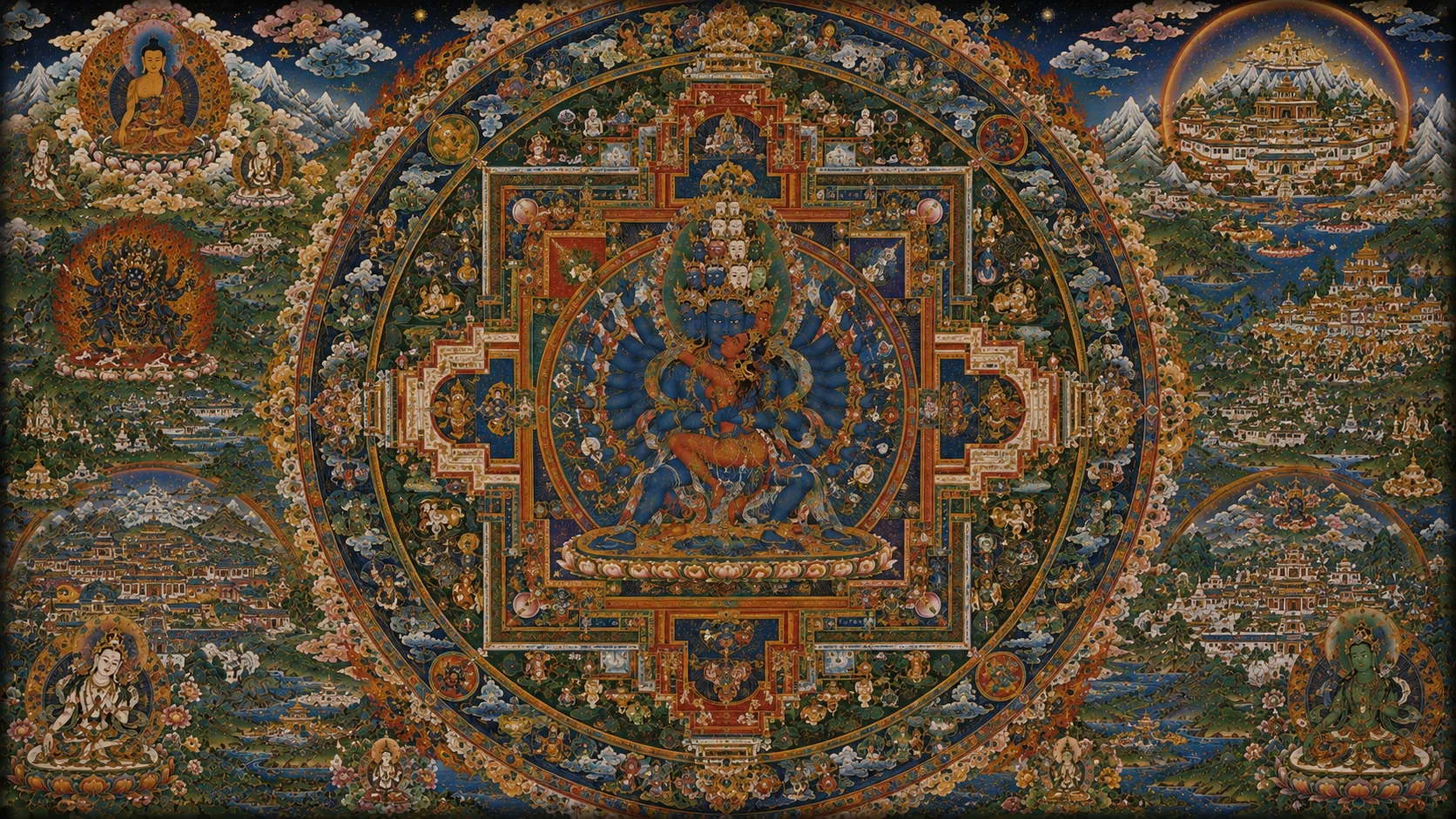
Kalachakra is depicted with four faces, each a different color in the various sadhana traditions — black, red, white, and yellow or orange — and with a great multiplicity of arms, commonly twenty-four, and multiple legs, each hand holding an implement that carries its own tantric meaning. He stands in yab-yum, in union, with his consort Vishvamata, known in Tibetan as Namkha Yingchugma, the Sky-Consort, also called Vishvamatri. Where Kalachakra is shown with four faces, Vishvamata is depicted with eight, and her many arms complete the union. This embrace of deity and consort is read throughout Tibetan Buddhism as the union of method, which is compassion, and wisdom, which is the direct realization of emptiness — two halves of a single enlightened intention, inseparable in the deity's form.
Three Wheels Turning as One
The doctrinal heart of the Kalachakra system is its correlation of three dimensions, traditionally spoken of as the three Kalachakras: the outer, which is the universe itself, its cosmology and the motion of the heavens; the inner, which is the subtle physiology of the human body, its channels, winds, and drops; and the other, or alternative, which is the ritual dimension of the mandala and its initiations. The tradition teaches that these three are not separate but mirror one another in intricate correspondence, so that what occurs in the vast turning of the cosmos also occurs, in miniature, within the practitioner's own subtle body, and that the path to enlightenment works by engaging that inner correspondence directly through meditation.
Time Measured, Time Transcended
Because the Kalachakra tantra concerns cyclical time so centrally, it also contains detailed astronomical and astrological calculations, forming what is known as the Kalachakra calendar. This calendrical and astrological material was historically put to direct use in Tibetan timekeeping and divination, so that the tantra's teaching was never purely abstract; it gave Tibet tools for measuring the very cycles it also taught practitioners to transcend. The outer wheel of the calendar and the inner wheel of meditative transformation were, in this way, understood as expressions of a single system rather than as separate concerns.
The Palace of Hundreds of Deities
The Kalachakra mandala is among the most architecturally intricate mandalas in the whole of Vajrayana Buddhism, a many-layered palace containing hundreds of deities arranged in elaborate concentric structure. For public initiations, this mandala has often been constructed in colored sand, grain by grain, an act of devotion and precision that mirrors the vast complexity of the system it represents. To stand before the completed sand mandala of Kalachakra is to look upon a rendering of the cosmos itself, translated into a residence for the enlightened mind.
The Empowerment Given to Multitudes
The Kalachakra initiation, known as the wang, is counted among the most complex tantric empowerments in Tibetan Buddhism, and historically it was given only to practitioners already advanced upon the tantric path. In the twentieth and twenty-first centuries this changed dramatically: the Fourteenth Dalai Lama has bestowed the Kalachakra initiation publicly, on a mass scale, many times over, presenting it repeatedly not merely as an entry into advanced practice but as a ritual undertaken for the sake of world peace. Through these vast public gatherings, an empowerment once reserved for a narrow circle of adepts has become one of the most widely attended ceremonies in the Buddhist world.
Forms Beyond Matter
Among the Kalachakra tradition's distinctive doctrinal contributions is its teaching on empty forms, in Tibetan tongzuk, the subtle, non-material appearances said to be experienced by practitioners in the advanced stages of completion-stage meditation. This concept is held to be somewhat particular to the Kalachakra system as compared with other highest yoga tantras, and it reflects the tradition's broader concern with the relationship between appearance and emptiness, between what is seen and what ultimately is.
The Six Branches of the Completion Stage
Where other highest yoga tantra traditions are known for their own completion-stage systems, such as the six yogas associated with the mahasiddha Naropa, the Kalachakra tradition preserves its own distinct sequence, the six-branch yoga, in Tibetan sbyor drug. Through this path structure, the practitioner works directly with the subtle winds, channels, and drops of the inner body, engaging the correspondences taught in the outer and inner Kalachakras to bring about the completion-stage realizations the system holds to be capable of yielding buddhahood within one lifetime.
Keepers of the Wheel
The Kalachakra system has been preserved above all within the Jonang school of Tibetan Buddhism, for which it has long stood as a central transmission, associated with masters such as Dolpopa Sherab Gyaltsen. It is also widely practiced within the Gelug school, carried forward significantly through the tradition of Je Tsongkhapa, and it is maintained, to varying degrees, within the Sakya and Kagyu lineages as well. Across these different schools, the Kalachakra has remained a living transmission, its initiations conferred, its six-branch yoga practiced, and its mandala built anew, generation after generation.
Rudra Chakrin and the Battle to Come
Central to the Kalachakra tradition's account of Shambhala is a prophecy concerning its future. The twenty-fifth of the Rigden kings, named Rudra Chakrin, known in Tibetan as Dragpo Khorlochen, is foretold to emerge from Shambhala at a future time to defeat the forces of adharma, often depicted in the tradition as barbarian invaders, in a final and decisive battle. His victory is said to usher in a golden age. This millenarian narrative is well attested within the tradition, and most contemporary teachers understand it to carry, alongside whatever literal meaning it holds, a symbolic and inner sense as well: the defeat of the afflictions that obscure the mind, fought and won within the practitioner. Some scholars have discussed whether the tantra's depictions of the barbarian forces reflect its historical composition in a period and place where Buddhist India stood in encounter with outside traditions, though this remains a matter of scholarly discussion rather than a settled point within the tradition itself.
The Hidden Kingdom and Its Long Shadow
The legend of Shambhala, the hidden and enlightened kingdom from which Rudra Chakrin is prophesied to come, has extended the Kalachakra tradition's reach far beyond its own ritual and doctrinal life, becoming one of the most evocative images associated with Tibetan Buddhism in the wider world. Within the tradition, Shambhala is not a myth told for its own sake but the vessel in which the Kalachakra teaching was kept safe across the centuries between its first giving to King Suchandra and its reintroduction into India, and the promised source from which, in time, it is said the world's afflictions will finally be met and overcome.
The Wheel That Does Not Stop
In Kalachakra, the tradition gathers the turning of the stars, the turning of the breath within the body, and the turning of the meditative path into a single wheel, and teaches that to understand any one of these turnings deeply is to begin to understand them all. The deity's four faces look out upon a cosmos that is also, the tradition insists, looking back inward upon itself, mirrored in the subtle body of every practitioner who takes up the path. From the asking of a king in Dhanyakataka, through centuries of safekeeping in Shambhala, to sand mandalas built anew before vast modern gatherings, the Wheel of Time has continued to turn, offered again and again as a path that leads, its lineages hold, beyond time itself into the timeless realization of enlightenment.
Sources & traditions
- EncyclopediaWikipedia — Kalachakra
- TraditionTibetan Buddhist texts, oral tradition and village tellings
Myths change from area to area and from time to time. This chronicle follows the most widely told versions; tellings in other villages, regions and eras may differ.