Vajrasattva — “the Diamond Being,” “the Adamantine Mind” — is the buddha of purification in the Vajrayana: the radiant white deity whose practice cleanses all negative karma and defilement, restoring the practitioner to original purity. He embodies the innate, indestructible purity of the enlightened mind, and his practice is one of the most fundamental of all tantric purifications.
The Diamond Being
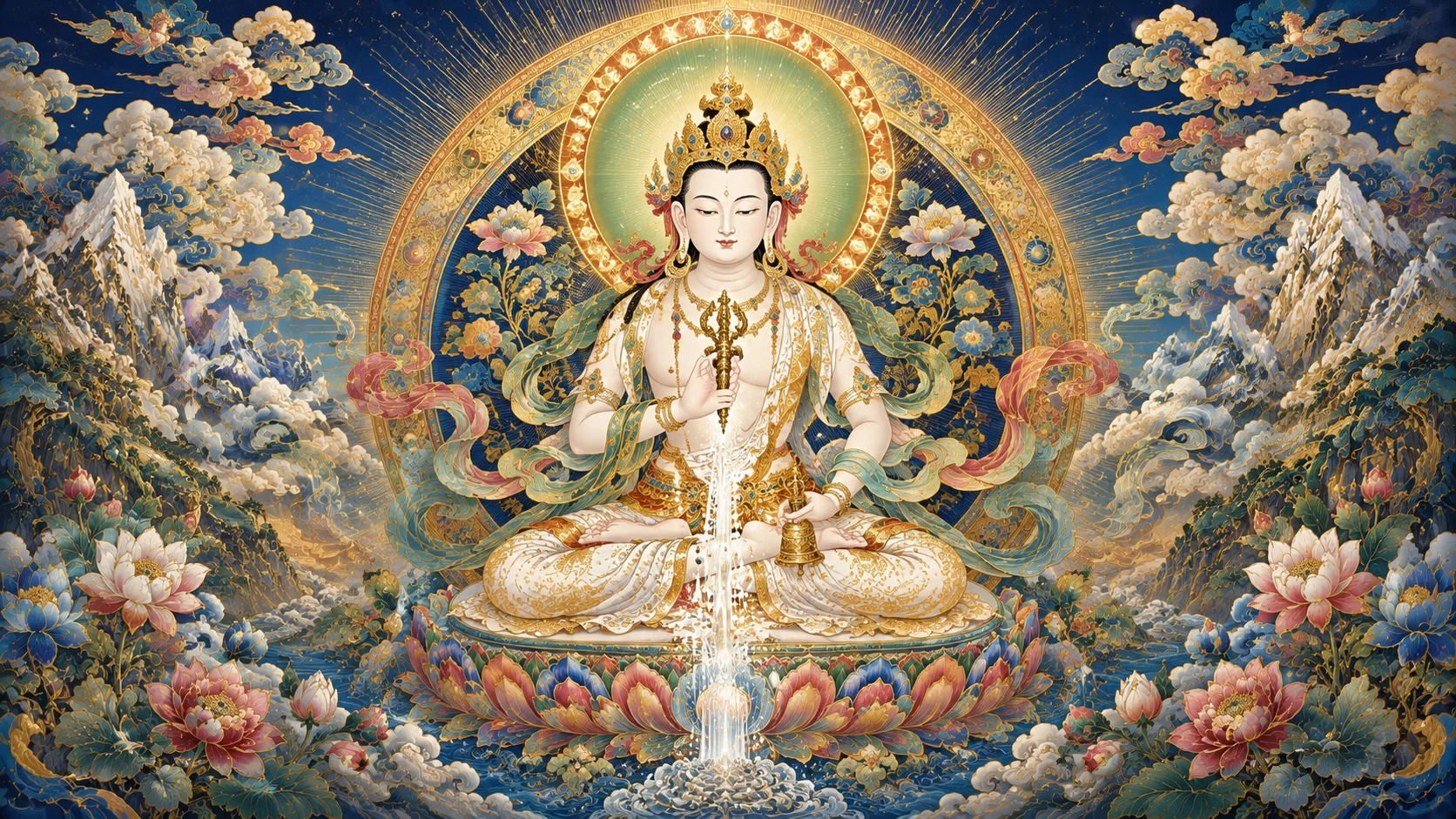
Vajrasattva (Tibetan Dorje Sempa) is depicted as a serene, beautiful white buddha, holding in his right hand at his heart the vajra (the diamond-thunderbolt, symbol of indestructible reality and skillful means) and in his left at his hip the ghanta (the bell, symbol of wisdom and emptiness). His whiteness signifies purity — the original, primordial purity of the mind that no defilement can ultimately stain. He represents the sambhogakaya, the radiant body of enlightenment, and the indestructible, diamond-like nature of awakened awareness.
Last updated .
The Lord Buddha of Purification
Vajrasattva’s supreme function is purification. The practice of Vajrasattva — with his hundred-syllable mantra — is the principal method in Tibetan Buddhism for purifying and cleansing all the negative karma, harmful actions, broken vows, and defilements that obscure the mind. Through visualizing Vajrasattva above one’s head and a stream of purifying nectar flowing down from him, washing away all negativity, the practitioner is cleansed and restored. This purification is considered an essential foundation of the entire tantric path — one of the “preliminary practices” that every practitioner undertakes — for the mind must be purified before the higher realizations can dawn.
The Restored Purity
Vajrasattva embodies the profound principle that the true nature of the mind is, and always has been, perfectly pure — that the defilements are adventitious, like clouds passing across an unchanging sky, and can be wholly cleansed to reveal the diamond-bright purity that was always there. His practice offers the hope that no negativity is beyond purification, no karma beyond cleansing, for one who undertakes the path with sincere regret and resolve. In Vajrasattva, Tibetan Buddhism gave form to purification and the indestructible purity of mind — the radiant white Diamond Being whose nectar washes away all defilement, restoring the practitioner to the original, adamantine purity of the awakened heart.
Before Tibet: An Indian Inheritance
Vajrasattva did not begin in Tibet. The name belongs first to the esoteric Sanskrit literature of early medieval India, and above all to the Sarva-tathagata-tattva-sangraha, the “Compendium of the Reality of All Tathagatas” — the foundational text of the Yoga tantras, and the source of the great Vajradhatu or “Diamond Realm” mandala. There Vajrasattva stands at the head of the sixteen vajra bodhisattvas ranged around the five buddhas, first among them and placed in the eastern quarter, the quarter of Akshobhya. Tibet received him already formed. He is not a Himalayan invention later given a Sanskrit name, but an inheritance from the period when Vajrayana was first working out its own technical vocabulary — a vocabulary in which “vajra being” meant something exact.
The Sixth Lord Buddha
Stand in front of a mandala of the Five Tathagatas — Vairocana at the centre, Akshobhya, Ratnasambhava, Amitabha and Amoghasiddhi at the four directions — and Vajrasattva is frequently not among them, because he does not sit comfortably inside any one family. In the Newar Buddhist traditions of the Kathmandu Valley he is counted openly as a sixth buddha, completing and presiding over the set of five. Elsewhere he is assigned to the vajra family of Akshobhya, which is exactly where purification would fall: that family’s work is the transmutation of anger and aversion into mirror-like wisdom, and its emblem is the vajra he holds at his heart. Yet his body is white — the colour of Vairocana at the hub of the mandala, not the deep blue of Akshobhya in the east. The iconography quietly declines to file him in one place, and that refusal is the point: he is where the five directions of awakening are being said at once.
Who Stands at the Origin? A Question the Schools Answer Differently
Ask a Sakya, Kagyu or Gelug teacher which buddha stands at the very source of the tantras, before the families divide at all, and the name that comes back is usually Vajradhara — “the Vajra-Holder,” dark blue, arms crossed at the heart with vajra and bell held together, a posture visibly distinct from Vajrasattva’s own split-handed gesture. In these “New Translation” (Sarma) schools Vajrasattva is understood as very close to Vajradhara, at times as inseparable from him, but his particular office is purification, and it is in that office that practitioners actually meet him.
Ask a Nyingma teacher and a different name comes first: Samantabhadra — Kuntuzangpo — the unadorned, deep-blue primordial buddha who has never for an instant been touched by delusion, and who should not be confused with the bodhisattva of the same name familiar from the Mahayana sutras. Here the two are ranked not by seniority but by kaya: Samantabhadra is the dharmakaya, formless and unteachable; Vajrasattva is the sambhogakaya, the first form in which the formless can be met at all. He is less a lesser deity than a hinge — the place where something that cannot be stated becomes something that can be shown. Both pictures hold within the school that keeps them, and neither side treats the difference as a contradiction.
The First Link in the Dzogchen Lineage
That hinge role is why the Nyingma school tells one of its most important origin stories through him. The Great Perfection teachings, Dzogchen, are held to have entered the world through three successive transmissions. The first is mind-to-mind and wordless, passing from Samantabhadra to Vajrasattva — buddha recognising buddha, with nothing conveyed, because nothing was ever absent. The second is symbolic, carried by Vajrasattva to the vidyadhara Garab Dorje, born in the tradition’s own telling in the land of Uddiyana, who receives it through sign and gesture rather than ordinary speech. Only with the third, the oral transmission between human beings, does Dzogchen become something one teacher can literally say to a student. So the buddha invoked to wash away a practitioner’s karma is also remembered as the first being to carry the Great Perfection out of pure realisation and into a lineage that living teachers still hold.
The Architecture of Confession
Take away the visualisation and the mantra and the practice still has a skeleton, one shared across Tibetan Buddhist purification generally: the four powers. There is the power of support, in which the practitioner first takes refuge and generates the intention to benefit others, so that what follows is framed by something larger than private anxiety. There is the power of regret, which teachers habitually illustrate with a blunt physical image — the remorse of someone who has just realised they swallowed poison: urgent, unfeigned, and emphatically not the same thing as wallowing in guilt. There is the power of the remedy, the antidote applied in place of the harm, which here is the visualisation of Vajrasattva and the recitation of his hundred-syllable mantra. And there is the power of resolve, the determination not to repeat the act, without which the other three purify nothing that stays purified.
It is worth noticing how far that structure travels. Contrition, an act of repair, a firm intention not to reoffend — the same three beats surface in penitential systems that never had the slightest contact with the Himalayas, because they are answering the same intractable human question: what is to be done about a wrong that cannot be undone?
One Hundred Thousand Times
None of this is archaeology. In Nyingma, Kagyu, Sakya and Gelug communities alike, Vajrasattva purification sits within the ngondro alongside refuge and prostrations, mandala offering and guru yoga — and it arrives with a number attached. The standard commitment is one hundred thousand recitations of the hundred-syllable mantra, counted bead by bead on a mala, accumulated over months and frequently over years of intermittent effort. It is one of the places in the tantric path where the arithmetic is itself the discipline. Purification here is not declared, and it is not felt into being; it is accumulated, one repetition at a time, until the count has honestly been met.
Telling Him Apart
A thangka offers more identifying detail than the vajra and bell alone. Vajrasattva is seated on a moon disc laid over a white lotus — the moon standing for cool, stainless clarity rather than the sun’s heat — and the syllable HUM rests at his heart as his seed. At a glance he is easy to mistake for the other serene white figures of the Tibetan pantheon, four-armed Avalokiteshvara above all, until the hands are read properly: no lotus, no crystal rosary, no jewel cupped between joined palms.
And there is a form of him that newcomers are rarely shown. In Highest Yoga Tantra contexts he also appears in yab-yum, in union with a consort, the pair read as a single statement about the inseparability of method and wisdom, bliss and emptiness. It belongs to advanced practice and is almost never the image put in front of a beginner — but it is no less part of who Vajrasattva is taken to be.