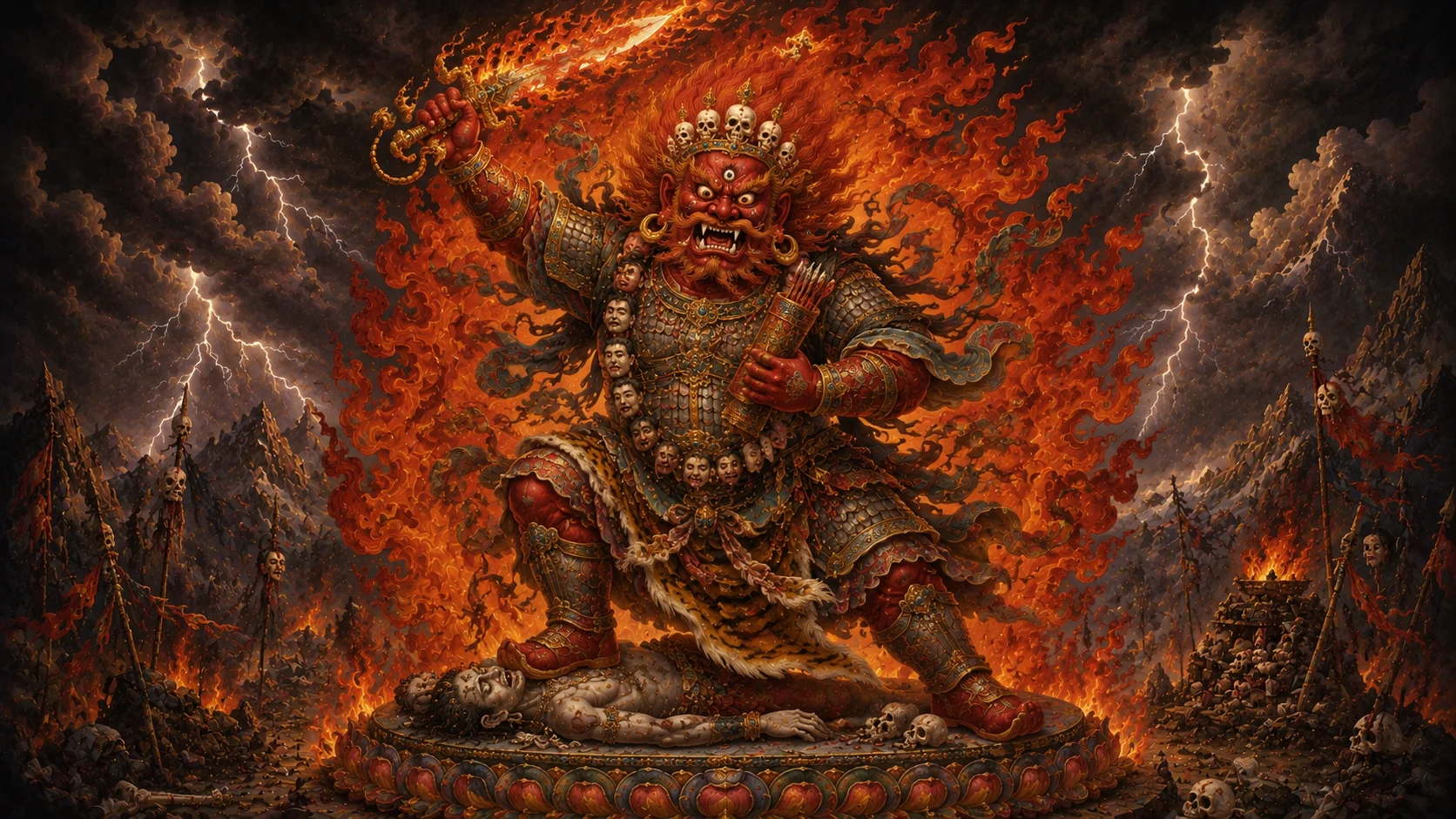
Hayagriva, the Horse-Necked One, called Tamdrin (rTa-mgrin) in Tibet, is a wrathful yidam and dharma-protector of Tibetan Buddhism: a horse-headed deity whose thunderous neigh is said to shatter delusion, overpower the false speech of nagas and demons, and subdue the forces that obstruct the dharma. Rooted in Indian tantric Buddhism and carried into Tibetan practice by lineages including the Nyingma and Kagyu, he is honoured as one of the most formidable of the wrathful deities, and, in the Nyingma tradition, as one of the Eight Herukas of the Kagyé.
A Name Carried Out of India
Hayagriva's practice entered Tibet from Indian tantric Buddhism, where wrathful horse-headed forms of enlightened speech were already cultivated as meditational deities. In Tibet the deity was received into several major lineages, the Nyingma and Kagyu among them, and given the name by which he is most widely known there: Tamdrin, rTa-mgrin, the Horse-Necked One. The Sanskrit Hayagriva and the Tibetan Tamdrin name the same tantric deity, and the two names are used according to the language of the tradition invoking him.
It is essential to distinguish this Tamdrin from a figure who shares only his iconographic motif and nothing else: the horse-headed avatar of Vishnu venerated in Hindu Vaishnava tradition, also called Hayagriva. The two are historically and doctrinally separate deities belonging to separate religious worlds. The Tibetan Buddhist Hayagriva discussed here is a tantric emanation within the Buddhist path, and his identity, function, and lineage have nothing in common with the Vaishnava figure beyond the coincidence of a horse's head.
Wrath Wearing the Face of Compassion
Hayagriva's doctrinal identity is that of a wrathful emanation transforming the obscurations of speech and the deeper delusion beneath them into enlightened activity. In a number of tantric cycles he is held to be the wrathful expression of Amitabha, the buddha of the Padma, or Lotus, family, whose domain is speech; in other lineages he is described as the wrathful counterpart of Avalokiteshvara, the bodhisattva of compassion. Both attributions are attested in the transmitted teachings, and practitioners should understand the emanation source as lineage-dependent rather than singular — different tantric cycles hold different views of Hayagriva's origin, and no single account should be taken as the whole of the tradition.
What unites these accounts is the understanding that Hayagriva's ferocity is not opposed to compassion but is compassion's own dynamic force, turned against what gentler means cannot reach: the obscuring power of false speech, the confusions of the untamed mind, and the malevolent forces, nagas among them, that resist pacification by any softer method.
The Neigh That Pierces Falsehood
The horse's cry is Hayagriva's signature and his teaching at once. Tradition holds that his neigh pierces through the deceptions and obscurations of speech, overpowering the false and poisonous utterances of nagas and demonic forces who would otherwise work harm through words, curses, or deceit. Widely cited exegesis reads the horse-head itself as a symbol of unstoppable, piercing enlightened speech: the mantra power that cannot be turned aside, moving with the force and directness of a horse's gallop and cry. Where ordinary speech falters against falsehood, Hayagriva's neigh is said to cut through it entirely.
Faces of Fire, a Crown of Horses
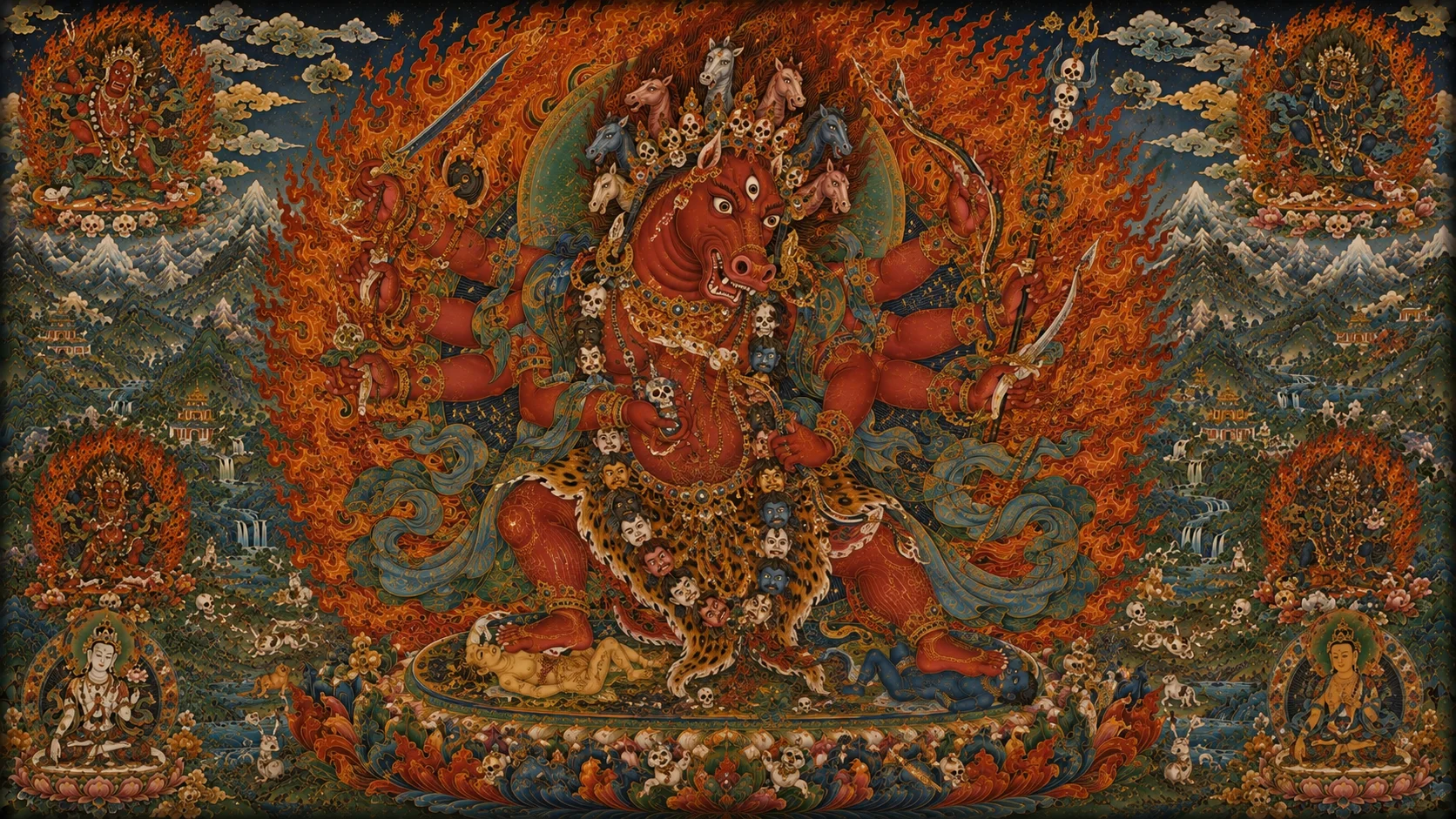
Hayagriva's iconography is that of the wrathful deities generally, rendered through his own distinguishing features. His body is typically red, wrathful in bearing, wreathed in flaming hair; a garland of skulls encircles him and he is shown in a dancing posture, treading upon subdued figures beneath his feet. Rising from his crown or hair is his defining mark, a horse's head, or in many depictions three small horse-heads, colored green or white, neighing above the wrathful human face or faces below. Many sadhanas describe him with three faces and either six or eight arms bearing tantric implements, though the exact count of heads and arms is not fixed across the tradition: it varies by tantric cycle, and any single description of his form should be understood as belonging to one lineage's transmission rather than to Hayagriva as such.
The Consort in Union
In a number of sadhana traditions Hayagriva is depicted in yab-yum, sacred union, with a wrathful consort; Vajravarahi is named as his consort in some transmitted cycles. As with the emanation source and the count of heads and arms, the consort's identity is specific to the tantric cycle in which the practice is transmitted rather than fixed for every lineage, and different sadhanas present the union differently.
Among the Ten Wrathful Ones
Certain systems of Tibetan Buddhist iconography and practice number Hayagriva among the Ten Wrathful Ones, the Krodha, a class of fierce deities whose collective function is the subjugation of what obstructs the dharma. His inclusion in this company marks him as belonging to the broader family of wrathful protectors who share the work of transforming obstruction into realization, even as each retains a distinct form, function, and transmission.
Principal Deity of the Kagyé
Within the Nyingma tradition, Hayagriva holds a position of particular importance as one of the Eight Herukas, the Drakpo Gyepa, who together constitute the Kagyé, the Eight Sadhana Teachings. As a principal deity within this cycle, his practice is bound closely to the Nyingma transmission descending from Padmasambhava's activity in Tibet. Nyingma hagiography ties both the practice and the terma, the revealed treasure-teachings, of Hayagriva to Padmasambhava, with later tertön, treasure-revealers, bringing these teachings to light in subsequent generations. This lineage gives Hayagriva's Nyingma transmission a depth and continuity distinct from his place in other schools, though the deity himself is honoured, under his own name and form, across the wider Tibetan Buddhist world.
A Practice of Two Registers
The tantric standing of Hayagriva's practice is not uniform across Tibetan Buddhism. In certain lineages, sadhanas devoted to him belong to Anuttarayoga, Highest Yoga Tantra, placing his practice among the most advanced tantric cycles transmitted in the Tibetan systems. In other lineages he is approached instead as a protector deity within lower tantra, invoked for his protective and obstacle-clearing function rather than cultivated through the complete generation and completion stages of the highest tantric path. This variance is itself part of the transmitted record and should not be flattened into a single account: Hayagriva is, depending on the lineage, either a supreme yidam of the highest tantric class or a powerful protector invoked at a different level of practice, and often both, according to which teachings a given practitioner has received.
Invoked Against the Serpent and the Unseen Harm
Among Hayagriva's most consistently attested functions is protection against nagas and the diseases and misfortunes attributed to their displeasure. Naga spirits, associated in Tibetan and broader Buddhist cosmology with water, the earth, and certain afflictions, are held to be susceptible to Hayagriva's overpowering neigh and wrathful presence, and his practice is invoked specifically to counter naga-caused illness. Beyond this, he is called upon more broadly to destroy dön, obstacles and negative forces of many kinds, that threaten the practitioner, the community, or the dharma itself. His terrifying aspect is understood as directed precisely at what is malevolent: it is said that his ferocity is itself unbearable to hostile spirits, who cannot withstand his wrathful presence or the force of his cry.
Meditational Deity and Guardian at Once
Hayagriva occupies a dual role within Tibetan Buddhist practice, standing both as a yidam, a meditational deity through whom a practitioner cultivates realization by identifying with his enlightened qualities, and as a dharma-protector who guards the teachings and those who uphold them. These two roles are not separate offices but two functions of a single tantric identity: the same wrathful form that a practitioner meditates upon as a path to transforming the obscurations of speech and delusion is invoked, in its protective aspect, to ward off disease, malevolent forces, and obstruction from without. Across the schools that hold his transmission, this combination of inward cultivation and outward protection is central to why his practice has endured with such consistency.
The Horse-Necked One in the Tibetan World
Carried from Indian tantric Buddhism into the Nyingma, Kagyu, and other Tibetan lineages, Hayagriva stands among the tradition's great wrathful deities: a horse-headed emanation whose neigh overpowers false speech, whose ferocity is compassion turned against what compassion alone cannot move, and whose practice spans, according to lineage, the heights of Highest Yoga Tantra and the vigilant, protective work of guarding the dharma against nagas, disease, and the obstacles that beset it. However the details of his form, his consort, or his precise emanation source are rendered in a given transmission, Tamdrin remains the Horse-Necked One whose cry is heard, in the traditions that hold him, as the sound of enlightened speech itself, unstoppable and piercing through delusion.
Sources & traditions
- EncyclopediaWikipedia — Hayagriva (Buddhism)
- TraditionTibetan Buddhist texts, oral tradition and village tellings
Myths change from area to area and from time to time. This chronicle follows the most widely told versions; tellings in other villages, regions and eras may differ.