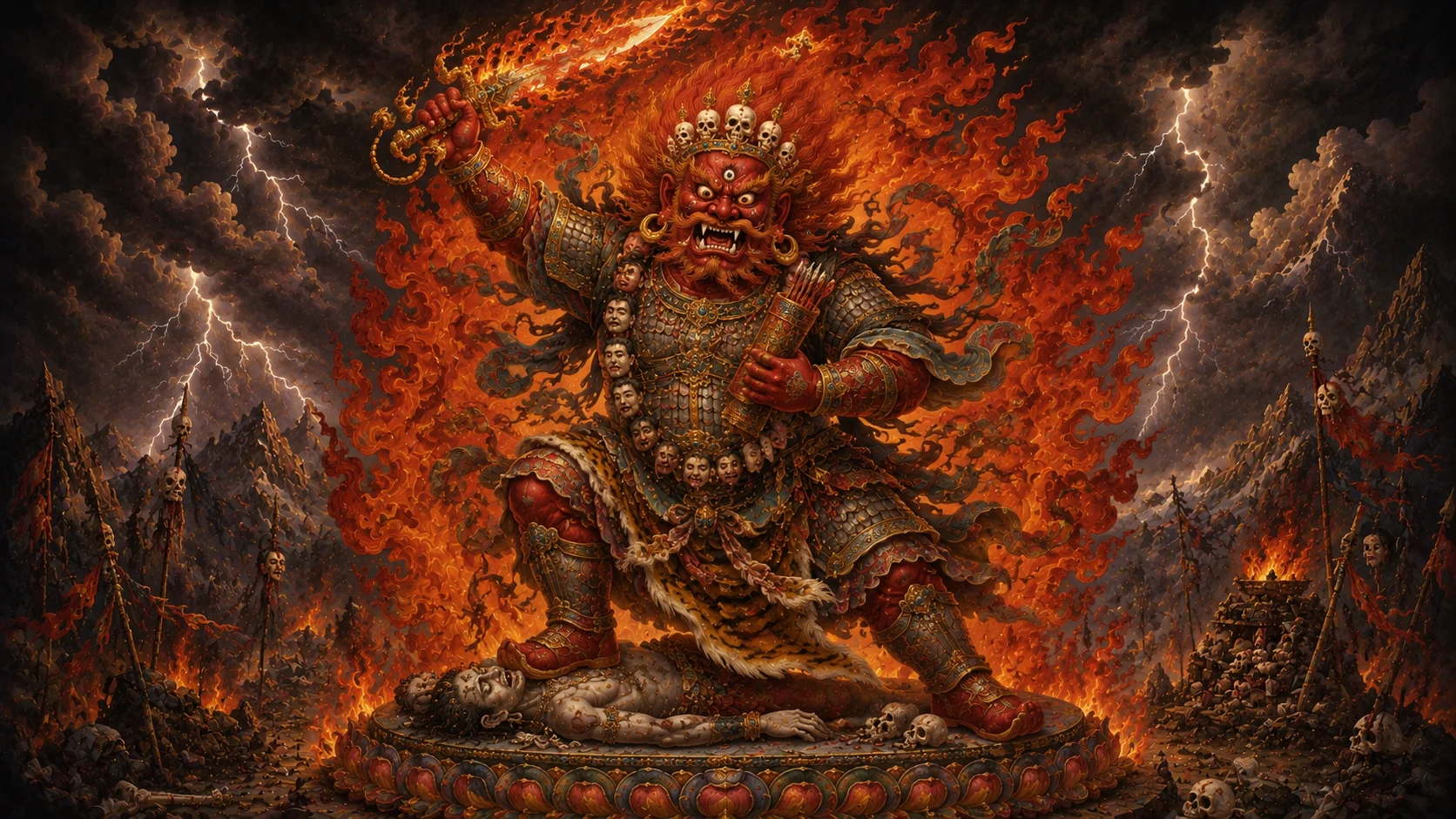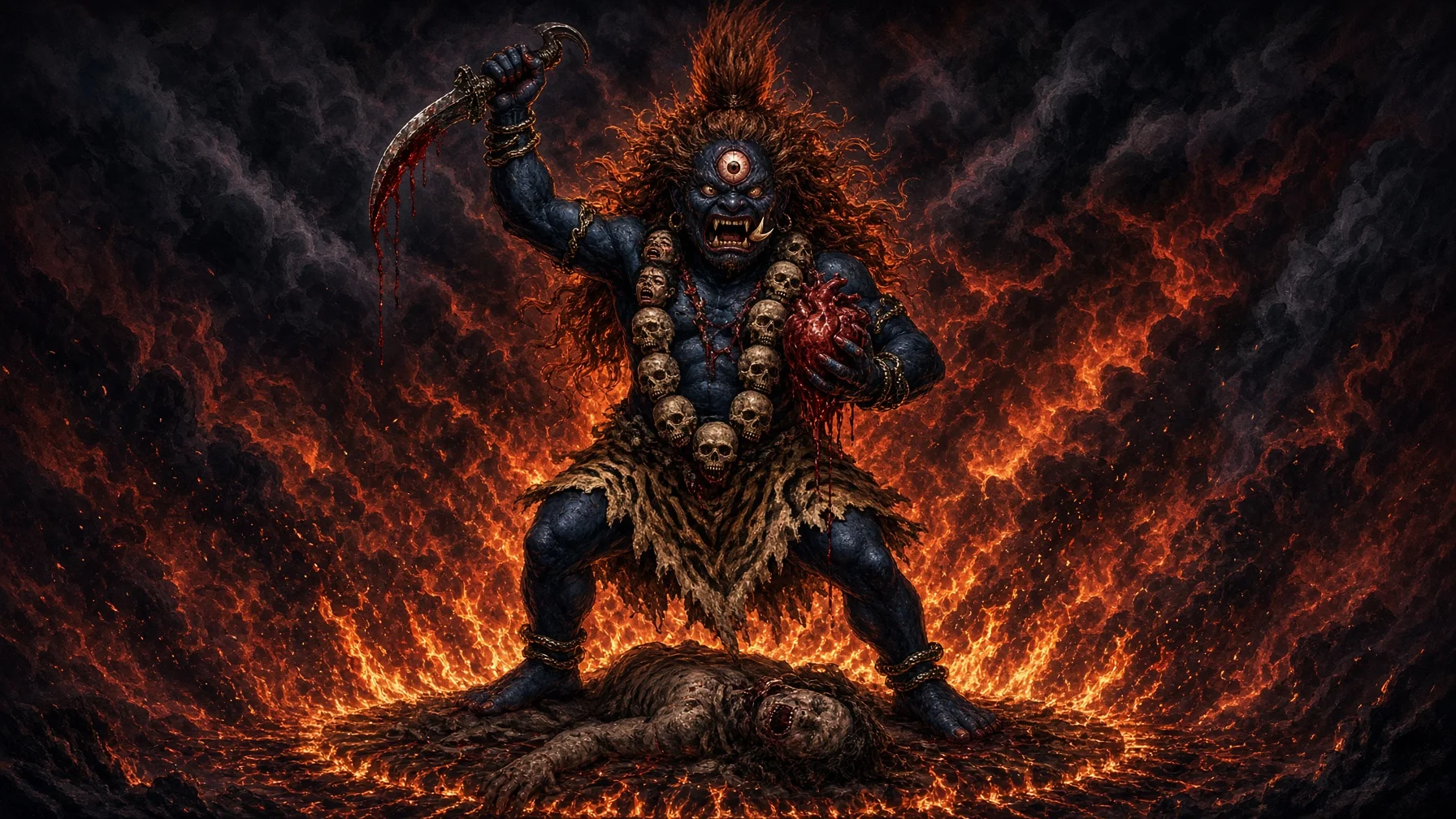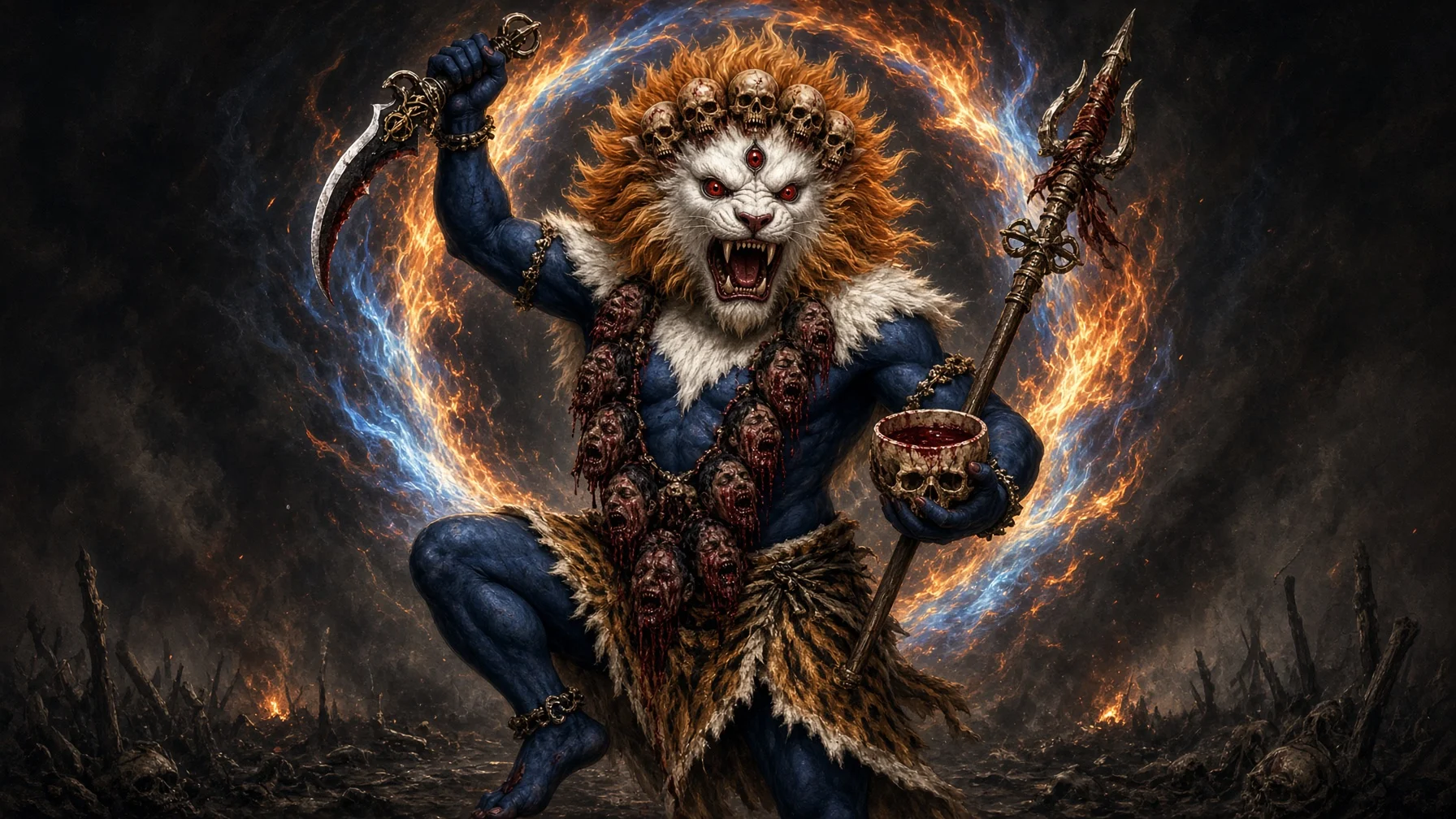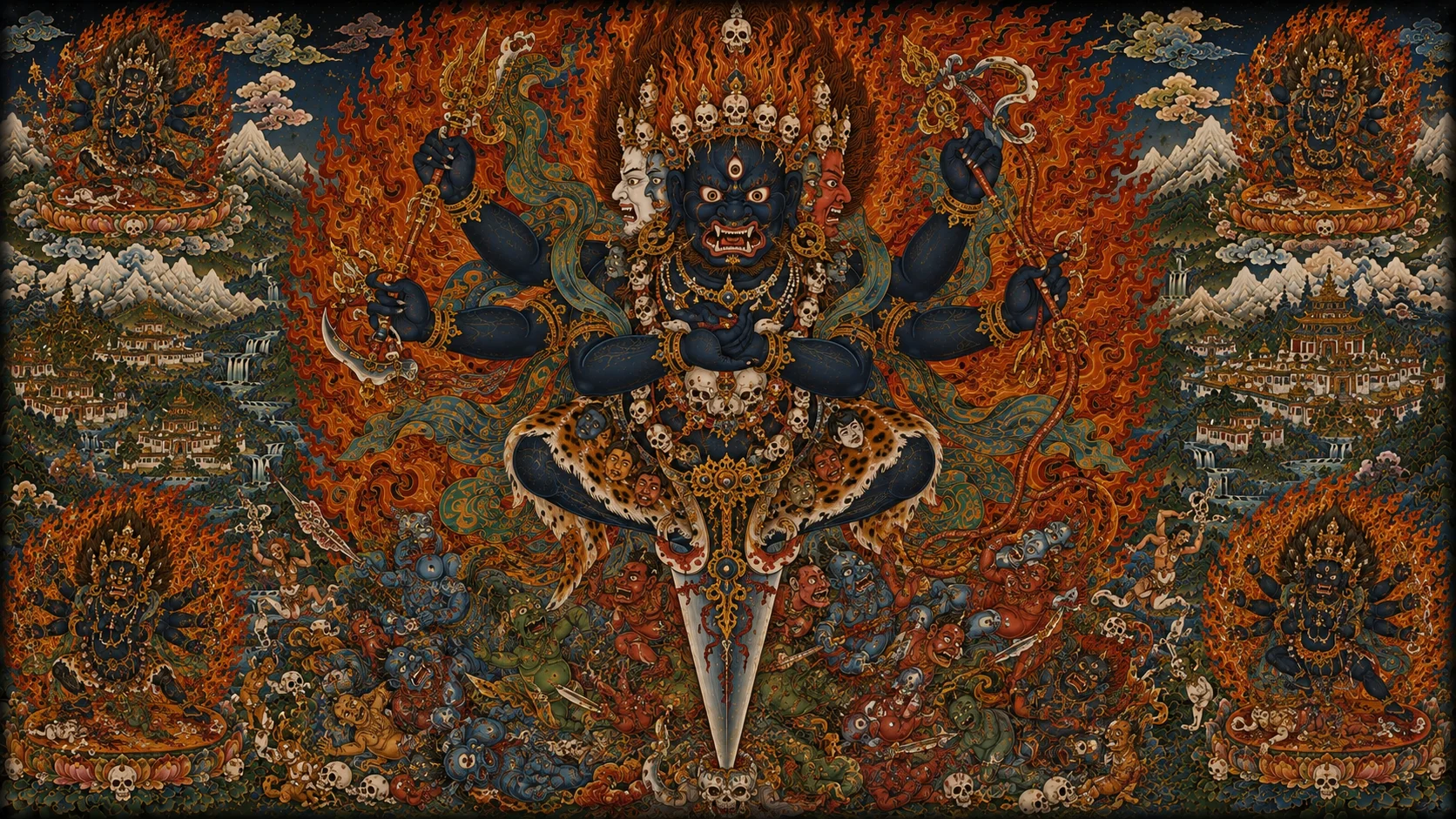
Vajrakilaya — “the Diamond Dagger,” also Vajrakumara — is a supremely wrathful meditational deity of Tibetan Buddhism, especially of the Nyingma school: a fierce, three-faced, six-armed deity whose essence is the phurba — the three-edged ritual dagger that pierces and nails down the forces of evil and the root of delusion. He is the wrathful activity of all the buddhas, the power that destroys obstacles utterly.
The Diamond Dagger
Vajrakilaya’s nature is bound to the phurba (Tibetan purba), the three-sided ritual dagger or spike that is his emblem and his very being. The three edges of the dagger symbolize the cutting-through and transformation of the three root poisons — ignorance, attachment, and aversion. As the deity of the phurba, Vajrakilaya is the embodiment of the enlightened activity that pierces, pins down, and destroys the forces of evil, the obstacles to the dharma, and the delusions that bind beings — nailing them down and transmuting them with the diamond-sharp point of awakened wrath.
The Wrathful Form
Vajrakilaya is depicted as a supremely fierce deity, dark blue or black, with three faces (often white, red, and blue) and six arms, with flaming hair, fangs, and a terrible aspect, often with the lower body of a phurba-blade itself, embracing his consort Diptachakra, trampling and subduing demons. Every detail expresses his function as the destroyer of obstacles and the embodiment of the buddhas’ wrathful, transformative activity. He is regarded as the wrathful aspect of the buddha-activity of all the buddhas, and especially associated with Padmasambhava, who is said to have attained realization through this practice.
The Destroyer of Obstacles
Vajrakilaya is one of the most important meditational deities (yidam) and dharma-protectors of the Nyingma school, his practice undertaken to remove obstacles, destroy negativity and demonic forces, and clear the way to enlightenment with overwhelming power. The phurba-dagger that is his essence is used in ritual to pin down and transform malevolent forces. His practice is held to be especially powerful in dangerous and obstacle-ridden times. In Vajrakilaya, Tibetan Buddhism gave form to the wrathful, obstacle-destroying activity of enlightenment — the Diamond Dagger whose three-edged blade pierces the root of delusion and nails down the forces of evil, the supremely fierce deity who clears the way to awakening with the diamond point of compassionate wrath.
A Tent-Peg Becomes a Deity
Long before it named a wrathful deity, the Sanskrit kila meant something almost domestic: a peg, a stake, a nail — the kind hammered into the ground to hold a tent down, fix a boundary, or pin the earth in place before a ritual ground was laid out on it. Indian tantra took the object first and let the meaning follow. A stake that fastens a physical space became an instrument that fastens hostile forces, holding them in one spot so they can be dealt with rather than merely fled. Translators have also read the deity's name against the verbal root kil, “to bind” or “to transfix,” taking kilaya as an imperative — the god's name as a command: bind. On either reading the emphasis falls not on killing but on holding fast.
In Tibet the deity took his place among the Kagye, the “Eight Great Sadhana Teachings” that the Nyingma school traces to Padmasambhava and the eight vidyadharas of India. Five of the eight are wisdom deities, and the tradition parcels out among them the aspects of an enlightened being:
- Yamantaka — enlightened body
- Hayagriva — enlightened speech
- Yangdak Heruka — enlightened mind
- Chemchok Heruka — enlightened qualities
- Vajrakilaya — enlightened activity
The remaining three teachings concern fierce goddesses, worldly offerings, and maledictory mantras. Vajrakilaya's portion, then, is the one that does rather than the one that knows: not wisdom, not speech, not even the enlightened mind, but the bare capacity to act against whatever obstructs awakening. That assignment explains the whole shape of his reputation. A practitioner rarely turns to Vajrakilaya in order to understand something. They turn to him when something is in the way.
The Retreat at Yangleshö
The decisive episode is set not in Tibet but in a cave above the Kathmandu Valley, at Yangleshö near present-day Pharping. Padmasambhava had gone there with his Nepalese consort Shakyadevi to accomplish the practice of Yangdak Heruka — the enlightened-mind deity of that same set of eight. The retreat stalled. Obstructing forces are said to have thrown the surrounding region into disorder: drought, failed harvests, spreading sickness. Whatever Yangdak Heruka could accomplish, it could not clear the thing blocking its own accomplishment.
What broke the deadlock, in the Nyingma account, had to be sent for. Padmasambhava dispatched disciples back to India for the Kilaya tantras, which they received from the master Prabhahasti — remembered in the Nyingma lists as the vidyadhara who held the Kilaya transmission. Tradition insists the obstacles subsided the moment the texts crossed the threshold, before a word of them had been practised. Padmasambhava then took up Vajrakilaya alongside the practice already underway, and the pairing succeeded where the single practice had not: the obstructing spirits were bound by oath, and he and Shakyadevi attained the third of the four vidyadhara levels, that of mahamudra.
Both halves of the story mattered enough to be fossilised in practice. Guru Rinpoche is held to have composed, for later generations, sadhanas that run the two deities together — the Yangphur cycles, in which Yangdak accomplishes the realisation and Vajrakilaya removes what stands in its path. It is an unusually candid piece of religious architecture: a tradition admitting in its liturgy that its highest practice needs a bodyguard.
What the Dagger Stands On
The two figures crushed beneath Vajrakilaya are usually named. They are Rudra — a demonised Shiva — and his consort, stretched prone on a sun disc and lotus. It is one of the oldest and least comfortable images in Mahayoga, and it is not a picture of a rival religion being put to death. Tibetan wrathful iconography almost never destroys what it treads on. It pins, extracts an oath, and puts the defeated party to work, so that the subdued becomes a protector sworn to guard the very teaching it had attacked. Rudra in these tantras stands for ego-clinging at its most magnificent: not petty selfishness but self-absorption swollen until it mistakes itself for God. The posture argues that such a thing cannot be reasoned with, only held down until it changes sides.
Diptachakra is not a decorative addition to the composition. She is a paler blue than he is, she carries her own implements — a skull-cup in one hand, a khatvanga staff in the other — and her outstretched right foot presses down on the trampled goddess. Whatever else the union depicts, both partners are doing the pinning.
Ornaments as Biography
Past the three faces and six arms, the details that fill out a Vajrakilaya image come almost entirely from the charnel ground and the battlefield. Gold, bone and serpent ornaments cross his chest and limbs. A garland of fifty freshly severed heads hangs at his throat; Diptachakra wears the same number as dry white skulls, drained of blood, wisdom to his method. The flayed skins of a human, an elephant and a tiger are draped over him. Vajra wings spread from his back. The whole assembly stands inside a blazing mass that the texts are careful to call awareness rather than fire — not something burning him, something he is emitting.
Every item on that list is a trophy. Tantric art dresses its wrathful deities in what they have overcome, which is why the effect is grisly rather than merely fierce. The ornaments are not decoration; they are the biography, worn.
One Deity, Three Schools
Vajrakilaya belongs first to the Nyingma, but he was never sealed inside it. The Khon family of the Sakya school — whose ancestors were disciples of Padmasambhava, and who would later found Sakya itself — has held Vajrakilaya as a core family practice since the imperial period, and the Sakyapas preserve one of the principal kama lineages of the deity: the unbroken oral transmission, as distinct from revealed treasure. The Kagyu came at him from the treasure side. The Vajrakilaya cycle revealed by the fifteenth-century tertön Ratna Lingpa, the Unsurpassed Secret Dagger, is practised in both Nyingma and Kagyu houses to this day, and monasteries in both schools mount drupchen on the strength of it — multi-day group accomplishment ceremonies run continuously, day and night, without letting the practice lapse. A deity whose entire function is clearing obstructions turned out to be too useful for any one school to keep.
Nor has the tradition stopped generating new Vajrakilaya material. Tertöns, the treasure-revealers who bring forth texts held to have been concealed by Padmasambhava for a later age, have produced fresh cycles in nearly every century, and the sequence runs into living memory. Dudjom Rinpoche (1904–1987), while practising a Vajrakilaya sadhana revealed by his own predecessor Dudjom Lingpa, brought forth a further cycle of his own, the Pudri Rekpung, still transmitted and practised today.
And he is danced. Tibetan monasteries perform cham, the masked ritual dance, and in the phurba cham the holder of the dagger advances to the centre of the courtyard and destroys a dough effigy standing in for the obstacles themselves — the mythology performed rather than recited, most often in the days before Losar, when the point of the exercise is to clear the ground before a new year is begun on it. Tradition traces the dance to Padmasambhava, who is said to have danced Vajrakilaya at the founding of Samye, subduing the spirits that had been pulling down by night what the builders raised by day.
Why the Blade Is Called Compassionate
The hardest thing to explain about Vajrakilaya from outside the tradition is why a religion organised around compassion produces a figure this frightening. The tantric answer is that the ferocity is aimed inward long before it is aimed anywhere else. The obstacles the phurba is driven into are, on the standard reading, the practitioner's own — the three poisons named on the dagger's three edges, and beneath them the fixed sense of a separate self that keeps manufacturing all three. Peaceful deities work by invitation. Some things do not accept invitations.
So the tradition insists on a distinction that sounds like sophistry until you sit with it: the deity's wrath is not anger. Anger wants its object gone. Vajrakilaya's activity wants it converted — pinned, sworn in, and set to work — which is precisely why nothing beneath his feet is ever dead. Compassion concentrated past a certain intensity stops looking gentle, and the tradition would say that is a fact about intensity rather than a fact about compassion. That paradox is what has kept the Diamond Dagger in continuous use for twelve centuries: a blade taken up out of love, reached for on the days when a gentler buddha would arrive too late.
Sources & traditions
- EncyclopediaWikipedia — Vajrakilaya
- TraditionTibetan Buddhist texts, oral tradition and village tellings
Myths change from area to area and from time to time. This chronicle follows the most widely told versions; tellings in other villages, regions and eras may differ.