Xmucane is the elderly grandmother creator-goddess and diviner of the K’iche’ Maya, one of the most consequential figures in the Popol Vuh despite entering the narrative somewhat later than the primary trio of Tepeu, Gukumatz, and Huracan. Paired throughout the text with her male counterpart Xpiacoc, Xmucane presides over the decisive later stages of the creation of humanity and later becomes, through her sons and grandsons, the ancestral matriarch of the Popol Vuh's central heroic lineage.
Role as Diviner and Grandmother of the Gods
Xmucane and Xpiacoc are described in the Popol Vuh as among the oldest of the K’iche’ gods, functioning as aj q’ij, or daykeepers — diviners skilled in interpreting omens, illness, dreams, and the cycles of the sacred calendar. This diviner role sets them apart from the primary creator trio: rather than speaking the world into existence through cosmic deliberation, Xmucane and Xpiacoc contribute specialized ritual and practical knowledge, called upon by Tepeu, Gukumatz, and Huracan at critical junctures when the more abstract, elemental power of the creator trio needs to be translated into precise, workable craft.
The Creation of Humanity
Xmucane is first called upon during the second attempt to create humanity, when the gods, having already failed to make satisfactory beings from mud, try carving humans from wood. With Xmucane and Xpiacoc's assistance, wooden figures are produced that can move, speak, and reproduce — a substantial improvement over the mud people, who simply dissolved in water and crumbled apart — but the wooden people prove to have no hearts, no minds, and no capacity for gratitude or memory of their makers; they populate the world and build houses but do so without genuine understanding, and are ultimately destroyed by a resinous flood sent by Huracan, their own household objects and animals turning against them in the process.
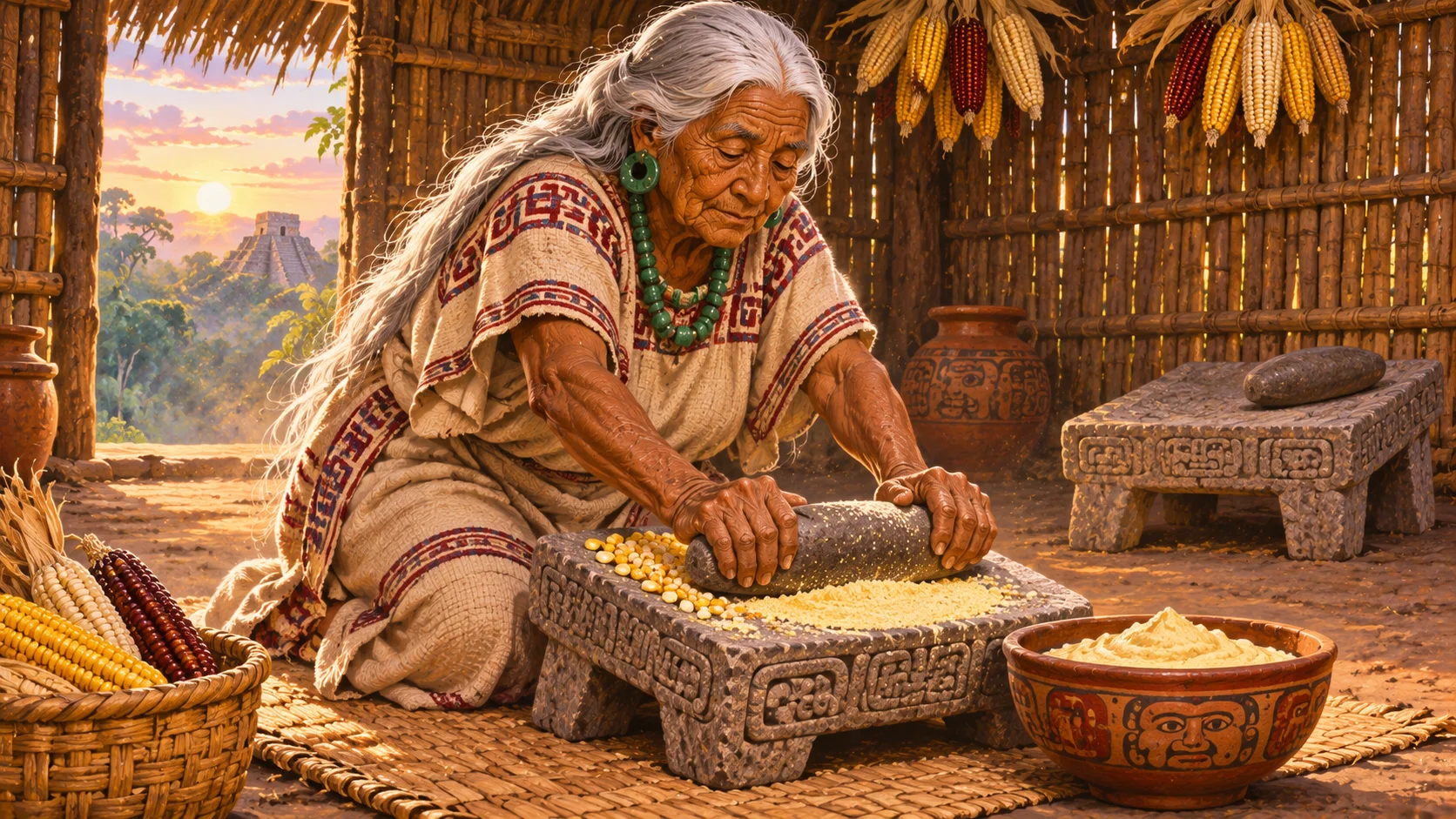
Xmucane's most celebrated act comes with the fourth and finally successful attempt at creating humanity: the gods gather white and yellow maize, and it is Xmucane herself who grinds this maize, mixing it with water to form the flesh and substance of the first true human beings. This detail — the grandmother goddess physically grinding the corn that becomes human flesh — ties Xmucane directly and intimately to the Popol Vuh's central symbolic identification of humanity with maize, a connection that remains deeply resonant in K’iche’ and broader Maya culture, where maize continues to be regarded as sacred rather than merely nutritional.
Grandmother of the Hero Twins
Xmucane and Xpiacoc are also the parents of two sons, One Hunahpu and Seven Hunahpu, who play ball above the underworld realm of Xibalba until the irritated lords of the underworld summon them, subject them to impossible trials, and ultimately defeat and sacrifice them. This tragedy makes Xmucane the grandmother of the Popol Vuh's central heroic figures: after One Hunahpu's death, his skull (hung in a calabash tree in Xibalba) impregnates a young underworld woman named Xquic (Blood Woman) through supernatural means; when the pregnant Xquic makes her way to the surface world seeking refuge, it is Xmucane who, after testing her honesty, takes her in. Xmucane subsequently raises Xquic's twin sons, Hunahpu and Xbalanque — the Hero Twins whose later exploits against the lords of Xibalba and against the boastful false-sun being Seven Macaw form the central heroic narrative of the Popol Vuh's middle books. Xmucane is also described as having already been raising two older grandsons, One Monkey and One Artisan (sons of the slain One Hunahpu by an earlier union), when the twins arrive, and the household dynamics between these different grandsons form part of the text's narrative texture.
Later in the story, when Hunahpu's arm is torn off in a conflict with Seven Macaw's monstrous sons, it is Xmucane and Xpiacoc together who help heal him, underscoring their continuing active role as protectors and restorers even after their primary creative work is complete.
Relationship to Other Deities in This Group
Xmucane works in explicit partnership with Xpiacoc throughout the text; the two are so consistently named as a pair that scholars and translators typically treat them as a linked unit, comparable in function (though distinct in character) to the way Tepeu and Gukumatz are paired as co-creators. Where Tepeu, Gukumatz, and Huracan represent the cosmic, elemental, and sovereign dimensions of creation — speech, feathered-serpent power, storm and lightning — Xmucane and Xpiacoc represent aged wisdom, ritual precision, and the more intimate, hands-on labor of shaping and nurturing humanity, first as makers and later as literal grandparents to the Popol Vuh's heroic lineage. This makes Xmucane one of the few deities in the K’iche’ pantheon whose role bridges the text's cosmogonic opening chapters and its later heroic narrative of the Hero Twins.
Enduring Significance
Xmucane's image as an aged, wise grandmother whose hands literally shape the first humans from sacred maize continues to carry deep resonance in K’iche’ Maya communities, where grandmothers and elder female relatives are often regarded as primary bearers of ritual, agricultural, and calendrical knowledge — a living echo of Xmucane's own role as diviner and daykeeper in the text that bears her name.
Xmucane's Distinctive Narrative Function
Within the overall structure of the Popol Vuh, Xmucane occupies an unusual dual position that few other figures in the text share: she is both a primordial creative force, present at the shaping of humanity itself, and a fully realized character within the later, more novelistic Hero Twins narrative, with her own household, her own difficult decisions (such as testing Xquic's honesty before accepting her as a daughter-in-law), and her own emotional responses to the deaths and triumphs of her descendants. This dual role — cosmic creator and flesh-and-blood grandmother navigating family complications — gives the Popol Vuh's account of humanity's origin an intimacy uncommon in creation narratives generally, where the acts of world-making and the everyday texture of family life are more often kept separate. Xmucane's grief and eventual pride as her grandsons Hunahpu and Xbalanque overcome the humiliations visited on their father and uncle in Xibalba give the text's cosmology a lived, generational depth: the world is not just made once at the beginning but continually re-secured and vindicated through the actions of her own descendants.
The Test of Xquic
One of the more memorable episodes involving Xmucane concerns her cautious reception of Xquic, the pregnant underworld maiden who arrives at her house claiming to be carrying One Hunahpu's children. Wary and skeptical, Xmucane sets Xquic a seemingly impossible task — to fill a net with maize from a garden that, unbeknownst to Xquic, contains only a single stalk — and it is only through supernatural assistance that Xquic succeeds, convincing Xmucane of both her honesty and the divine nature of the pregnancy. This episode reinforces Xmucane's established role as a discerning, testing figure, echoing her broader identity as a diviner skilled in separating truth from deception, genuine devotion from false claims — the same discernment the gods as a whole exercise across the Popol Vuh's repeated, careful evaluation of each attempt to create satisfactory humanity.
Xmucane's Household and the Older Grandsons
Before Xquic and the Hero Twins arrive, Xmucane is already raising One Monkey and One Artisan, the sons of the slain One Hunahpu by an earlier union, and the Popol Vuh depicts these older grandsons as skilled but arrogant artists and musicians who treat their newly arrived half-brothers Hunahpu and Xbalanque with open jealousy and cruelty. This domestic tension eventually resolves dramatically: angered by their brothers' mistreatment, Hunahpu and Xbalanque trick One Monkey and One Artisan into climbing a tree that magically grows too tall to descend, transforming them into monkeys as a consequence — a transformation that echoes the earlier fate of the failed wooden people, who likewise became monkeys after their own destruction, linking two separate episodes of the text through a shared symbolic outcome. Xmucane, though clearly grieved by this loss, is depicted as ultimately reconciled to the change once she witnesses the transformed brothers' antics, a small but telling detail suggesting the text's willingness to blend sorrow, moral consequence, and even comedy within the same extended household drama presided over by its aged grandmother.
Sources & traditions
- EncyclopediaWikipedia — Xmucane and Xpiacoc
- TraditionMaya texts, oral tradition and village tellings (Mesoamerica)
Myths change from area to area and from time to time. This chronicle follows the most widely told versions; tellings in other villages, regions and eras may differ.