Xbalanque is the second of the Hero Twins of the K’iche’ Maya Popol Vuh, brother and constant partner to Hunahpu in the long campaign that avenges their father Hun Hunahpu’s death and ultimately overthrows the lords of the underworld Xibalba. Often the quicker-witted and more resourceful of the two in moments of crisis, Xbalanque is credited in the text with restoring his brother after decapitation and, at the story’s close, ascends to the sky as the moon.
Name and Character
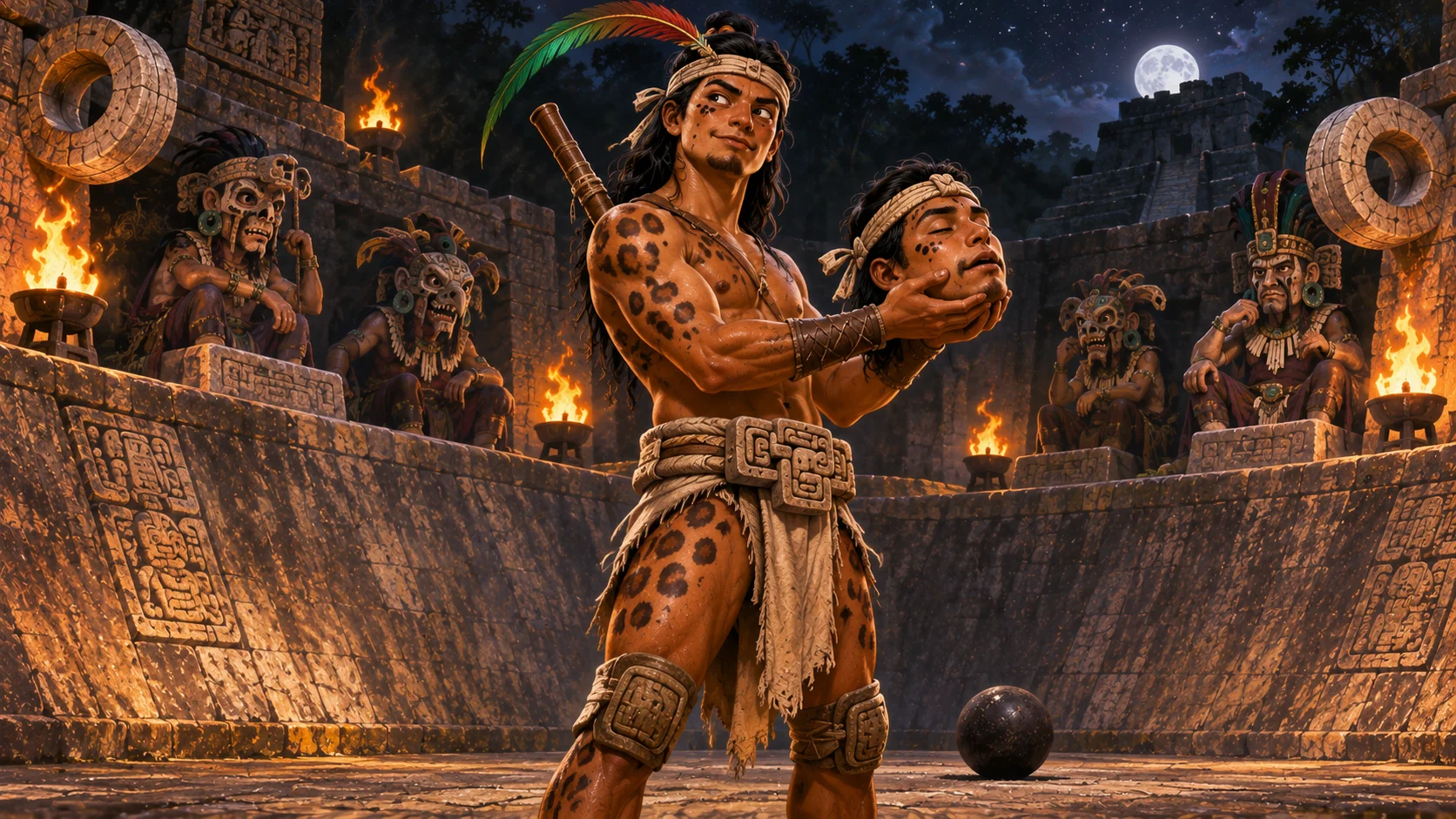
Xbalanque’s name has been read by scholars in several overlapping ways, most commonly as deriving from K’iche’ elements meaning “jaguar sun,” “hidden sun,” or “jaguar deer,” built from roots associated with the jaguar (balam) combined with a solar or cervine element; some analyses also suggest an initial element related to yax, meaning “precious” or “first,” a term that precedes several important names and titles in Classic Maya hieroglyphic writing. Within the pairing of the twins, Xbalanque has often been characterized by later commentators as the more overtly warlike or jaguar-associated of the two, sometimes described in comparative scholarship as marked by jaguar-spotted skin or whiskers, in contrast to Hunahpu’s more explicitly solar and hunting-focused associations — though the Popol Vuh itself generally presents the brothers acting in close, largely undifferentiated partnership rather than assigning them sharply separate domains through most of the narrative.
Birth and Early Trials
Like his brother, Xbalanque was conceived when the severed head of their father Hun Hunahpu, hanging in a fruiting calabash tree in Xibalba, spat into the hand of the underworld maiden Xquic, who fled to the surface world and gave birth to the twins in the household of their grandmother Xmucane. Raised largely without the favor of that grandmother and mistreated by their jealous half-brothers, One Monkey and One Artisan, the twins grew into expert hunters and, together, engineered the trick that transformed their tormentors into monkeys after luring them up an ever-growing tree — one of several episodes in which Xbalanque acts in inseparable partnership with Hunahpu rather than as a distinct protagonist.
The twins together destroyed the boastful bird-demon Vucub Caquix and his monstrous sons Zipacna and Cabrakan, clearing away a family of false claimants to power over sun, mountain, and earthquake before turning to the deeper task of confronting Xibalba itself over the death of their father and uncle.
The Vengeance Motive
Central to Xbalanque’s participation in every trial that follows is the inherited grievance the twins carry from before their own birth: their father Hun Hunahpu and uncle Vucub Hunahpu were destroyed by the same lords of Xibalba the twins now confront, and the recovery of their father’s hidden ball-game equipment — concealed for years by their grandmother Xmucane out of grief — is what finally draws the underworld’s attention back to the surface world and prompts the second summons. Xbalanque’s determination through the underworld’s trials is thus framed throughout the text not as adventure for its own sake but as filial duty: a debt owed to a father neither twin ever knew in life, discharged at last through victory over the very lords who killed him.
Xbalanque’s Decisive Role in Xibalba
Once summoned to the underworld, the twins together outwitted trap after trap set by the lords One Death and Seven Death, from correctly identifying the true lords among their wooden decoys to surviving the successive trial-houses of Xibalba. Xbalanque’s individual contribution becomes most pronounced at the story’s most dangerous turn, in the House of Bats, Zotzilaha. When Hunahpu, hiding through the night in his blowgun from the razor-winged death-bat Camazotz, incautiously looked out to check for daybreak and was decapitated on the spot, it was Xbalanque who took charge of the crisis. He is credited with rallying the animals of the forest — among them a coati — to help fashion a substitute head for his brother carved from a squash, disguising the loss long enough to outmaneuver the lords of Xibalba in the ballgame that followed and ultimately recover Hunahpu’s real head, restoring his brother to wholeness. The episode marks Xbalanque as the twin whose resourcefulness in a moment of genuine catastrophe holds the pair’s mission together.
The brothers went on to submit themselves, by choice, to being burned alive in Xibalba’s great oven, correctly anticipating the lords’ intentions and controlling the terms of their own deaths rather than suffering the surprise that had destroyed their father. Reconstituted from their scattered, ground bones, they returned to Xibalba in disguise as itinerant performers, staging a spectacle of sacrifice and resurrection between themselves that so impressed One Death and Seven Death that the lords demanded to undergo the same trick — at which point the twins sacrificed the two chief lords of death and declined to revive them, breaking the underworld’s absolute dominion over humankind.
Ascension and Astral Identity
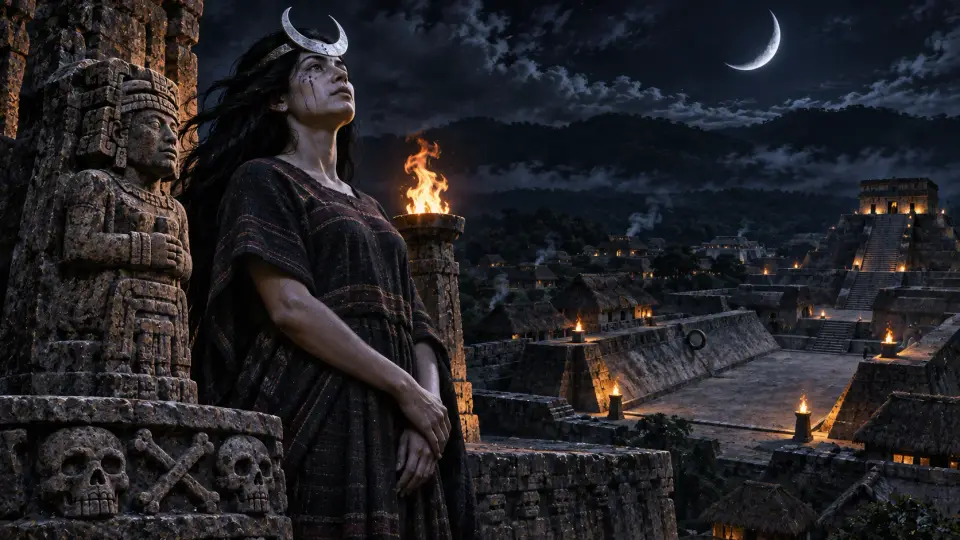
With Xibalba’s power broken, Hunahpu and Xbalanque rose out of the underworld into the sky, where the Popol Vuh establishes Hunahpu as the sun and Xbalanque as the moon of the present created world — the light by which the newly successful human beings of the following chapters would live. It is worth noting, as careful readers of the comparative literature have pointed out, that lunar and solar assignments for culture-hero twins vary somewhat across different Mesoamerican traditions and later interpretive commentary, and some broader discussions have associated Xbalanque, in other contexts or later syncretic traditions, with Venus rather than strictly the moon; the K’iche’ text itself, however, as rendered in the standard modern translations of Dennis Tedlock and Allen J. Christenson, resolves the pair as sun and moon respectively at the story’s conclusion.
Symbolic and Cosmological Significance
Xbalanque’s arc, inseparable from his brother’s throughout most of the narrative, embodies the Popol Vuh’s central movement from death to restored and renewed life: born from a decapitated father’s posthumous act, he in turn restores his own brother’s severed head, and the pair’s shared death and resurrection in Xibalba becomes the template by which the lords of death are themselves finally undone. His association with the moon completes, alongside Hunahpu’s sun, the establishment of the two great lights that govern the world in which the maize-based humanity of the Popol Vuh’s final chapters will live.
A Twin Defined by Partnership
Unlike many paired heroes in world mythology who are eventually given sharply distinct character arcs, Xbalanque is notable for how thoroughly the Popol Vuh keeps him bound to Hunahpu’s actions throughout most of the text: the pair speak in unison, plan together, and are rarely described undertaking major independent action until the crisis in the House of Bats forces Xbalanque into sole responsibility for a moment. Scholars examining the text’s underlying structure have suggested that this near-total narrative fusion of the two brothers may reflect broader Mesoamerican ideas about duality and complementary opposition — day and night, sun and moon, hunter and jaguar — in which paired forces are understood as two expressions of a single underlying principle rather than as fully separate individuals competing for narrative primacy. Xbalanque’s late, decisive independence in restoring his brother’s head is thus rendered more striking by contrast with the tightly synchronized partnership that defines the rest of the twins’ adventures.
Reading the Painted Vases
In the twentieth century the scholar Michael Coe recognized that scenes painted on Classic Maya ceramic vases correspond to episodes of the Popol Vuh, including the Hero Twins. His work, in books such as The Maya Scribe and His World and Lords of the Underworld, showed that stories related in a sixteenth-century text were already being illustrated centuries earlier.
The discovery changed how the Popol Vuh is understood. It indicates that the story of the twins is part of an old and widely known tradition rather than a post-conquest invention, and that painters of the Classic period knew versions of it.
The Ball Game and Its Courts
The Hero Twins' conflict with the lords of Xibalba takes place through a ball game, which was a central ritual and sport throughout Mesoamerica. Ball courts are found in many Maya cities, and the Great Ballcourt at Chichén Itzá, about 168 meters long, is the largest known.
The game could carry cosmic meanings, with the movement of the ball compared to celestial bodies, and the twins' triumph over the lords of death is bound up with it. Understanding the court helps readers see why a story about a game could also be a story about life and death.
The Houses of Trial
When the twins travel to Xibalba they are put through a series of ordeals in houses of trial, among them a dark house, a cold house, a jaguar house, a fire house, a bat house and a house of blades. Each is overcome by cleverness rather than force.
The sequence is one of the best known parts of the narrative. It combines humor, danger and ingenuity, and it presents Xbalanque and Hunahpu as heroes who succeed by wit and endurance.
Performers and Magicians
After their apparent deaths the twins return as wandering performers who display astonishing tricks, including burning houses and restoring them and sacrificing one another and coming back to life. These acts impress the lords of Xibalba, who ask to be shown the same trick.
The scene shows a dramatic and theatrical side of the story, and it has been connected to ritual performance. It also leads to the downfall of the lords, since they cannot survive the trick they demand.
Sourcing and Legacy
Xbalanque’s story survives in the Popol Vuh, the K’iche’ Maya text composed in the mid-sixteenth century and preserved through the early eighteenth-century transcription and Spanish translation of the Dominican friar Francisco Ximénez, now held at the Newberry Library in Chicago, with the modern scholarly translations of Dennis Tedlock and Allen J. Christenson serving as the standard English references for the narrative recounted here. Among K’iche’ Maya communities in the Guatemalan highlands today, Xbalanque’s partnership with his brother in overcoming death remains part of a living tradition upheld by traditional daykeepers, recognized by UNESCO in 2012 as part of Guatemala’s Intangible Cultural Heritage.
Sources & traditions
- EncyclopediaWikipedia — Maya Hero Twins
- TraditionMaya texts, oral tradition and village tellings (Mesoamerica)
Myths change from area to area and from time to time. This chronicle follows the most widely told versions; tellings in other villages, regions and eras may differ.