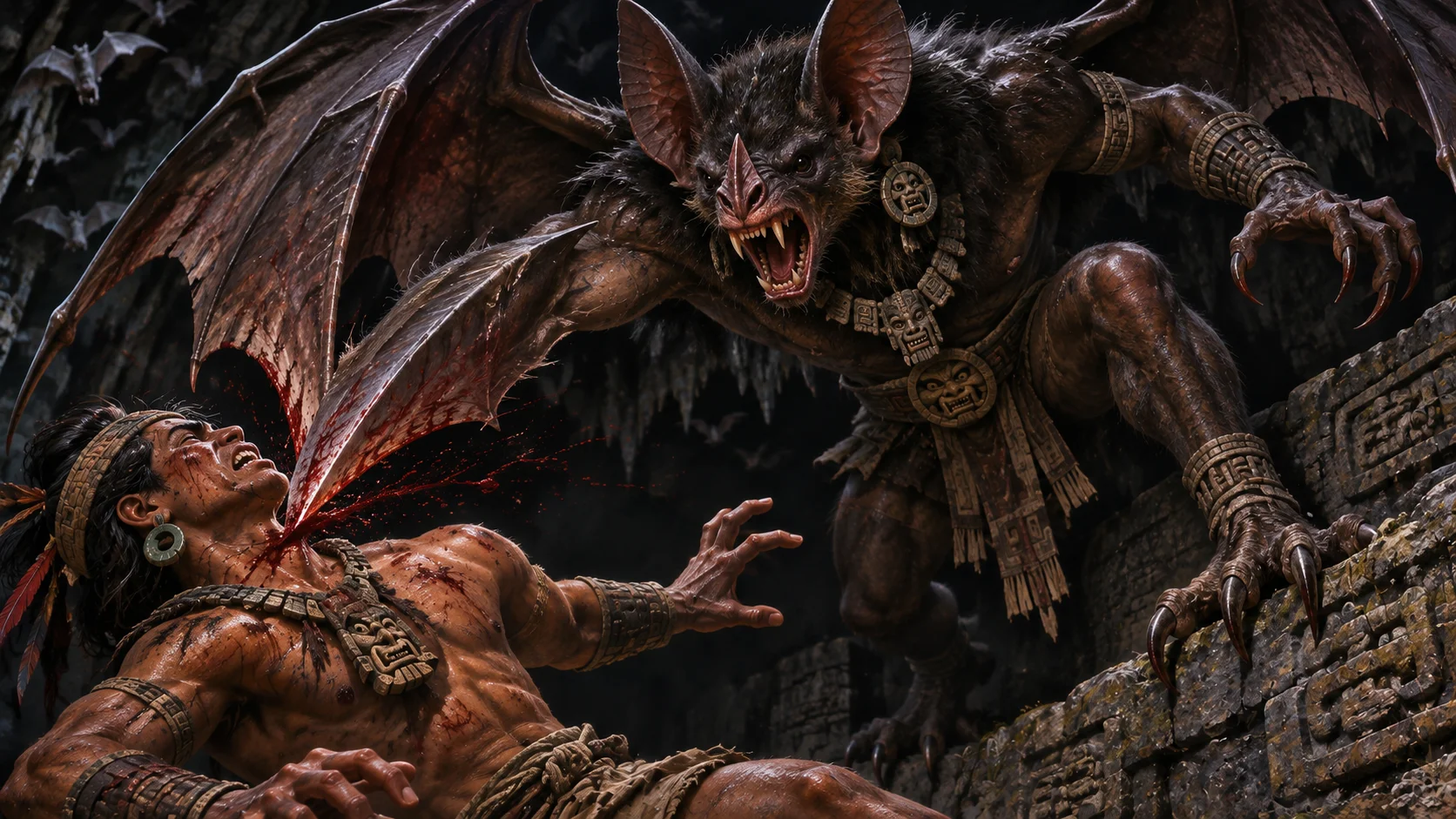
Camazotz — K’iche’ Kame Sotz’, the “Death Bat” or “Snatch Bat” — is the monstrous bat-being who rules the House of Bats in the underworld realm of Xibalba in the Popol Vuh. It is Camazotz who decapitates the Hero Twin Hunahpu during the twins’ night of trial in his domain, an act that briefly threatens to end the twins’ entire quest before their combined cunning restores what was lost.
A Guardian of Xibalba’s Trials
In the Popol Vuh’s account of the underworld, the lords of Xibalba subject visitors — and especially the ballplayers they summon to their realm — to a sequence of trial-houses, each designed to destroy or humiliate anyone who cannot outwit its particular danger. Among the houses named in the text are the Dark House, the Cold House (sometimes called the Rattling House, filled with hail and chattering cold), the Jaguar House, the Razor House, the Fire House, and the Bat House, called Zotzilaha or Zotz’i-ha. It is within this last house that Camazotz dwells, described as filled with shrieking, razor-winged bats whose bladed snouts and wings could slash and kill on contact.
Camazotz himself is presented as no ordinary bat but a supernatural death-bringer, a being whose name combines the K’iche’ words for death and bat, marking him from the outset as an embodiment of one of Xibalba’s core threats rather than merely an animal antagonist. His domain is one of the most dangerous the Hero Twins face on their journey, following their success in the Dark House, the Razor House, the Cold House, the Jaguar House, and the Fire House through a series of careful evasions and tricks.
The Night in the House of Bats
Hunahpu and Xbalanque, forewarned by their own cleverness and the accumulated experience of the earlier trial-houses, take shelter for the night inside their blowguns, hoping to wait out the darkness safely hidden from Camazotz and his swarm of death-bats as the creatures shriek and circle overhead throughout the night. The strategy holds until near dawn, when Hunahpu, anxious to know whether daylight has finally arrived and the danger passed, cautiously extends his head out of the blowgun to check. In that single exposed instant, Camazotz strikes, severing Hunahpu’s head from his body with one stroke.
The lords of Xibalba seize on the death as a triumph, taking Hunahpu’s head and suspending it above the ballcourt as a trophy, intending to display their victory to Xbalanque and to use the head itself as the ball in the following day’s contest. This moment represents the gravest setback the twins encounter anywhere in the narrative — a literal decapitation of one of the two protagonists at the hands of Xibalba’s own guardian-monster, occurring deep within the underworld with no immediate recourse.
Why This Trial Stands Apart
Commentators on the Popol Vuh often single out the Bat House episode as the single moment of greatest dramatic tension in the entire Hero Twins cycle, precisely because it is the one point at which the text allows one of its two protagonists to actually suffer the fate — death by decapitation — that has already claimed their father. Every other trial the twins face, from the burning bench to the poisoned bird given to Cabrakan, is one they engineer or anticipate; Camazotz’s strike is the single moment where Xibalba genuinely gets the better of them, if only for a night, and the text’s insistence on restoring Hunahpu fully rather than having him continue in some diminished, one-headed state signals how completely the narrative is committed to the idea that its heroes cannot be permanently defeated by the very death that destroyed their father.
Restoration and the Twins’ Response
Rather than despairing, Xbalanque acts quickly, enlisting the aid of animals of the forest — among them a coati, in most tellings of the episode — to help him fashion a convincing substitute head for his brother, carved from a squash or gourd, so that Hunahpu’s body could continue to function and the loss could be concealed from the lords of Xibalba for as long as necessary. Through a ballgame played the following day against the underworld lords, during which the twins arrange for the game to be interrupted and Hunahpu’s true head recovered, they succeed in restoring his real head to his body in place of the carved squash, undoing the damage Camazotz had inflicted and allowing the twins to continue their contest with Xibalba’s rulers essentially unbroken.
Symbolic and Cosmological Significance
Camazotz’s episode dramatizes, more starkly than any other single moment in the Hero Twins cycle, the genuine mortal risk of the twins’ descent into Xibalba: unlike the earlier contests with Vucub Caquix, Zipacna, and Cabrakan, in which the twins acted as the aggressors employing careful trickery from a position of relative safety, the Bat House episode shows them as vulnerable prey within a hostile domain, saved from total defeat only by a single moment’s vigilance failing and by the twins’ capacity to recover from even a fatal-seeming blow. The episode also reinforces the recurring theme of death and restoration that runs through the entire cycle, anticipating the twins’ own later willing deaths and resurrection at the story’s climax.
Beyond the Popol Vuh itself, bat imagery held considerable weight across ancient Maya visual culture: the Classic-period city of Copán in present-day Honduras used a bat-head sign as part of its emblem glyph, and bat imagery appears prominently in the city’s sculpture, including a notable full-figure carved bat deity with outstretched wings and a leaf-nosed face broadly consistent with the anthropomorphized leaf-nosed bat often associated with Camazotz in later interpretation. Scholars caution, however, that the relationship between these earlier Classic-period bat images — which more often appear as a way, or animal spirit-companion, associated with disease and the night rather than as a named narrative character — and the specific figure of Camazotz described centuries later in the K’iche’ text is suggestive rather than a settled one-to-one identification.
Textual Sourcing
The Bat House episode and Camazotz’s role within it appear in the second part of the Popol Vuh, the K’iche’ Maya sacred narrative composed in alphabetic script in the mid-sixteenth century and preserved through the transcription and Spanish translation made around 1701 by the Dominican friar Francisco Ximénez, whose manuscript is held today at the Newberry Library in Chicago. The episode is rendered in full in the standard modern English translations of Dennis Tedlock and Allen J. Christenson, both of which situate Camazotz within the broader sequence of Xibalba’s trial-houses that the Hero Twins must survive before their final confrontation with the lords of death.
Modern Popularization and Caution
Camazotz has become, alongside Xibalba itself, one of the most widely recognized names from the Popol Vuh to circulate in popular fiction, film, and games well beyond Mesoamerican studies, often adapted loosely as a generic monstrous bat-god disconnected from the specific narrative role he occupies in the K’iche’ text. Specialists in Maya studies generally caution against collapsing this single, specific guardian of one trial-house within Xibalba into a broader, generalized bat-deity presiding over the whole of Maya religion; the Popol Vuh’s Camazotz is a narrowly defined narrative antagonist bound to one episode, however memorable, rather than a universal deity worshipped in the way that, for example, the rain deity Chaac or the maize deity were venerated across the Maya world.
Living Legacy
Camazotz remains among the most vivid and widely recognized figures to emerge from the Popol Vuh cycle, cited frequently in discussions of Maya art, iconography, and the broader symbolic role of bats — associated with night, caves, and the underworld — across Mesoamerican cultures. Among K’iche’ Maya communities in the Guatemalan highlands today, where the Popol Vuh remains a living document upheld by traditional daykeepers and recognized by UNESCO in 2012 as part of Guatemala’s Intangible Cultural Heritage, the Bat House episode continues to be understood as a central test within the larger, still-resonant story of the Hero Twins’ triumph over the forces of death.
Sources & traditions
- EncyclopediaWikipedia — Camazotz
- TraditionMaya texts, oral tradition and village tellings (Mesoamerica)
Myths change from area to area and from time to time. This chronicle follows the most widely told versions; tellings in other villages, regions and eras may differ.