Tohil was the principal patron deity of the K'iche' Maya of highland Guatemala at the time of the Spanish conquest — a fire god, and in various readings also a sun and rain deity, whose myth of granting fire to the K'iche' ancestors in exchange for a promise of human sacrifice forms one of the most consequential and morally complicated episodes in the entire Popol Vuh.
A God of Multiple, Overlapping Domains
Tohil's principal identity was as a fire deity, but colonial and epigraphic sources also associate him with the sun and with rain, an unusual combination that reflects how Mesoamerican deities frequently governed clusters of related natural phenomena rather than a single narrowly defined domain. Scholars disagree about the precise meaning of his name: some connect it to toh, meaning "rain," others to a word for "tribute" or "payment" — a reading that, if correct, would resonate strikingly with the tribute of blood and sacrifice the god demands of his followers in the Popol Vuh — and still others propose a connection to obsidian, the volcanic glass central to Mesoamerican fire-making, weaponry, and ritual bloodletting alike. No single etymology commands full scholarly consensus, and it is worth presenting the name's meaning as genuinely disputed rather than settled.
The Gift of Fire and the Price of Sacrifice
Tohil's status as the leading member of the founding K'iche' triad, ahead of Awilix and Jacawitz, reflects the K'iche's own understanding of fire and the sun as the most fundamentally indispensable of the cosmic gifts received at Tollan — without warmth and light, neither settlement, agriculture, nor the eventual dawn described later in the narrative would have been possible at all, making Tohil's patronage the load-bearing element on which the other two gods' contributions ultimately depended.
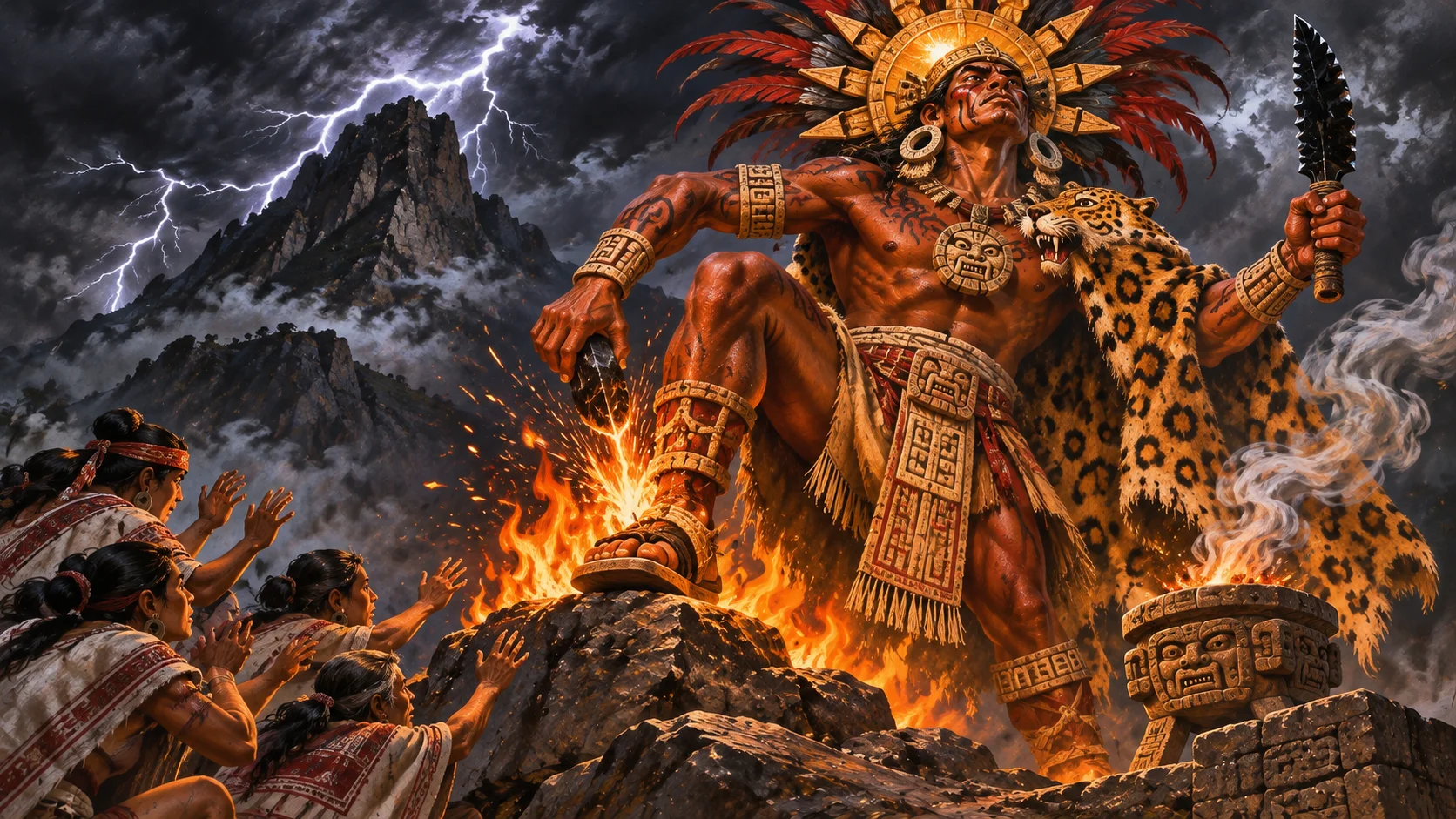
The Popol Vuh recounts that after the K'iche' ancestors and their allied peoples gathered at the mythical place of origin, Tollan, to receive their languages and gods, a devastating cold descended upon them, made worse by heavy hail, with no fire yet available to warm themselves. Tohil is described as producing fire for the K'iche' ancestors, traditionally by means of a fire-drilling or twist-drill ritual, but only on the condition that the K'iche' provide him with sacrifice in return — a bargain the text frames, strikingly, through the image of Tohil "suckling" on the blood offered to him, likened to an infant nursing at its mother's breast. This exchange establishes, within the Popol Vuh's own internal logic, the origin of the practice of human sacrifice and captive-taking among the K'iche', presented not as an arbitrary cruelty but as the literal price paid for the god's ongoing protection, warmth, and guidance through the dangerous migration that follows.
Tohil as Warrior and Protector
Beyond fire, Tohil is also credited in the Popol Vuh's telling with granting the K'iche' military strength and protection against rival groups encountered during their migration and subsequent settlement of the highlands, functioning as a war patron in addition to his fire and sun associations. This martial dimension helps explain why the blood offerings demanded of the K'iche' extended to captives taken specifically in warfare, tying Tohil's cult directly into the ongoing project of territorial expansion and defense that occupied the K'iche' confederation throughout the Postclassic period, right up until the arrival of Spanish forces brought an end to K'iche' political independence altogether.
The Kaqchikel Break: "Fire Thieves"
Not every group that gathered at Tollan accepted Tohil's terms. According to the tradition, the Kaqchikel, a closely related highland Maya people, refused the human sacrifice Tohil demanded in exchange for fire and instead stole fire from the god directly — an act of defiance embedded so deeply in Kaqchikel self-understanding that their very ethnonym is traditionally glossed as meaning "fire thieves." This episode is significant because it shows that Tohil's demand for sacrifice was not simply accepted as an unquestionable cosmic given even within the highland Maya world of the Popol Vuh's own telling; it was, for at least one neighboring people, a bargain worth refusing outright.
The Contested Kukulkan Connection
A claim sometimes made about Tohil is that he is equivalent to, or closely identified with, the feathered-serpent deity known among the Yucatec Maya as Kukulkan and among the Aztec and other central Mexican peoples as Quetzalcoatl. The evidence for this connection is genuinely more indirect and contested than a simple equation would suggest: what can be said with more confidence is that Tohil may originally have shared an identity, or at least a very close conceptual overlap, with Q'uq'umatz, the K'iche' Maya's own feathered-serpent deity (whose name itself directly translates the "feathered serpent" concept into K'iche'), with the two later diverging into separate figures with their own distinct priesthoods and cult practices. Whether or how far this K'iche' feathered-serpent tradition should then be equated with the specifically Yucatec Kukulkan, or the more distant central Mexican Quetzalcoatl, involves additional layers of regional and linguistic translation that scholars continue to debate, and a responsible account should present the Tohil–Kukulkan link as a plausible but unresolved area of comparative Mesoamerican religious history, not as an established one-to-one identification.
Turning to Stone and Continued Worship
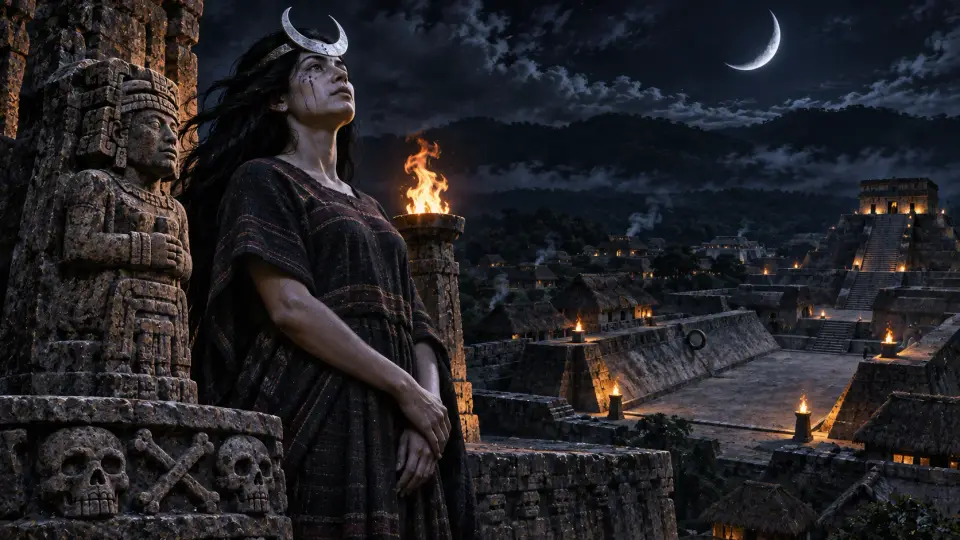
Like his companion deities Awilix and Jacawitz, Tohil is described in the Popol Vuh as turning to stone at the coming of the first dawn, his active speaking presence in the narrative giving way to a fixed stone effigy that continued to receive tribute and sacrifice at his temple in the K'iche' capital of Q'umarkaj. As the principal deity among the K'iche's three great patron gods, Tohil's cult remained central to K'iche' religious and political identity right up until the Spanish conquest, when Pedro de Alvarado's forces overthrew the K'iche' kingdom and, with it, the temple structure that had sustained centuries of tribute to the god who had, in the K'iche's own foundational story, first given them fire.
The Ethics of an Uncomfortable Myth
The Tohil fire-and-sacrifice narrative sits at the center of one of the more genuinely difficult interpretive challenges in Popol Vuh scholarship: the text itself does not present the sacrifice demand as a villainous imposition to be overcome, in the way a modern reader might expect, but as the foundational, ongoing covenant that defines the K'iche's relationship to their patron god and, by extension, to the cosmic order itself. Refusing the bargain, as the Kaqchikel are remembered as having done, is treated by the K'iche' tradition as a genuine act of defection rather than moral heroism. A responsible modern account of Tohil has to resist the temptation to either sanitize this demand for tribute and sacrifice or to sensationalize it; it should instead be understood on its own terms, as an expression of a Mesoamerican theological framework in which the maintenance of cosmic order — fire, warmth, the sun's continued rising, protection from enemies — was widely understood to require reciprocal offerings of the most valuable thing a community could give, human blood and human life, a framework attested with variations across many Mesoamerican societies of the period, not uniquely invented by or confined to the K'iche'.
Copal and the Smoke of Offering
The burning of copal, a tree resin known in K'iche' as pom, was and remains a central element of Maya ritual. Its fragrant smoke is understood as a way of feeding the gods and carrying prayers upward, and it is used in ceremonies across the region.
Given that Tohil's gift was fire, copal burning has an obvious connection to his cult. Fire and fragrant smoke formed a bridge between humans and the divine, and the Popol Vuh's story of fire granted in exchange for offerings reflects that practice.
A Name That May Mean Payment
Some scholars have connected the name Tohil with a Mayan root meaning to pay or to repay, which would fit the god's role in a story about an agreement in which fire is received in return for offerings. This reading is suggestive, though not all specialists accept it.
Names in the Popol Vuh often carry meanings that bear on the roles of the figures. Even where the etymology is uncertain, it is useful to know that the idea of exchange and obligation is built into the way the text frames the relationship between the K'iche' and their patron.
Making Fire in Mesoamerica
Fire in ancient Mesoamerica was made with a drill twirled in a hearth board, and the act of kindling a flame could be ceremonial. In central Mexico the ritual of the New Fire marked the end of a calendar cycle, and similar rites of renewal existed elsewhere.
This background shows why the gift of fire was so important in the Popol Vuh. Fire was a technology and a sacred substance, and a god who provided it held a crucial place in the community's life.
Reading the Popol Vuh as a Document of Its Time
The Popol Vuh was written by K'iche' nobles after the Spanish conquest, in a setting of great upheaval. The text preserves traditions about the origin of the lineages and their patron gods, and it also reflects the concerns of the authors who wrote it.
Scholars read it both as sacred narrative and as a political and historical document. The story of Tohil shows how a founding agreement between a god and a people could be used to explain the lineage's status and identity.
Tohil After the Dawn
Once the first sunrise ends the age of darkness in the Popol Vuh's narrative, Tohil's transformation into stone does not end his story so much as change its register: he ceases to be a speaking character in an unfolding myth and becomes instead a fixed, permanent object of cultic devotion, embedded in the landscape and in the temple architecture of the K'iche' capital. This shift from mythic actor to worshipped stone effigy is itself a pattern repeated with Awilix and Jacawitz, and reflects a broader Maya and Mesoamerican theological habit of treating the mythic past not as a closed, finished narrative but as something whose key figures remained physically present and ritually accessible in the present day of the worshippers who told and retold their stories.
Sources & traditions
- EncyclopediaWikipedia — Tohil
- TraditionMaya texts, oral tradition and village tellings (Mesoamerica)
Myths change from area to area and from time to time. This chronicle follows the most widely told versions; tellings in other villages, regions and eras may differ.